What to expect
Prepare for Software Engineer interviews at Aerotek by connecting technical fundamentals to client requirements and technical communication. This guide gives you six focused practice questions, an illustrated design exercise and a study plan with concrete outputs. Use it to build answers you can explain and test, then adjust the emphasis to the actual team and assessment.
Aerotek's official company resource provides background on recruiting and staffing services. That context helps you ask better questions about users and product constraints. It does not establish a required interview language, a fixed sequence of rounds or a promised set of questions.
Explore six guide-only practice questions →
Build a role brief before you study
A useful starting question for this domain is how a team would detect and recover from a client changing its acceptance criteria after a candidate has implemented a feature. Write down who is affected, what they should be able to trust and which component owns the accepted state. This is an original practice scenario, not a description of Aerotek's internal architecture.
Read the vacancy with three columns in your notes: a stated requirement, an example from your work that demonstrates it, and an uncertainty to ask about. Separate an explicit language or framework requirement from a tool you happen to prefer. If the role is mainly frontend, focus on state, accessibility and browser behavior; if it is infrastructure-oriented, bring deeper evidence about concurrency, failure recovery and operation under load.
Ask the recruiter which assessments apply, whether work is live or take-home, what tools are permitted and how seniority changes the expected depth. Make those answers change your preparation. A timed coding discussion calls for a different rehearsal from a project review or a collaborative debugging session.
Choose your first practice session
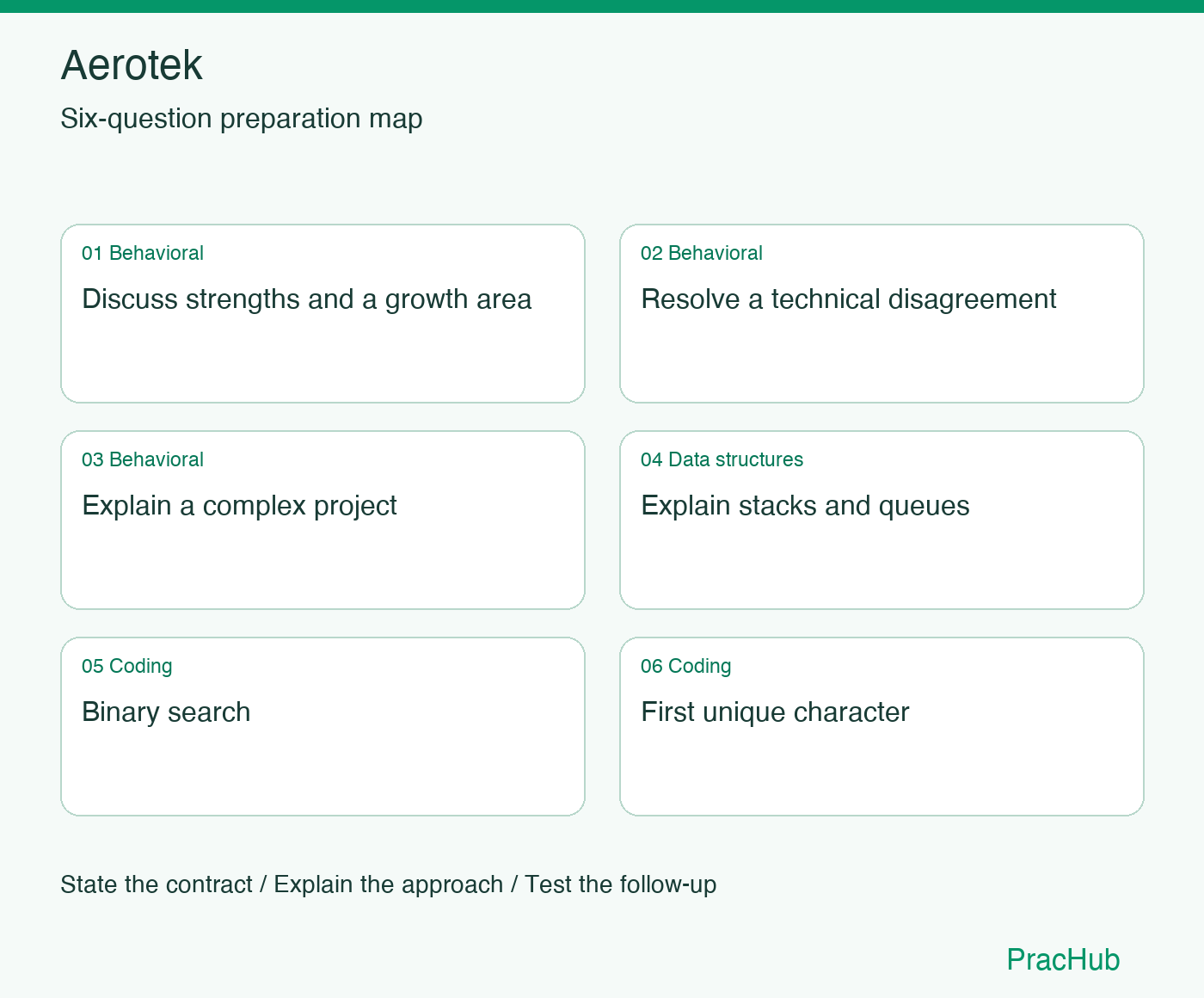
Begin with discuss strengths and a growth area, resolve a technical disagreement, explain a complex project. Read each prompt without its answer, state the contract aloud and attempt a solution before checking the approach. The follow-ups are designed to expose assumptions, so write the changed requirement before changing your implementation.
For a coding task, retain one small example with expected output. For a design task, draw the state owner and one failure boundary. For a project question, identify your own decision and the evidence behind it. These artifacts make gaps visible much faster than rereading an explanation you already recognize.
Guide-only practice question bank
These six practice topics are selected from the published third-party guide. PracHub supplies the clarified problem statements, solution approaches and follow-ups. Treat them as preparation material; their inclusion does not independently verify that this employer asked them.
Discuss strengths and a growth area
Practice prompt: Identify one engineering strength and one area you are actively improving, with evidence for each.
Solution approach:
- Use a real example to make the strength concrete. Describe your action and result rather than listing qualities such as hardworking or detail-oriented.
- Choose a genuine growth area and explain the feedback or incident that revealed it. State the practice you adopted and what progress you can actually observe.
- Connect both to the role without pretending the weakness has vanished. The answer should demonstrate self-awareness and a credible learning process.
Follow-up: What feedback would help you evaluate whether that improvement is working?
Resolve a technical disagreement
Practice prompt: Describe a disagreement about a design or implementation and how the team reached a decision.
Solution approach:
- State the shared objective and each option’s strongest argument. Focus on constraints and evidence rather than portraying another person as unreasonable.
- Explain how you tested the disputed assumption, gathered missing input or proposed a reversible experiment. Name your own action and how the decision was recorded.
- Describe the outcome, including what happened if your preferred option was not selected. A useful answer shows collaboration without pretending disagreement disappeared.
Follow-up: What would you do if new evidence later contradicted the chosen approach?
Explain a complex project
Practice prompt: Walk through a project you owned, including the difficult decisions and your individual contribution.
Solution approach:
- Begin with the user problem and constraints, then draw the smallest useful architecture. Identify what you implemented, what others owned and which decisions you influenced.
- Explain one rejected option and the evidence behind the choice. Describe a failure case and how the system or team recovered.
- Give a verifiable result without inventing metrics. End with what you would change today and why new information would justify that change.
Follow-up: Which decision would you revisit first if the workload grew tenfold?
Explain stacks and queues
Practice prompt: Explain a stack and a queue in simple language, then connect each to a program.
Solution approach:
- Use a stack of plates for last-in, first-out: the most recently added plate is removed first. Use a line of people for first-in, first-out: the earliest arrival is served first. Trace A then B so the two removal orders are unambiguous.
- Connect a stack to undo history and a queue to pending work. Define empty behavior and capacity limits. A queue implemented by repeatedly shifting an array may require linear work per removal; a deque or ring buffer avoids that repeated movement.
- Show push/pop and enqueue/dequeue separately, and explain why a priority queue is a different policy. If several workers consume tasks, completion order may differ from dequeue order even though the queue itself is FIFO.
Follow-up: How would you implement a bounded queue and signal that it is full?
Binary search
Practice prompt: Find a target in a sorted array; return an index or an explicit not-found result.
Solution approach:
- Declare an interval convention, such as inclusive [lo, hi], and maintain it throughout the loop. Compare the midpoint and discard the half that cannot contain the target.
- Move to mid + 1 or mid - 1 after a failed comparison so the interval strictly shrinks. Use lo + (hi - lo) // 2 to avoid unnecessary overflow risk in fixed-width arithmetic.
- Check empty input, one element, values outside the range and duplicates. Time is O(log n), extra space O(1); finding the first duplicate requires a different stopping rule.
Follow-up: How would you return the first position whose value is at least the target?
First unique character
Practice prompt: Return the index of the first non-repeating character in a string, or -1 if none exists.
Solution approach:
- Count characters first, then scan the original sequence in order and return the first count of one. The second scan preserves the required first occurrence.
- This takes O(n) time and O(k) additional storage for k distinct symbols. State whether the input is restricted ASCII, Unicode code points or grapheme clusters before choosing an array or map.
- For swiss, return index 1. Test empty input, all identical symbols and a unique symbol at the end. Define case sensitivity rather than silently normalizing the data.
Follow-up: How would you answer repeatedly while characters arrive as a stream?
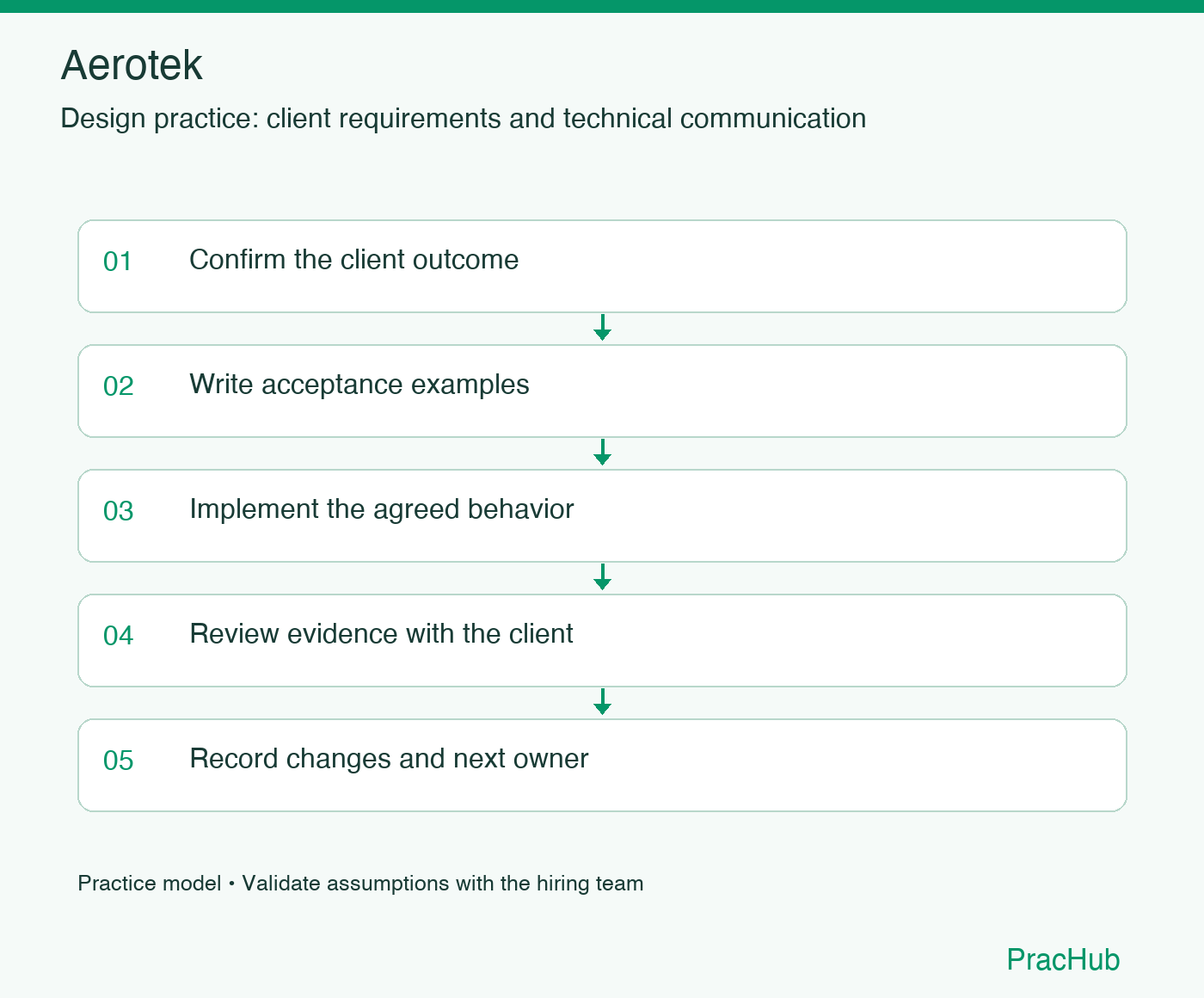
Worked example: turn a client change into testable acceptance criteria
Aerotek is a staffing and recruiting business. For a software role associated with a staffing organization, confirm the actual client, assignment and assessment before assuming an internal engineering stack. This original exercise focuses on requirements and communication alongside the source's basic coding topics.
Resolve the meaning of an apparently small change
Suppose you built a search function that returns any matching index in a sorted list. During review, the client asks for the first matching index because duplicate entries have a business meaning. Your original answer may satisfy the old requirement while failing the new one. First confirm that distinction with a small example rather than arguing about whether the implementation is “correct.”
For [2, 4, 4, 4, 9] and target 4, an arbitrary-match search may return 2. The revised contract requires 1. For an absent target, agree on -1 or another documented result. Also confirm whether the list is guaranteed sorted and what the index represents in the caller's workflow.
Implement the revised contract
A lower-bound search retains a half-open candidate interval and finds the first position whose value is at least the target. The final equality check distinguishes a matching value from the place where an absent value would be inserted.
def first_match(values, target):
    lo, hi = 0, len(values)
    while lo < hi:
        mid = lo + (hi - lo) // 2
        if values[mid] < target:
            lo = mid + 1
        else:
            hi = mid
    if lo < len(values) and values[lo] == target:
        return lo
    return -1
The interval shrinks on every iteration. The algorithm uses logarithmic comparisons and constant extra space for a random-access sequence. A linked list does not provide constant-time access to its midpoint, so this performance argument does not transfer unchanged.
Test an empty list, a one-element match, a target below all values, a target above all values and duplicates at both ends. Include the client's duplicate example as an acceptance test. If input may be unsorted, address that as a separate contract change rather than silently sorting and returning an index into a different ordering.
Explain the disagreement without assigning blame
A useful project story has four concrete parts: the original agreement, the newly discovered need, the alternatives you discussed and the evidence used to accept the result. Say what you personally changed. If schedule or scope changed, explain how the responsible stakeholder made that decision.
For example: “The original acceptance example contained unique values. In review we discovered that duplicates needed stable ordering. I added a duplicate example, showed the difference between any-match and first-match behavior, and confirmed the revised result before changing the implementation.” Use this structure with your own experience; do not present this hypothetical story as something you actually did.
Connect the simpler questions to real behavior
A stack is a last-in, first-out structure, like undoing the most recent action first. A queue is first-in, first-out, like processing requests in arrival order. Neither analogy establishes a complete concurrent processing system: retries, priorities and multiple workers can change observed completion order.
For the first-unique-character exercise, count characters and then scan the original sequence for the first count of one. Clarify whether the result is a code-point index, a byte offset or a user-perceived character position. This is a useful communication test as well as a coding task: a short question can hide a requirement that changes the correct answer.
Ask the recruiter which technical topics apply to the actual assignment and who evaluates the work. Ask the client how acceptance changes are recorded, who resolves ambiguity and what a successful first month looks like. Those answers are more useful than assuming every placement has the same interview process.
Explain your reasoning in the interview
Make the first answer small and correct
Begin with the contract and a simple approach. Explain its cost and limitations, then improve the part that conflicts with a stated constraint. If you propose an optimization, preserve a test that demonstrates the original behavior. In a design discussion, a small system with a clear failure contract is easier to evaluate than a large diagram with unnamed responsibilities.
Handle a changed requirement explicitly
When the interviewer adds concurrency, a larger dataset or a failing dependency, pause and name the assumption that changed. Describe what remains correct and which boundary needs revision. Do not restart the entire answer unless the new requirement invalidates the original model. This makes adaptation visible and gives the interviewer a chance to correct your interpretation early.
Bring a project story with evidence
Prepare an example relevant to client requirements and technical communication. Explain the constraint, your personal contribution, an alternative you considered and the outcome you verified. If you lack professional experience in this domain, use a course or personal project honestly and describe what extra controls production work would need. Never invent traffic numbers, savings or responsibility to make the story sound more senior.
A two-week preparation plan
This is a suggested schedule, not Aerotek's interview timeline. Move effort toward the confirmed assessment and the topics where your first attempt exposed a gap.
| Session | Concrete output |
|---|---|
| Days 1–2 | A role brief and an attempted answer to discuss strengths and a growth area. |
| Days 3–4 | A tested answer to resolve a technical disagreement, including one failure or boundary case. |
| Days 5–6 | Rehearse explain a complex project and explain a changed requirement. |
| Days 7–8 | Complete explain stacks and queues and compare your reasoning with its checklist. |
| Days 9–10 | Work through binary search and first unique character. |
| Days 11–12 | Annotate the design diagram with ownership, failure and recovery. |
| Days 13–14 | Run a mock, repair the weakest answer and prepare questions for the team. |
After each session, record what you could not explain without looking at the answer. Turn that uncertainty into a small test, diagram or documented example. Repeating a question is useful when the second attempt demonstrates a specific improvement, such as a clearer invariant or a previously missed edge case.
Questions to ask the team
Ask which user workflow needs the most attention, how the team knows a change is working and where engineers spend time diagnosing failures. For Aerotek, use the discussion of client requirements and technical communication to make the questions concrete: who defines acceptance, how requirement changes are agreed and who reviews the delivered work?
Also ask how code reviews, production support and onboarding work for this specific role. The answers help you assess the work and prepare relevant examples without assuming that every team at one company has the same stack or responsibilities.
Frequently asked questions
Are these confirmed Aerotek interview questions?
The six topics are selected from a third-party company guide; the problem clarifications, solution approaches, diagrams and follow-ups are PracHub preparation material. The third-party listing is not independent confirmation that this team asks these questions. Use current recruiter instructions for the actual format.
Do I need to use the language shown in a reference?
Use the language required by the assessment, or your strongest suitable language when there is a choice. Reference documentation helps verify behavior; it does not prove the employer requires that language. Be ready to explain your data structures and test cases without relying on memorized syntax.
What if I have only a weekend?
Complete the first two selected questions, trace the design failure above and prepare one honest project story. Prefer a few answers you can defend over a wide list of topics you cannot explain. For more exercises, use the PracHub Software Engineer question bank.
Sources and further reading
- Aerotek: company background — context on recruiting and staffing services; use the actual vacancy to establish role requirements.
- Dataford: Aerotek Software Engineer guide — source of the selected practice topics, with PracHub-authored explanations and follow-ups. Its company-question attribution has not been independently confirmed.
- Python data structures — Review sequences, dictionaries, sets and their behavior when implementing the coding exercises.