What to expect
Prepare for Software Engineer interviews at AGDATA by connecting technical fundamentals to data contracts and query performance. This guide gives you six focused practice questions, an illustrated design exercise and a study plan with concrete outputs. Use it to build answers you can explain and test, then adjust the emphasis to the actual team and assessment.
AGDATA's official company resource provides background on agricultural data and program management. That context helps you ask better questions about users and product constraints. It does not establish a required interview language, a fixed sequence of rounds or a promised set of questions.
Explore six guide-only practice questions →
Build a role brief before you study
A useful starting question for this domain is how a team would detect and recover from a corrected purchase record being counted twice in a program report. Write down who is affected, what they should be able to trust and which component owns the accepted state. This is an original practice scenario, not a description of AGDATA's internal architecture.
Read the vacancy with three columns in your notes: a stated requirement, an example from your work that demonstrates it, and an uncertainty to ask about. Separate an explicit language or framework requirement from a tool you happen to prefer. If the role is mainly frontend, focus on state, accessibility and browser behavior; if it is infrastructure-oriented, bring deeper evidence about concurrency, failure recovery and operation under load.
Ask the recruiter which assessments apply, whether work is live or take-home, what tools are permitted and how seniority changes the expected depth. Make those answers change your preparation. A timed coding discussion calls for a different rehearsal from a project review or a collaborative debugging session.
Choose your first practice session
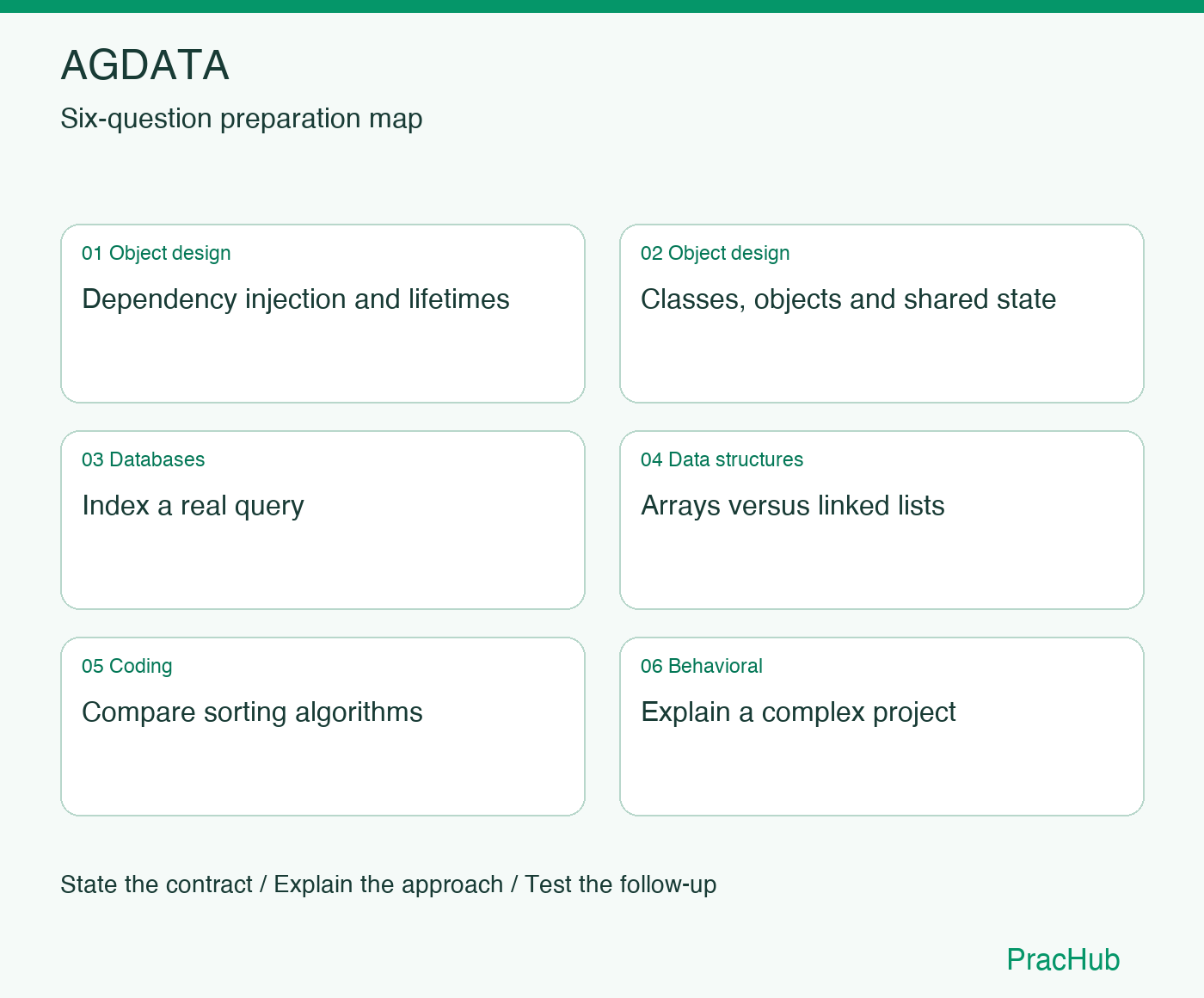
Begin with dependency injection and lifetimes, classes, objects and shared state, index a real query. Read each prompt without its answer, state the contract aloud and attempt a solution before checking the approach. The follow-ups are designed to expose assumptions, so write the changed requirement before changing your implementation.
For a coding task, retain one small example with expected output. For a design task, draw the state owner and one failure boundary. For a project question, identify your own decision and the evidence behind it. These artifacts make gaps visible much faster than rereading an explanation you already recognize.
Guide-only practice question bank
These six practice topics are selected from the published third-party guide. PracHub supplies the clarified problem statements, solution approaches and follow-ups. Treat them as preparation material; their inclusion does not independently verify that this employer asked them.
Dependency injection and lifetimes
Practice prompt: How would you implement dependency injection in an application?
Solution approach:
- Construct a service with its collaborators supplied by the caller rather than constructing them inside each method. A report service can receive a repository interface and a clock, letting tests control data and time without contacting production infrastructure.
- Define ownership and lifetime explicitly. A request-scoped database context should not be captured by a singleton; otherwise state can leak across requests or a disposed dependency may be reused. A container wires objects but does not remove lifetime decisions.
- Test one successful request, a repository failure and two independent requests. Prefer a small interface representing required behavior over a large service locator from which business code can request anything.
Follow-up: How would you test time-dependent behavior without sleeping or changing the system clock?
Classes, objects and shared state
Practice prompt: Explain the difference between a class and an object using a small application example.
Solution approach:
- Describe a class as a definition of behavior and representation, and an object as a particular instance with identity and state. Two purchase objects can use the same class while retaining different customer identifiers and amounts.
- Separate per-instance fields from shared static or class-level fields. A mutable collection accidentally shared by every instance can mix transactions from different customers; identify where construction creates a fresh collection.
- Demonstrate with two objects: change one amount and show that the other remains unchanged. Explain reference aliasing separately: assigning a second variable to the same object does not create a copy.
Follow-up: What is copied by a shallow copy when an object contains a mutable list?
Index a real query
Practice prompt: What is a database index, and how does it affect read and write performance?
Solution approach:
- An index is an additional access structure that can avoid scanning all records for suitable predicates. Start with a concrete query, such as records for one customer in a date range, before choosing an index on customer and date.
- Use the query plan and representative data to see whether the database chooses the index. Low selectivity can make a scan cheaper. A composite index is sensitive to access patterns and ordering; adding one index per column does not reproduce every composite access path.
- Measure insert and update cost as well as query latency. Index entries consume storage and must be maintained. Test a common customer, a skewed customer with many records and a query whose predicate cannot use your proposed index effectively.
Follow-up: When would an index speed up reads but make the overall workload worse?
Arrays versus linked lists
Practice prompt: Compare arrays and linked lists in memory use and operation cost.
Solution approach:
- An array supports indexed access in constant time, while a linked list must normally traverse nodes to reach a numbered position. Dynamic arrays reserve capacity and occasionally resize; distinguish amortized append cost from a single expensive resize.
- A linked list can insert next to an already-known node with a constant number of pointer changes. Finding that location remains linear without another index. Include node pointers, allocator overhead and cache locality when discussing memory and speed.
- Choose a representation for the actual operations. Sequential scans and frequent indexed reads usually favor arrays. Test empty input, head removal and repeated growth; do not select a list merely because the task mentions insertion.
Follow-up: How does combining a hash map with a doubly linked list support an LRU cache?
Compare sorting algorithms
Practice prompt: Explain how you choose a sorting algorithm and compare its time and space costs.
Solution approach:
- For comparison sorting, mergesort provides O(n log n) worst-case time and typically O(n) auxiliary storage for arrays. Quicksort has expected O(n log n) time with suitable pivot selection but can degrade to O(n squared); recursive stack use depends on partition balance and implementation.
- Ask whether stability matters, whether data fits in memory and whether the input is already partially ordered. Insertion sort takes O(n squared) worst-case time but can be useful for small or nearly sorted inputs. A counting-based method needs a suitably bounded key range and is not a universal comparison-sort replacement.
- Trace duplicate keys carrying different record identifiers to demonstrate stability. Test empty, already sorted, reverse-sorted and duplicate-heavy input. Include temporary storage and recursion in the space analysis, and inspect the chosen library sort contract before relying on stability.
Follow-up: How would your design change when the records no longer fit in memory?
Explain a complex project
Practice prompt: Walk through a project you owned, including the difficult decisions and your individual contribution.
Solution approach:
- Begin with the user problem and constraints, then draw the smallest useful architecture. Identify what you implemented, what others owned and which decisions you influenced.
- Explain one rejected option and the evidence behind the choice. Describe a failure case and how the system or team recovered.
- Give a verifiable result without inventing metrics. End with what you would change today and why new information would justify that change.
Follow-up: Which decision would you revisit first if the workload grew tenfold?
Worked example: correct a purchase without counting it twice
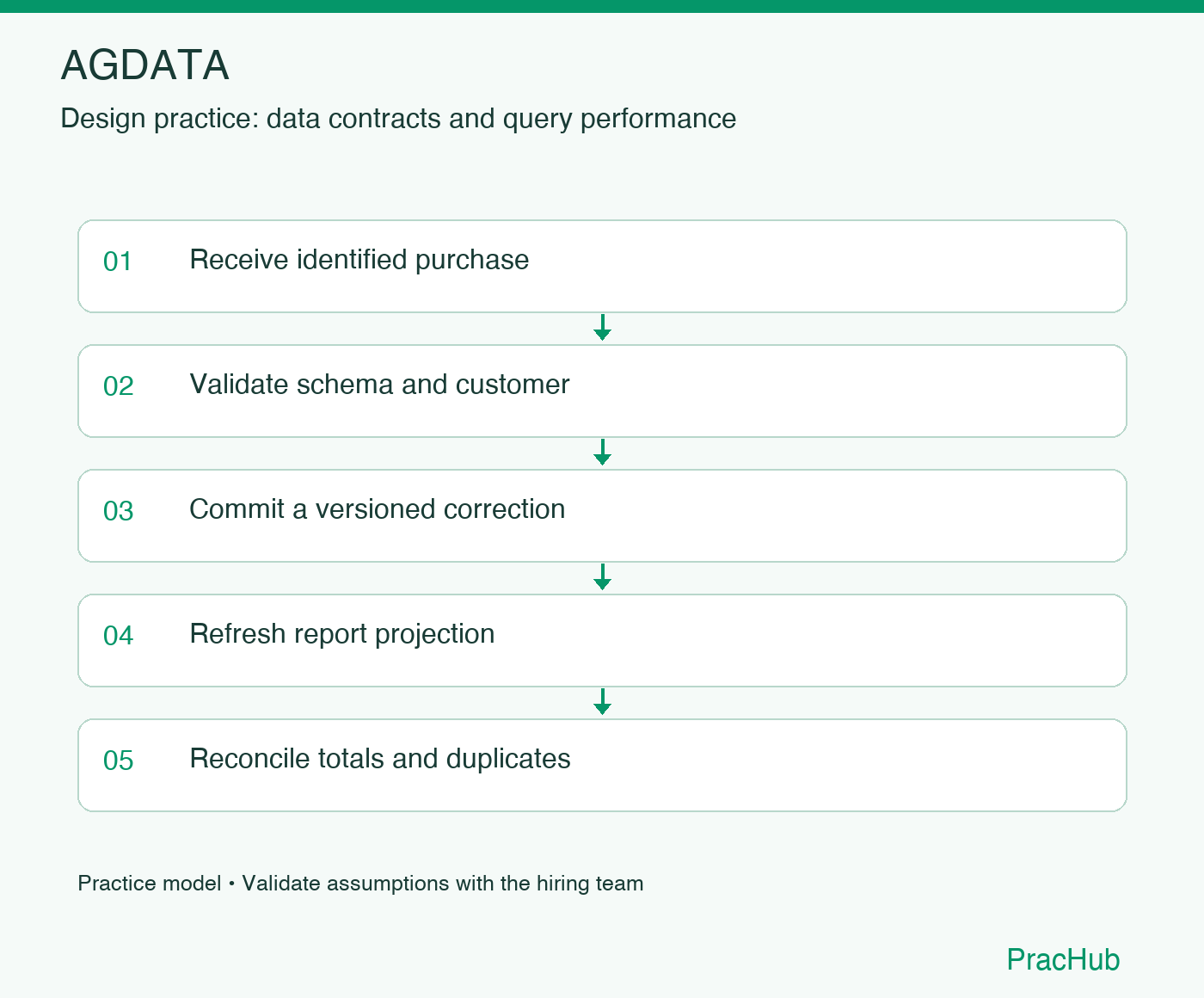
Imagine an agricultural reporting service receives a purchase, then a corrected amount for the same purchase. A client retries the correction because its response timed out. This is an original preparation exercise; it does not describe AGDATA's implementation.
Define identity before choosing an index
Use (customer_id, purchase_id) to identify the business record and an increasing source version to identify a correction. Assume each event contains the complete replacement amount, not an increment. This distinction matters: applying amount += incoming_amount would double-count a retry. Money needs an exact decimal type and an explicit currency, not a floating-point accumulator.
For a simplified PostgreSQL table with a unique constraint on the business identity, a version-aware write can look like this:
INSERT INTO purchase_current
    (customer_id, purchase_id, version, amount, currency)
VALUES (42, 'P-17', 2, 85.00, 'USD')
ON CONFLICT (customer_id, purchase_id)
DO UPDATE SET version = EXCLUDED.version,
              amount = EXCLUDED.amount,
              currency = EXCLUDED.currency
WHERE EXCLUDED.version > purchase_current.version;
The first version might have recorded 100.00 USD. Version 2 replaces it with 85.00 USD. Repeating version 2 must leave 85.00 USD; a delayed version 1 must also leave 85.00 USD. A duplicate version carrying a different amount is a data conflict to investigate, not a harmless retry. Store or compare a payload fingerprint if the input contract cannot otherwise rule that out.
This example assumes a current-state report can sum the latest records. An incremental aggregate needs more care: compute the difference from the previously accepted amount and coordinate the aggregate update with the accepted version. Updating the purchase in one transaction and the aggregate in an unrelated request can leave them inconsistent.
Make the dependency-injection answer concrete
Separate parsing and validation from persistence. Pass a purchase repository into the correction service rather than constructing a database connection inside the business method. A fake repository makes version-rule tests quick; integration tests against the actual database still need to prove the concurrent conflict behavior. A mock cannot establish that a unique constraint or transaction works.
For a customer-and-date report, consider an index beginning with the equality filter and then the range field, such as (customer_id, purchased_at). Compare the real query plan, scanned rows and write cost. The business-identity constraint supports correctness; the reporting index supports an access pattern. They serve different purposes.
Test observable outcomes
| Input sequence | Expected current amount | What the test demonstrates |
|---|---|---|
| Version 1: 100; version 2: 85 | 85 | Replacement semantics |
| Version 2: 85 twice | 85 | Retry safety |
| Version 2: 85; version 1: 100 | 85 | Older input cannot roll back state |
| Version 2: 85; version 2: 90 | Conflict recorded | Contradictory input is visible |
| Two customers use purchase P-17 | Two independent records | Tenant identity is part of the key |
A strong follow-up is: what happens if a correction changes the reporting period? Explain how the old period is adjusted and the new period is updated, how the operation is recovered after failure and which reconciliation detects an omitted adjustment. Confirm these exercise assumptions before offering a production design.
Explain your reasoning in the interview
Make the first answer small and correct
Begin with the contract and a simple approach. Explain its cost and limitations, then improve the part that conflicts with a stated constraint. If you propose an optimization, preserve a test that demonstrates the original behavior. In a design discussion, a small system with a clear failure contract is easier to evaluate than a large diagram with unnamed responsibilities.
Handle a changed requirement explicitly
When the interviewer adds concurrency, a larger dataset or a failing dependency, pause and name the assumption that changed. Describe what remains correct and which boundary needs revision. Do not restart the entire answer unless the new requirement invalidates the original model. This makes adaptation visible and gives the interviewer a chance to correct your interpretation early.
Bring a project story with evidence
Prepare an example relevant to data contracts and query performance. Explain the constraint, your personal contribution, an alternative you considered and the outcome you verified. If you lack professional experience in this domain, use a course or personal project honestly and describe what extra controls production work would need. Never invent traffic numbers, savings or responsibility to make the story sound more senior.
A two-week preparation plan
This is a suggested schedule, not AGDATA's interview timeline. Move effort toward the confirmed assessment and the topics where your first attempt exposed a gap.
| Session | Concrete output |
|---|---|
| Days 1–2 | A role brief and an attempted answer to dependency injection and lifetimes. |
| Days 3–4 | A tested answer to classes, objects and shared state, including one failure or boundary case. |
| Days 5–6 | Rehearse index a real query and explain a changed requirement. |
| Days 7–8 | Complete arrays versus linked lists and compare your reasoning with its checklist. |
| Days 9–10 | Work through compare sorting algorithms and explain a complex project. |
| Days 11–12 | Annotate the design diagram with ownership, failure and recovery. |
| Days 13–14 | Run a mock, repair the weakest answer and prepare questions for the team. |
After each session, record what you could not explain without looking at the answer. Turn that uncertainty into a small test, diagram or documented example. Repeating a question is useful when the second attempt demonstrates a specific improvement, such as a clearer invariant or a previously missed edge case.
Questions to ask the team
Ask which user workflow needs the most attention, how the team knows a change is working and where engineers spend time diagnosing failures. For AGDATA, use the discussion of data contracts and query performance to make the questions concrete: which system owns the truth, which views may lag and who handles discrepancies between them?
Also ask how code reviews, production support and onboarding work for this specific role. The answers help you assess the work and prepare relevant examples without assuming that every team at one company has the same stack or responsibilities.
Frequently asked questions
Are these confirmed AGDATA interview questions?
The six topics are selected from a third-party company guide; the problem clarifications, solution approaches, diagrams and follow-ups are PracHub preparation material. The third-party listing is not independent confirmation that this team asks these questions. Use current recruiter instructions for the actual format.
Do I need to use the language shown in a reference?
Use the language required by the assessment, or your strongest suitable language when there is a choice. Reference documentation helps verify behavior; it does not prove the employer requires that language. Be ready to explain your data structures and test cases without relying on memorized syntax.
What if I have only a weekend?
Complete the first two selected questions, trace the design failure above and prepare one honest project story. Prefer a few answers you can defend over a wide list of topics you cannot explain. For more exercises, use the PracHub Software Engineer question bank.
Sources and further reading
- AGDATA: company background — context on agricultural data and program management; use the actual vacancy to establish role requirements.
- Dataford: AGDATA Software Engineer guide — source of the selected practice topics, with PracHub-authored explanations and follow-ups. Its company-question attribution has not been independently confirmed.
- Microsoft: dependency injection — Review construction, registration and dependency lifetimes.
- dev.java learning resources — Review language-specific object-oriented behavior and core library concepts.
- PostgreSQL indexes — Inspect access paths and the write cost of indexes.
- Python data structures — Review sequences, dictionaries, sets and their behavior when implementing the coding exercises.