What to expect
Prepare for a Aircall Software Engineer conversation by connecting technical fundamentals to shared state and API design. This guide gives you six focused practice questions, an illustrated design exercise and a study plan with concrete outputs. Use it to build answers you can explain and test, then adjust the emphasis to the actual team and assessment.
Aircall's official company resource provides background on business phone and communication software. That context helps you ask better questions about users and product constraints. It does not establish a required interview language, a fixed sequence of rounds or a promised set of questions.
Explore six guide-only practice questions →
Build a role brief before you study
A useful starting question for this domain is how a team would detect and recover from two browser tabs updating one shared call note. Write down who is affected, what they should be able to trust and which component owns the accepted state. This is an original practice scenario, not a description of Aircall's internal architecture.
Read the vacancy with three columns in your notes: a stated requirement, an example from your work that demonstrates it, and an uncertainty to ask about. Separate an explicit language or framework requirement from a tool you happen to prefer. If the role is mainly frontend, focus on state, accessibility and browser behavior; if it is infrastructure-oriented, bring deeper evidence about concurrency, failure recovery and operation under load.
Ask the recruiter which assessments apply, whether work is live or take-home, what tools are permitted and how seniority changes the expected depth. Make those answers change your preparation. A timed coding discussion calls for a different rehearsal from a project review or a collaborative debugging session.
Choose your first practice session
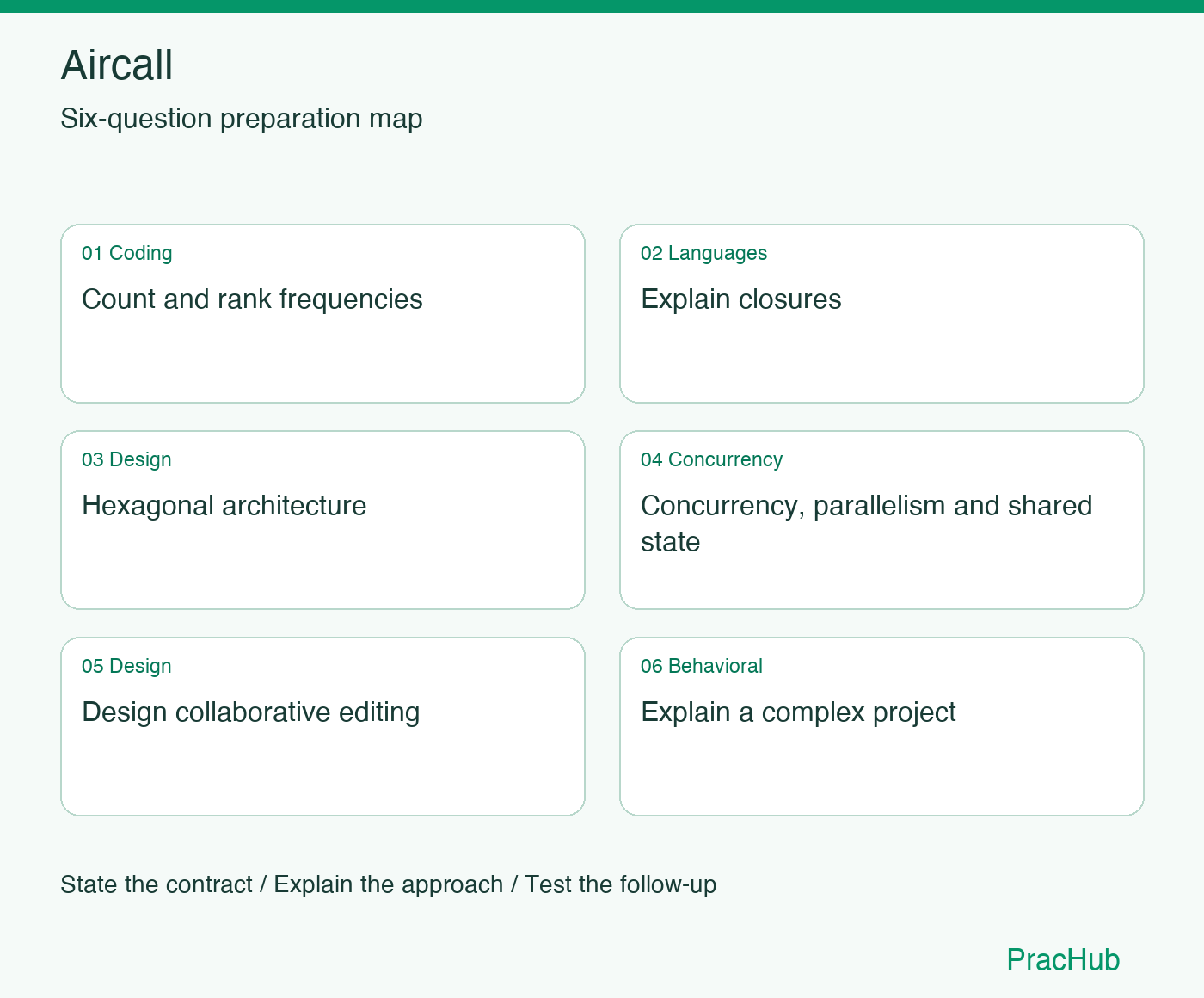
Begin with count and rank frequencies, explain closures, hexagonal architecture. Read each prompt without its answer, state the contract aloud and attempt a solution before checking the approach. The follow-ups are designed to expose assumptions, so write the changed requirement before changing your implementation.
For a coding task, retain one small example with expected output. For a design task, draw the state owner and one failure boundary. For a project question, identify your own decision and the evidence behind it. These artifacts make gaps visible much faster than rereading an explanation you already recognize.
Guide-only practice question bank
These six practice topics are selected from the published third-party guide. PracHub supplies the clarified problem statements, solution approaches and follow-ups. Treat them as preparation material; their inclusion does not independently verify that this employer asked them.
Count and rank frequencies
Practice prompt: Count occurrences by key and return the most frequent key with a deterministic tie rule.
Solution approach:
- Use a hash map from key to count, then compare counts under the chosen tie rule. The key could be a character, user ID or error code; validate the field before counting.
- Expected processing is O(n), with O(k) space for k distinct keys. A full sort is unnecessary for one maximum; top-K requires an additional bounded selection structure.
- Test no records, one record, equal counts and malformed records. Explain whether invalid records are rejected, skipped with an error count, or quarantined.
Follow-up: How would you handle a key space too large for an in-memory map?
Explain closures
Practice prompt: Explain a closure using a function that retains access to variables from its defining scope.
Solution approach:
- Show an outer function creating state and returning an inner function that reads or updates it. The inner function’s behavior depends on the captured binding, not simply a copied textual value.
- Discuss useful applications such as callbacks and private state. Explain loop-variable capture according to the chosen language’s actual scoping rules.
- Test repeated calls and multiple separately created closures. Consider retained references when long-lived callbacks keep large objects reachable.
Follow-up: How would you avoid capturing stale state in an asynchronous UI callback?
Hexagonal architecture
Practice prompt: Explain ports and adapters using a service that reads data and invokes an external system.
Solution approach:
- Keep domain decisions behind interfaces representing required capabilities. Adapters implement those interfaces for a database, HTTP service or test double.
- Dependencies should allow the business behavior to be tested without a live external system. This separation does not require a separate deployable microservice for every layer.
- Demonstrate one use case and one failing dependency. Avoid interfaces that merely copy a vendor API into the domain without expressing the application’s actual contract.
Follow-up: How would you replace a vendor integration while keeping domain tests unchanged?
Concurrency, parallelism and shared state
Practice prompt: Explain concurrency versus parallelism and show how a race can occur in a shared read-modify-write operation.
Solution approach:
- Concurrency concerns overlapping progress; parallelism means work executes at the same time. An asynchronous program can have races even on one thread when an operation yields between reading and writing state.
- Define the invariant and place synchronization around the full operation that must be atomic. Choose locks, atomic primitives or ownership transfer based on the state, not just the language.
- Demonstrate two increments reading the same old value. Test cancellation, exceptions and cleanup; a thread-safe container does not automatically make a multi-step business operation atomic.
Follow-up: How would you avoid holding a lock while waiting on a slow network operation?
Design collaborative editing
Practice prompt: Allow multiple clients to edit shared content while recovering from disconnects and conflicting updates.
Solution approach:
- Define the edit model and the required consistency. Simple whole-record updates may use versions and explicit conflict resolution; fine-grained simultaneous editing may need a different merge model.
- Keep accepted state at a clear authority and identify operations so retries can be recognized. Separate unsent local edits from confirmed shared changes.
- Test two clients editing the same field, reconnect after missed events and deletion racing with editing. Explain the user experience for a conflict rather than only naming an algorithm.
Follow-up: What requirements would justify operational transformation or a CRDT over a simpler versioned record?
Explain a complex project
Practice prompt: Walk through a project you owned, including the difficult decisions and your individual contribution.
Solution approach:
- Begin with the user problem and constraints, then draw the smallest useful architecture. Identify what you implemented, what others owned and which decisions you influenced.
- Explain one rejected option and the evidence behind the choice. Describe a failure case and how the system or team recovered.
- Give a verifiable result without inventing metrics. End with what you would change today and why new information would justify that change.
Follow-up: Which decision would you revisit first if the workload grew tenfold?
Design walkthrough: shared state and API design
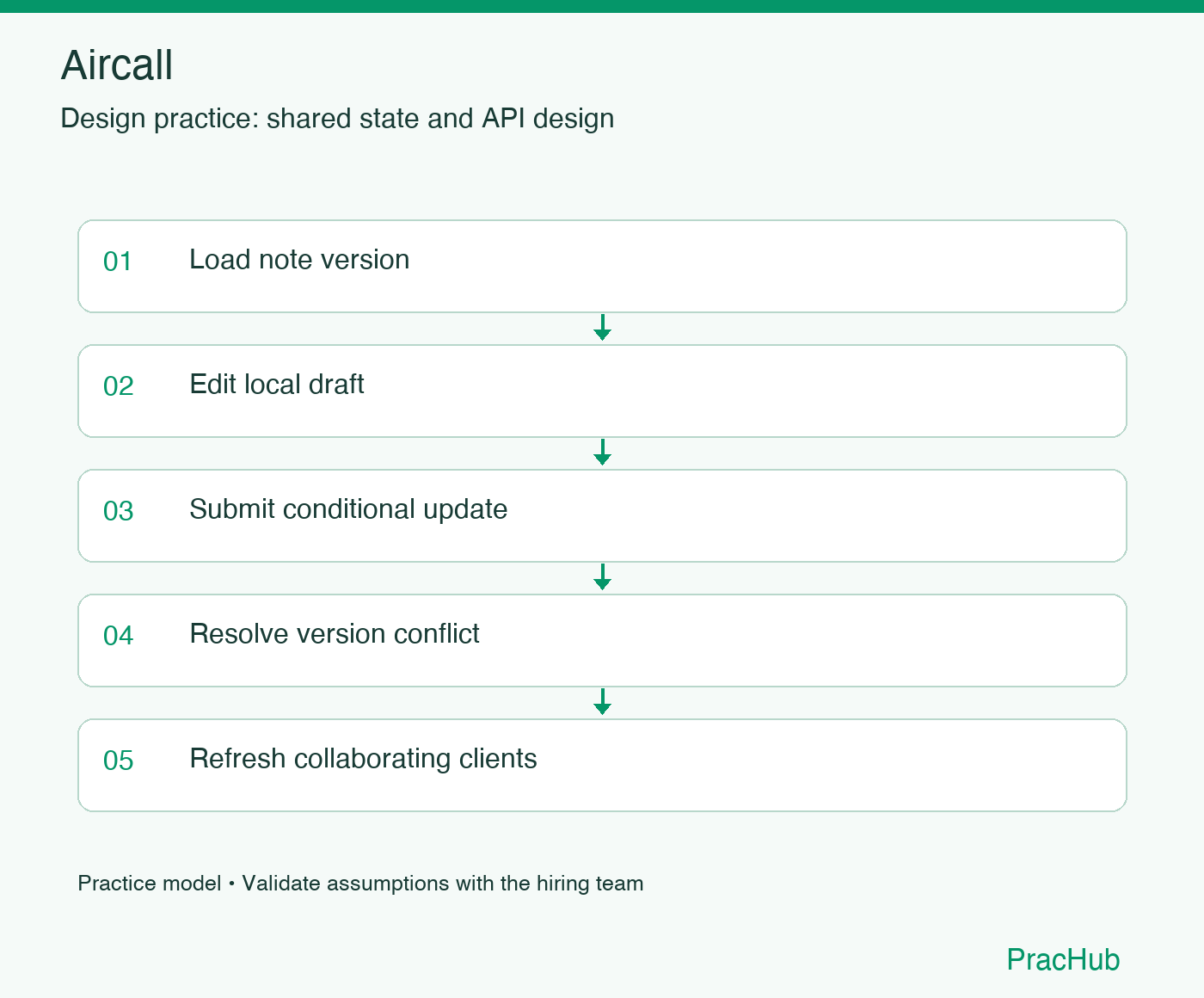
Use this exercise to connect the selected topics to a plausible application in business phone and communication software. The diagram is a preparation model with deliberately simplified boundaries. It is not a claim about the company's deployed systems.
Scenario: Two browser tabs updating one shared call note. Explain how the system discovers the discrepancy, what remains authoritative and what a user can do while recovery is in progress.
Establish the contract
Start at load note version. Define the input identity, the caller's permissions and the result that counts as acceptance. Use one normal request and one invalid request to test whether your description is precise. If the operation can be repeated, decide whether a retry means another attempt at the same work or an intentionally new operation.
Then explain edit local draft. Identify what is checked before state changes and what may still fail afterward. Avoid a success response that implies more than the system has actually completed. An accepted request, a durable record, a delivered message and a refreshed screen can be four different milestones.
Put ownership where the invariant lives
At submit conditional update, name the record or state transition that must remain correct when two callers race. Choose a transaction, conditional update or single owner for that invariant. Describe the losing caller's result as carefully as the winning caller's result. A lock or queue is useful only if it protects the right boundary.
Keep derived displays and reports separate from authoritative state. Write down which version a displayed result represents and how that version is invalidated or refreshed. If a view may lag, define how the user recognizes that it is pending or stale. Do not hide an uncertain outcome behind a generic error message that encourages uncontrolled retries.
Make the failure observable
Now exercise resolve version conflict with a slow or unavailable dependency. Trace the identifier through the request, durable record, asynchronous work and final view. For the scenario above, show one concrete discrepancy between expected and observed state and the evidence that distinguishes an incomplete operation from a completed operation whose response was lost.
Finish with refresh collaborating clients. A recovery procedure should explain who can perform it, how repeated execution is made safe and what evidence proves completion. Bound retries and surface work that cannot progress automatically. Keep the original failure visible long enough to investigate rather than deleting the evidence as part of a replay.
Test the design before adding more components
Run four variations: a duplicate request, an out-of-order observation, a dependency timeout and an unauthorized caller. For each, record the expected durable state and the user-visible result. If a variation does not apply to your chosen operation, explain why instead of adding a mechanism by habit.
Only then discuss scaling. Identify the first likely bottleneck using the work performed per request, the size of retained state and the slowest dependency. More replicas can amplify a shared database or queue bottleneck. Explain what you would measure before choosing sharding, caching or another independently deployed service.
Explain your reasoning in the interview
Make the first answer small and correct
Begin with the contract and a simple approach. Explain its cost and limitations, then improve the part that conflicts with a stated constraint. If you propose an optimization, preserve a test that demonstrates the original behavior. In a design discussion, a small system with a clear failure contract is easier to evaluate than a large diagram with unnamed responsibilities.
Handle a changed requirement explicitly
When the interviewer adds concurrency, a larger dataset or a failing dependency, pause and name the assumption that changed. Describe what remains correct and which boundary needs revision. Do not restart the entire answer unless the new requirement invalidates the original model. This makes adaptation visible and gives the interviewer a chance to correct your interpretation early.
Bring a project story with evidence
Prepare an example relevant to shared state and API design. Explain the constraint, your personal contribution, an alternative you considered and the outcome you verified. If you lack professional experience in this domain, use a course or personal project honestly and describe what extra controls production work would need. Never invent traffic numbers, savings or responsibility to make the story sound more senior.
A two-week preparation plan
This is a suggested schedule, not Aircall's interview timeline. Move effort toward the confirmed assessment and the topics where your first attempt exposed a gap.
| Session | Concrete output |
|---|---|
| Days 1–2 | A role brief and an attempted answer to count and rank frequencies. |
| Days 3–4 | A tested answer to explain closures, including one failure or boundary case. |
| Days 5–6 | Rehearse hexagonal architecture and explain a changed requirement. |
| Days 7–8 | Complete concurrency, parallelism and shared state and compare your reasoning with its checklist. |
| Days 9–10 | Work through design collaborative editing and explain a complex project. |
| Days 11–12 | Annotate the design diagram with ownership, failure and recovery. |
| Days 13–14 | Run a mock, repair the weakest answer and prepare questions for the team. |
After each session, record what you could not explain without looking at the answer. Turn that uncertainty into a small test, diagram or documented example. Repeating a question is useful when the second attempt demonstrates a specific improvement, such as a clearer invariant or a previously missed edge case.
Questions to ask the team
Ask which user workflow needs the most attention, how the team knows a change is working and where engineers spend time diagnosing failures. For Aircall, use the discussion of shared state and API design to make the questions concrete: which system owns the truth, which views may lag and who handles discrepancies between them?
Also ask how code reviews, production support and onboarding work for this specific role. The answers help you assess the work and prepare relevant examples without assuming that every team at one company has the same stack or responsibilities.
Frequently asked questions
Are these confirmed Aircall interview questions?
The six topics are selected from a third-party company guide; the problem clarifications, solution approaches, diagrams and follow-ups are PracHub preparation material. The third-party listing is not independent confirmation that this team asks these questions. Use current recruiter instructions for the actual format.
Do I need to use the language shown in a reference?
Use the language required by the assessment, or your strongest suitable language when there is a choice. Reference documentation helps verify behavior; it does not prove the employer requires that language. Be ready to explain your data structures and test cases without relying on memorized syntax.
What if I have only a weekend?
Complete the first two selected questions, trace the design failure above and prepare one honest project story. Prefer a few answers you can defend over a wide list of topics you cannot explain. For more exercises, use the PracHub Software Engineer question bank.
Sources and further reading
- Aircall: company background — context on business phone and communication software; use the actual vacancy to establish role requirements.
- Dataford: Aircall Software Engineer guide — source of the selected practice topics, with PracHub-authored explanations and follow-ups. Its company-question attribution has not been independently confirmed.
- Python data structures — Review sequences, dictionaries, sets and their behavior when implementing the coding exercises.
- MDN web documentation — Look up browser APIs, networking and JavaScript behavior relevant to the selected exercises.
- Microsoft architecture patterns — Compare documented patterns and their tradeoffs instead of treating a pattern name as a complete design.
- Effective Go — Review channels, goroutines and synchronization alongside the current language specification.