What to expect
Prepare for Software Engineer interviews at DigitalOcean by connecting technical fundamentals to cloud operations and bounded failure recovery. This guide gives you six focused practice questions, an illustrated design exercise and a study plan with concrete outputs. Use it to build answers you can explain and test, then adjust the emphasis to the actual team and assessment.
DigitalOcean's official company resource provides background on cloud infrastructure and developer platforms. That context helps you ask better questions about users and product constraints. It does not establish a required interview language, a fixed sequence of rounds or a promised set of questions.
Explore six guide-only practice questions →
Build a role brief before you study
A useful starting question for this domain is how a team would detect and recover from a cache node failure causing a surge of requests to an already busy origin. Write down who is affected, what they should be able to trust and which component owns the accepted state. This is an original practice scenario, not a description of DigitalOcean's internal architecture.
Read the vacancy with three columns in your notes: a stated requirement, an example from your work that demonstrates it, and an uncertainty to ask about. Separate an explicit language or framework requirement from a tool you happen to prefer. If the role is mainly frontend, focus on state, accessibility and browser behavior; if it is infrastructure-oriented, bring deeper evidence about concurrency, failure recovery and operation under load.
Ask the recruiter which assessments apply, whether work is live or take-home, what tools are permitted and how seniority changes the expected depth. Make those answers change your preparation. A timed coding discussion calls for a different rehearsal from a project review or a collaborative debugging session.
Choose your first practice session
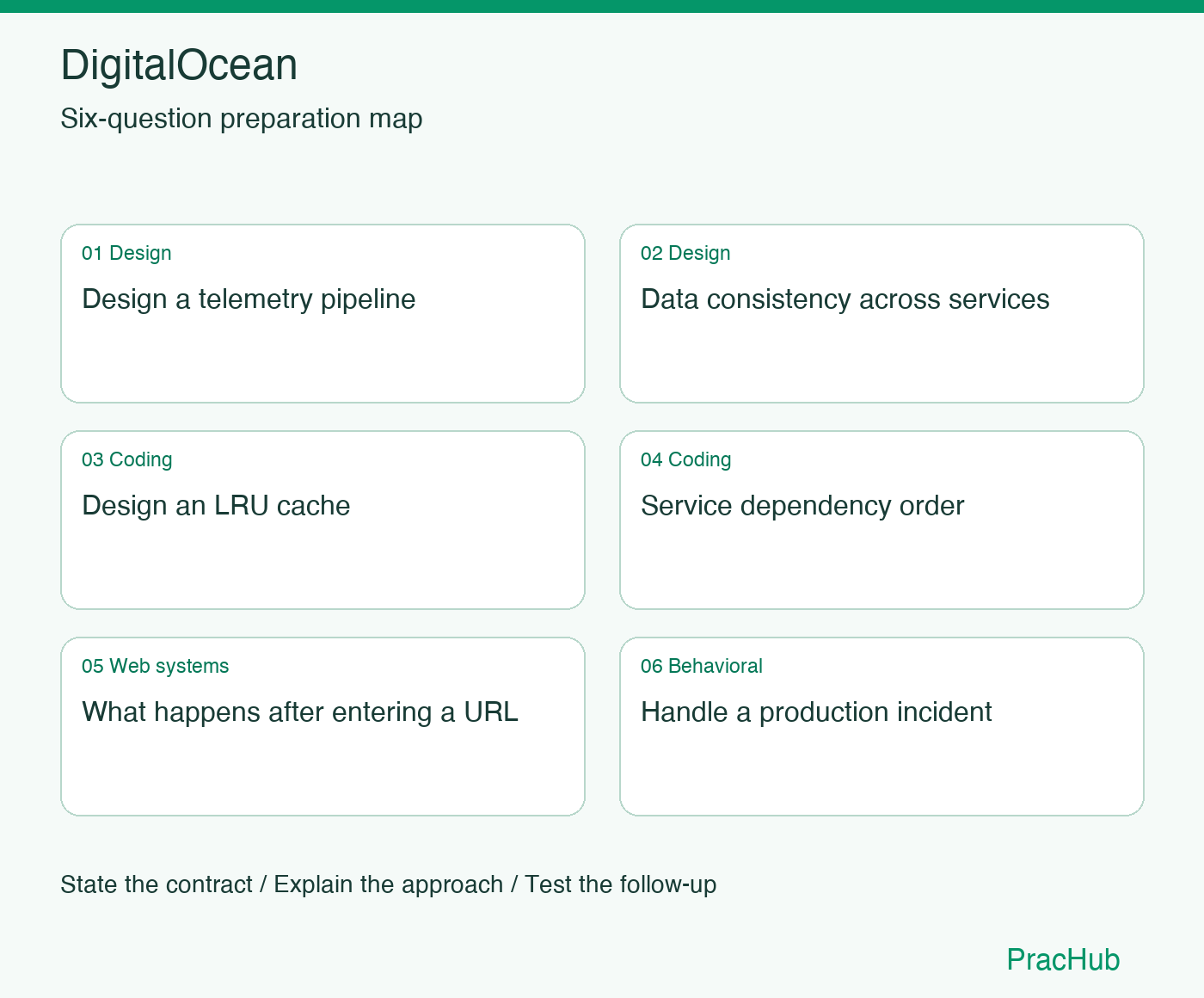
Begin with design a telemetry pipeline, data consistency across services, design an lru cache. Read each prompt without its answer, state the contract aloud and attempt a solution before checking the approach. The follow-ups are designed to expose assumptions, so write the changed requirement before changing your implementation.
For a coding task, retain one small example with expected output. For a design task, draw the state owner and one failure boundary. For a project question, identify your own decision and the evidence behind it. These artifacts make gaps visible much faster than rereading an explanation you already recognize.
Guide-only practice question bank
These six practice topics are selected from the published third-party guide. PracHub supplies the clarified problem statements, solution approaches and follow-ups. Treat them as preparation material; their inclusion does not independently verify that this employer asked them.
Design a telemetry pipeline
Practice prompt: Design an observability pipeline for thousands of servers.
Solution approach:
- Separate metrics, logs and traces because their retention and query patterns differ. Agents should attach bounded metadata and send through buffered collectors with backpressure, rather than allowing telemetry to exhaust application memory.
- Define acceptable loss, sampling and retention per signal. Control label cardinality: a user or request identifier in every metric label can create an unmanageable number of time series. Keep correlation identifiers in logs or traces when appropriate.
- Monitor the monitoring path itself through queue age, dropped events and collector health. Test an unavailable collector and an alert with no incoming data. Dashboards should distinguish healthy zero errors from a broken collection pipeline.
Follow-up: Which signals must remain available during a regional failure?
Data consistency across services
Practice prompt: Keep a business operation understandable when one service commits and another service or notification fails.
Solution approach:
- Choose one durable owner for the accepted operation and state the invariant it guarantees. Independent service calls do not automatically form one atomic transaction.
- Use a transactional outbox when a database change must produce a recoverable event. Consumers still need idempotency because delivery may repeat. Multi-step workflows may need explicit compensating actions.
- Trace a lost response, duplicate delivery and an unavailable downstream service. Give users and operators a stable operation ID and visible pending or failed states.
Follow-up: Which actions can be compensated, and which require manual resolution?
Design an LRU cache
Practice prompt: Implement a fixed-capacity cache with get and put, evicting the least recently used entry when full.
Solution approach:
- Combine a hash map with a doubly linked recency list. A hit moves its node to the most-recent end; insertion evicts the opposite end when capacity is exceeded.
- Keep list and map updates consistent. Handle replacing an existing key, capacity one and the policy for capacity zero. Operations take expected O(1) time with O(capacity) space.
- Trace capacity two: put A, put B, get A, put C. B must be evicted. Test repeated updates to the same key and a miss that must not create a node.
Follow-up: How would you make a get-and-recency-update atomic under concurrent access?
Service dependency order
Practice prompt: Return a valid build order from service dependencies, or report a cycle.
Solution approach:
- Represent an edge from prerequisite to dependent and compute each node’s indegree. Start a queue with zero-indegree nodes, emit each node, and decrement its dependents. Enqueue a dependent only when all prerequisites have been emitted.
- If fewer than all nodes were emitted, the remaining graph contains a cycle. Return a clear failure rather than a partial order described as complete. Runtime and space are O(V + E) with adjacency lists.
- For edges A to C and B to C, either A,B,C or B,A,C is valid. Test isolated services, duplicate edges, self-dependencies and a cycle. Deduplicate edges or count and decrement duplicate edges consistently.
Follow-up: How would you return parallel build stages rather than one linear order?
What happens after entering a URL
Practice prompt: Trace an HTTPS navigation from the entered URL to a usable browser page.
Solution approach:
- Cover URL parsing, cache checks and host resolution where needed. Existing connections and cached results mean not every navigation repeats every setup step.
- Explain secure connection setup and HTTP request/response behavior. HTTP/3 uses QUIC, so a claim that every HTTPS request requires a new TCP connection is too broad.
- Trace HTML parsing, scripts, styles, layout and painting. Separate server response time from the time until the interface is usable, then identify measurements for each boundary.
Follow-up: How would you isolate a slow DNS lookup from a slow rendering phase?
Handle a production incident
Practice prompt: Describe how you investigated and mitigated a serious service problem under pressure.
Solution approach:
- Establish scope, user impact and an incident timeline. Separate observed facts from hypotheses, and choose the next log, query or trace that distinguishes competing explanations.
- Mitigate with a bounded action and communicate its effect. Preserve enough evidence for root-cause analysis rather than restarting everything without a reason.
- Explain recovery validation, follow-up ownership and a prevention change. If you use a personal or course project, state that context honestly instead of implying production responsibility.
Follow-up: What evidence told you the service was recovered rather than temporarily quiet?
Worked example: an LRU cache under an origin outage
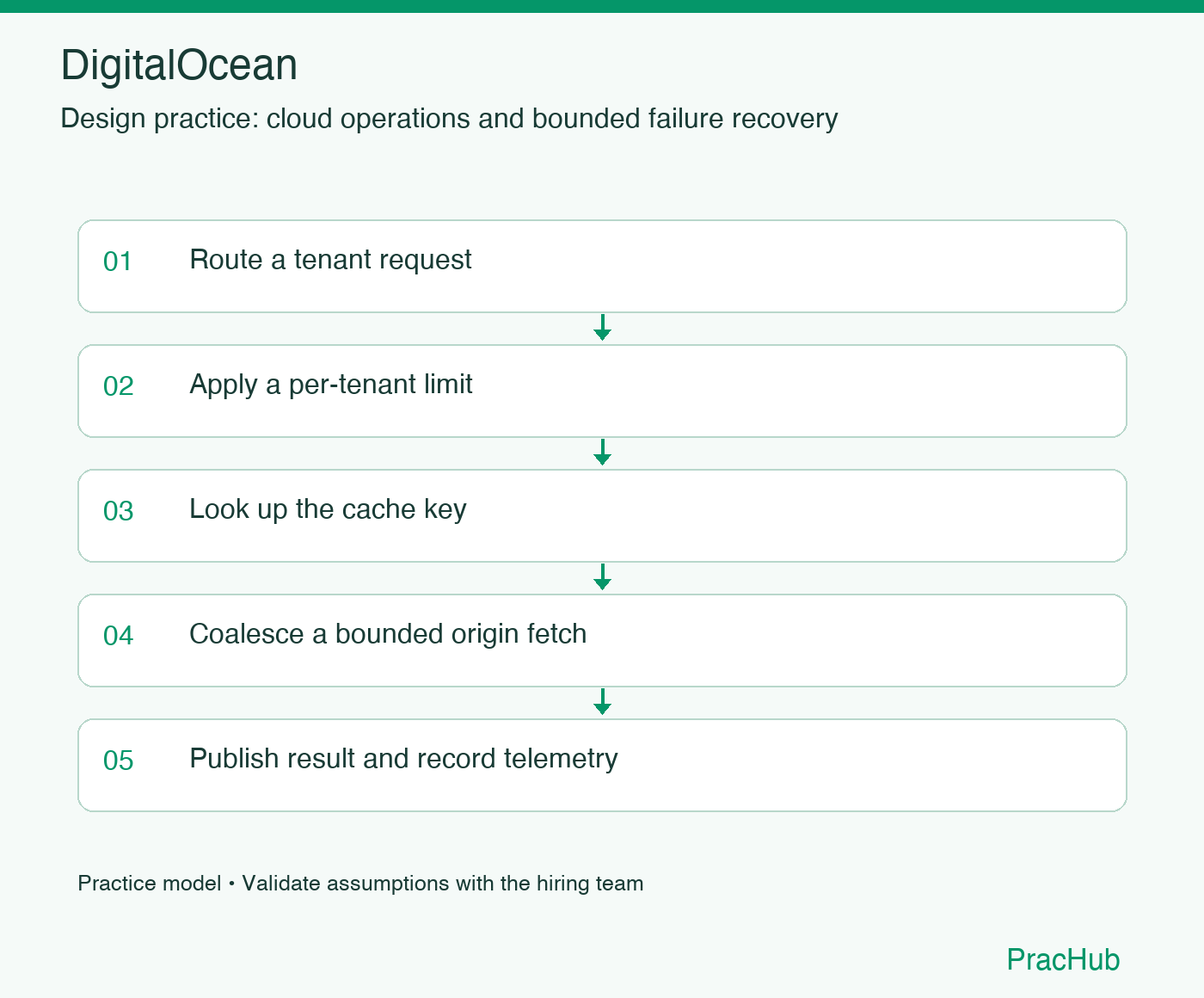
Start with a small in-memory cache in front of a remote service. Then introduce two conditions: many callers request the same absent key, and the origin becomes slow. This original exercise combines eviction, concurrency, telemetry and incident handling without assuming DigitalOcean uses this implementation.
Keep the basic LRU contract precise
A hash map points from each key to a node in a doubly linked list. A successful read moves the node to the most-recent end. A write updates and moves an existing node, or inserts a new one and evicts the least-recent entry when capacity is exceeded. The expected lookup and list operations are constant time under the usual hash-table assumptions.
Here is a compact Python reference implementation using OrderedDict for those operations. It deliberately omits concurrency, expiry and origin fetching so the eviction contract remains testable.
from collections import OrderedDict

class LRU:
    def __init__(self, capacity):
        if capacity < 0:
            raise ValueError('capacity must be nonnegative')
        self.capacity = capacity
        self.items = OrderedDict()

    def get(self, key):
        if key not in self.items:
            return False, None
        self.items.move_to_end(key)
        return True, self.items[key]

    def put(self, key, value):
        if self.capacity == 0:
            return
        self.items[key] = value
        self.items.move_to_end(key)
        if len(self.items) > self.capacity:
            self.items.popitem(last=False)
Returning a separate hit flag lets None be a valid cached value. With capacity two, write A and B, read A, then write C: B must be evicted. Also test updating an existing key, capacity zero and repeated misses. An entry-count bound is only a memory bound if value sizes are controlled; variable-size responses call for byte accounting.
Add bounded origin work
Eviction does not prevent a cache stampede. Maintain a separate in-flight operation per key so concurrent misses can await the same fetch. Bound the total number of distinct in-flight keys as well, otherwise a stream of unique misses can exhaust resources. Ensure the in-flight entry is removed on success, error and cancellation.
Use a short lock for shared bookkeeping; avoid holding a global cache lock across the network request. Define whether a caller timing out cancels only its own wait or the shared operation. For multiple tenants, include the appropriate authorization scope in the cache key and enforce access before returning a value. A high cache-hit rate cannot justify cross-tenant data exposure.
During an origin failure, an explicitly permitted stale value may be better than a failed request. That is a product and data-freshness decision: some data must never be served stale. Bound retries, avoid synchronizing all retries at the same instant and preserve the difference between a miss and a failed fetch.
Instrument the failure path
Measure hit and miss counts, origin latency, origin failures, in-flight operations, evictions and retained bytes. Use latency distributions rather than only averages. Avoid raw tenant IDs or cache keys as unbounded metric labels; use sampled structured logs or controlled trace attributes where detailed correlation is needed.
For an incident rehearsal, describe the first user symptom, the evidence that distinguishes origin failure from cache contention, a reversible mitigation and a recovery check. After service returns, watch whether queued retries cause a second spike. Explain how you would verify recovery from user-visible latency and errors, not merely a green process-health endpoint.
Explain your reasoning in the interview
Make the first answer small and correct
Begin with the contract and a simple approach. Explain its cost and limitations, then improve the part that conflicts with a stated constraint. If you propose an optimization, preserve a test that demonstrates the original behavior. In a design discussion, a small system with a clear failure contract is easier to evaluate than a large diagram with unnamed responsibilities.
Handle a changed requirement explicitly
When the interviewer adds concurrency, a larger dataset or a failing dependency, pause and name the assumption that changed. Describe what remains correct and which boundary needs revision. Do not restart the entire answer unless the new requirement invalidates the original model. This makes adaptation visible and gives the interviewer a chance to correct your interpretation early.
Bring a project story with evidence
Prepare an example relevant to cloud operations and bounded failure recovery. Explain the constraint, your personal contribution, an alternative you considered and the outcome you verified. If you lack professional experience in this domain, use a course or personal project honestly and describe what extra controls production work would need. Never invent traffic numbers, savings or responsibility to make the story sound more senior.
A two-week preparation plan
This is a suggested schedule, not DigitalOcean's interview timeline. Move effort toward the confirmed assessment and the topics where your first attempt exposed a gap.
| Session | Concrete output |
|---|---|
| Days 1–2 | A role brief and an attempted answer to design a telemetry pipeline. |
| Days 3–4 | A tested answer to data consistency across services, including one failure or boundary case. |
| Days 5–6 | Rehearse design an lru cache and explain a changed requirement. |
| Days 7–8 | Complete service dependency order and compare your reasoning with its checklist. |
| Days 9–10 | Work through what happens after entering a url and handle a production incident. |
| Days 11–12 | Annotate the design diagram with ownership, failure and recovery. |
| Days 13–14 | Run a mock, repair the weakest answer and prepare questions for the team. |
After each session, record what you could not explain without looking at the answer. Turn that uncertainty into a small test, diagram or documented example. Repeating a question is useful when the second attempt demonstrates a specific improvement, such as a clearer invariant or a previously missed edge case.
Questions to ask the team
Ask which user workflow needs the most attention, how the team knows a change is working and where engineers spend time diagnosing failures. For DigitalOcean, use the discussion of cloud operations and bounded failure recovery to make the questions concrete: which system owns the truth, which views may lag and who handles discrepancies between them?
Also ask how code reviews, production support and onboarding work for this specific role. The answers help you assess the work and prepare relevant examples without assuming that every team at one company has the same stack or responsibilities.
Frequently asked questions
Are these confirmed DigitalOcean interview questions?
The six topics are selected from a third-party company guide; the problem clarifications, solution approaches, diagrams and follow-ups are PracHub preparation material. The third-party listing is not independent confirmation that this team asks these questions. Use current recruiter instructions for the actual format.
Do I need to use the language shown in a reference?
Use the language required by the assessment, or your strongest suitable language when there is a choice. Reference documentation helps verify behavior; it does not prove the employer requires that language. Be ready to explain your data structures and test cases without relying on memorized syntax.
What if I have only a weekend?
Complete the first two selected questions, trace the design failure above and prepare one honest project story. Prefer a few answers you can defend over a wide list of topics you cannot explain. For more exercises, use the PracHub Software Engineer question bank.
Sources and further reading
- DigitalOcean: company background — context on cloud infrastructure and developer platforms; use the actual vacancy to establish role requirements.
- Dataford: DigitalOcean Software Engineer guide — source of the selected practice topics, with PracHub-authored explanations and follow-ups. Its company-question attribution has not been independently confirmed.
- Google SRE: monitoring distributed systems — Use latency, traffic, errors and saturation to structure operational diagnosis.
- AWS transactional outbox pattern — Study how to coordinate a durable state change with recoverable event delivery.
- Python data structures — Review sequences, dictionaries, sets and their behavior when implementing the coding exercises.
- MDN web documentation — Look up browser APIs, networking and JavaScript behavior relevant to the selected exercises.