Airbnb Cross-Functional Interview Guide: Product, Design, and Engineering Trade-Offs
Quick Overview
This Airbnb cross-functional interview guide explains how product, design, and engineering trade-offs may be evaluated in software engineering interviews. It distinguishes official Airbnb role expectations from candidate-reported formats, provides likely questions and strong answer structures, and includes a practical 48-hour preparation workflow using PracHub.
A technically sound answer can still fail an Airbnb cross-functional interview. The problem is usually not the architecture. It is that the candidate treats product as a requirements handoff, design as a collection of screens, and engineering as the only function allowed to make hard decisions.
Real product work is messier. A smoother booking flow may increase conversion but create fraud risk. A polished interaction may be expensive on older devices. A fast launch may help guests while making host operations harder. This interview explores how you reason when product value, user experience, and engineering constraints pull in different directions.
Before the interview, use PracHub's company-specific interview prep to understand the broader Airbnb loop, then practice real interview questions with written solutions. The goal is not to memorize a perfect compromise. It is to make a defensible decision and show how you would validate it.
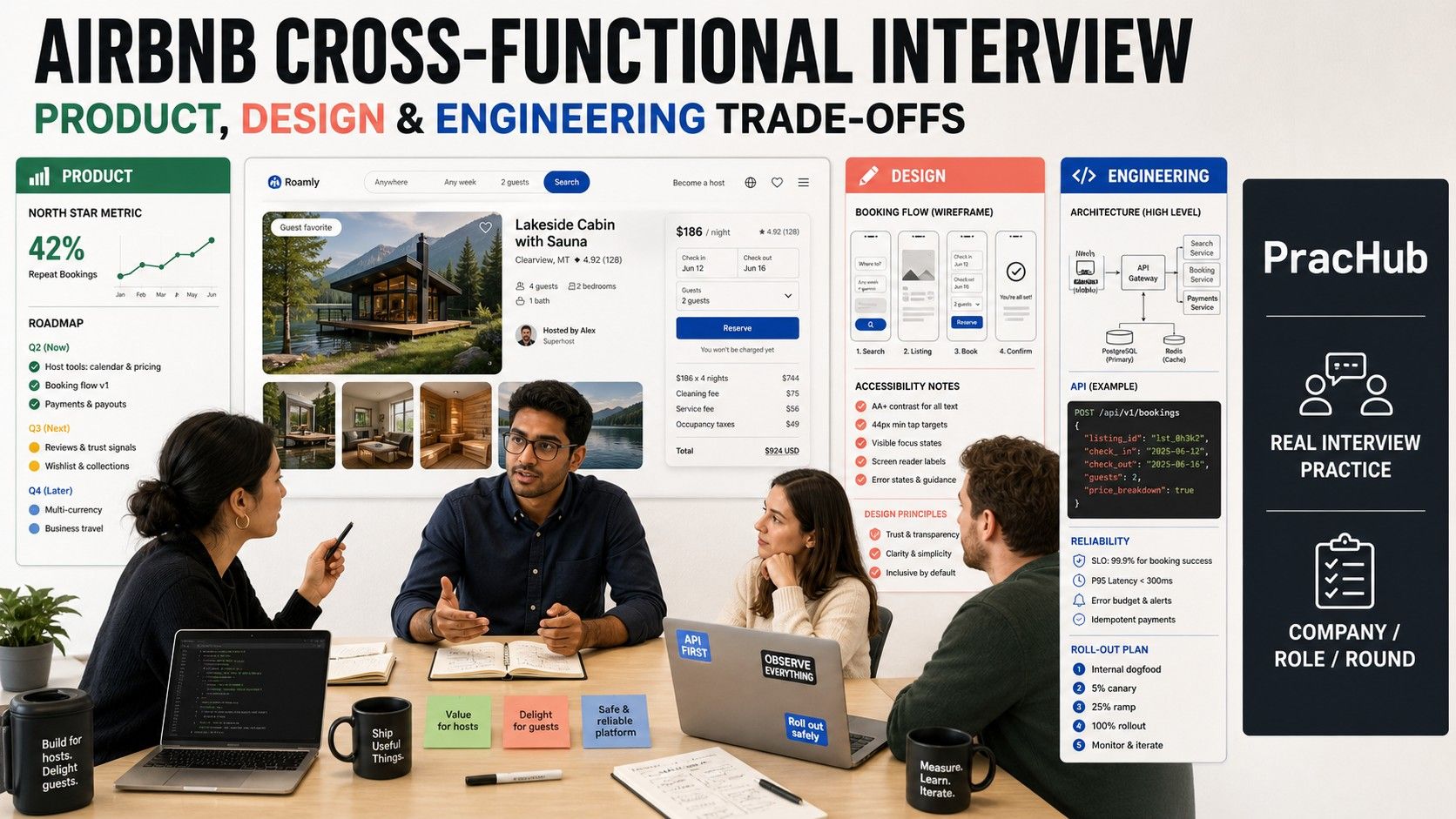
Strong cross-functional answers connect product outcomes, design quality, and engineering reality.
Quick Answer: What Is the Airbnb Cross-Functional Interview?
The Airbnb cross-functional interview evaluates how you collaborate across disciplines and make product decisions under competing constraints. Depending on the role and team, you may discuss a past project, resolve a hypothetical disagreement, critique a product flow, or explain an engineering trade-off to a product or design partner.
Airbnb does not publish one universal round name, duration, or rubric. Its official careers FAQ says the process varies by position and emphasizes meeting multiple people on the team. Treat your recruiter brief and calendar invitation as the source of truth.
What Is Official, and What Is Candidate-Reported?
| Question | What Airbnb publishes | How to prepare safely |
|---|---|---|
| Is there always a dedicated round? | The process depends on the position | Do not assume every loop uses the same label |
| Who conducts it? | Candidates meet multiple people on the current team | Expect a manager or adjacent-function partner, but verify |
| What does it test? | Current roles emphasize UX, feasibility, product quality, collaboration, and impact | Prepare evidence across product, design, and engineering |
| How long is it? | No universal public duration | Use the calendar invitation, not an online average |
Public candidate accounts commonly describe a conversational round with someone from product, design, data, or management. Some report a project deep dive; others receive situational questions. Those patterns are useful for preparation, but they are anecdotal and team-dependent, not official Airbnb policy.
Why Airbnb Tests Cross-Functional Judgment
The round reflects how Airbnb describes the work itself. An official Airbnb engineering profile describes coordinating across design, product, engineering, and QA, creating a clear program vision, and using influence rather than direct authority. Airbnb's technical writing also repeatedly shows teams balancing user experience, business context, and implementation constraints.
Current product roles similarly describe working backward from guest and host needs, aligning engineering and design, running experiments, and delivering measurable outcomes. Airbnb's official values add four cultural lenses: Champion the Mission, Be a Host, Embrace the Adventure, and Be a Cereal Entrepreneur.
This does not reveal a secret interview scorecard. It does show that a strong candidate must be more than technically correct: they should be user-aware, candid about constraints, open to iteration, and capable of moving a shared decision forward.
The Three Lenses Every Strong Answer Needs
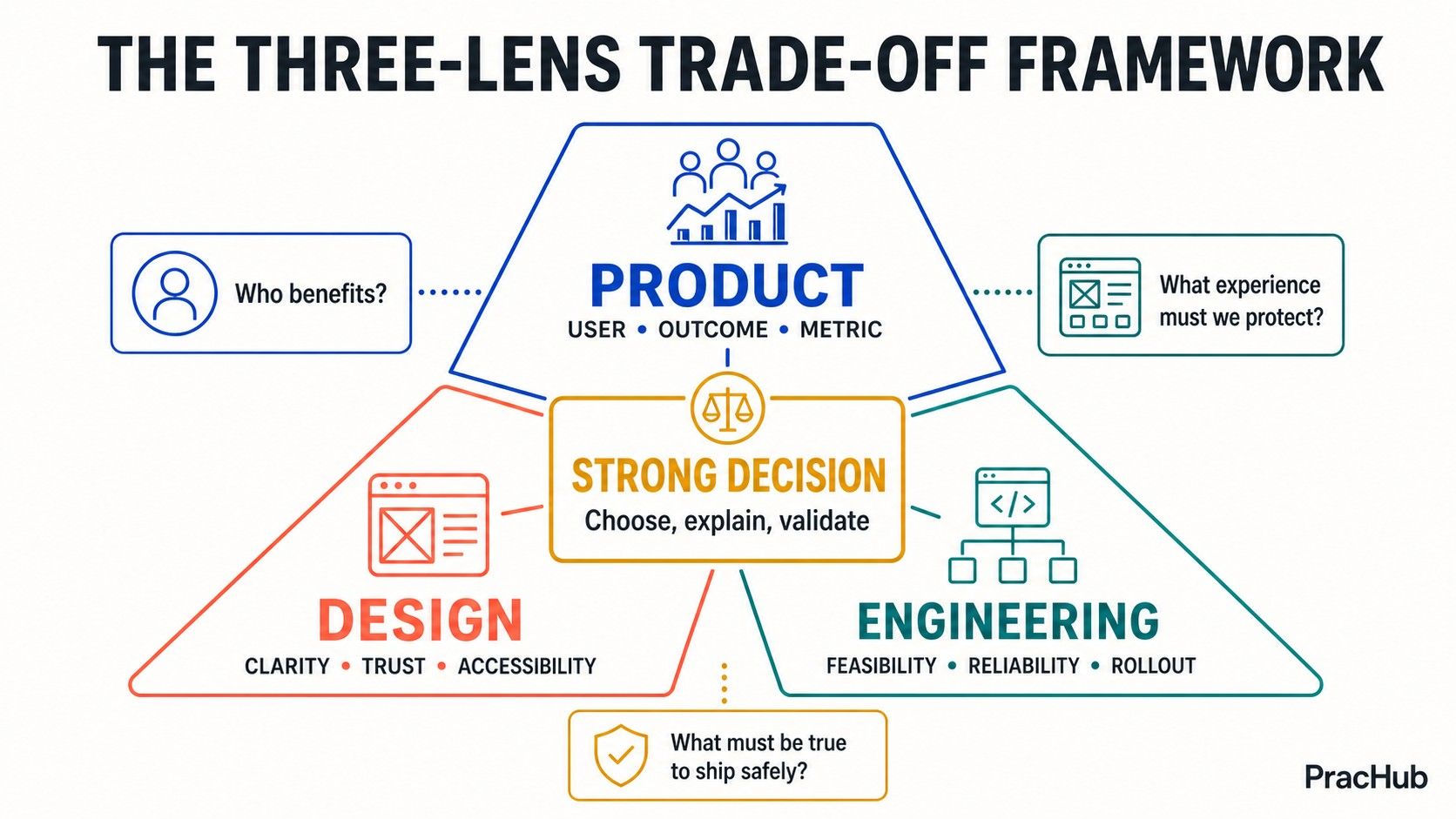
A strong decision lives at the intersection of customer value, experience quality, and technical feasibility.
Product: Which Outcome Matters?
Define the user, problem, business or marketplace outcome, and success metric. Airbnb is a multi-sided marketplace, so name the affected guest, host, or operator and consider whether an improvement for one group creates cost for another.
Design: What Experience Are We Protecting?
Discuss clarity, trust, accessibility, error recovery, consistency, and emotional friction. Do not reduce design to visual polish. A design partner is often protecting user understanding and confidence, especially in high-stakes flows such as booking, identity, payments, cancellation, or privacy.
Engineering: What Must Be True to Ship Reliably?
Surface feasibility, latency, data quality, privacy, maintainability, rollout risk, and operational cost. Strong engineers do not use complexity as an automatic veto. They explain which constraint is hard, how much it costs, and what smaller experiment could reduce uncertainty.
Trade-Offs You Should Be Ready to Discuss
| Tension | Weak framing | Stronger cross-functional framing |
|---|---|---|
| Conversion vs. trust | Remove every step | Reduce avoidable friction while preserving informed consent and confidence |
| Craft vs. launch speed | Polish or ship | Define the minimum quality bar, prototype the risky interaction, and stage the rollout |
| Personalization vs. privacy | More data creates a better product | Use the minimum data needed, explicit controls, and measurable user benefit |
| Guest vs. host outcomes | Optimize the primary funnel | Measure both sides and identify where incentives or operations diverge |
| Local solution vs. platform work | Build the reusable system first | Compare repeated demand, migration cost, and the value of learning with a narrower release |
| Consistency vs. experimentation | Never break the design system | Protect core patterns while creating a bounded test for a new behavior |
Airbnb's engineering post about privacy-first social features is a useful real example. The product aimed to help guests connect, design had to preserve understandable controls, and engineering separated user and profile identifiers to enforce context-specific privacy. The article also credits alignment across engineering, product, privacy, and legal.
Questions the Interviewer May Ask
| Likely question | Signal being tested | Evidence to include |
|---|---|---|
| Tell me about a disagreement with product or design. | Perspective-taking and influence | Their goal, your concern, options considered, and shared outcome |
| When did technical constraints change the product? | Translation and judgment | User impact, concrete constraint, alternative scope, and validation |
| How would you improve an Airbnb booking flow? | Product and design thinking | Target user, problem, metric, edge cases, and rollout |
| Describe a feature you intentionally did not build. | Prioritization | Opportunity cost, evidence, stakeholder alignment, and revisit trigger |
| How do you explain architecture risk to a PM? | Communication without jargon | Business consequence, likelihood, mitigation, and decision deadline |
| What did design see that engineering initially missed? | Humility and learning | Changed assumption, product effect, and new working practice |
| Tell me about a cross-functional launch that went wrong. | Accountability | Failure signal, your contribution, recovery, and lasting change |
A Five-Part Framework for Trade-Off Answers
1. User and outcome: Name who is affected and what success means. 2. Constraints: Separate hard constraints from assumptions. 3. Options: Present two or three credible choices, not one proposal and two straw men.
4. Decision: Choose a direction and explain why it is appropriate now. 5. Validation: Define a prototype, experiment, staged rollout, guardrail metric, or review point. A decision sounds senior when it is clear, reversible where possible, and tied to evidence.
Example: Product Wants Speed, Design Wants Trust
Suppose a PM wants to shorten a booking flow, while design argues that removing the price breakdown will surprise guests. A weak answer picks a side immediately. A stronger answer identifies the shared objective: improve completion without reducing price confidence.
You might preserve the total and essential fee explanation, test a progressively disclosed breakdown, and instrument completion, backtracking, support contacts, and cancellation behavior. Engineering can estimate the data and rendering work, design can prototype comprehension, and product can define the launch threshold. The compromise is not the point; the decision process and validation plan are.
How the Signal Changes by Level
At mid-level, interviewers often need evidence that you communicate clearly, raise constraints early, and collaborate through delivery. Senior candidates should show ownership of ambiguous scope, principled pushback, and the ability to improve the decision rather than merely implement it.
Staff-level evidence expands further: aligning multiple teams, creating reusable mechanisms, resolving incentives, and making decisions that balance near-term learning with long-term architecture. Scope matters, but so does whether other functions trusted your judgment after disagreement.
Build Two Cross-Functional Project Stories
Choose one successful launch and one difficult decision or miss. For each, document the user problem, stakeholders, conflicting goals, options, your recommendation, the final decision, measurable result, and what changed afterward.
Use "we" for team context and "I" for your actions. Avoid turning partners into obstacles. A convincing disagreement story explains why the other position was reasonable and what new evidence changed the decision.
A 48-Hour Preparation Workflow
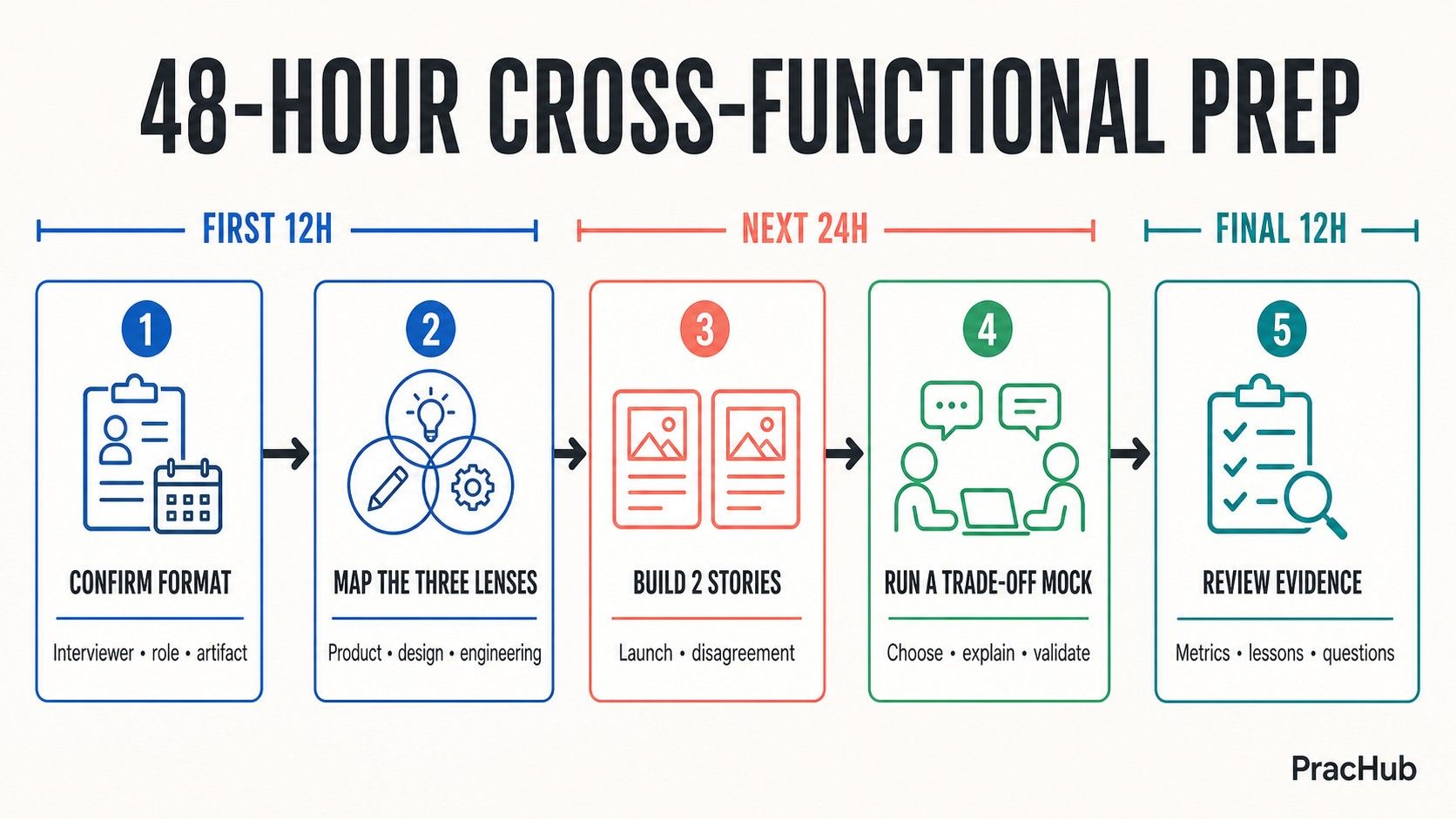
Move from recruiter context to evidence, practice, feedback, and final review.
First 12 hours: ask the recruiter who you will meet, the expected format, and whether the discussion centers on past work or a scenario. Review the job description and the broader Airbnb Software Engineer Interview Guide.
Next 24 hours: prepare two project stories and practice one product scenario. Use PracHub's system design questions to rehearse requirements, trade-offs, and rollout plans, then use behavioral and leadership questions to test disagreement and failure stories.
Final 12 hours: run a mock with interruptions. Ask the mock interviewer to play a skeptical PM or designer, challenge your assumptions, and request a decision. Review concise evidence notes rather than memorizing a script.
Common Mistakes
The most common mistake is framing collaboration as persuasion: "I explained the technical facts, and they agreed." Other weak patterns include hiding behind "it depends," inventing metrics without a baseline, optimizing only for guests, treating design as aesthetics, or using platform complexity to block a useful experiment.
Do not perform agreement for its own sake. Healthy cross-functional work includes respectful pushback. Show that you can disagree, make the constraint legible, help the group choose, and commit after the decision.
Questions to Ask Your Cross-Functional Interviewer
Ask how the team resolves product-quality and delivery tension, where engineers influence product direction, how design and engineering review early concepts, and which metrics reveal a healthy guest-host balance. These questions demonstrate curiosity without pretending you already know the team's operating model.
Frequently Asked Questions
Is the Airbnb cross-functional interview behavioral?
It often uses behavioral examples, but it can also include a product scenario, design critique, project deep dive, or technical trade-off discussion. Prepare past evidence and live reasoning. Your recruiter should confirm whether tools, a presentation, or a specific artifact are involved.
Will I be interviewed by a product manager or designer?
Possibly, but Airbnb does not publish a universal interviewer assignment. Candidate reports vary by role and team. Check the invitation and ask your recruiter. Prepare to communicate with any adjacent function rather than overfitting to one interviewer title.
Do I need to use Airbnb in every answer?
No. Your strongest evidence usually comes from products you actually built. Use Airbnb-style guest, host, trust, marketplace, and global considerations when answering a hypothetical Airbnb question, but do not force unrelated experiences into invented company context.
How technical should my answer be?
Technical enough to make feasibility and risk concrete, but clear enough for a non-engineering partner to use. Explain architecture through customer, delivery, reliability, privacy, or cost consequences. Go deeper when the interviewer asks rather than front-loading jargon.
How do I know whether my story is strong?
A strong story identifies a real tension, represents each function fairly, shows your personal contribution, names the decision, and provides evidence of the outcome. It should also explain what you learned or changed in the way the team works.
Final Takeaway
The Airbnb cross-functional interview is not a test of whether you always agree with product and design. It tests whether you can understand their goals, expose engineering reality, make trade-offs visible, choose a direction, and learn from the result.
Use PracHub to study Airbnb company questions, practice realistic technical and behavioral follow-ups, and enter the conversation with two evidence-rich stories plus a repeatable decision framework.
Sources and Methodology
This guide was researched on August 6, 2026. Official claims were checked against Airbnb's Careers FAQ, Life at Airbnb values page, an Airbnb Tech profile on cross-functional program leadership, and the Airbnb Tech article on privacy-first connections. Airbnb does not publicly define a universal cross-functional round. Format descriptions reflect recurring candidate-reported patterns and are presented as variable rather than official policy. Frameworks and recommendations are PracHub editorial analysis.
Related Articles
Microsoft As-Appropriate Interview Guide: What the Final Interviewer Is Evaluating
Prepare for Microsoft's As-Appropriate interview: learn what the AA final interviewer may evaluate, likely questions, technical risks, and a practical plan.
Software Engineer Project Deep Dive Interview Guide: Architecture, Impact, and Follow-Ups
Prepare for a software engineer project deep dive interview: choose the right project, explain architecture, prove impact, and handle technical follow-ups.
NeetCode Pro Review 2026: Is the Paid Upgrade Worth It?
NeetCode Pro review for 2026: compare free vs paid features, $119 annual and $297 lifetime pricing, courses, company tags, AI tools, and alternatives.
AlgoMaster.io Review 2026: DSA Patterns, System Design, and AI Mocks
AlgoMaster.io review for 2026: compare DSA patterns, system design, AI mocks, current pricing, limitations, and a practice-first PracHub workflow for engineers.
Comments (0)