Microsoft As-Appropriate Interview Guide: What the Final Interviewer Is Evaluating
Quick Overview
This Microsoft As-Appropriate interview guide explains what the AA final interviewer may evaluate, why the format varies, and how to prepare for behavioral, technical, project, and leveling follow-ups. It maps official Microsoft competencies to evidence, corrects common myths, provides likely questions, and includes a practical 48-hour preparation workflow using PracHub.
You finish the scheduled Microsoft interview loop, and the recruiter adds one more conversation: an As-Appropriate interview, often shortened to AA. Online advice immediately splits into extremes. One person calls it a final approval; another calls it a hidden technical round; someone else says it is Microsoft's version of an Amazon Bar Raiser.
The uncertainty is the point to prepare for. Microsoft does not publish a universal AA format, and teams use late-stage interviews differently. The safest strategy is to expect a senior interviewer to test the evidence that matters most for this role: technical judgment, scope, impact, collaboration, customer focus, and how you learn.
Before the round, use PracHub's company-specific interview prep to map the Microsoft loop, then practice real interview questions with written solutions. The AA is easier to handle when you are ready for both a leadership conversation and a technical follow-up.
Treat the Microsoft AA as a flexible evidence check, not a ceremonial conversation or a guaranteed offer.
Quick Answer: What Is the Microsoft AA Interview?
The Microsoft As-Appropriate interview is a team-dependent, late-stage interview commonly described by candidates as an additional calibration round. It may be conducted by a senior manager, hiring leader, or experienced interviewer and can probe culture, leadership, leveling, technical judgment, or a concern left by the earlier loop.
Microsoft's public hiring guidance does not define a company-wide AA round, so do not assume every team uses one or that every AA follows the same script. Your recruiter's instructions are more authoritative than a generic online guide.
What the AA Interview Is Not
| Common claim | More accurate interpretation | Preparation implication |
|---|---|---|
| "The offer is already decided" | An extra interview still produces hiring evidence | Treat it as a real evaluated round |
| "It is only culture fit" | Behavioral, technical, and role-specific probes can overlap | Keep coding and design knowledge warm |
| "It is Microsoft's Bar Raiser" | The analogy is informal; Microsoft publishes no identical universal role | Prepare for Microsoft criteria, not Amazon terminology |
| "Everyone gets an AA" | Process and sequencing vary by organization, role, and level | Ask the recruiter what this meeting represents |
An AA invitation is encouraging because the team is still investing time in your candidacy. It is not a reliable offer signal by itself. Friendly tone, short duration, or senior interviewer title also cannot tell you the final decision.
What Microsoft's Official Criteria Tell Us
Microsoft's current interview guidance names six core competencies: collaboration, drive for results, customer focus, influencing for impact, judgment, and adaptability. It also emphasizes growth mindset, specific past examples, clear reasoning, curiosity, and reflection.
For technical roles, Microsoft says it evaluates problem solving, design, coding, and testing. Those published criteria are a stronger foundation than trying to predict a secret AA checklist.
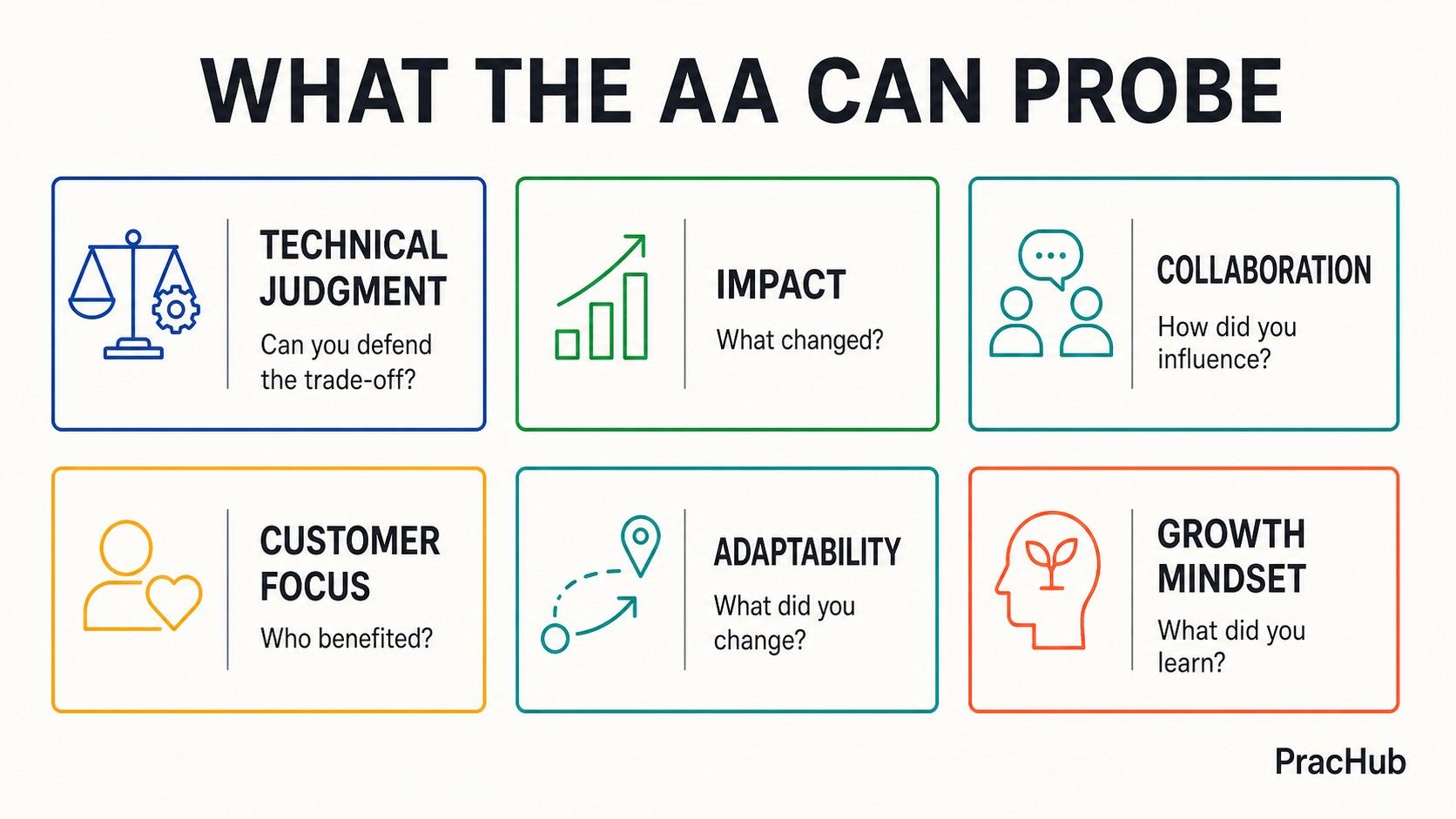
The final interviewer can move across technical and behavioral signals, but every strong answer needs specific evidence.
| Signal | Evidence to prepare | Possible AA probe |
|---|---|---|
| Judgment | A consequential decision with alternatives and constraints | What would change your decision? |
| Drive for results | Baseline, action, measurable result, and your contribution | How did you know the work succeeded? |
| Collaboration | A disagreement handled without avoiding the conflict | What did the other person believe? |
| Customer focus | A trade-off anchored to a user or operational outcome | Whose need did you prioritize and why? |
| Adaptability | A plan changed after new evidence or failure | What did you learn too late? |
| Technical excellence | Design rationale, clean implementation, tests, and failure modes | What breaks at the next scale? |
What the Final Interviewer May Be Evaluating
A late-stage interviewer rarely needs a second generic resume walkthrough. A more useful interpretation is that they are checking whether the overall evidence forms a coherent hire at the proposed role and level.
They may test whether your claimed scope matches your examples, whether impact is attributable to your work, whether technical decisions survive follow-ups, and whether you can collaborate across boundaries. If earlier feedback was mixed, the interviewer may deliberately press the uncertain area. That is an editorial inference from the format, not a published Microsoft rule.
Who Conducts the AA, and When Does It Happen?
Public candidate reports frequently describe a senior manager, director, skip-level leader, or experienced interviewer. Some AA conversations appear at the end of the main loop; others are scheduled later as an additional meeting. The interviewer may be close to the hiring team or more independent.
Ask the recruiter five direct questions: how long the round is, who the interviewer is, whether it is technical, whether coding tools are involved, and which part of the role to emphasize. A recruiter may not reveal the rubric, but format details can prevent the wrong preparation.
Can the Microsoft AA Be Technical?
Yes, it can. Candidate reports include behavioral conversations, project deep dives, architecture questions, and coding or problem-solving follow-ups. The mix depends on the role, interviewer, and evidence already collected.
For software engineering roles, retain the habits in Microsoft's official technical interview guide: clarify ambiguity, explain a plan, produce real code when asked, and test before declaring the solution complete. Use PracHub's system design questions to rehearse trade-offs and edge cases rather than memorizing one architecture.
Questions You Should Be Ready to Answer
| Question | What it can reveal | Strong answer shape |
|---|---|---|
| Why Microsoft and this team? | Motivation and role understanding | Team problem, relevant evidence, contribution you want to make |
| Tell me about your highest-impact project. | Scope, ownership, and results | Baseline, personal decision, result, and reflection |
| Describe a technical decision you would change. | Judgment and growth mindset | Original constraints, new evidence, improved trade-off |
| When did you influence without authority? | Cross-team collaboration | Stakeholder incentives, resistance, action, durable outcome |
| Tell me about a failure or difficult feedback. | Accountability and adaptability | Specific miss, ownership, correction, changed behavior |
| How would you improve this product or system? | Customer focus and strategic thinking | User, problem, constraint, option, metric, risk |
| What should I know that the loop did not ask? | Self-awareness and evidence selection | One role-relevant signal supported by a fresh example |
Build a Six-Story Evidence Bank
Prepare six stories covering impact, conflict, failure, ambiguity, customer judgment, and technical leadership. Each story should have a primary Microsoft competency, a secondary signal, one measurable outcome, and two follow-up details that did not fit the opening answer.
A story is weak if it proves only that the team succeeded. Mark exactly what you proposed, decided, implemented, changed, or learned. Use "we" for shared context and "I" for your contribution.
Use Microsoft's STAR(R) Model
Microsoft recommends the STAR(R) model: Situation, Task, Action, Result, and Reflection. The extra reflection matters in an AA because it shows whether success or failure changed your future judgment.
Keep Situation and Task short. Spend most of the answer on Action, make Result concrete, and end Reflection with a changed practice rather than a generic lesson. For targeted practice, use PracHub's behavioral and leadership questions.
How to Answer a Technical Judgment Follow-Up
Use a five-part structure: constraint, options, decision, evidence, boundary. Name the constraint that mattered, compare viable alternatives, explain the decision, show what happened, and identify when the choice would stop being appropriate.
For example, do not say, "We chose Cosmos DB because it scales." Explain the access pattern, consistency requirement, operational constraint, rejected alternative, observed result, and the workload that would force a redesign. Depth is more persuasive than a list of technologies.
A 48-Hour AA Preparation Plan
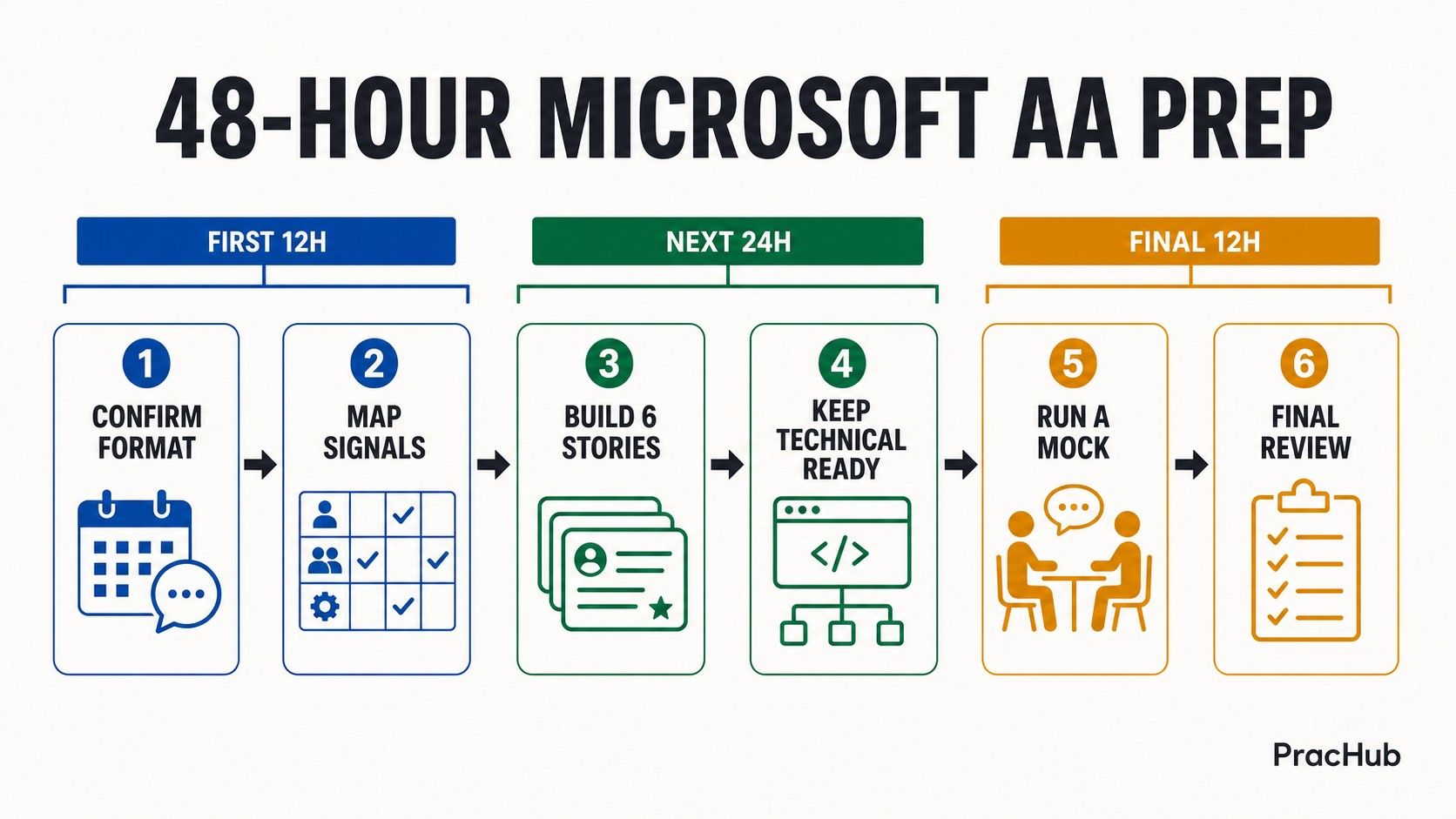
Convert the vague AA label into a concrete plan: verify the format, map signals, rehearse evidence, and retain technical readiness.
First 12 hours: confirm the format, review the job description, study the interviewer if publicly appropriate, and map the six official competencies to your evidence bank. Identify one loop area that may need stronger proof.
Next 24 hours: rehearse six stories, one project deep dive, one design problem, and one timed coding question. Ask a mock interviewer to interrupt and challenge attribution instead of politely accepting the first answer.
Final 12 hours: review concise notes, prepare three thoughtful questions, test the interview setup, and stop adding new material. Use the broader Microsoft Software Engineer Interview Guide to check the rest of the loop.
Common AA Mistakes
The biggest mistake is treating the meeting as ceremonial. Other weak patterns include reciting values without evidence, forcing every answer into one favorite project, exaggerating scope, blaming a teammate in a conflict story, and preparing only behavioral questions.
Do not reverse-engineer earlier interviewer reactions in real time. If the AA asks a technical question, solve it normally. If the interviewer challenges a story, clarify the concern and add evidence instead of guessing which previous round you are repairing.
Do Not Read the Ending Like an Offer Signal
A warm close, a discussion about Microsoft culture, or questions about start dates may feel positive, but none guarantees an offer. A short interview is not automatically bad, either. Hiring decisions depend on the full loop and organizational needs.
Ask when to expect an update and send any follow-up through the recruiter. Microsoft officially recommends asking for the timeline rather than inferring the result from interviewer behavior.
Frequently Asked Questions
Does everyone get a Microsoft As-Appropriate interview?
No universal Microsoft source says every candidate receives one. Candidate reports and recruiter descriptions vary by team, role, geography, and level. Treat your invitation as process-specific and ask the recruiter how it fits into your loop.
Is the AA interview a sign that I passed?
It means your candidacy remains active, but it is not an offer. The interview can still add evidence about hiring, leveling, technical depth, or role fit. Continue preparing as seriously as you did for earlier rounds.
Is Microsoft AA the same as an Amazon Bar Raiser?
No official Microsoft material establishes that equivalence. Both labels are sometimes used online to describe late-stage calibration, but the governance, rubric, and interviewer role should not be assumed identical. Prepare around Microsoft competencies and the specific job.
Will the Microsoft AA include coding?
It can, although many reported AA interviews are more conversational. Keep coding, design, testing, and project details ready unless your recruiter explicitly confirms a nontechnical format. The interviewer may also turn a behavioral example into a technical deep dive.
How long is the AA interview?
Many candidates report a standard interview block, often around 30 to 60 minutes, but Microsoft publishes no universal AA duration. Use the calendar invitation and recruiter guidance as the source of truth.
Final Takeaway
Prepare for the Microsoft As-Appropriate interview as a flexible final evidence check. Show specific impact, defend technical decisions, connect work to customers, handle disagreement with maturity, and make reflection credible.
Start with PracHub's Microsoft company research, practice realistic technical and behavioral questions, and enter the AA ready for whichever signal the final interviewer decides to examine.
Sources and Methodology
This guide was researched on August 6, 2026. Universal interview and competency claims were checked against Microsoft's official How We Hire, Interview Tips, Technical Interviewing, and Culture pages. Microsoft does not define a universal As-Appropriate round on those pages. Descriptions of timing, interviewer seniority, and question mix reflect recurring public candidate reports and are presented as variable, anecdotal patterns rather than official policy. The preparation framework and recommendations are PracHub editorial analysis.
Comments (0)