Software Engineer Project Deep Dive Interview Guide: Architecture, Impact, and Follow-Ups
Quick Overview
This software engineer project deep dive interview guide explains how to choose a strong project, structure a concise opening, draw the architecture, prove personal ownership, quantify impact, and answer technical follow-ups. It includes a scoring rubric, question map, worked example, confidentiality guidance, FAQs, and a seven-day preparation plan using PracHub real interview questions.
A project deep dive can feel deceptively comfortable: the topic is your own work, so what could surprise you? Then the interviewer asks why you chose that data model, what failed at peak load, which metric moved because of your decision, and what your teammate owned instead. A polished project summary can unravel in minutes.
The solution is not a longer monologue. It is a short, evidence-backed story with enough technical depth to survive follow-up questions. This guide shows you how to choose the right project, explain its architecture, separate your contribution from the team's work, quantify impact, and prepare the questions that usually come next.
Start by practicing PracHub's real project deep dive prompt with a written solution. Then use company-specific interview prep to check whether your target loop calls this a project retrospective, technical deep dive, project presentation, or hiring-manager round.
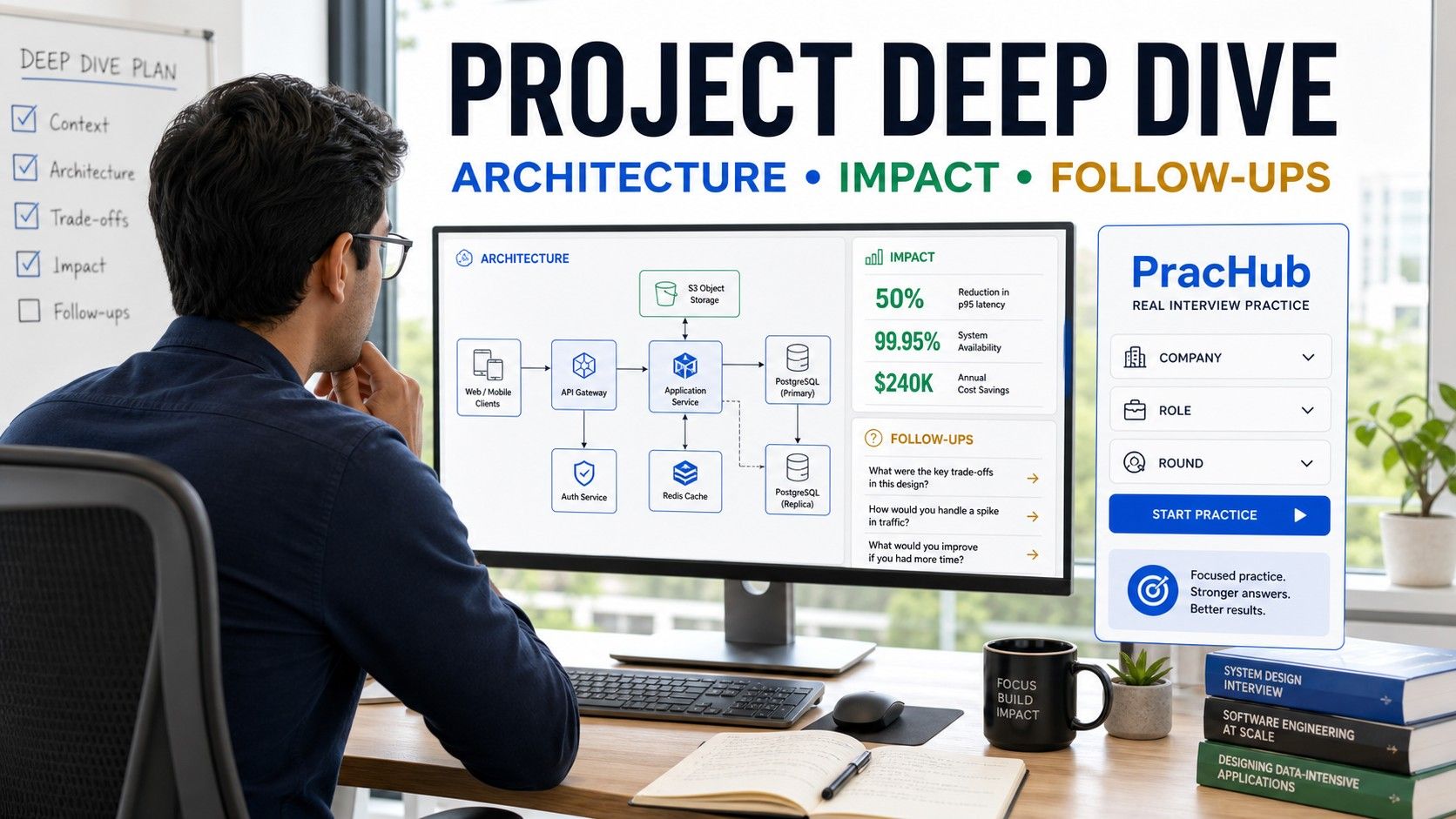
A strong project deep dive connects one real system to clear ownership, defensible decisions, measurable impact, and honest reflection.
Quick Answer: How Should You Prepare?
Choose one project with meaningful ownership, draw its architecture from memory, prepare two consequential trade-offs, and build evidence for the result. Your opening story should take about five to seven minutes, leaving most of the interview for discussion.
For every major claim, prepare the next two questions. If you say latency improved, know the baseline, measurement window, bottleneck, change, and remaining limit. If you say you led the project, know which decisions were yours, who else contributed, and how you handled disagreement.
What Is a Software Engineer Project Deep Dive?
A software engineer project deep dive is an interview about a system you actually helped build. The interviewer uses your past work to evaluate technical judgment, ownership, execution, communication, and learning under realistic constraints.
It is not the same as a behavioral answer or a standard system design interview. Behavioral questions often emphasize an event and your response. System design starts with a hypothetical product. A project deep dive begins with real evidence and asks whether you understand the system beyond the slide-level story.
| Round | Starting point | Main evidence | Typical pressure test |
|---|---|---|---|
| Project deep dive | A system you worked on | Decisions, execution, production results | "Why did you choose that, and what happened?" |
| System design | A hypothetical requirement | Reasoning and architecture built in the interview | "How does the design change at scale?" |
| Behavioral | A past situation | Actions, collaboration, and reflection | "What did you personally do?" |
The exact format varies by company and team. Some interviews are conversational; others ask for a short presentation or architecture diagram. Confirm timing, slide rules, and confidentiality expectations with your recruiter instead of assuming a universal format.
What Interviewers Are Actually Scoring
The round is less about choosing a fashionable stack than showing repeatable engineering judgment. OpenAI's official interview guide says its engineering interviews look for well-designed solutions, code quality, performance, testing, communication, and collaboration. Anthropic similarly emphasizes how candidates think through problems and analyze trade-offs.
| Signal | Strong evidence | Weak signal |
|---|---|---|
| Technical depth | Explains data flow, bottlenecks, failure modes, and tests | Names services without explaining behavior |
| Ownership | Separates personal decisions from team contributions | Uses "we" for every action |
| Judgment | Connects alternatives to constraints and evidence | Claims one technology was simply "best" |
| Impact | Provides a baseline, outcome, and credible attribution | Reports an impressive number with no measurement story |
| Reflection | Names debt, mistakes, and what would change now | Presents a frictionless success story |
Choose a Project That Can Survive Follow-Ups
Your most famous project is not always your best interview project. Choose one where you can explain the problem, architecture, implementation, rollout, operational behavior, and result without guessing. A smaller system you owned deeply often produces a stronger interview than a large platform you only touched at the edge.
Score each candidate project from zero to two on five dimensions: personal ownership, technical depth, meaningful trade-offs, measurable impact, and relevance to the target role. Prefer the project with the best total, provided you can discuss it without exposing confidential information.
Abstract customer names, proprietary algorithms, sensitive volumes, and internal identifiers. You can say that figures are rounded or normalized. Never invent detail to replace what you cannot disclose.
Build a Five-to-Seven-Minute Core Story
Your opening should create a map, not consume the interview. Use this sequence: problem, constraints, architecture, your ownership, hardest decision, execution, result, and reflection.
Project thesis: "I led the migration of a synchronous order workflow to an event-driven pipeline because peak traffic was causing timeouts. I owned the service boundary, retry model, and rollout. The change reduced timeout-related failures, but introduced consistency and observability trade-offs that I would handle differently today."
That thesis tells the interviewer what changed, why it mattered, what you owned, and where the technical conversation can go. Keep supporting context short. Spend your time on decisions and evidence, not company history.
Explain Architecture in Layers
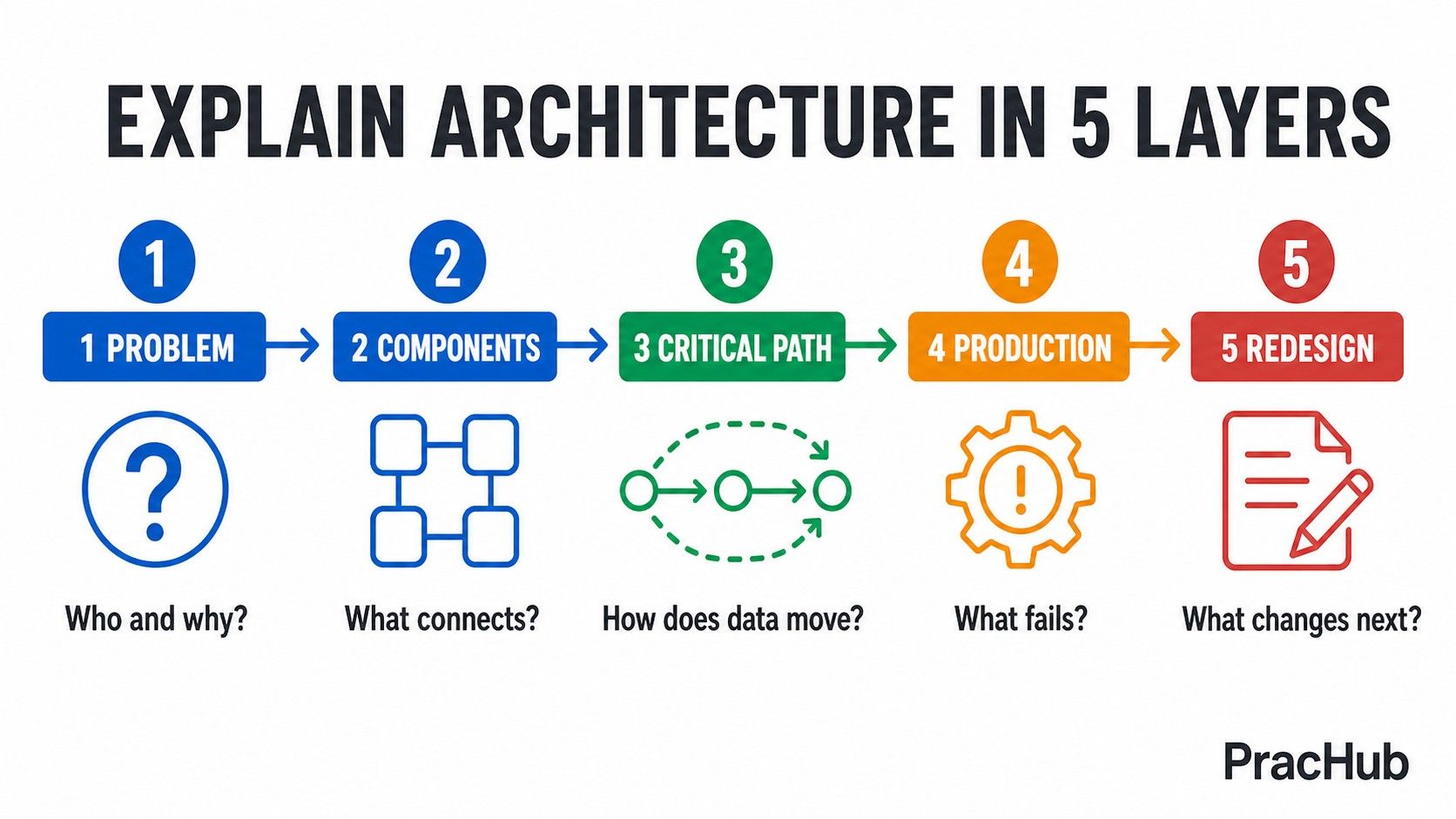
Move from the user problem to components, the critical path, production behavior, and finally the counterfactual redesign.
Begin with one sentence about the user and constraint. Then draw only the components needed to explain the critical path. Show where requests enter, where state lives, which calls are synchronous, which work is asynchronous, and where failures become visible.
Be ready to move through five depths: the problem boundary, component map, critical request or data path, production behavior, and counterfactual design. Production behavior includes capacity, backpressure, retries, idempotency, consistency, observability, security, deployment, and recovery. You do not need to mention every topic; you do need depth on the ones your system actually exercised.
For each major box, ask yourself: why does it exist, what alternative did we reject, what fails here, and how would we know? That turns a diagram into an architecture argument.
Prove Personal Ownership Without Erasing the Team
Use "we" for shared context and "I" for your decisions and actions. For example: "We agreed to separate ingestion from processing. I wrote the proposal, compared queue semantics, ran the failure test, and changed the retry design after the review."
Senior-level ownership also includes influence. Explain how you aligned teams, surfaced risk, changed scope, reviewed a design, mentored an engineer, or handled an incident. Be precise about authority: proposing, deciding, implementing, and approving are different forms of contribution.
Turn Impact Into Evidence
A strong impact claim has four parts: baseline, change, outcome, and attribution. Instead of saying "we improved reliability," explain which failure rate or operational signal changed, over what period, and why your intervention plausibly caused the movement.
Business impact counts too: adoption, conversion, support volume, developer time, infrastructure cost, release frequency, or risk reduction. If a metric is unavailable, use honest qualitative evidence such as an eliminated manual step or a documented incident class. Do not manufacture precision.
Prepare the Follow-Up Tree
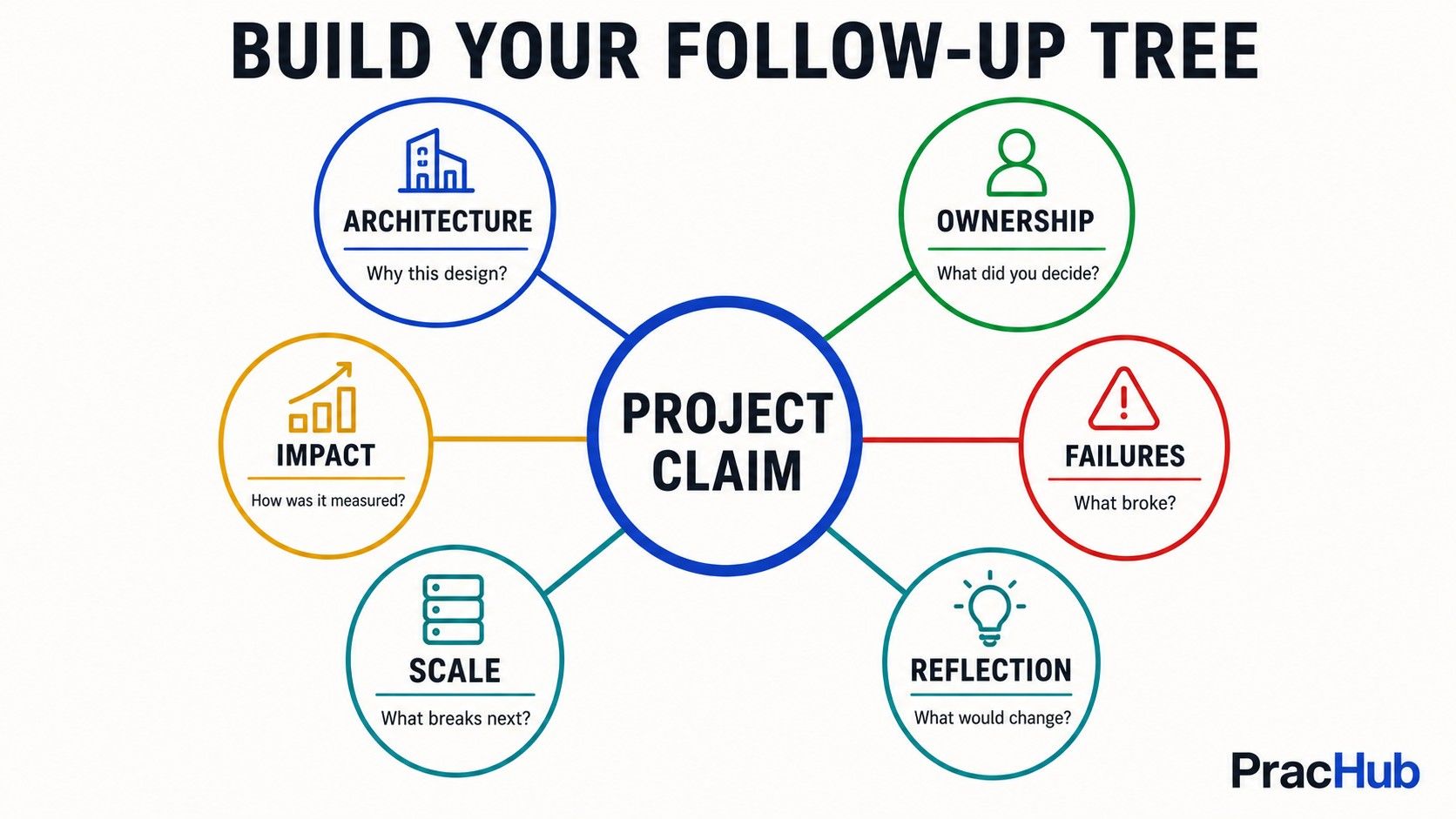
Every headline claim should lead to evidence, a trade-off, a failure mode, and a thoughtful next decision.
| Probe area | Likely question | Prepare this evidence |
|---|---|---|
| Requirements | What constraint changed the design most? | One explicit constraint and the decision it forced |
| Architecture | Why this boundary or data store? | Alternatives, workload, and failure behavior |
| Scale | What breaks at ten times the load? | First bottleneck, detection signal, and next change |
| Reliability | What failed in production? | Incident, blast radius, mitigation, and prevention |
| Ownership | What did you personally decide? | A specific decision and artifact you produced |
| Impact | How do you know it worked? | Baseline, result, measurement, and caveat |
| Reflection | What would you change today? | New information and a better trade-off |
Practice answering each in 60 to 90 seconds. Then ask a partner to keep drilling on one thread. You are ready when you can say "I don't remember the exact number" without losing the reasoning around it.
What a Strong Answer Sounds Like
Suppose you led a notification pipeline migration. Start with the customer failure: synchronous fan-out delayed checkout during traffic spikes. State the key constraints: no lost transactional messages, gradual rollout, and limited on-call capacity.
Draw the request path, durable event log, consumers, idempotency key, retry policy, dead-letter handling, and monitoring. Explain why you rejected direct fan-out, what you personally designed, how you tested duplicate delivery, and which rollout metric stopped the first launch. Finish with the measured outcome and one design debt you would now remove.
The power comes from the chain of reasoning. The architecture, ownership, failure, and impact all describe the same project instead of four disconnected achievements.
Common Mistakes That Lower the Signal
Starting too broad leaves no time for depth. Reciting a memorized speech makes interruptions feel threatening. Using only "we" hides ownership, while using only "I" makes collaboration sound implausible.
Other common problems are architecture diagrams with fifteen unexplained boxes, technology choices without alternatives, results without baselines, and lessons that amount to "communicate more." The fix is specificity: one consequential decision, one real failure or constraint, one measurable outcome, and one changed belief.
A Seven-Day Practice Plan
Days 1-2: score three projects, choose one, and write a one-page dossier. Draw the architecture from memory and remove details that do not support the core decision.
Days 3-4: build a decision log with two alternatives, two failure modes, and your impact evidence. Practice the five-to-seven-minute opening, then answer ten follow-ups without slides.
Days 5-6: run two mocks. In the first, optimize for technical clarity. In the second, ask the interviewer to challenge ownership and attribution. Review PracHub's behavioral and leadership questions for collaboration probes and its real interview questions with written solutions for additional technical practice.
Day 7: rehearse once with the exact interview medium, verify confidentiality, and stop adding new content. Your goal is a flexible conversation, not perfect recitation.
Frequently Asked Questions
How long should my project deep dive answer be?
Aim for a five-to-seven-minute core story unless the recruiter specifies a presentation length. That is enough to establish the problem, architecture, ownership, decision, and impact while preserving time for the follow-ups that produce most of the signal.
Should I prepare slides?
Ask the recruiter. If slides are allowed, keep them visual and sparse: problem, architecture, decision, rollout, and result. You should still be able to explain the project without them because the interview may become conversational quickly.
Can I use a school or personal project?
Yes, especially for early-career roles. Choose a project with genuine decisions, implementation depth, testing, and evidence of iteration. Be honest about the scale and users; do not present hypothetical production behavior as something you observed.
What if the project is confidential?
Abstract names, sensitive numbers, customer details, and proprietary logic. State that values are rounded or normalized. If abstraction removes the technical substance, choose another project. Interview performance is never worth violating an agreement or employer trust.
What if I cannot remember an exact metric?
Say so and provide the measurement method, direction, or approved range you can defend. Interviewers can distinguish honest uncertainty from unsupported precision. Review design docs and dashboards before the interview when permitted.
Final Checklist
You are ready when you can explain the project in seven minutes, redraw the critical architecture, defend two trade-offs, separate your work from the team's, support the result with evidence, discuss a real failure, and name what you would change now.
Use PracHub to turn that preparation into a realistic interview: start with the technical project deep dive question, pressure-test adjacent architecture topics, and use company pages to match your story to the loop you are actually entering.
Sources and Methodology
This guide was researched and reviewed on August 6, 2026. Evaluation themes were checked against OpenAI's official interview guide, which describes its focus on solution design, code quality, performance, testing, communication, and collaboration, and Anthropic's official careers guidance, which emphasizes direct evidence of ability, problem solving, and trade-off analysis. Format recommendations, project-selection scorecard, answer framework, follow-up tree, and practice plan are PracHub editorial guidance; the exact process for any role should be confirmed with that company's recruiter.
Comments (0)