Akuna Capital SWE OA 2027: Round 1, Role-Specific Round 2, and Cutoffs
Quick Overview
An evidence-based Akuna Capital SWE OA 2027 guide covering Round 1 formats, role-specific Round 2 expectations, no-public-cutoff guidance, real Akuna practice questions, and interview preparation for C++, Python, and Full Stack Web internships.
Updated August 16, 2026: The most misleading advice about the Akuna Capital SWE intern online assessment is often the simplest: “Round 2 is harder.” It may be harder, but that does not tell you what to practice. Akuna is hiring Summer 2027 interns across C++, Python, and Full Stack Web, and the work described for those tracks is meaningfully different.
Recent candidate reports support that split. Some applicants describe a quick first assessment with language fundamentals or several algorithmic questions. Others report a second assessment labeled as backend/full-stack work, a C++ debugging or implementation task, or a longer optimization problem. There is also no public Akuna score cutoff that lets you turn one candidate's result into a guaranteed pass.
Start with real Akuna Capital Software Engineer questions on PracHub. The question bank helps you practice timed algorithms, order-book modeling, systems implementation, and performance-aware edge cases without pretending that a past prompt is your exact 2027 assessment.
Akuna Capital SWE OA 2027: Quick Verdict
Treat the assessment invitation as the source of truth. Confirm the role title, target language, length, platform, proctoring requirements, and whether the email calls the next step a coding assessment, technical assessment, or role-specific exercise.
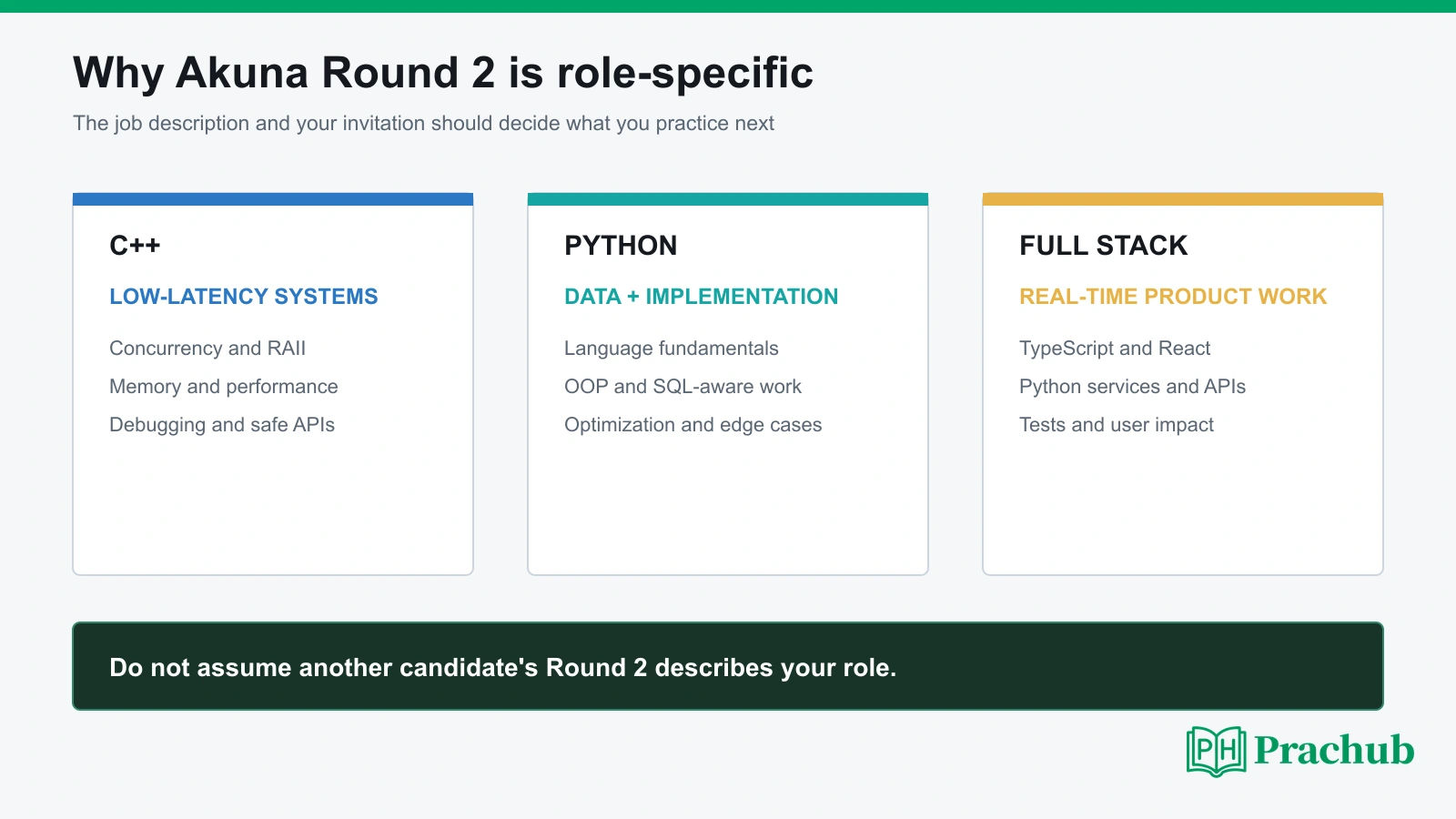
For 2027, Akuna publicly lists separate Summer internship roles for C++, Python, and Full Stack Web. Its C++ posting emphasizes multithreaded, asynchronous, distributed systems; its Python posting references post-trade/data engineering and large market-data volumes; and its Full Stack posting names React, TypeScript, Python, real-time applications, and tests. That is a strong reason not to import another track's Round 2 rumor into your own prep plan.
| Candidate question | Best evidence-based answer |
|---|---|
| Are there two Akuna SWE assessments? | Recent 2025-26 candidate reports repeatedly describe Assessment 1 followed by a role-specific Assessment 2. Akuna does not publish a universal official format. |
| What is Round 1? | It varies by track. Reports include fundamentals/MCQs, several algorithmic problems, and timed implementation work. Use your invitation, not a generic template. |
| What is Round 2? | Reports include backend/full-stack implementation, debugging, C++ systems work, and optimization. Its label and language are the best preparation clue. |
| What score or percentage passes? | Akuna does not publicly publish a universal score, test-case percentage, or aggregate cutoff for SWE interns. |
| Does a fast OA2 invite guarantee an interview? | No. It is a positive process signal, but it does not guarantee a recruiter call, later interview, or offer. |
Why the Role Matters More Than the Round Number
Akuna is not running one generic SWE internship. The current public job descriptions describe distinct engineering environments. This matters because a role-specific screen can sensibly test the work an intern will be expected to do.
C++: performance, concurrency, and reliability
Akuna's C++ intern page describes high-performance systems and says its C++ estate is heavily multithreaded, asynchronous, and distributed. That makes careful ownership, synchronization, latency-aware choices, data structures, debugging, and predictable failure handling worth practicing alongside standard algorithms.
Python: data, implementation, and clean fundamentals
The Python internship can sit in Post Trade Technology or Data Engineering and work with large volumes of trading and market data. Recent reports mention Python fundamentals, OOP, SQL-like reasoning, and optimization. Practice expressive, testable Python, not only short LeetCode functions.
Full Stack Web: product behavior under real-time constraints
Akuna's Full Stack Web role calls out React, TypeScript, Python, real-time trading applications, and unit/integration testing. A role-related technical task can therefore reward state management, API boundaries, validation, testing, and debugging more than a purely abstract puzzle.
What Recent Candidates Report About Round 1
Reports are inconsistent because the tracks differ. A 2025 C++ intern report described three algorithmic problems in 80 minutes, including a market-order simulation. Other C++ candidates describe completing some but not all visible test cases and still receiving a second assessment invitation.
For Python, recent 2026 reports describe a first assessment centered on language fundamentals or roughly 28 multiple-choice questions, while older internship reports mention simple arrays and OOP. These are candidate accounts, not official rules. They are useful only as a signal to read the role name closely.
What to practice for a general Round 1
Build speed in arrays, maps, sorting, heaps, intervals, graphs, strings, and simulation. Read the entire prompt before coding, identify the exact output contract, and test duplicates, empty inputs, tie-breaking, overflow, and repeated operations.
For a market-style simulation, define how events change state before you start. For example: what happens on cancellation of a missing order, an update at the current best price, two equal-price orders, or an empty book? Correct state transitions usually matter more than prematurely clever code.
What “Role-Specific Round 2” Usually Means
Round 2 does not appear to be one reusable Akuna problem. In 2025-26 reports, candidates have described a 45-minute full-stack/backend exercise, a C++ debugging assessment, a longer single optimization question, and Python work described as an approximation or optimization problem. The common pattern is practical depth in the selected track.
That is why the best question to ask is not “What was OA2?” but “What does my OA2 invitation say?” Match the assessment label to the job description and build a targeted simulation around that overlap.
If the invitation says backend or full stack
Practice turning requirements into a small API or stateful component. Define input validation, state ownership, idempotency, ordering, errors, and tests. Start with the narrow correct version, then make it robust without rewriting the entire solution.
If it says C++ or debugging
Review RAII, move semantics, smart pointers, iterator invalidation, object lifetime, mutexes, condition variables, atomics, races, and compilation errors. Practice explaining the failure before proposing a patch, then add one test that would have caught it.
If it says optimization or approximation
Clarify the objective function, constraints, and whether the evaluator rewards exactness, quality, speed, or all three. Build a correct baseline first. Then improve the dominant bottleneck with a measurable change; do not sacrifice correctness merely to chase a better-looking constant factor.
Akuna Cutoffs: What Is Known and What Is Not
Known: Akuna publicly posts requirements for roles, including education, work authorization, and in the Python intern posting a major GPA requirement. It does not publish a universal SWE OA pass score, percentage-of-tests threshold, or formula combining Assessment 1 and Assessment 2.
Not known: whether a specific role uses a hard test-case threshold, how much a partial solution contributes, whether scores are aggregated across assessments, or the score required in a given recruiting week. Candidate anecdotes cannot answer these questions reliably.
A second invite, a quick follow-up, or a perfect visible-test run is not a contract. It may indicate progress, but recruiters can still weigh role alignment, code quality, resume review, interview calibration, and headcount.
How to Treat Visible and Hidden Tests
Visible tests are examples, not a complete specification. If an order simulator handles the examples but mishandles cancellation order, duplicate IDs, or a zero-quantity update, hidden tests may expose it. Write down the invariants that must hold after every operation.
For optimization tasks, do not trust one small benchmark. Test dense versus sparse input, repeated values, largest constraints, adversarial ordering, and cases where your heuristic makes no improvement. Time your implementation only after it is correct.
Practice with Real Akuna Questions from PracHub
These are real Akuna question-bank records stored by PracHub, not predictions of your exact Summer 2027 prompt. The links are grouped around the implementation, performance, debugging, and trading-domain reasoning that connect the job descriptions to candidate-reported assessment styles.
| PracHub question | Difficulty | Practice focus | Why it fits |
|---|---|---|---|
| Implement a Ring Buffer | Medium | State, arrays, O(1) operations | Build a compact API with clear full/empty behavior, invariants, and edge-case tests. |
| Design an Order-Matching Engine | Hard | Market simulation, heaps, correctness | Practice price-time behavior, cancellation, matching, and deterministic state transitions. |
| Fix and Harden an Object Pool | Hard | C++ concurrency and debugging | Train RAII, thread safety, races, shutdown behavior, and explaining a safe patch. |
| Solve Swaps, Graph Paths, and Movie DP | Medium | Algorithms under time pressure | Build breadth across graph, ordering, and dynamic-programming decisions for Round 1-style practice. |
Attempt the exercises timed and keep an error log. For additional practice, use real interview questions with written solutions and the company-specific interview prep directory to compare assessment patterns across market makers.
A Better Prep Decision Process
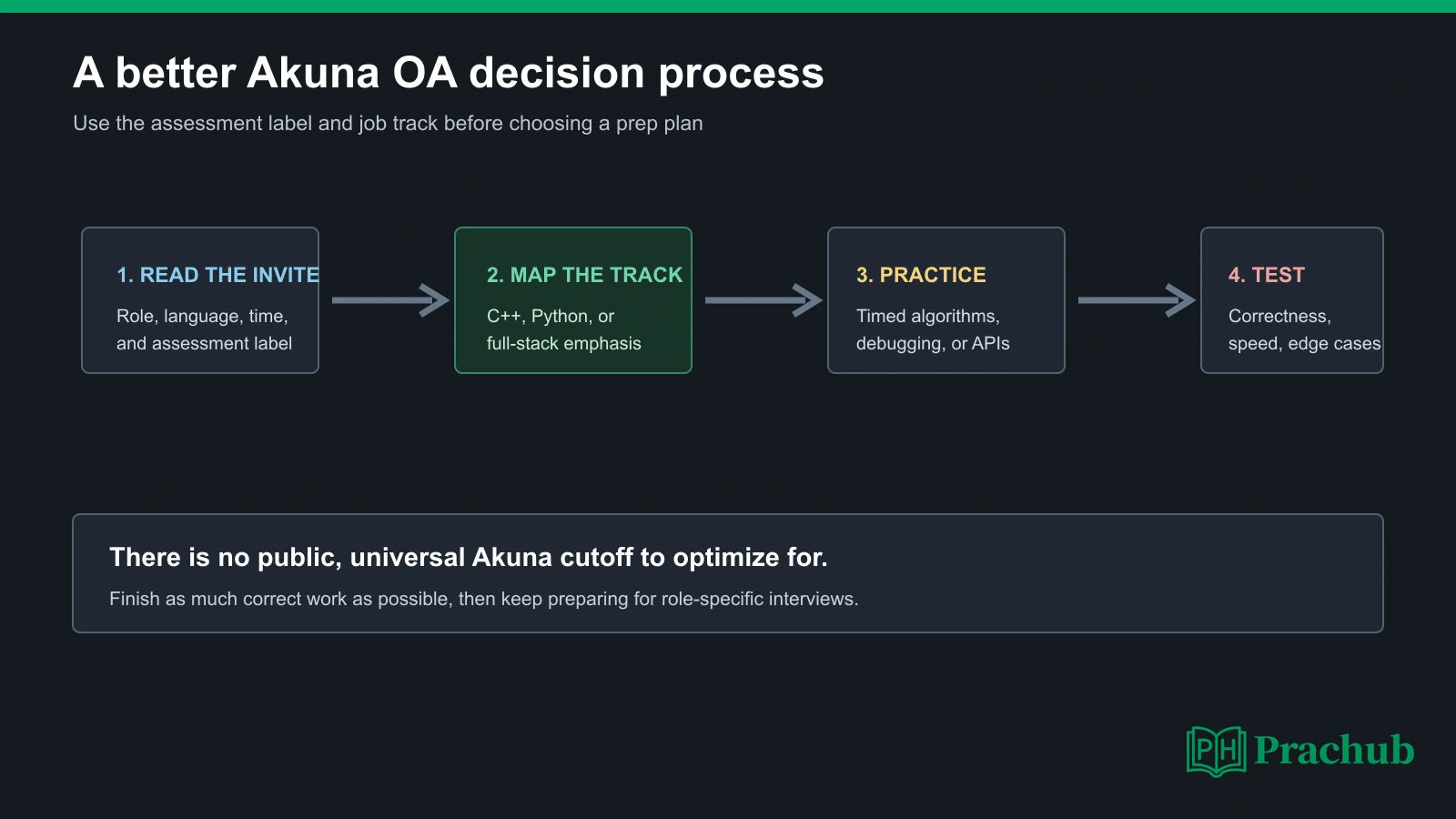
Start with the email. If it gives a language, prepare in that language. If it names backend, build a stateful service. If it names a technical screen, cover DSA plus testing. If it names C++, spend a meaningful share of time on compilation, memory, lifetime, and concurrency.
| Invitation clue | Best next practice block | What to avoid |
|---|---|---|
| Python or fundamentals | Language semantics, OOP, dictionaries, parsing, SQL-adjacent reasoning, and clean tests. | Assuming the later round is another short quiz. |
| C++ or systems | Algorithms plus RAII, lifetime, concurrency, profiling, and debugging exercises. | Only grinding language-agnostic LeetCode. |
| Backend/full stack | Requirements, API design, state transitions, validation, testing, and readable implementation. | Overbuilding frameworks before the core behavior works. |
| Optimization/approximation | Correct baseline, objective clarity, complexity analysis, profiling, and targeted improvement. | Guessing at a cutoff or optimizing a broken solution. |
Time Management for Akuna OAs
Use the first 5 percent of the timer to map the task. Identify requirements, forbidden operations, input shape, output format, and the largest constraint. For multiple problems, scan the full set before selecting the first target.
Leave 10 to 15 percent of the timer for tests, compilation, and final review. If a difficult task is not moving, write the most correct partial version you can, document the remaining bottleneck in your own notes, and move to a higher-confidence problem or improvement.
What Happens After Assessment 2?
Candidate reports from 2025-26 describe recruiter calls or a short technical conversation after both assessments, followed by technical interviews. The timing varies from days to weeks, and an assessment result is not the entire process.
Prepare the next stages while waiting. You should be ready to explain a project that demonstrates engineering judgment, discuss why trading technology interests you, and reason aloud about correctness, performance, and trade-offs.
Prepare a credible “Why Akuna?”
Connect your interest to the actual engineering environment: low-latency systems, real-time applications, reliability under market pressure, close work with traders and quants, or ownership of production-like intern projects. “I want to work in quant” is not yet a differentiated answer.
Prepare a project deep dive
Cover the problem, architecture, your personal decisions, one trade-off, testing approach, a failure or bottleneck, and the result. Be ready to explain how the design behaves with more traffic, a slower dependency, corrupted data, or a stricter latency budget.
Prepare behavioral evidence
Use behavioral and leadership practice for stories about ownership, disagreements, precision, and learning from a mistake. Focus on choices you personally made and the measurable or observable outcome.
A Seven-Day Akuna OA Plan
Days 1-2: Establish the baseline
Read the job description and invitation twice. Run a timed diagnostic in the language used by the role, then classify each failure as concept, implementation, debugging, tests, or time management.
Days 3-4: Train the role-specific gap
For C++, alternate algorithms with debugging and concurrency. For Python, alternate core language work with stateful parsing and data problems. For Full Stack, alternate coding drills with a small component/API exercise and tests.
Day 5: Simulate Round 1
Run one strict timed session. Review every hidden-test risk, not just the final score. Reimplement your two worst solutions cleanly the following morning.
Day 6: Simulate Round 2
Create a compact, realistic task: a buggy class, a small API with new requirements, or an optimization problem. Start from a correct baseline and explain every design decision aloud.
Day 7: Prepare the interview behind the OA
Review your error log, practice one Akuna question, prepare your project deep dive, and verify deadline, browser, proctoring, language, and identity requirements. Do not add a new framework or language at the last minute.
Akuna Capital SWE OA 2027 FAQ
Is Akuna OA Round 1 automatic?
Some recent candidates describe an automatic first assessment, but Akuna does not publish a universal automation policy for every internship role. An invite is a real evaluation, not proof that later human review is guaranteed.
Is Round 2 always harder?
Many candidates describe it as more demanding because it is often role-specific or more implementation-heavy. But “harder” is not a format. The right preparation comes from its label, target language, duration, and job track.
What is the Akuna cutoff?
There is no public universal cutoff for SWE intern assessments. Avoid optimizing for a rumored percentage, a full visible-test run, or someone else's timeline. Aim for correct, robust work across the scope you can complete.
Should C++ candidates practice LeetCode only?
No. Algorithms remain useful, but the C++ job description emphasizes multithreaded and asynchronous systems. Add ownership, lifetime, synchronization, debugging, performance, and API design to the plan.
What should Python candidates focus on?
Practice core Python fluency, OOP, parsing, maps, state, data-oriented reasoning, and testable implementation. Recent reports include fundamentals, but the public role also points to market-data and post-trade work.
Practice for Your Akuna Track, Not a Rumor
The Akuna SWE assessment pipeline is best understood as a funnel with a general first screen and a more role-shaped second screen. Your goal is not to guess an unpublished cutoff. It is to finish correct work, handle edge cases, and demonstrate the engineering habits the selected track actually demands.
Practice real Akuna Capital Software Engineer questions on PracHub. Start with the four linked questions, time your work, and carry the same focus on correctness and trade-offs into the interviews that follow.
Sources and Evidence Notes
Current role-track claims come from Akuna's official 2027 postings for C++, Python, and Full Stack Web. The postings describe the work but do not publish an OA question set or passing cutoff.
Round format, timing, and difficulty examples are candidate reports rather than official policy, including a 2026 C++ intern Round 1/2 discussion, a 2026 Python OA2 discussion, a C++ Assessment 2 report, and a 2025-26 internship thread. They do not override your invitation or recruiter guidance.
Related Articles
Coinbase SWE Intern OA Guide: CodeSignal, Cultural Assessment, and Interview Timeline
Coinbase SWE intern OA guide: CodeSignal format, cultural assessment prep, evidence-based timeline, practice questions, and what happens next.
Robinhood SWE Intern OA Guide: CodeSignal, Scoring, and What Comes Next
Robinhood SWE intern OA guide: CodeSignal scoring, score reuse, cutoff myths, coding strategy, and what to prepare for after submission.
Sentry SWE Intern OA 2027: One 60-Minute Problem, Edge Cases, and Hidden Tests
Sentry SWE intern OA 2027 guide: a 60-minute one-problem report, edge-case checklist, hidden-test strategy, and practical coding prep.
Virtu Financial SWE Intern OA 2027: Coding Questions, C++, and What Comes Next
Virtu SWE intern OA 2027: HackerRank after resume screening, coding question patterns, C++ prep, hidden tests, and what comes next.
Comments (0)