Sentry SWE Intern OA 2027: One 60-Minute Problem, Edge Cases, and Hidden Tests
Quick Overview
Sentry SWE intern OA 2027 guide: what historical candidate reports say about a 60-minute HackerRank problem, how to handle edge cases and hidden tests, and how to prepare for production-minded software engineering work.
A one-question online assessment sounds friendlier than a long list of problems. In practice, it can be tougher. With one 60-minute prompt, every detail matters: the input contract, the first and last operation, the output format, and the one case you did not think to test before time expires.
If you are searching for the Sentry SWE Intern OA 2027, start with one important caveat. Public candidate reports from prior cycles describe a 60-minute, one-problem HackerRank assessment, but Sentry has not publicly committed to that exact 2027 format. Treat the invite you receive as the source of truth. This guide turns the recurring signal in those reports into a preparation plan that still works if the platform, timing, or prompt changes.
The practical takeaway: prepare for a compact coding assessment that rewards complete, carefully tested implementation. Use real interview questions with written solutions on PracHub to rehearse the part that matters most: shipping a correct answer under a real clock, then reviewing the edge cases your first pass missed.
Quick verdict: what to expect from the Sentry intern OA
| Question | Best current answer |
|---|---|
| Is it one problem in 60 minutes? | Possibly, but not guaranteed. Candidate reports from 2024 and 2025 described that setup; it is not an official 2027 format announcement. |
| Is HackerRank involved? | Past candidates reported HackerRank. Confirm the platform and rules in your own invitation. |
| How hard is the problem? | Reports suggest a manageable core idea made difficult by implementation details, edge cases, and time pressure. |
| Is there a published cutoff? | No public Sentry cutoff is available. Do not optimize for a rumored score; optimize for a clean, complete solution. |
| What should you practice? | Reading specifications, modeling state, writing tests, and explaining trade-offs - not only memorizing patterns. |
Sentry's current internship description is useful context even though it does not publish an OA blueprint. It describes interns working from technical scoping through implementation, testing, and shipping. That makes a production-minded practice routine more valuable than trying to reverse-engineer one historical prompt.
Why a one-problem OA can feel harder than several questions
In a multi-question assessment, you can bank points by finishing the easy task and moving on. A single longer problem removes that escape hatch. You must choose a data model, interpret ambiguous wording, cover constraints, and deliver the exact output the judge expects.
The trap is assuming that a familiar algorithm is enough. A solution can have the right high-level complexity and still fail hidden tests because it mishandles duplicate events, empty input, ordering, a boundary timestamp, or a trailing newline. Correctness is a chain; hidden tests look for the weak link.
The common failure pattern
A candidate reads the happy-path example, recognizes a pattern, and codes immediately. At minute 42, they discover an edge case, patch one branch, and create a second regression. The fix is not to code more slowly; it is to reserve time for specification work and adversarial tests before the final submit.
What past Sentry candidate reports actually say
Public reports are anecdotal, incomplete, and cycle-specific. Still, two reports are directionally useful: a 2024 candidate described a one-question HackerRank exercise involving text wrapping, while a 2025 candidate described one medium-ish problem in 60 minutes with many edge cases. Neither report proves your 2027 assessment will be identical.
The shared lesson is stronger than any one prompt: be ready to turn a detailed written specification into working code. Do not spend your prep week guessing an exact question. Practice inputs with rules, state transitions, formatting requirements, and enough cases to make a superficially correct answer fail.
What Sentry's internship expectations signal
The Fall 2026 Sentry internship listing says interns contribute to real projects and work across the development lifecycle, including technical specs, implementation, testing, and shipping. It names algorithms, data structures, GitHub, and experience with dynamic languages such as Python or JavaScript as relevant background.
That does not tell us the exact 2027 OA question type. It does tell us what a strong preparation loop should resemble: clarify the contract, make a sensible first implementation, test the fragile paths, and leave the code easier to reason about than when you started.
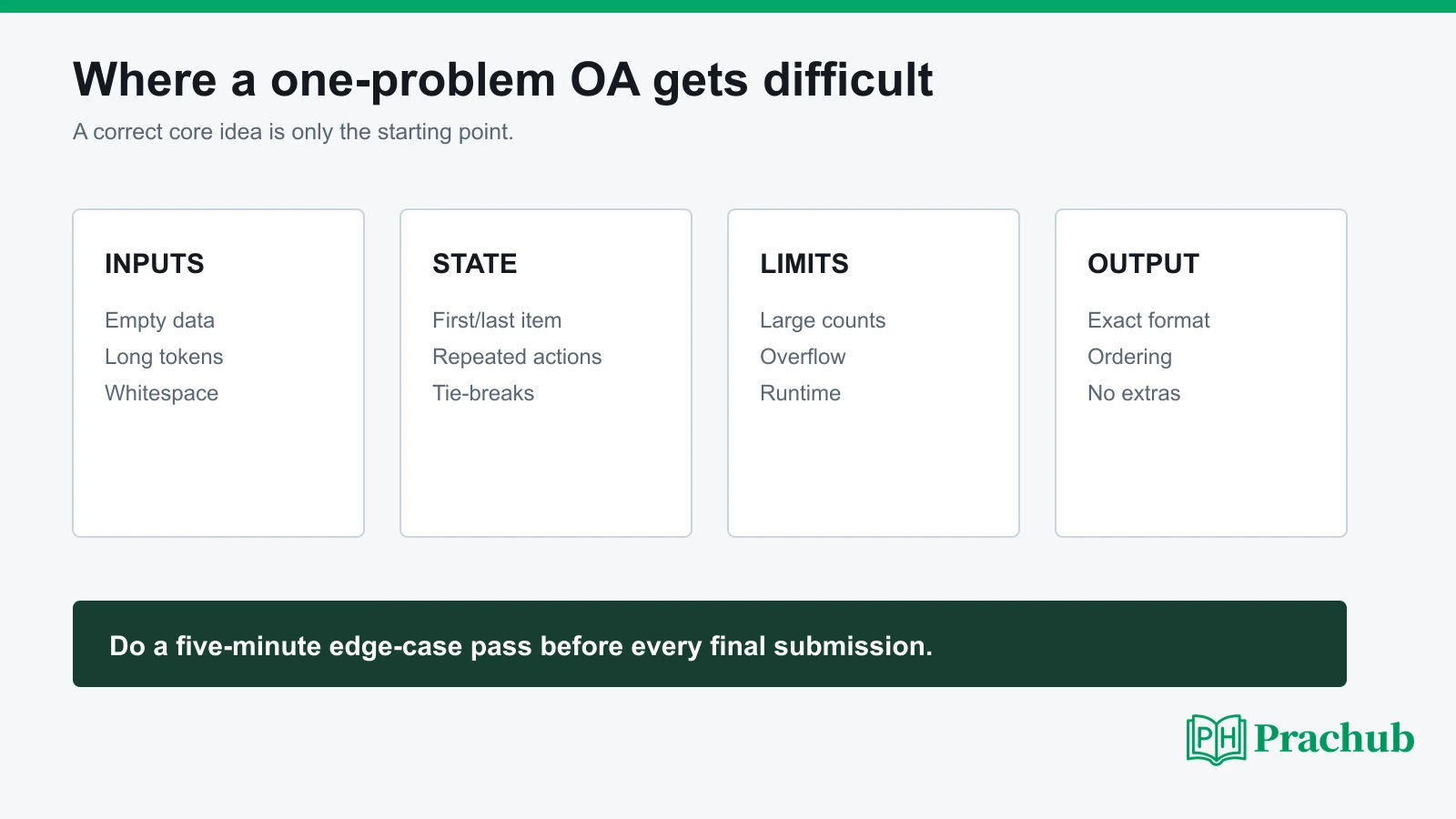
The edge-case checklist to run before you submit
Before writing code, turn the problem statement into a short checklist. Do this on scratch paper or in comments. The goal is not a giant test suite; it is catching the failure modes that hidden tests are designed to expose.
1. Inputs and parsing
Ask whether the input can be empty, contain one item, include duplicates, have extra whitespace, or contain a token longer than the example implies. If parsing is part of the task, test blank lines, separators, and the first and last token. Never assume examples show every valid shape.
2. State transitions
For simulations, queues, caches, schedules, and text manipulation, identify the first operation, the last operation, and repeated operations. What happens when a removal targets something absent? When an update repeats? When two items have the same priority? Those questions are often where an otherwise good solution breaks.
3. Constraints and complexity
Write down the maximum size before you select a brute-force approach. If the prompt has many operations, distinguish the initial collection size from the number of updates. A simple nested loop can look elegant on samples and still time out at the judge's limit.
4. Output and ordering
Hidden tests also catch output mistakes. Check required ordering, inclusive versus exclusive boundaries, capitalization, spacing, and whether to return a value or print it. When there is a tie, make the tie-break rule explicit in the code rather than relying on incidental iteration order.
Practice with real PracHub questions
These are real question-bank records stored by PracHub, not predictions of Sentry's exact 2027 prompt. They are useful practice because they force the kind of state modeling, boundary analysis, and test discipline that a single longer OA rewards.
| PracHub question | Level | Main pattern | Why it is useful |
|---|---|---|---|
| Implement a crash-resilient LRU cache | Medium | State, caching, recovery | Tests state updates, invariants, and behavior after failure. |
| Implement interval room counter and token manager | Medium | Intervals, ordering, tokens | Builds discipline around boundary times and precise operation rules. |
| Debug Watch List Movie Operations | Medium | Debugging, state, tests | Practices isolating incorrect assumptions in an unfamiliar implementation. |
For each question, set a 60-minute timer. Spend the final ten minutes testing your own implementation rather than reading a solution. Then compare your approach with the written solution and write down the first edge case you missed. That feedback loop is much more useful than simply collecting completed problems.
A 60-minute plan that leaves room for hidden tests
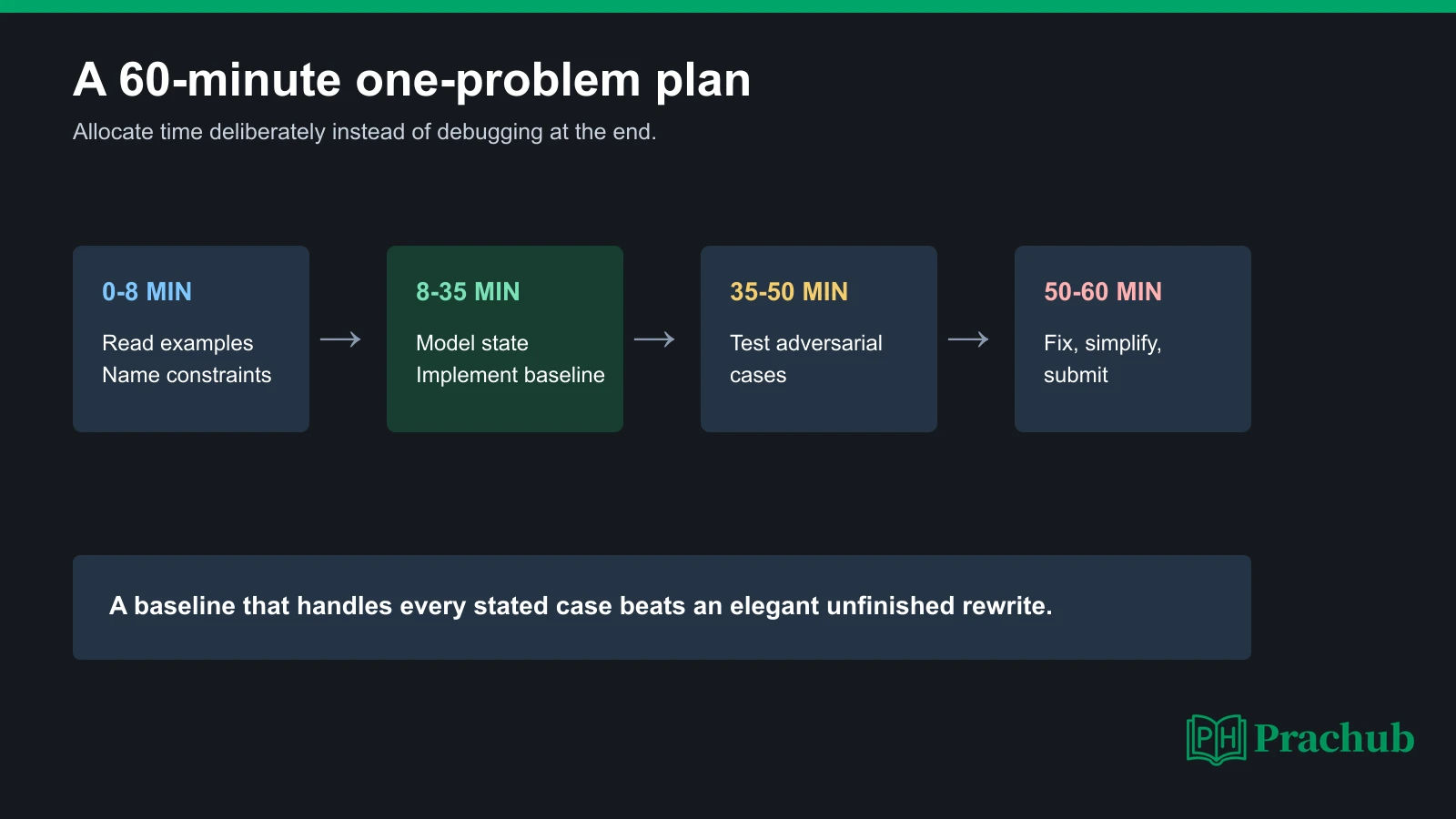
Minutes 0-8: read for contracts, not patterns
Read every example and constraint. Restate the input, output, mutation rules, and tie-breakers in one or two sentences. If a requirement is unclear, select the interpretation most consistent with the examples and implement it consistently.
Minutes 8-35: implement the smallest complete baseline
Choose the simplest approach that satisfies the stated bounds. Name state clearly and avoid abstractions you cannot test quickly. A plain implementation with the right invariant is safer than a clever rewrite that consumes your remaining time.
Minutes 35-50: attack your own solution
Create a tiny test for each checklist category: empty, one item, duplicate, boundary, maximum-ish size, and format. Walk through a stateful example by hand. If the environment offers custom tests, use them to challenge your assumptions rather than reproduce the sample exactly.
Minutes 50-60: simplify and submit
Remove debugging prints, recheck the function signature, and read the output requirements one last time. Do not replace a working baseline with a risky optimization unless the constraints clearly require it. A complete, understandable solution is usually the better final submission.
How to think about hidden tests
Hidden tests are not a trick contest. They let the assessment distinguish a solution that matches a couple of examples from one that implements the full specification. Treat every sentence in the prompt as a potential test family.
A useful habit is to ask: “What would I test if I were reviewing this code?” That naturally leads to odd ordering, absent state, duplicated input, long sequences of operations, and limits near the stated maximum. This is also a strong habit for later technical screens and take-homes.
What may happen after the OA
Sentry does not publish a universal 2027 post-OA timeline or cutoff. Recruiter communication can vary by role, team, and recruiting volume. If your assessment is submitted, keep preparing instead of pausing for an update: review the ideas you struggled with, keep your project stories current, and be ready for a follow-up coding or conversational round.
For the broader interview loop, move beyond one coding test. Explore company-specific interview prep, practice system design questions if the role advances, and prepare concise stories through behavioral interview practice.
A seven-day Sentry OA preparation plan
Days 1-2: complete two timed stateful or parsing-heavy problems. Do a written postmortem for each. Days 3-4: add array, string, hash map, sorting, and interval problems, but keep the focus on tests and output contracts. Day 5: run a full 60-minute simulation with no hints.
Day 6: revisit your mistakes and implement one solution from scratch without looking. Day 7: keep the session light: review your personal checklist, language input/output conventions, and a few common complexity trade-offs. You are preparing your decision process, not cramming an answer key.
Frequently asked questions
Is the Sentry SWE intern OA definitely one 60-minute question?
No. Historical candidate reports described that format, but Sentry has not made it a public 2027 guarantee. Check your assessment invite for the actual platform, duration, and rules.
How difficult is the Sentry OA?
Past reports point to a problem whose main idea may be manageable, while edge cases and exact implementation make it demanding. Practice complete solutions, not just pattern recognition.
Do I need a perfect score?
There is no public Sentry cutoff to target. Aim to submit a correct, readable answer that handles the full specification and avoids preventable boundary errors.
Final takeaway
The best way to prepare for a possible one-problem Sentry OA is not to hunt for a leaked prompt. It is to become reliable at translating a specification into tested code before time runs out. Start with a small set of real interview questions with written solutions, simulate the clock, and turn every missed edge case into a reusable checklist item for the next attempt.
Sources
Related Articles
Coinbase SWE Intern OA Guide: CodeSignal, Cultural Assessment, and Interview Timeline
Coinbase SWE intern OA guide: CodeSignal format, cultural assessment prep, evidence-based timeline, practice questions, and what happens next.
Robinhood SWE Intern OA Guide: CodeSignal, Scoring, and What Comes Next
Robinhood SWE intern OA guide: CodeSignal scoring, score reuse, cutoff myths, coding strategy, and what to prepare for after submission.
Virtu Financial SWE Intern OA 2027: Coding Questions, C++, and What Comes Next
Virtu SWE intern OA 2027: HackerRank after resume screening, coding question patterns, C++ prep, hidden tests, and what comes next.
Akuna Capital SWE OA 2027: Round 1, Role-Specific Round 2, and Cutoffs
Akuna Capital SWE OA 2027: Round 1, role-specific Round 2, no public cutoff, question patterns, prep strategy, and what comes next.
Comments (0)