Robinhood SWE Intern OA Guide: CodeSignal, Scoring, and What Comes Next
Quick Overview
Robinhood SWE intern OA guide explaining the evidence behind CodeSignal use, the current 200-600 Assessment Score, score sharing and retakes, cutoff myths, timed coding strategy, and what candidates should prepare for next.
A CodeSignal score can look wonderfully precise. You finish a few problems, see a number, and immediately wonder whether it is enough for Robinhood. That number is useful feedback, but it is not a public Robinhood pass/fail promise - and treating it as one is a fast way to spend your preparation time on the wrong thing.
This Robinhood SWE Intern OA guide explains what is actually known: Robinhood has publicly used CodeSignal in its technical hiring process, CodeSignal's current certified assessments use a 200-600 Assessment Score, and the company that receives the result decides how to use it. What is not public is a universal Robinhood 2027 format, score cutoff, response window, or rule that every intern applicant receives the same test.
Start here: practice complete solutions under a timer, not a rumored threshold. PracHub's real interview questions with written solutions let you rehearse coding, APIs, and the practical edge cases that matter after the first screen - then review what a more robust answer would have done differently.
Quick verdict
| Question | Best evidence-based answer |
|---|---|
| Does Robinhood use CodeSignal? | It has publicly done so. CodeSignal's Robinhood customer story says the company adopted CodeSignal for technical assessment and interviewing in 2019. Confirm your current invite because workflows can vary by role and cycle. |
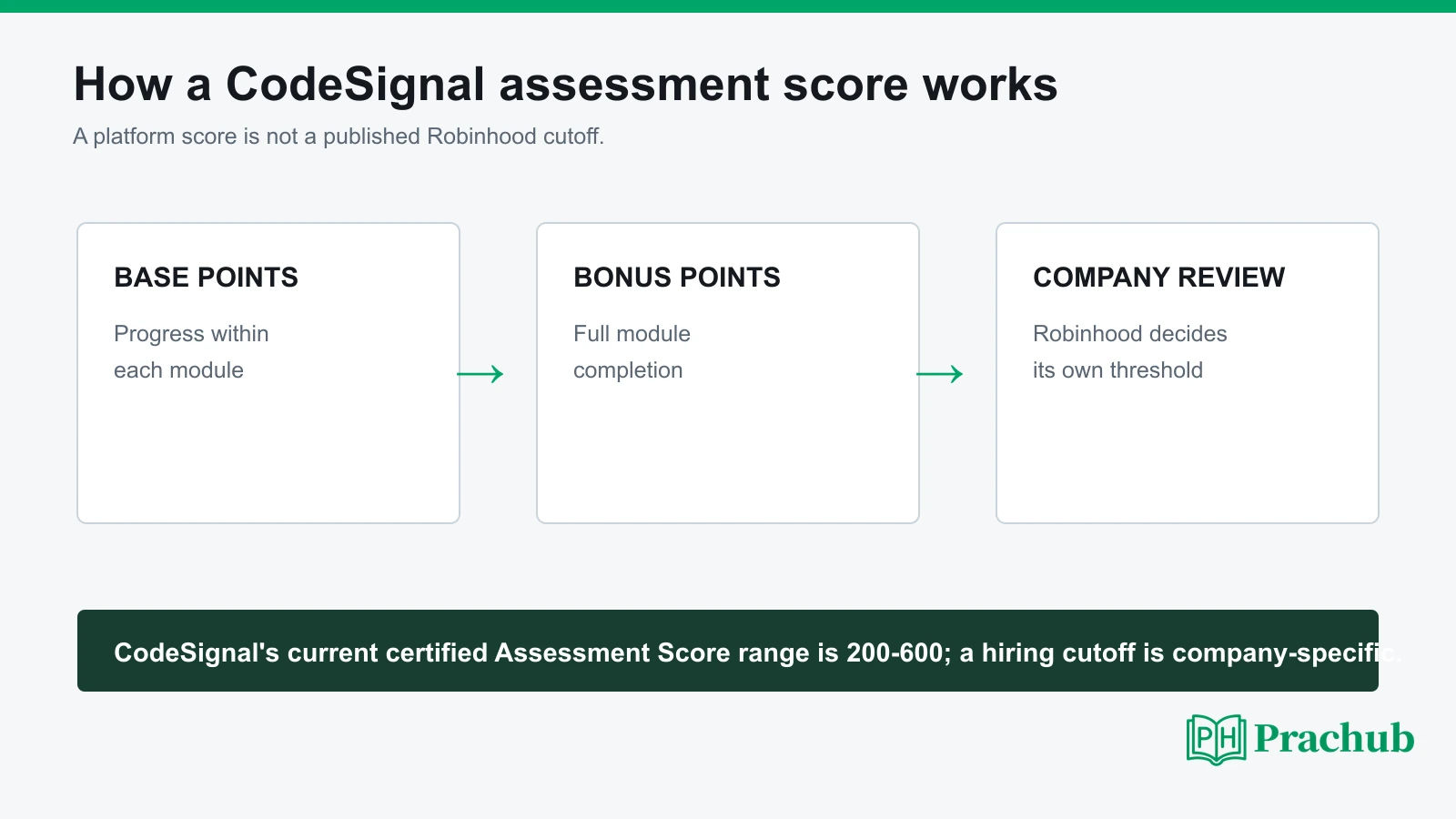
| What does a CodeSignal score mean? | For current certified assessments, CodeSignal documents an Assessment Score from 200 to 600, combining module progress with bonus points for complete modules. |
| What Robinhood score passes? | No public, universal Robinhood cutoff is available. A platform score range is not a company-specific hiring rule. |
| Can a prior score be shared? | CodeSignal says an eligible existing result may be shareable, but the invitation and employer rules decide whether that option appears. |
| What comes after the OA? | Keep preparing for a potential technical screen, project discussion, design, and behavioral rounds rather than waiting around for one score. |
That distinction is the heart of this guide. CodeSignal provides a measurement system; Robinhood owns the hiring decision. Your invitation, its deadline, and recruiter communication are more current than any old forum post or score anecdote.
What we know about Robinhood and CodeSignal
Robinhood is featured in a CodeSignal customer story stating that the company adopted CodeSignal's technical assessment and interview products in 2019. The story describes skills evaluation near the beginning of the interview process and live coding later in the funnel. It is credible evidence that the platforms have been used together, not an announcement of an identical 2027 intern OA for every candidate.
Candidate reports from different years also mention multiple environments for Robinhood roles, including CodeSignal and CoderPad. That is exactly why it is risky to memorize a four-question format or a single target score. Read your invitation first: it is the authoritative source for the platform, timing, allowed languages, verification steps, and whether an existing result can be reused.
How CodeSignal scoring works - and what it does not tell you
CodeSignal's current documentation says certified assessments produce an Assessment Score from 200 to 600. The score uses two tiers: base points reward progress within modules, while bonus points are associated with fully completing a module. It also gives candidates skill-area proficiency feedback, but CodeSignal says that feedback is developmental rather than a validated hiring decision on its own.
That mechanism explains why a score is more nuanced than “number of problems solved.” It does not reveal Robinhood's internal bar, the weight a recruiter gives the score, or how a particular team balances it against your resume, location, timing, experience, and later interviews.
Do not use old score scales as a current cutoff
Old discussions often cite scores such as 480, 820, or 850. They may refer to older CodeSignal scoring systems, a custom assessment, a different role, or a different year. CodeSignal now documents conversion from historical coding-score thresholds to the current 200-600 Assessment Score for certified assessments, which makes direct comparison especially unreliable.
The useful question is not “What number got someone through three years ago?” It is “Did I fully understand the invitation, solve as much of the assessment correctly as possible, and leave enough time to validate my code?” That is a preparation question you can actually control.
How to read a Robinhood OA invite without over-interpreting it
When the email arrives, make a small fact sheet before you open the editor. Record the role title, platform, deadline including time zone, total duration, number of attempts, allowed languages, whether a practice environment is available, and any identity or proctoring requirements. Those facts are more valuable than a speculative question list because they determine the simulation you should run before test day.
Then separate the message into three buckets. Confirmed: facts written in the invitation. Platform-level: documented CodeSignal behaviors such as its score model or share-result options. Unconfirmed: a Reddit score, an older candidate's format, or a claim about automatic advancement. This simple distinction keeps preparation practical and prevents a historical anecdote from becoming an imaginary rule.
If the invite includes an assessment link with a start window, do not click through while tired or between meetings. Check your device, network, editor settings, keyboard layout, and language choice beforehand. If the role permits a practice assessment, use it to learn the environment, not to try to predict Robinhood's exact questions. The best rehearsal is still a timed session where you must read, implement, test, and submit without external hints.
Should you share an existing CodeSignal result or retake?
CodeSignal says candidates invited to an assessment may have the option to share an eligible existing result or retake, subject to eligibility and cooldown rules. If you retake and earn a lower score, the requesting company receives the new result after validation; a previous score may still be visible if it was already shared with that same company. Those are platform mechanics, so use the exact options shown in your invite.
A practical decision rule: share an eligible result when it is recent, you understand what it measures, and the invitation explicitly offers sharing. Retake when the invitation requires it, your current score is not representative of your ability, or you have had time to improve the relevant skills. Do not assume a score can be reused simply because a friend reused theirs for another company.
What to practice for a Robinhood SWE OA
Robinhood's real question bank on PracHub is broader than an OA. It is still useful because it shows the practical shape of later SWE evaluation: implementation discipline, edge cases, API and security thinking, and clear ownership. Your first screen may only test coding, but preparing those skills now keeps the OA from becoming a dead end.
Timed implementation, not just pattern recognition
Spend most of your OA prep on arrays, strings, hash maps, sorting, two pointers, intervals, graphs, and careful parsing. The habit to build is writing a correct baseline, testing it against small adversarial inputs, then improving it only when constraints demand it. On CodeSignal, incomplete cleverness is usually less valuable than a fully working solution with good input handling.
Fintech-flavored correctness
Even in a general coding problem, practice saying what happens with duplicate events, failed writes, ordering, authorization, and stale data. Financial-product systems make correctness and auditability feel concrete. That mindset makes you better at both hidden tests and the follow-up discussion where an interviewer asks, “What could still go wrong?”
Practice with real Robinhood questions from PracHub
These are stored Robinhood question-bank records on PracHub. They are not predictions of the exact 2027 OA. Use them to expand from timed coding into the engineering judgment that may appear later in the Robinhood process.
| PracHub question | Stored round | Practice focus | Why it helps |
|---|---|---|---|
| Implement Calendar Layout and String Packing | Onsite | Intervals, strings, exact output | Builds the specification-reading and boundary discipline that hidden tests reward. |
| Design a Secure Trading App on AWS | Technical Screen | APIs, authorization, PII, auditability | Connects generic systems practice to realistic fintech trade-offs. |
| Present a Project With Correctness Guarantees | Onsite | Ownership, retries, idempotency | Prepares you to explain reliable engineering decisions after the coding stage. |
Run the first question as a 70-minute simulation. For the other two, practice a five-minute outline before speaking or writing. The aim is to get comfortable turning an answer into a coherent engineering story, not to guess the next prompt.
A better score strategy than chasing a cutoff
Read the whole assessment before rushing into Question 1
If multiple tasks are visible, scan the constraints and point structure first. Identify the task you can complete cleanly, but do not spend so long optimizing one hard problem that you miss available points elsewhere. If the platform unlocks levels or modules progressively, understand the rule before you allocate time.
Use small tests deliberately
Before a final run, create a test for empty input, one item, duplicate values, a boundary index or timestamp, and maximum-ish size. Check exact return type and output formatting. These five quick checks catch a remarkable number of “the algorithm was right” failures.
Keep the final minutes for submission quality
Do not spend the last minute on a broad rewrite. Remove debug output, re-read function signatures, and verify language-specific behavior around integers, mutable collections, and string parsing. The useful final question is: Does this code implement every explicit rule in the prompt?
What comes next after a Robinhood OA
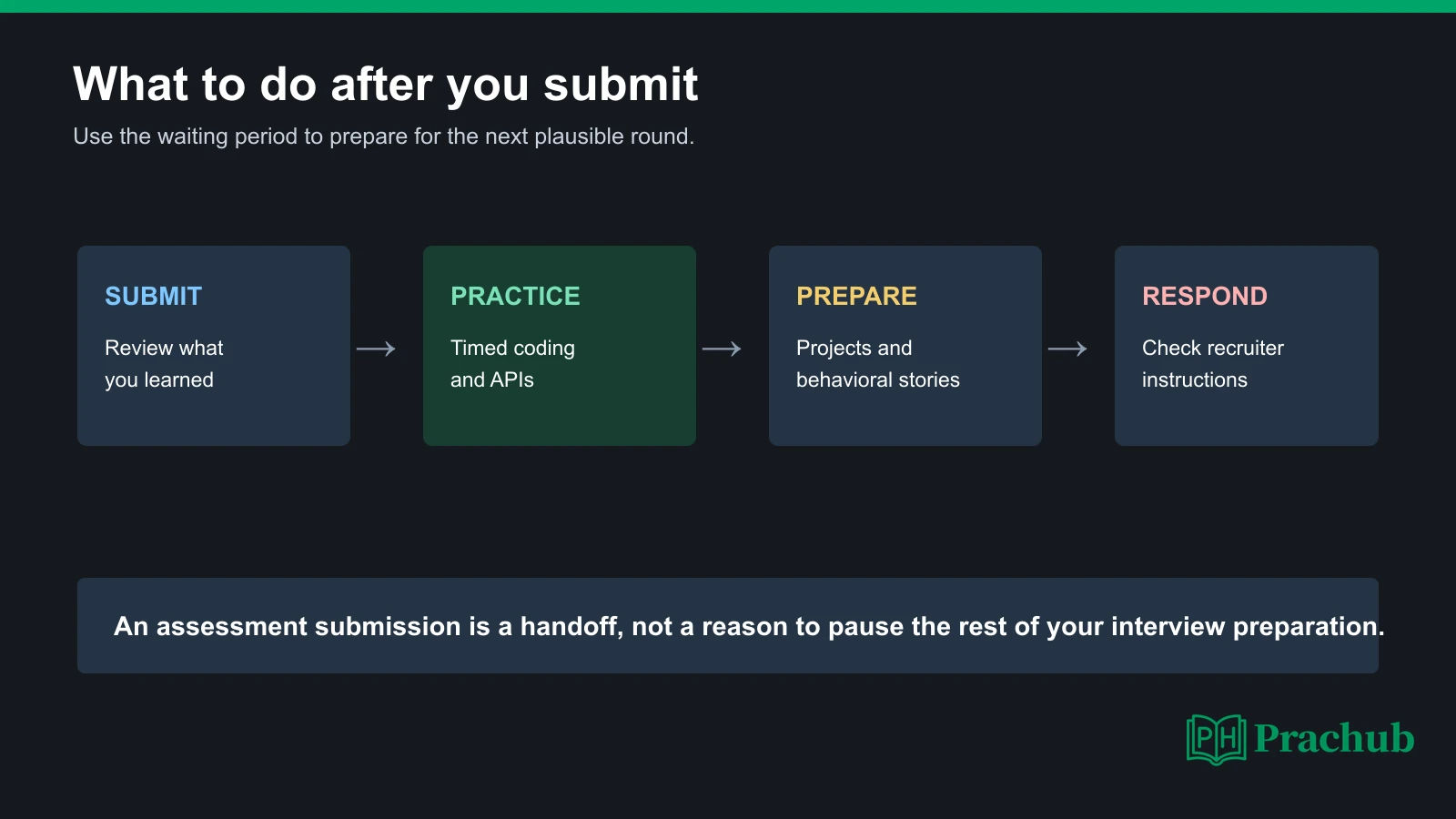
There is no public, universal post-OA calendar for Robinhood. A recruiter may contact you quickly, an application system may update later, or the role may not progress. Do not read silence as a score signal, and do not pause your broader search while you wait.
Use the waiting period to prepare the likely next surfaces: timed coding, a concise project walkthrough, and technical judgment in a product setting. Explore company-specific interview prep for target-company questions; use system design questions for API and reliability thinking; and build concrete examples through behavioral interview practice.
A seven-day preparation plan
Days 1-2: complete two timed coding sessions and make an error log with the bug, why it happened, and a new checklist item. Days 3-4: focus on strings, maps, intervals, and implementation-heavy tasks. Make a point of testing empty and duplicate cases before checking solutions.
Day 5: simulate a full CodeSignal-style session using the exact duration in your invitation. Day 6: revisit the errors from Days 1-5 and explain one real project in terms of constraints, trade-offs, and measurable impact. Day 7: keep it light: review your language template, interview logistics, and the instructions in your invite.
Frequently asked questions
Does Robinhood use CodeSignal for every SWE intern?
Robinhood has publicly used CodeSignal, but there is no public promise that every role and cycle uses the same platform or format. Your invitation is the current authority.
What Robinhood CodeSignal score is enough?
Robinhood does not publish a universal cutoff. CodeSignal's current 200-600 Assessment Score describes the platform's score range, not Robinhood's internal decision threshold.
Can I reuse a CodeSignal score?
Only if the invitation offers an eligible existing result. CodeSignal's reuse and retake behavior depends on assessment eligibility, cooldowns, and the requesting company's setup.
Final takeaway
Robinhood's use of CodeSignal is a useful preparation signal, not a license to obsess over an unverified cutoff. Prepare to complete real coding tasks accurately, understand the specific invite you receive, and keep building the skills needed after the OA. Start with real interview questions with written solutions, then use the review to turn every edge-case miss into a stronger next attempt.
Comments (0)