Airbnb CodeSignal Industry Coding Assessment 2027: Four Levels, 90 Minutes, Scoring, and What Comes Next
Quick Overview
Prepare for the Airbnb CodeSignal ICA with five Airbnb-tagged OA practice questions, a worked file-store example, and clearly sourced format, scoring, and follow-up guidance.
An Airbnb CodeSignal invitation can require a different kind of preparation from a standard algorithm screen: you may need to extend one working program through several rounds of requirements. Officially, CodeSignal's Industry Coding Assessment (ICA) contains one project with four progressive levels and a 90-minute maximum. Airbnb candidates have reported that format, but your invitation determines which assessment you will take. CodeSignal ICA rules
For candidates preparing for 2027, the evidence available when this guide was checked on September 21, 2026 comes from current platform documentation and 2026 candidate reports. It does not establish a universal Airbnb 2027 hiring process.
Start with the Airbnb Software Engineer questions on PracHub. The five Airbnb-tagged OA records below focus on evolving stateful programs, followed by a worked example showing how a later feature can break an earlier invariant.

What the Airbnb CodeSignal evidence actually supports
Candidate-reported: A Glassdoor review posted August 17, 2026, describing a July interview, mentions a task-management and scheduling exercise with four parts over 90 minutes. A separate August 5 review describes a four-level ICA involving cloud storage. These are anonymous accounts of particular experiences, not an Airbnb assessment specification. Airbnb Software Engineer interview reports
A July 22 commenter in an Airbnb interview discussion also reports completing a level's tests before advancing. That supports practicing incremental implementation, while leaving the exact unlocking behavior subject to the assessment you receive. Candidate discussion
Read the assessment name before choosing a practice format. CodeSignal's General Coding Assessment (GCA) is a different product: four questions in 70 minutes, available from the start. Advice about choosing which independent question to attempt first does not automatically fit an ICA project. Official GCA structure
If your invitation says only “CodeSignal,” check its assessment details or ask the recruiter to confirm the format. Do not infer the timer, permitted tools, or question structure from the platform name alone.
How the four progressive levels change your approach
A progressive assessment extends the same codebase as requirements grow. Earlier behavior becomes a compatibility constraint: a new operation may need more state, but existing commands must continue producing the required results.
CodeSignal's published Industry Coding framework moves from basic implementation and edge cases into data processing, advanced features, and a further extension. It emphasizes adapting existing code while preserving earlier functionality. These are capability categories, not promises that every Level 3 contains timestamps or every Level 4 contains account merging. Official Industry Coding framework
Preparation advice: Choose data structures that make the current contract explicit. For a file store, a record containing a name and size is easier to extend with ownership than several unrelated maps whose entries can drift apart. Add abstraction when it clarifies a requirement; predicting every possible future feature wastes time.
After an extension, rerun previous tests before adding more code. In supported progressive workspaces, CodeSignal's “Level changes” view shows files added, modified, or removed between levels. Inspect those changes instead of assuming the instructions and helper files stayed the same. Level-diff documentation
Five Airbnb practice questions worth starting with
Each linked PracHub record below is labeled Airbnb / Software Engineer / Online Assessment. That catalog attribution makes the selection relevant; it does not mean Airbnb guarantees these prompts or that the records reproduce your future assessment. The practice focus and checks below are editorial suggestions.
| Airbnb question on PracHub | Practice focus |
|---|---|
| Implement a Capacity-Aware In-Memory File Store | Quotas, naming, and rejected operations. |
| Design a Stateful Working Hours Register | Completed sessions and delayed promotions. |
| Implement a Time-Aware Banking System | Scheduled payments, merges, and historical balances. |
| Implement a Time-Aware Task Management System | Time boundaries and explicit state transitions. |
| Implement a Multi-Level Recipe Management Service | Search ordering and index consistency. |
Use a different correctness check for each domain. In the file store, a rejected resize must preserve usage and naming. In the working-hours register, a promotion must not rewrite completed work. In the banking system, inspect pending payments as well as balances after a merge. For the task manager, specify the state before and after each command. For recipes, verify that an edit updates every affected search result. These checks turn a company question list into a focused practice session.
Begin with the file store if you want a concrete capacity invariant. Choose the working-hours register next to practice historical state, then the banking system for interacting transitions. Recipe management is useful for deterministic outputs and index maintenance; the task manager provides another domain for checking whether your method transfers.
For working hours, separate an open session from completed sessions. For banking, distinguish an account's current balance from its historical balance and pending payments. Those distinctions prevent later requirements from forcing you to reconstruct information you already discarded.
Open each record and follow its actual contract. A question's company label is useful context, but copying a remembered rule from another banking or storage problem can still produce the wrong answer.
A worked file-store drill: protect the capacity invariant
The following is an original practice example, inspired by the skills in the Airbnb file-store record. Its numbers, operation sequence, and simplified rules are illustrative, not a reported Airbnb prompt.
Define a user with capacity 100 units. Files belong to that user; usage equals the sum of their stored sizes. Compression halves a file's size and adds a compressed-name suffix. Decompression restores its original size and name, provided the operation fits within capacity and causes no name collision.
| Operation | Expected result | Usage afterward |
|---|---|---|
Add notes with size 60 | Succeeds | 60 |
Compress notes to size 30 | Succeeds; stored name changes | 30 |
Add photo with size 50 | Succeeds | 80 |
Decompress notes back to size 60 | Reject: the resulting usage would be 110 | 80 |
After the rejection, the compressed file must still have size 30 and retain its compressed name. A solution that increments usage, renames the file, and only then checks capacity leaves partially changed state behind. Returning “failure” does not repair that state.
One safe implementation pattern is to calculate the proposed state first:
proposed_usage = current_usage - stored_size + restored_size
validate capacity and destination-name availability
if either check fails: return failure without mutation
otherwise: commit name, size, and usage together
Now add a regression check: looking up photo must still return 50 after the rejected decompression. Then attempt a valid smaller operation. This catches implementations that return the expected error while quietly damaging a counter or index.
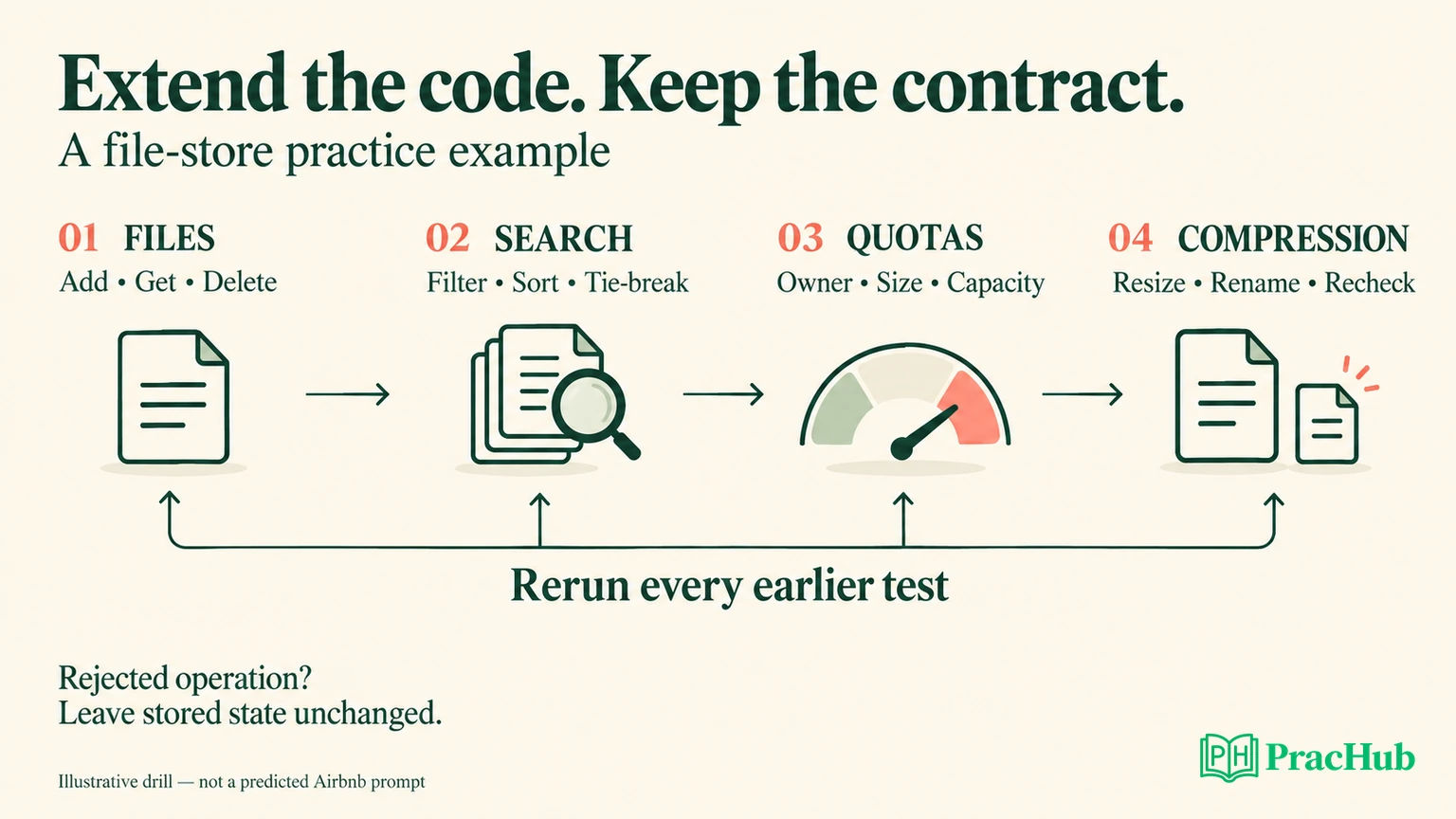
A second useful drill is deterministic search. Create two equally sized files, give them names in the opposite order from insertion, and apply the prompt's tie-break rule. Repeat after compression changes one size. This tests both ordering and whether search reads current data.
The lesson is specific: once file size affects capacity, search, and compression, one mutation has several observable consequences. Test those consequences together rather than writing isolated happy-path tests for each method.
Rehearse the assessment as one changing program
Editorial recommendation: During a practice session, reveal requirements in stages. Implement basic operations first, then add search, quotas, and compression. Keep the same program and test suite throughout. This is a rehearsal design, not an official sequence of Airbnb levels.
Before coding each stage, identify its input contract, return values, invalid-operation behavior, and ordering rules. Write one successful case and one rejected case with expected state afterward. For a timestamped problem, establish whether an event at time t occurs before or after a scheduled action also due at t.
Use small helpers around decisions that recur: resolving an object, checking capacity, comparing sort keys, or applying due events. Avoid spreading the same rule across several handlers. When a requirement changes, you want one place to inspect and a short regression test that proves the effect.
Use the advertised duration for your mock, but do not assign an equal block to every level. Record how long reading, implementation, and debugging actually take you. If the first two stages consume most of the session, simplify the model before practicing another difficult extension.
A useful debrief names the failure precisely: “I updated current pay and lost historical rates” or “my rejected decompression changed the file name.” That gives the next practice session a target. “I need to code faster” does not.
When a test fails, reduce the command sequence until you can explain the mismatch by hand. In the file-store drill, adding, compressing, adding again, and decompressing is enough to expose the capacity bug. A hundred random operations can obscure it. Keep the reduced sequence as a regression test, then restore the larger test suite.
Finally, review complexity against the stated constraints. Scanning all files may be acceptable for a small exercise; repeatedly sorting a growing collection across many commands may require a different index. Make that decision from the supplied limits and required ordering. Adding a sophisticated index before understanding updates creates another structure you must keep correct.
How to interpret the ICA score
Official: CodeSignal lists an ICA Coding Score range of 200–600 and associates higher scores with more completed assessment work. It also says candidates are not necessarily expected to complete everything within the allotted time. ICA scoring and rules
That description does not establish an Airbnb pass mark or equal points per level. We did not find a public Airbnb cutoff that applies across roles and recruiting cycles. Treat claims such as “500 guarantees the next round” as unsupported unless your recruiter explicitly supplies that rule.
For preparation, track completed requirements and regression failures alongside the score. If an extension breaks working behavior, investigate the shared state or helper it changed before adding more features. This is an engineering strategy, not a claim about hidden scoring weights.
CodeSignal explains where certified assessment results appear in your account. Its documentation also distinguishes custom assessments whose hiring company may choose not to expose the score. A missing score therefore requires checking the assessment type, not guessing an outcome. Finding your assessment result
Before starting: setup and permitted tools
Check the deadline, assessment name, supported language, and rules in your invitation. Use the platform's practice environment to become comfortable with running tests and navigating files before the real attempt.
Official: Some CodeSignal assessments require identity verification and access to your camera, microphone, and screen. The platform indicates whether proctoring is required before the assessment. Prepare the requested identification and equipment, and follow the rules shown for that attempt. CodeSignal proctoring
Do not assume an external editor, AI assistant, or online reference is permitted because you used it during practice. If a setup problem prevents you from proceeding, report the specific error through the platform or recruiter rather than repeatedly starting new attempts.
What comes next after submission?
Separate three events: submitting work, verification, and Airbnb's hiring decision. Official: CodeSignal describes a typical one-to-three-business-day verification process for proctored assessments. That is a platform review window, not a promise that an Airbnb recruiter will contact you within three days. Proctored assessment timeline
Save the submission confirmation and check any visible status. If the recruiter's stated response window passes, a focused follow-up can ask whether the result was received and what the next step is. A score alone cannot identify the next interview format.
For your own debrief, record the data model, a tricky boundary, and a change you would make with more time. Keep that separate from any confidential assessment content. If a later interview asks about your reasoning, explain the decisions you actually made.
For your next practice session, choose one problem from the Airbnb Software Engineer question collection, implement it before reading the solution, and add a test proving that a rejected operation preserves state. That exercise directly targets the challenge of extending a working program under a timer.
Sources and Further Reading
- CodeSignal: Industry Coding Assessment rules and scoring
- CodeSignal: Industry Coding Skills Evaluation Framework
- CodeSignal: General Coding Assessment structure
- Glassdoor: Airbnb Software Engineer candidate reports
- Reddit: Airbnb interview discussion with July 2026 candidate comments
- CodeSignal: Viewing changes between question levels
- CodeSignal: Finding your assessment result
- CodeSignal: Proctoring requirements
- CodeSignal: Proctored assessment verification timeline
Researched and revised September 21, 2026. Candidate experiences vary by role, location, and hiring cycle; follow your own invitation.
Comments (0)