Amazon SDE Intern OA 2027: Coding, MERN Debugging, Work Style, and What Comes Next
Quick Overview
A current, evidence-based guide to the Amazon SDE Intern OA 2027, covering coding, MERN or multi-framework repository debugging, Work Style, format variations, preparation, and next steps.
You open the Amazon SDE Intern assessment expecting two isolated algorithm problems. Instead, the first task looks familiar, the second drops you into an existing web repository, and the final section asks how you would respond to ambiguous workplace situations.
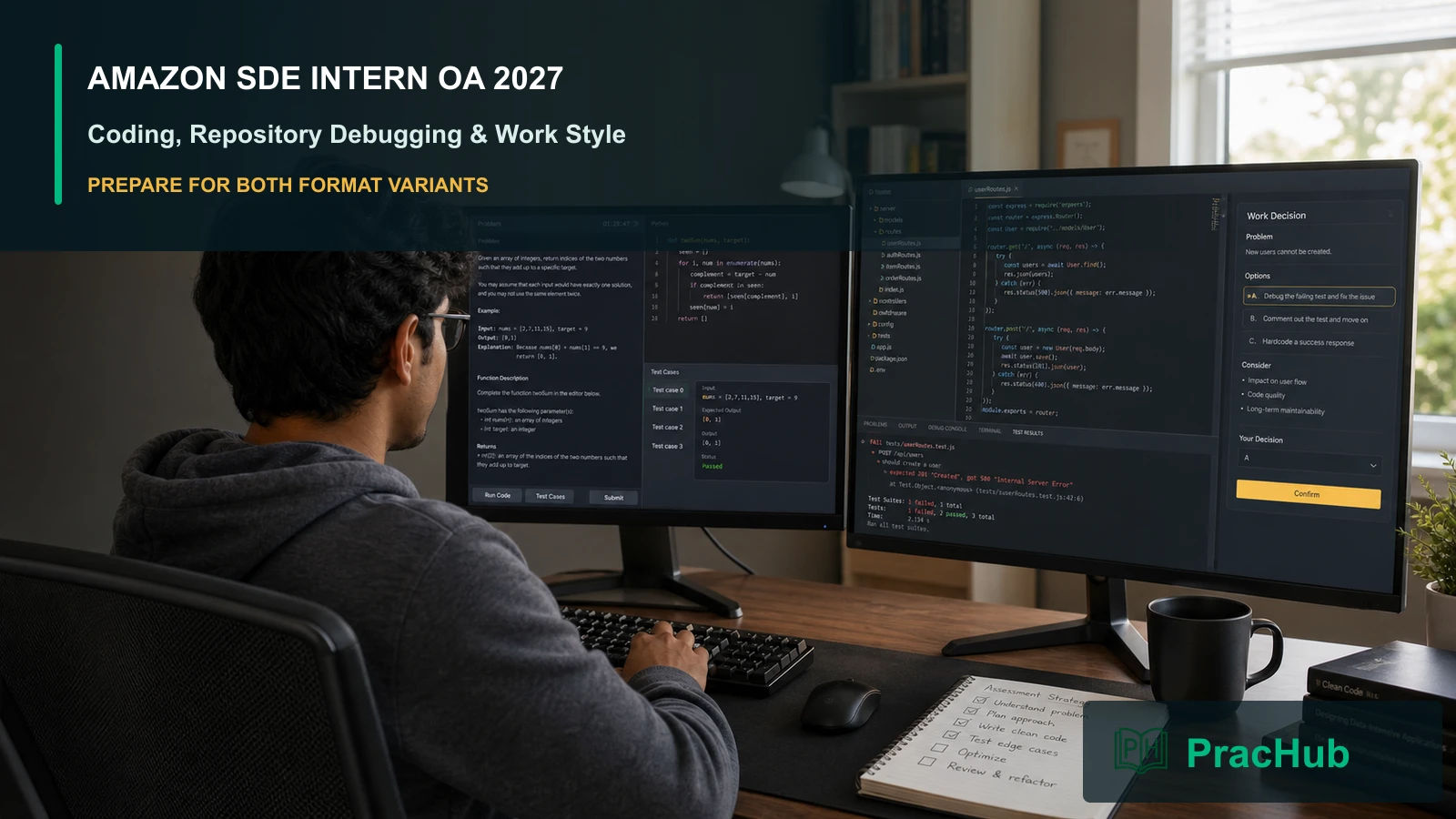
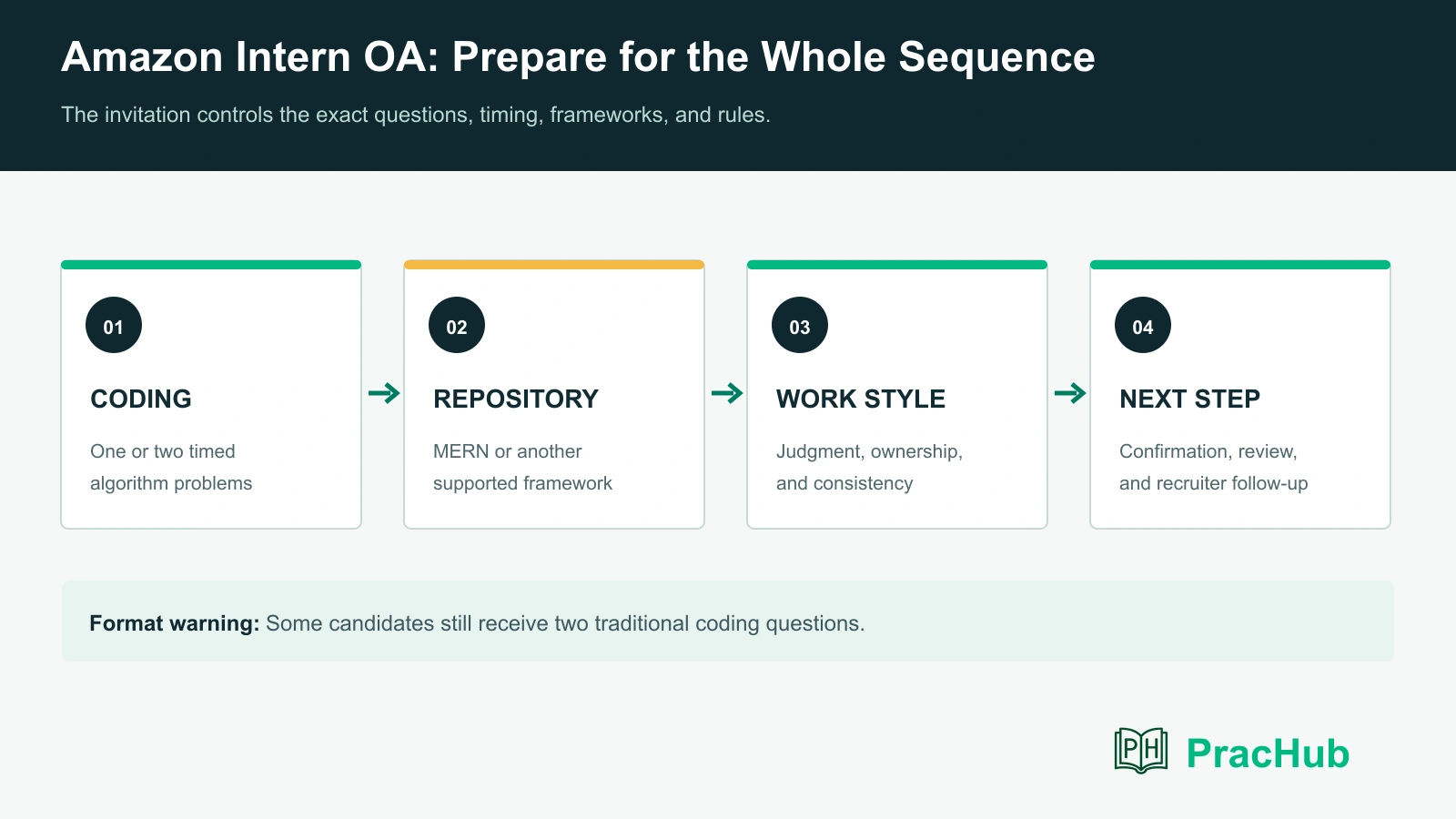
That combination is showing up in current Amazon SDE Intern 2027 candidate reports: traditional coding, an AI-assisted repository task that may use MERN or another framework, and a Work Style or work-simulation component. But there is an important catch: not every candidate receives the same version.
Start with Amazon Software Engineer questions to practice company-specific coding and behavioral signals. Then use this guide to prepare for both the repository-based format and the two-traditional-question variant without overfitting to one Reddit post.
Quick verdict
Prepare for three skills, not one rumored sequence: timed algorithmic coding, safe changes inside an unfamiliar repository, and consistent judgment in Work Style scenarios. Your invitation email is the authority because Amazon can vary the assessment by role, location, platform, and recruiting cycle.
Amazon's official university SDE OA page describes an internship assessment of roughly 90 minutes: an average 70-minute Coding Assessment, a 15-minute Workstyles Assessment, and a short feedback survey. Recent candidates, however, report technical variants such as one traditional problem followed by a 60-minute repository task. One report mentioned MERN; another candidate chose Spring Boot; and another received two traditional coding questions instead.
| What we know | Evidence | How to prepare |
|---|---|---|
| Coding and Workstyles are part of Amazon's university SDE OA | Amazon's official candidate guidance | Budget preparation across technical execution and judgment. |
| Some 2027 intern candidates report one coding problem plus repository debugging | Recent candidate reports | Practice navigating and testing an unfamiliar application. |
| MERN is one reported framework, not a universal requirement | Candidate-specific experience | Review your strongest supported stack and follow your invitation. |
| Some candidates still receive two traditional coding questions | Recent format-variation report | Do not abandon balanced DSA preparation. |
What may be in the Amazon SDE Intern OA 2027?
Think of the current assessment as a family of related formats rather than a single guaranteed template. Amazon publishes the broad categories; the invitation and assessment platform define your actual sequence, time limits, resources, and rules.
| Part | What it can look like | Main signal |
|---|---|---|
| Traditional coding | One or two timed data-structure and algorithm problems | Correctness, complexity, edge cases, and implementation speed |
| Repository debugging | Read an existing web app, fix bugs or add a small feature, and pass tests | Code navigation, diagnosis, testing, and change discipline |
| Work Simulation | Choose or rank responses to realistic engineering situations | Prioritization, communication, ownership, and customer judgment |
| Workstyles Assessment | Indicate which statements best describe how you work | Consistency with your actual decision-making preferences |
| Feedback survey | A short experience survey after the scored sections | Usually administrative rather than technical |
Why current reports disagree
Assessment content can change while a recruiting cycle is active. Teams may also use different configurations, and a platform can route candidates to different question sets. An August 2026 candidate described one 40-minute algorithm task and one 60-minute repository task, while another candidate reported receiving two traditional questions despite an invitation that referenced AI-assisted coding.
The practical conclusion is simple: train for both paths. If the repository task appears, you will not waste time learning the interface. If it does not, you still have enough DSA coverage to handle a conventional second problem.
How to prepare for the coding section
Do not build your study plan around one leaked problem. A current report calling a question "LeetCode medium" tells you more about expected fluency than exact content. Review arrays, strings, hash maps, sorting, intervals, stacks, queues, trees, graphs, and basic dynamic programming.
For each timed problem, write down the contract before coding: input range, duplicates, empty cases, ordering, mutation rules, and expected complexity. Produce a correct baseline, test it on a tiny example, then add the boundary cases most likely to appear in hidden tests.
A better 40-minute routine
Use the first five minutes to restate the problem and choose a data structure. Spend the next twenty-five minutes implementing the simplest correct approach that meets the constraints. Reserve the final ten minutes for dry runs, overflow or indexing checks, and cleanup.
If you are stuck, do not silently rewrite the solution three times. Reduce the problem to a smaller example, identify the invariant, and ask what information must be retained at each step. That reasoning habit transfers directly to the repository task.
What the MERN repository task actually tests
A MERN task is not primarily a React trivia quiz. It tests whether you can understand the path from an incoming request through Express routing, controller or service logic, MongoDB persistence, and the returned response. The defect may sit in any layer, including tests or validation.
One current report described a basic MERN debugging task; another candidate said several full-stack frameworks were available. A separate report described choosing Spring Boot for a backend repository. Treat MERN as one implementation option, not proof that every intern must master the entire JavaScript ecosystem.
For a deeper walkthrough of prompting, logs, minimal patches, and hidden tests, use the existing Amazon AI-assisted coding OA guide. This article focuses on how that task fits into the wider 2027 intern process.
A disciplined debugging sequence
- Read the task and repository instructions. Identify the required behavior, test command, and files you are expected to touch.
- Reproduce the failure. Run the narrowest relevant test or request before making changes.
- Trace one path end to end. Follow route, middleware, controller, service, model, and response.
- State a hypothesis. Explain which assumption is broken and what evidence would confirm it.
- Make the smallest coherent patch. Avoid unrelated refactors that increase the review surface.
- Test beyond the happy path. Cover missing fields, duplicates, authorization, invalid identifiers, and partial failures.
- Review the final diff. Remove debug output and confirm the patch matches local conventions.
How to use AI without losing control of the solution
If the assessment provides an approved AI assistant, use it to accelerate comprehension, not to outsource judgment. Good prompts are bounded: ask for the request path, likely failing assumptions, or a test matrix for one function. Then verify every suggestion against the repository and task statement.
A weak prompt says, "Fix the app." A stronger prompt says, "Trace POST /orders from the route to persistence, identify where invalid quantities should be rejected, and list the smallest files that may require changes. Do not edit code yet." The second prompt creates an inspectable plan and reduces accidental scope.
Never assume the assistant understands hidden tests or Amazon's intended contract. You own the final code, and the assessment may log browser activity or restrict resources. Follow the rules shown in your invitation and on the platform rather than copying behavior from someone else's assessment.
How to approach Work Simulation and Work Style
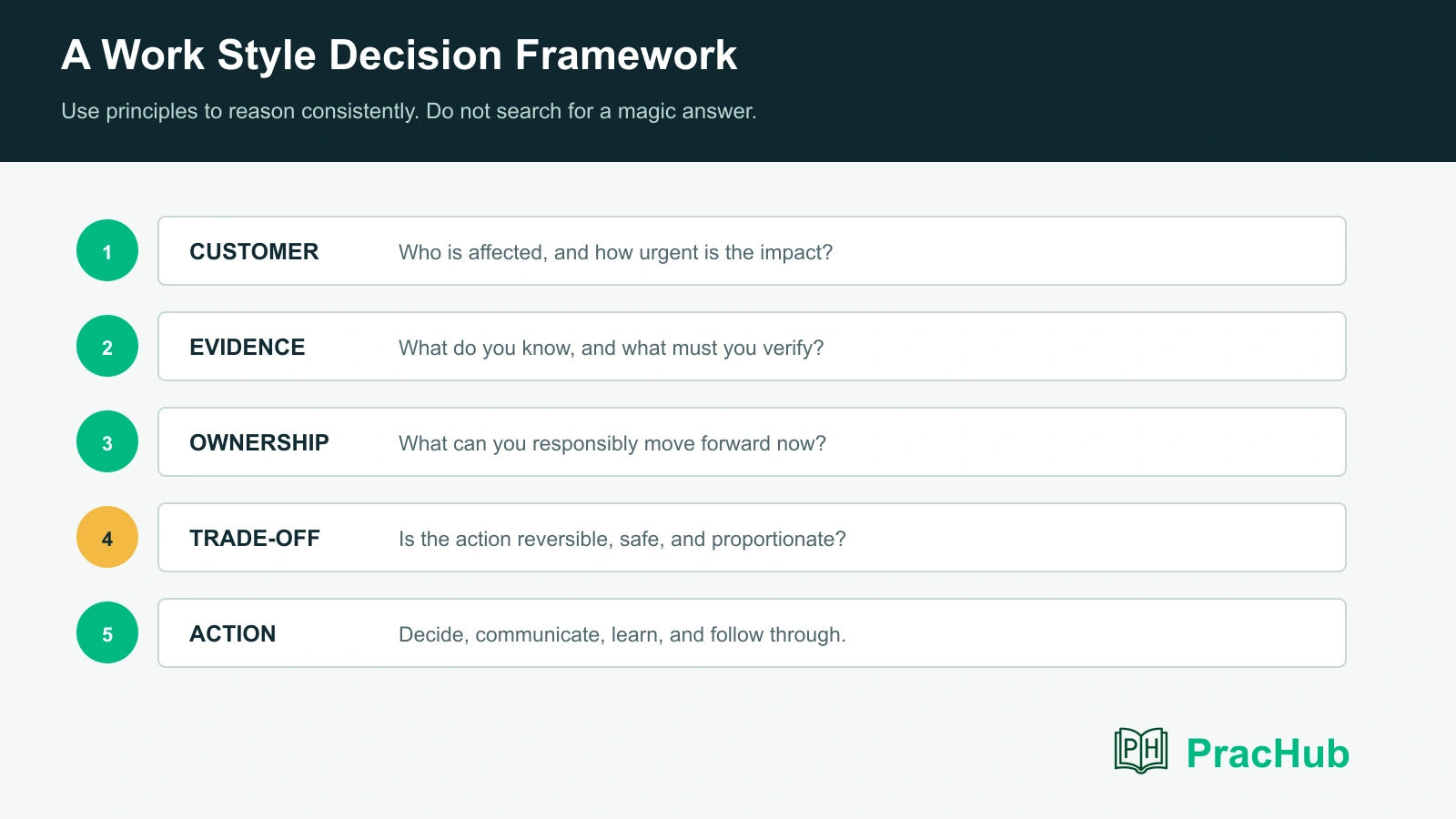
The Work Style section is not a trivia test with a list of magic phrases. Amazon says its Leadership Principles guide daily decisions, so reviewing those principles helps you understand the trade-offs behind the scenarios. The goal is to answer consistently, not to select whichever option sounds most dramatic.
In work-simulation questions, first identify the customer or business impact. Then determine what evidence you have, what remains uncertain, which action is reversible, and who needs to be informed. Strong responses usually combine ownership with appropriate collaboration instead of either escalating everything or acting alone.
Use Leadership Principles as a decision lens
| Situation | Useful principle lens | What a strong response shows |
|---|---|---|
| A defect affects users before a deadline | Customer Obsession, Bias for Action | Contain impact, communicate clearly, and choose a reversible next step. |
| You disagree with a technical direction | Have Backbone; Disagree and Commit | Use evidence, raise the concern respectfully, then support the decision. |
| You caused a mistake | Ownership, Earn Trust | State the impact, fix it, and improve the process without deflecting blame. |
| Requirements are incomplete | Dive Deep, Invent and Simplify | Clarify the highest-risk assumption and make progress with explicit trade-offs. |
For additional story practice, use PracHub's Behavioral and Leadership questions. Prepare examples from projects, classes, internships, clubs, or part-time work; intern-level scope is fine when the reasoning is specific.
Practice with Amazon questions from PracHub
These question-bank records are useful practice, not predictions of your exact 2027 assessment. The table intentionally mixes coding, AI validation, ownership, and customer judgment because the current OA evaluates more than algorithm recall.
| PracHub question | Practice focus | Why it helps |
|---|---|---|
| Find the Most Frequently Used Meeting Room | Intervals, heaps, state tracking | Trains careful implementation and tie-breaking under time pressure. |
| Validate AI-Generated Code Safely | AI-assisted engineering judgment | Builds a repeatable verification process for generated changes. |
| Explain Conflict, Ownership, and AI Use | Ownership and behavioral evidence | Connects technical decisions to Amazon-style follow-up questions. |
| Discuss Feedback, User Needs, Influence, Deadlines, and Learning | Customer judgment and collaboration | Strengthens concise stories across several Work Style themes. |
A seven-day preparation plan
| Day | Focus | What to do |
|---|---|---|
| Day 1 | Format check | Read your invitation, list the stated sections and rules, then complete one timed coding diagnostic. |
| Day 2 | Core coding | Practice arrays, hash maps, sorting, and intervals; review every failed edge case. |
| Day 3 | Trees and graphs | Complete two traversal problems and explain complexity before submitting. |
| Day 4 | Repository navigation | Clone a small app, map one request path, run tests, and fix one seeded defect. |
| Day 5 | Framework refresh | Review routes, validation, persistence, error handling, and test commands in your strongest supported stack. |
| Day 6 | Work Style | Review Amazon's Leadership Principles and practice five concise scenario decisions plus three STAR stories. |
| Day 7 | Full simulation | Run one coding task, one repository patch, and a short judgment set; finish by checking logistics. |
What happens after you submit?
Confirm that the platform displays a completion page. Amazon's official guidance says candidates completing a two-part assessment should receive a completion email within 24 hours; contact the recruiter if it does not arrive. Save the invitation, deadline, and completion confirmation.
Passing every visible test is valuable, but it is not an automatic interview guarantee. Recruiters may still consider hidden-test performance, code quality, Work Style responses, eligibility, role capacity, and resume fit. Current candidate reports show follow-ups ranging from interest forms to interview scheduling, while others wait longer.
Keep applying while you wait. Check spam and the candidate portal, but avoid reading meaning into every status change. If the recruiter provided a contact window, follow that instruction; otherwise, a brief, professional follow-up after a reasonable interval is enough.
Frequently asked questions
Does every Amazon SDE Intern 2027 OA include MERN debugging?
No. MERN appears in current candidate reports, but other candidates mention Spring Boot or several framework choices, and at least one candidate received two traditional coding problems. Prepare for repository work, then follow the exact invitation you receive.
How many coding questions are in the Amazon intern OA?
The technical section can vary. Recent reports include one traditional coding question plus one repository task, as well as two traditional questions. Amazon's official page publishes average section timing rather than promising one fixed question count.
Is the Amazon Work Style Assessment timed?
Amazon's official university page lists an average of about 15 minutes for Workstyles. Candidate reports sometimes describe Work Simulation or Work Style sections without a visible time limit. Trust the timer and instructions in your own assessment.
Can I use outside resources or AI?
Use only resources explicitly permitted by your invitation and assessment instructions. Amazon's candidate guidance says browser activity may be logged and restricts certain actions and private resources. An AI tool being present inside one assessment does not authorize external assistants in another.
Do all passing test cases lead to an interview?
No. Test results are one signal. Amazon may also evaluate hidden tests, implementation quality, Work Style results, resume fit, eligibility, and hiring capacity.
Final takeaway
The best Amazon SDE Intern OA 2027 strategy is not to guess whether you will receive MERN. It is to become competent in both assessment modes: solve one bounded algorithm problem cleanly, then enter an unfamiliar repository, trace the behavior, make a small patch, and prove it with tests.
Use Amazon Software Engineer questions to turn that plan into company-specific practice. Pair coding drills with AI-validation and behavioral questions, then simulate the exact sequence listed in your invitation. That gives you preparation that survives format changes instead of depending on one reported screen.
Sources and evidence notes
| Source | What it supports |
|---|---|
| Amazon University SDE Online Assessment | Official section names, average timing, completion, and assessment guidance. |
| Amazon Software Development Topics | Official emphasis on coding and applying computer-science fundamentals. |
| Amazon Leadership Principles | Official decision principles used in Amazon's work. |
| HackerRank Code Repository Questions | Platform capability for bug fixes, feature work, repository changes, and tests. |
| August 2026 candidate discussion | Reported coding, MERN debugging, and Work Style sequence. |
| Current Amazon intern OA discussion | Reported 40-minute coding and 60-minute repository variants. |
| Format-variation report | Evidence that some candidates still receive two traditional coding questions. |
Comments (0)