Amazon AI-Assisted Coding OA Guide 2026: Repository Bugs, AI Prompts, and Hidden Tests
Quick Overview
Amazon AI-Assisted Coding OA Guide 2026: Repository Bugs, AI Prompts, and Hidden Tests now pairs its existing format and process guidance with a clearly sourced PracHub practice set. The added section shows each question's actual company, stored round, difficulty, prompt shape, and a timed workflow without claiming guaranteed assessment reuse.
An unfamiliar repository is open, several tests are failing, and an AI assistant is waiting for instructions. The hard part is not asking AI to "fix the code." It is understanding the system well enough to decide what to ask, whether the answer is correct, and what the hidden tests may still expose.
That is the emerging challenge described in multiple 2026 Amazon candidate reports. Amazon has not published one universal AI-assisted OA format, so this guide separates official guidance from reported experiences and gives you a preparation method that remains useful when the exact timer, repository, or number of bugs changes.
Start with PracHub's real Amazon interview questions, especially the current software engineering fundamentals and coding reports. Then use the workflow below to turn those questions into repository-level debugging practice.
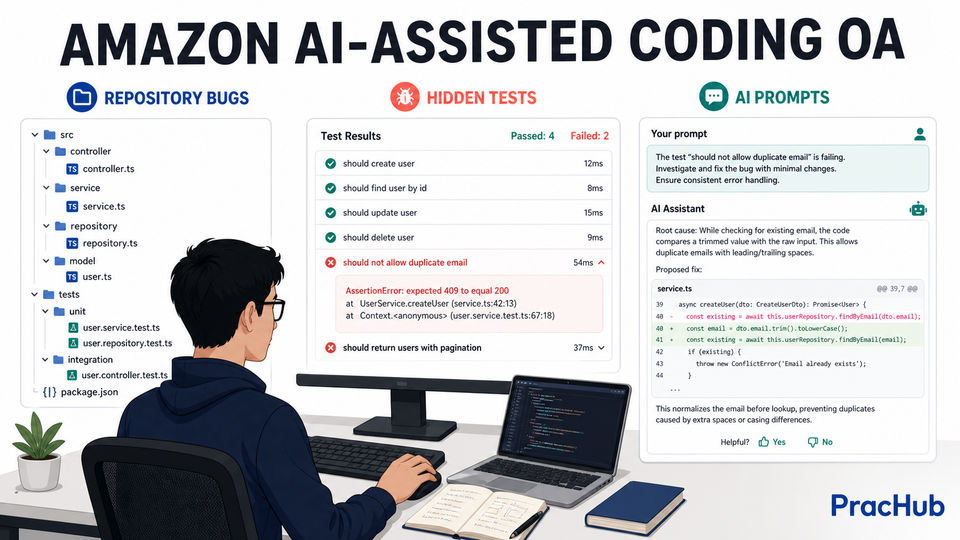
The strongest candidate stays in control of the diagnosis, the generated diff, and the final evidence.
Quick Verdict
Treat the Amazon AI-assisted coding task as a debugging assessment with an AI tool, not a prompt-writing contest. Recent candidate reports describe an unfamiliar codebase, broken behaviors, an embedded assistant, and visible or hidden tests. The exact structure appears to vary by role and location.
Your best loop is: reproduce the failure, trace the code path, form a hypothesis, ask one bounded question, inspect the diff, run tests, and verify the contract yourself.
Use only tools that the assessment explicitly provides or permits. Amazon's current university OA guidance says browser activity may be logged and warns candidates against copy-paste behavior; the instructions in your invitation and test environment are the final authority.
What Is the Amazon AI-Assisted Coding OA?
Amazon's official SDE assessment pages still describe role-dependent coding assessments and tell candidates to check their invitation for the exact structure. The university page says formats can differ by country, while the SDE II page describes a more traditional two-question coding challenge.
Separately, multiple 2026 candidate reports describe a newer repository task with a built-in AI assistant. Reports commonly mention fixing several bugs in an existing application and passing a test suite. Some candidates received a traditional algorithm question plus the repository task; others reported different sequencing, timers, and test counts.
| Evidence level | What it supports | What it does not prove |
|---|---|---|
| Amazon official guidance | The OA is role-dependent; coding, problem solving, and robust, tested code matter | A universal AI-repository format, timer, or passing score |
| Multiple 2026 candidate reports | Some SDE candidates are receiving AI-assisted repository debugging tasks | That every team, country, or level uses the same version |
| Your invitation and assessment UI | Your sections, time limits, allowed resources, and integrity rules | How another candidate's assessment was configured |
Practical conclusion: prepare for the reported repository format, but do not memorize one candidate's numbers. Read your invitation as the test specification.
How It Differs From a Traditional DSA Question
A normal coding question gives you a compact contract and asks you to design an algorithm. A repository task gives you a partially working system and asks you to recover the contract before making a safe change.
| Dimension | Traditional DSA task | AI-assisted repository task |
|---|---|---|
| Starting point | Function signature and constraints | README, project tree, tests, and existing code |
| Main challenge | Choose and implement an algorithm | Locate the failing path and repair behavior without regressions |
| Context | Usually one file | Controllers, services, models, repositories, configuration, and tests |
| AI role | Often absent | May help inspect or edit code, subject to the assessment rules |
| Proof | Complexity plus test cases | Reproduction, focused diff, passing tests, and contract reasoning |
Do not abandon algorithms. Candidate reports suggest the new task can appear alongside conventional coding, and later Amazon interviews still test coding fundamentals. Use PracHub's Amazon Software Engineer coding questions to keep that lane active.
What the Task Is Likely Measuring
Amazon has not published a scoring rubric for this reported format. Based on the task design, official emphasis on robust and well-tested code, and repeated candidate descriptions, the following skills are reasonable preparation targets rather than confirmed score weights.
| Likely signal | What strong work looks like |
|---|---|
| Repository navigation | You identify the relevant entry point and trace the data flow before editing |
| Debugging judgment | You use failures and requirements to form a testable hypothesis |
| AI direction | Your prompts are narrow, evidence-rich, and constrained |
| Code review | You inspect every generated change and reject unnecessary scope |
| Verification | You run focused tests, then the broader suite, and add edge cases mentally or in code |
| Ownership | You can explain why the patch satisfies the contract without blaming or trusting the tool |
The common thread is engineering control. AI may accelerate exploration, but you still own the diagnosis and the submitted code.
The Seven-Step Repository Debugging Loop
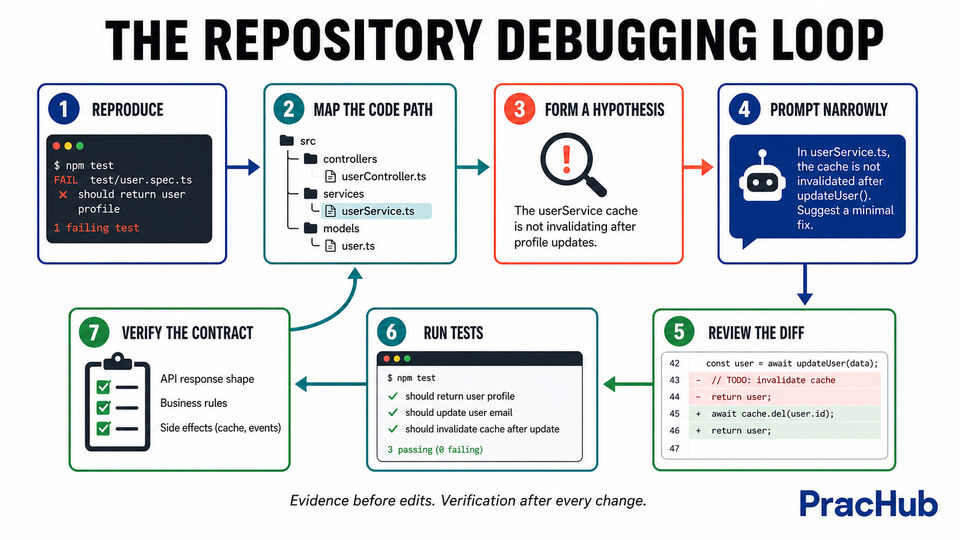
Keep each cycle small enough that you can connect evidence, change, and result.
1. Read the Contract Before the Implementation
Scan the task description, README, test commands, project structure, and visible tests. Write down the expected behavior in one sentence. A failing test is evidence; it is not always the complete requirement.
2. Reproduce One Failure
Run the smallest relevant test or action. Capture the exact assertion, exception, status code, or state mismatch. If everything is failing, choose one representative path instead of asking the assistant to repair the entire repository.
3. Trace the Execution Path
Follow the request or function call from entry point to data access. Search for the failing symbol, related model fields, and neighboring tests. Sketch a short path such as route -> controller -> service -> repository.
4. State a Hypothesis
Write what you think is wrong and what observation would disprove it. This prevents random edits and gives the AI assistant a bounded investigation.
5. Prompt for One Job
Ask the assistant to inspect a specific path, explain a condition, or propose the smallest patch. Include the requirement, observed failure, relevant files, and constraints. Do not ask it to change tests merely to make them green.
6. Review the Diff
Check every changed line. Look for altered public behavior, swallowed errors, duplicated logic, unrelated refactors, invented APIs, or broad exception handling. Revert anything you cannot defend.
7. Verify Narrowly, Then Broadly
Re-run the original failure first. Then run the surrounding tests and, if time permits, the full suite. Finally, test one boundary that was not visible in the samples.
For more practice with this exact mode of thinking, use PracHub's existing codebase interview guide.
How to Write Better AI Prompts
A useful prompt reduces uncertainty without surrendering judgment. A weak prompt hides your reasoning and invites a large, hard-to-review patch.
| Weak prompt | Better prompt | Why it is better |
|---|---|---|
| "Fix this repository." | "The reset-password test expects an expired token to be rejected. Trace the validation path and identify the smallest likely defect. Explain before editing." | Names the behavior, evidence, scope, and requested action |
| "Why do tests fail?" | "Test fundLoan_rejectsOverfunding fails with an updated balance. Inspect only the service and repository calls involved and list two hypotheses." | Directs investigation without assuming the answer |
| "Make all tests pass." | "Propose a minimal patch for the confirmed boundary bug. Do not edit tests or public interfaces. Show the diff and name the edge cases it covers." | Constrains scope and makes review possible |
A repeatable prompt format is context + expected behavior + observed evidence + scope + requested action + constraints. After the response, inspect the code yourself. A polished explanation is not proof.
Worked Example: A Bug the AI Can Easily Misdiagnose
Imagine a service that funds a loan. The visible test checks a normal transfer, but a hidden test may try a zero amount, an amount above the remaining loan balance, or a write that succeeds for one record and fails for the other.
async function fundLoan(userId: string, loanId: string, amount: number) {
  const user = await users.find(userId);
  const loan = await loans.find(loanId);

  if (user.balance < amount) throw new Error("insufficient balance");

  user.balance -= amount;
  loan.funded += amount;
  await users.save(user);
  await loans.save(loan);
}
The obvious check is present, but the contract is incomplete. A strong candidate asks: Can amount be zero or negative? Can funding exceed the loan's remaining amount? What happens when either entity is missing? Must the two writes be atomic?
A bounded prompt might be: "The funding service passes the happy path but the contract requires a positive amount, no overfunding, and no partial state update. Inspect this method and its repository API. Propose the smallest change that enforces those invariants without changing tests."
Then verify the proposed patch against amount = 0, a negative amount, exactly the remaining balance, one unit above it, insufficient user funds, missing entities, and a simulated persistence failure. The assistant can suggest code; only your tests establish confidence.
What Hidden Tests Usually Probe
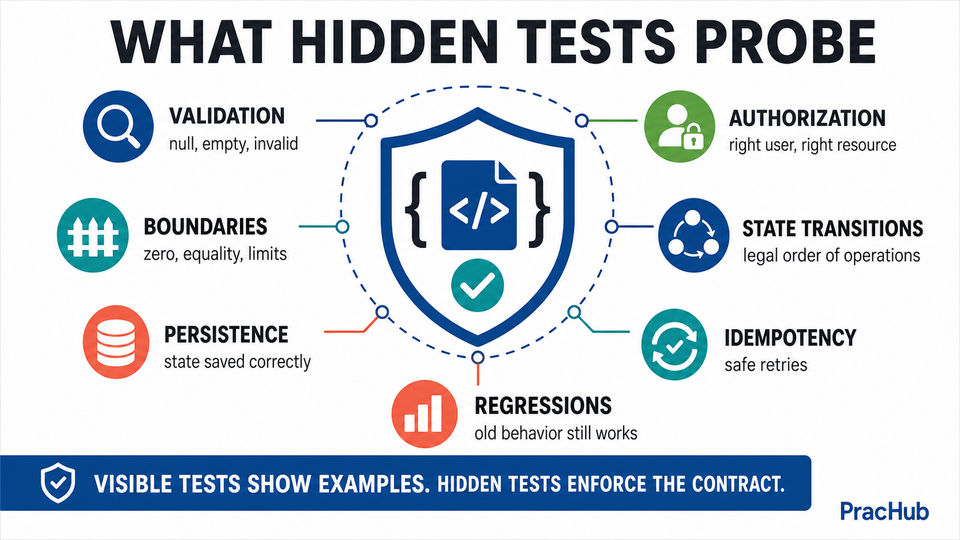
Translate every requirement into at least one normal case, boundary, and failure case.
| Hidden-test family | Questions to ask |
|---|---|
| Validation | What happens for null, empty, zero, negative, malformed, or unknown input? |
| Boundaries | Are equality, expiration, capacity, and last-item cases correct? |
| Persistence | Was the intended state actually saved, and only once? |
| Authorization | Can one user modify another user's resource? |
| State transitions | Can an operation run from an invalid state or repeat after completion? |
| Idempotency and retries | Does repeating a request duplicate work or corrupt totals? |
| Regression | Did the patch break an adjacent successful path? |
Hidden tests are usually not riddles. They encode requirements and engineering invariants that the visible examples do not fully cover. PracHub's guide to coding assessment hidden test cases provides a broader boundary checklist.
Five Mistakes That Waste the Most Time
Prompting before reproducing. Without the actual failure, the assistant guesses from surface patterns.
Changing too much at once. A multi-file refactor makes it harder to identify which edit fixed the bug and which introduced a regression.
Editing the tests to match the code. Unless the task explicitly says a test is wrong, the tests and written contract are evidence to satisfy, not obstacles to remove.
Trusting green visible tests. A happy-path suite may still miss authorization, rollback, boundary, and idempotency failures.
Using unapproved external tools. Practice with any lawful tool you prefer, but during the live OA use only resources allowed by Amazon and the assessment provider. Do not paste private assessment content into outside services.
A Seven-Day Preparation Plan
| Day | Focus | Deliverable |
|---|---|---|
| 1 | Timed Amazon coding diagnostic | One DSA problem plus an error log |
| 2 | Repository mapping | Trace three features from entry point to persistence |
| 3 | Bug reproduction | Fix two seeded bugs without AI |
| 4 | Bounded prompting | Use AI for diagnosis, then review every proposed line |
| 5 | Hidden-test design | Add validation, boundary, state, and regression cases |
| 6 | Full simulation | One algorithm task and one repo-debug task under a timer |
| 7 | Light review and setup | Confirm invitation rules, environment, language, and test commands |
Use PracHub's Amazon question hub for the diagnostic and algorithm practice. For the later behavioral stage, pair technical preparation with Amazon Leadership Principles questions and the Amazon OA Work Simulation guide.
Practice with real questions from PracHub
These are real Amazon question-bank records, not a prediction of your exact assessment. We prioritize source reports that mention an OA, then use PracHub's stored Technical Screen, Onsite, and Take-home rounds. The table keeps the stored round visible so the evidence is not relabeled.
| Question | Evidence | Difficulty | Main pattern |
|---|---|---|---|
| Q1: Highest Average-Salary Team in an Org Chart | Amazon · Technical Screen | Medium | Sliding window |
| Q2: Merge Overlapping Time Ranges | Amazon · Technical Screen | Medium | Intervals |
| Q3: Caesar Cipher with Translation-Table Optimization | Amazon · Technical Screen | Medium | Strings |
| Q4: Detect and Break a Cycle in a Singly Linked List | Amazon · Technical Screen | Medium | Graphs |
What the prompts actually ask
Q1. Highest Average-Salary Team in an Org Chart
Bank evidence: Amazon, Technical Screen, Medium. Highest Average-Salary Team in an Org Chart A company's reporting structure is a single hierarchy. Every employee has a unique integer id, a name, an integer salary, and a managerid — the id of the person they report to. Exactly one employee (the CEO) has managerid = null, meaning they have no manager.
Q2. Merge Overlapping Time Ranges
Bank evidence: Amazon, Technical Screen, Medium. Merge Overlapping Time Ranges You are building the scheduling backend for a shared conference room. Each reservation that has ever been placed is recorded as a pair [start, end] of integer timestamps (epoch seconds), where start <= end.
Q3. Caesar Cipher with Translation-Table Optimization
Bank evidence: Amazon, Technical Screen, Medium. Implement a Caesar cipher. Given a string text and an integer shift, return a new string in which every alphabetic character is rotated forward by shift positions within its own case, wrapping around the alphabet; all non-alphabetic characters are left unchanged.
Q4. Detect and Break a Cycle in a Singly Linked List
Bank evidence: Amazon, Technical Screen, Medium. You are given the head of a singly linked list. The list may or may not contain a cycle: somewhere in the list, one node's next pointer may point back to an earlier node, forming a loop. Do two things: 1. Detect whether the list contains a cycle. 2.
Run the set like an assessment
- Read all four prompts first. Give each a difficulty estimate and choose an order before coding.
- Hide the solution. Write the invariant, complexity target, and three edge cases before opening the editor.
- Use one timer. Preserve five minutes at the end for boundary, tie, scale, and output-format tests.
- Log the failure mode. Record the broken invariant or missed edge case, not merely the question title.
Amazon AI-Assisted Coding OA FAQ
Is the AI-assisted repository task now on every Amazon SDE OA?
No public Amazon page confirms that. Multiple 2026 candidates report receiving it, including candidates for SDE I, graduate, intern, and some SDE II processes, but the format varies. Follow the structure stated in your invitation.
How many bugs and hidden tests are there?
Candidate reports mention different bug and test counts. Do not prepare around one number. Train a repeatable debug-and-verify loop that works whether the repository contains two defects or several.
Is the built-in assistant Amazon Q?
Do not assume so. Amazon has public documentation for Amazon Q Developer, but that does not establish the identity or capabilities of an assessment's embedded assistant. Use the interface and help text presented in your assessment.
Can I use ChatGPT, Claude, or another external AI during the OA?
Only if the assessment instructions explicitly allow it. Amazon's university OA guidance says browser usage may be logged and warns against copy-paste behavior. The safe rule is to use only the built-in assistant and resources expressly permitted for your test.
What if the AI produces a patch that passes visible tests?
Review the diff and test the contract yourself. Check invalid input, boundaries, persistence, authorization, retries, and adjacent behavior. You are responsible for the submitted implementation, even when a tool generated part of it.
Does passing every test guarantee an interview?
Amazon does not publish a universal cutoff or weighting for this reported task. Official OA pages describe a broader evaluation that can include coding, problem solving, work styles, and other role-dependent sections. Complete every required section carefully.
Final Takeaway
The 2026 Amazon AI-assisted coding OA changes the interface, not the engineering standard. You still need to understand requirements, navigate unfamiliar code, isolate a defect, make a small defensible change, and prove that it works beyond the happy path.
Practice the two lanes together: use PracHub's Amazon coding questions for algorithm speed, then use current Amazon interview reports and written solutions to train debugging, testing, and full-loop judgment. The goal is not to make AI look capable. It is to show that you remain the engineer in control.
Comments (0)