Coding Assessment Hidden Test Cases: Why Solutions Fail and How to Debug Them
Quick Overview
Coding Assessment Hidden Test Cases: Why Solutions Fail and How to Debug Them now pairs its existing format and process guidance with a clearly sourced PracHub practice set. The added section shows each question's actual company, stored round, difficulty, prompt shape, and a timed workflow without claiming guaranteed assessment reuse.
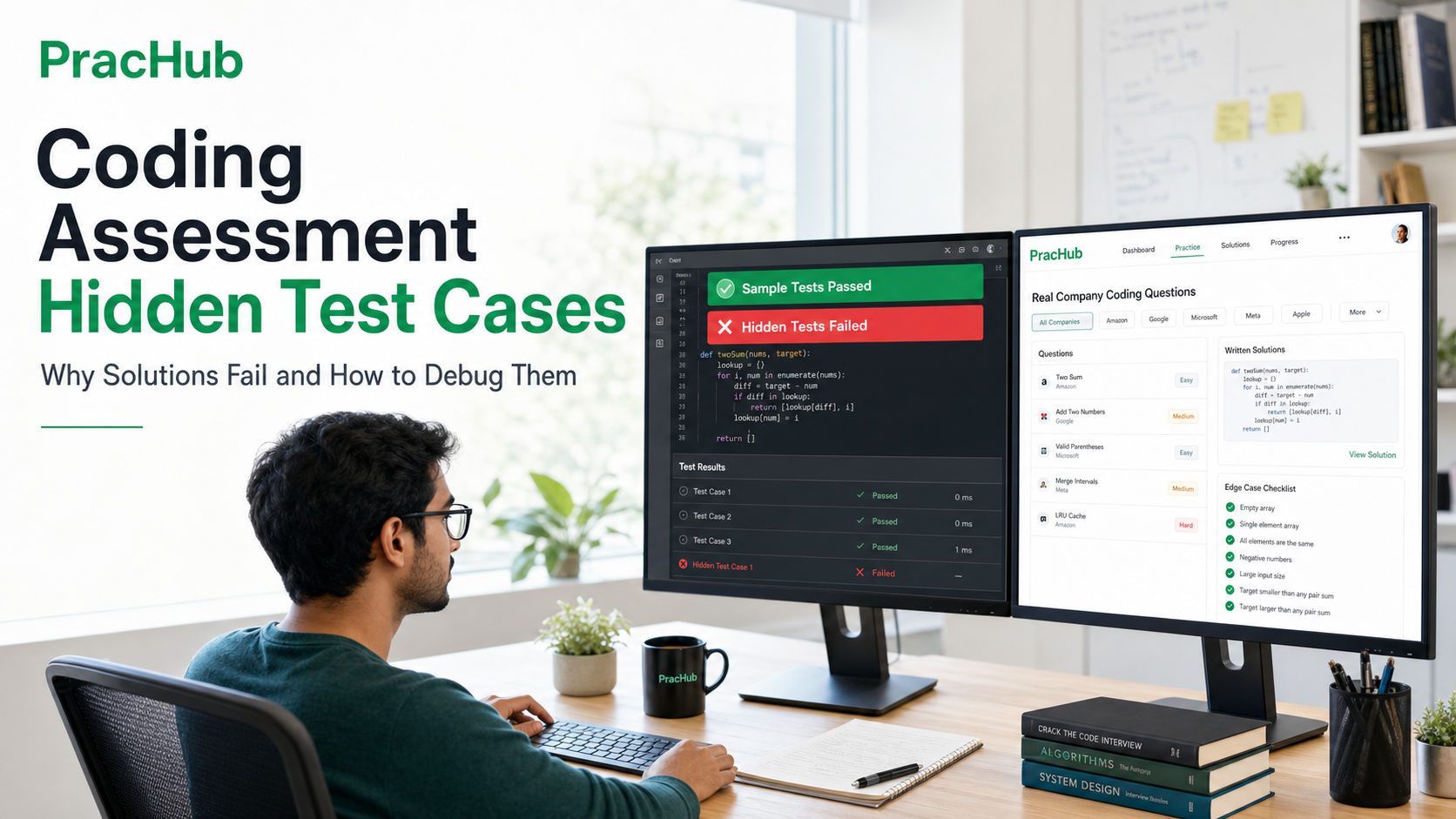
Your solution passes every sample. You submit it, and half the hidden tests fail. That result feels arbitrary, but it usually points to a specific gap: an unstated assumption, an untested boundary, a performance limit, or a language-level bug.
If you are preparing for an online assessment, practice with real interview questions with written solutions on PracHub before the timer starts. Use company-specific interview prep to learn which problem styles and constraints are most relevant to your target.
Quick Answer
Hidden test cases are private inputs used to check whether a solution works beyond the examples shown in the prompt. They often cover empty or minimal inputs, maximum constraints, duplicates, unusual ordering, overflow, invalid assumptions, and performance. The fastest debugging strategy is to classify the failure, generate test families, shrink failing inputs, and compare your code with a simple reference solution.
What Are Hidden Test Cases?
Sample tests teach you the input and output format. Hidden tests evaluate whether the implementation satisfies the full specification. HackerRank's official documentation explains that non-sample test cases are hidden from candidates and can evaluate edge conditions and unseen scenarios.
Platforms may also separate different goals. Codility describes correctness as producing valid results for moderate inputs and corner cases, while performance tests examine whether the solution remains efficient at scale. A hidden failure is therefore not always a mysterious logical edge case.
First Classify the Failure
| Failure Signal | Most Likely Cause | First Check |
|---|---|---|
| Wrong answer | Logic, boundary, or misunderstood requirement | Trace the smallest counterexample |
| Timeout | Complexity, repeated work, or slow I/O | Estimate operations at maximum input size |
| Runtime error | Indexing, recursion depth, null access, or overflow | Test minimum and maximum structures |
| Some groups pass | One input family or constraint range is broken | Compare what the passing cases have in common |
| Output mismatch | Formatting, ordering, or extra debug text | Inspect exact whitespace and required order |
Do not optimize before you know whether the answer is wrong. Do not rewrite the algorithm when the problem is a stray print statement. Classification protects the limited time you have left.
Why Solutions Pass Samples but Fail Hidden Tests
The sample confirms format, not completeness
A prompt may show one ordinary input with distinct positive values. That does not prove the real data excludes zeros, negatives, duplicates, sorted arrays, repeated queries, or disconnected components. Treat every missing guarantee as a question.
Boundary conditions change the control flow
Off-by-one errors hide inside loops, binary search, prefix sums, windows, and substring ranges. Test the smallest legal input, the first input that enters a loop, the last valid index, and a case where the answer sits at either boundary.
The code depends on accidental ordering
Hash maps, sets, event streams, graph neighbors, and equal-priority items may not arrive in the order you saw locally. If the output requires ordering, sort explicitly. If it does not, make sure your logic does not depend on iteration order.
Values exceed the numeric type
Individual inputs may fit in a 32-bit integer while their sum, product, count, distance, or timestamp difference does not. Promote before arithmetic and check whether the language silently overflows, changes precision, or converts between signed and unsigned values.
The algorithm is correct but too slow
An O(n²) solution can pass three tiny samples and fail every maximum-size test. Translate the constraint into an operation budget. If n is 100,000, nested full scans are usually the first suspect.
A Repeatable Hidden-Test Debugging Workflow
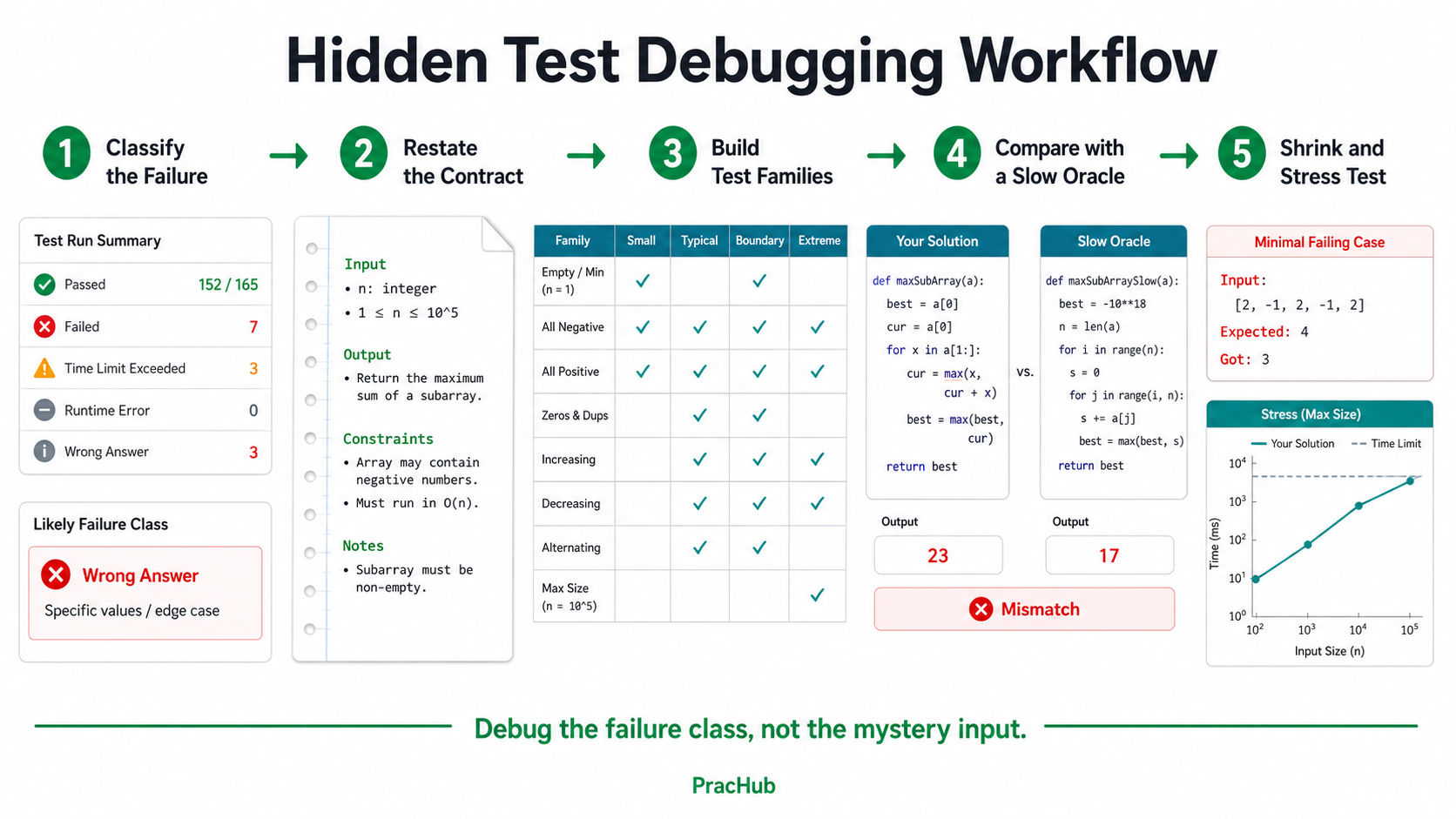
Step 1: Restate the contract. Write down legal input ranges, output rules, mutation rules, ordering requirements, and every assumption your code makes.
Step 2: Build test families. Cover minimum, maximum, all-equal, all-distinct, already sorted, reverse sorted, duplicate-heavy, zero-heavy, and structurally disconnected inputs where relevant.
Step 3: Use a slow oracle. For small inputs, write a simple brute-force solution you trust. Generate many tiny cases and compare both implementations. This converts an invisible hidden failure into a visible counterexample.
Step 4: Shrink the failure. Remove elements, shorten strings, reduce values, or delete graph edges while the mismatch remains. A five-element counterexample is easier to understand than a random array of 100 values.
Step 5: Stress performance separately. Generate the largest legal shape and measure the dominant loop, memory use, recursion depth, and I/O. Correctness tests and stress tests answer different questions.
The 30-Minute Triage Plan
Minutes 0-5: Re-read constraints and confirm the required output format. Remove debug output and check the exact function signature.
Minutes 5-15: Test minimum inputs, duplicates, zeros, extremes, and both ends of every range. Trace state changes by hand.
Minutes 15-25: Compare against a brute-force oracle on small generated cases. Fix the smallest mismatch rather than guessing at random.
Minutes 25-30: Stress maximum input size, review complexity, then submit the simplest verified correction. A broad rewrite in the final minutes creates new bugs.
Build Your Own Hidden-Test Checklist
| Input Family | Example | Bug It Exposes |
|---|---|---|
| Minimum | Empty input or one element | Initialization and base cases |
| Boundary answer | Match at the first or last position | Off-by-one errors |
| Duplicates | All equal or repeated keys | Incorrect uniqueness assumptions |
| Extreme values | Largest magnitude and long sums | Overflow and precision loss |
| Adversarial order | Sorted, reverse, or alternating | Worst-case behavior and ordering dependence |
| Maximum size | Largest allowed n | Timeout, memory, and recursion limits |
Customize this table by problem type. Graph questions need disconnected nodes, cycles, self-loops, and multiple paths. String problems need empty strings, repeated characters, Unicode assumptions, and overlapping matches. Interval problems need touching, nested, and identical ranges.
Language Traps That Look Like Algorithm Bugs
In Python, watch recursion depth, mutable default arguments, and quadratic string building. In Java, check integer promotion, comparator overflow, and object equality. In JavaScript, remember that Number cannot exactly represent every large integer and that default array sorting is lexicographic. In C++, review signed-versus-unsigned comparisons, overflow, iterator invalidation, and uninitialized values.
Also confirm whether the platform calls your function once or runs multiple test cases in the same process. Global state, caches, and mutated input can leak from one case into the next.
How to Practice Before the Assessment
Do not practice only until the sample passes. After every solution, create at least five adversarial tests and explain what each one protects against. Then read the written solution and compare assumptions, complexity, and edge-case handling.
On PracHub, filter real questions by company and role, solve them without help, and keep a short failure log: missed requirement, boundary bug, data-type bug, complexity bug, or implementation bug. Patterns in that log tell you what to review before the next assessment.
Practice with real questions from PracHub
A platform or process article cannot honestly attribute one company's question to every employer that uses the format. This set therefore uses real cross-company PracHub questions to rehearse common OA patterns. Each row shows its actual company and stored round; none is claimed to be supplied by this platform.
| Question | Evidence | Difficulty | Main pattern |
|---|---|---|---|
| Q1: In-Memory URL Shortener: Encode and Decode | Microsoft · Technical Screen | Medium | Graphs |
| Q2: Highest Average-Salary Team in an Org Chart | Amazon · Technical Screen | Medium | Sliding window |
| Q3: Merge Overlapping Intervals | J.P. Morgan · Technical Screen | Medium | Intervals |
| Q4: Find Largest Adjacent Stock Price Change | Instacart · Technical Screen | Medium | Strings |
What the prompts actually ask
Q1. In-Memory URL Shortener: Encode and Decode
Bank evidence: Microsoft, Technical Screen, Medium. Implement an in-memory URL shortener that can encode a long URL into a short URL and decode that short URL back to the original long URL. Design a class Codec (or the equivalent in your language) that supports two operations: - encode(longurl) — take a long URL string and return a short URL string.
Q2. Highest Average-Salary Team in an Org Chart
Bank evidence: Amazon, Technical Screen, Medium. Highest Average-Salary Team in an Org Chart A company's reporting structure is a single hierarchy. Every employee has a unique integer id, a name, an integer salary, and a managerid — the id of the person they report to. Exactly one employee (the CEO) has managerid = null, meaning they have no manager.
Q3. Merge Overlapping Intervals
Bank evidence: J.P. Morgan, Technical Screen, Medium. Merge Overlapping Intervals You are given an array intervals where each element intervals[i] = [starti, endi] represents a closed interval on the number line.
Q4. Find Largest Adjacent Stock Price Change
Bank evidence: Instacart, Technical Screen, Medium. You are given an unsorted list of stock price records. Each record has two fields: - date: a date string in YYYY-MM-DD format - price: an integer stock price Sort the records by date in ascending order. Then find the adjacent pair of dates with the largest absolute price change.
Run the set like an assessment
- Read all four prompts first. Give each a difficulty estimate and choose an order before coding.
- Hide the solution. Write the invariant, complexity target, and three edge cases before opening the editor.
- Use one timer. Preserve five minutes at the end for boundary, tie, scale, and output-format tests.
- Log the failure mode. Record the broken invariant or missed edge case, not merely the question title.
Frequently Asked Questions
Can candidates see hidden test case inputs?
Usually not. The exact visibility depends on the platform and employer settings. You may receive a failure category, score, or partial feedback without the private input. Debug by generating input families from the specification rather than trying to guess one secret case.
Does failing one hidden test mean the algorithm is wrong?
Not necessarily. The core idea may be correct while the implementation mishandles one boundary, overflows, mutates shared state, formats output incorrectly, or times out on a specific input shape. Classify the failure before changing the algorithm.
Why do all sample tests pass but the score stay low?
Samples are intentionally small and illustrative. A low score can mean the solution fails broader correctness cases, maximum constraints, performance groups, or required formatting. Re-read the full contract and test beyond the examples.
Should I add many random tests?
Random tests are most useful when paired with a trusted brute-force oracle. Otherwise, a failure may be hard to interpret and a passing run proves little. Start with deliberate boundary families, then use randomized differential testing on small inputs.
Final Takeaway
Hidden tests reward specification discipline, not mind reading. Classify the failure, challenge every assumption, test boundaries, compare with a simple oracle, and stress performance separately. That workflow is faster and more reliable than making speculative changes after each submission.
Build the habit before the OA with real interview questions and written solutions, then narrow your practice through PracHub company pages. The goal is not just to pass visible samples. It is to submit code you can defend against inputs you have never seen.
Comments (0)