Anduril Software Engineer Interview Guide 2026: Coding, Systems, and Mission Fit
Quick Overview
This 2026 Anduril software engineer interview guide covers the role-dependent process, progressive coding, object-oriented and system design, project deep dives, and mission fit. It shows candidates how to prepare for changing requirements, degraded-network constraints, field reliability, and honest values questions with real Anduril practice on PracHub.
An Anduril coding question can look ordinary for ten minutes. Then the interviewer adds references between objects, asks what becomes unreachable, or changes the operating constraints. The real test is whether your model and code survive the next requirement.
Start with real Anduril software engineer interview questions on PracHub. Solve one without hints, compare your reasoning with the written solution, and repeat it after adding a new edge case.
Anduril does not publish one universal software engineer loop. This guide separates its current official hiring and role signals from candidate-reported interview patterns, which can change by team, level, location, and security requirements. Confirm your exact rounds with your recruiter.
Strong Anduril preparation connects adaptable code, resilient systems, and an honest reason for choosing the mission.
Quick Verdict: What Does Anduril Evaluate?
Prepare for four connected signals: adaptable coding, systems judgment, ownership, and mission fit. Anduril's current engineering roles span networking, autonomy, robotics, data processing, cloud and edge infrastructure, real-time telemetry, established codebases, and software deployed on physical systems.
The exact emphasis depends on the job. A new-grad loop may lean toward fundamentals and object-oriented design, while an experienced Mission Software Engineer can face deeper questions about C++, Rust, distributed communications, degraded networks, or hardware integration.
| Signal | What it may look like | Strong evidence |
|---|---|---|
| Coding | Algorithms, multi-part implementation, or object-oriented design | Clear model, correct code, tests, and clean adaptation |
| Systems | Networking, telemetry, autonomy, edge reliability, or integration | Explicit failure behavior and practical trade-offs |
| Ownership | Resume deep dive, ambiguous execution, or field constraints | Personal decisions, measurable impact, and learning |
| Mission fit | Why Anduril, why defense technology, and why this team | Specific motivation that remains credible under follow-ups |
Anduril Software Engineer Interview Process in 2026
Anduril's official early-career page describes a recruiter call, technical and behavioral interviews, and role-specific assessments that may include live coding, presentations, or in-depth technical discussions. Recent candidate reports commonly add a technical screen and a final set of coding, object-oriented or system design, and mission-focused conversations.
Treat that as a planning map, not a guaranteed sequence. Team-specific roles can replace general questions with domain depth in C++, Linux, perception, networking, simulation, embedded systems, or infrastructure.
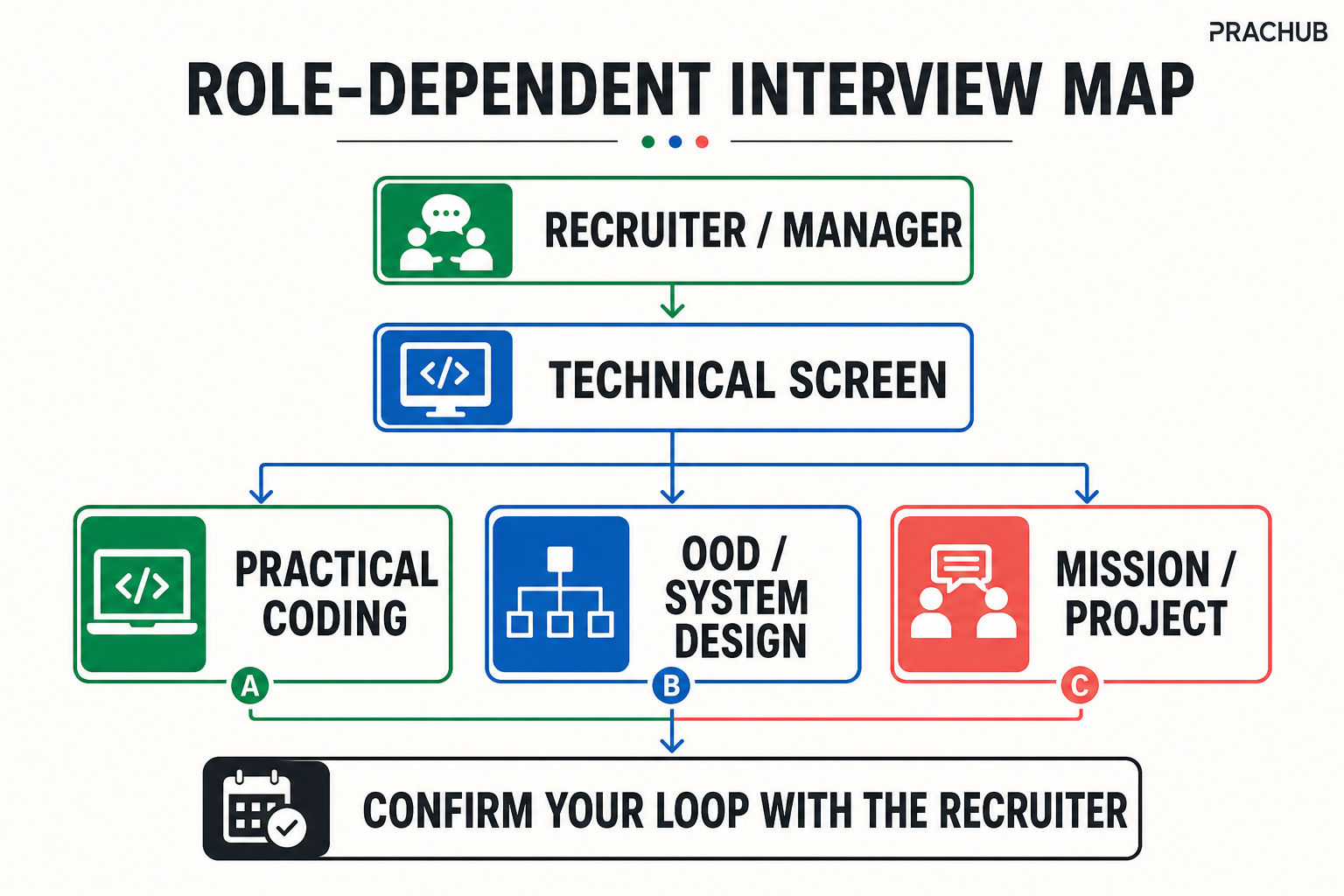
Ask what each round evaluates, which language and tools are allowed, and whether the design round is object-oriented or distributed systems.
| Possible stage | Likely focus | Preparation target |
|---|---|---|
| Recruiter or manager screen | Background, team fit, role scope, and motivation | A specific answer to why this product and mission |
| Technical screen | Coding fundamentals or a progressive implementation problem | Clarify, code, test, and adjust without losing structure |
| Technical final rounds | Coding, OOD, systems, debugging, or team-specific depth | Production trade-offs tied to the job description |
| Behavioral or senior conversation | Ownership, speed, collaboration, resilience, and mission fit | Evidence-rich stories and honest values alignment |
How to Prepare for Anduril Coding Interviews
Do not prepare with memorized LeetCode solutions alone. Candidate reports describe ambiguous or multi-phase prompts, and the current PracHub set includes heap and graph problems where later requirements change the data model.
For example, Find Heap Objects Not Referenced by the Stack begins with direct reachability. The follow-up, Find Unreachable Objects in a Heap Graph, adds references between objects and turns the model into graph traversal.
Use a six-step coding rhythm
Restate, model, implement, test, explain, extend. Define the input contract and ambiguous cases before coding. Build the smallest correct version, test normal and boundary cases, state the time and space cost, then identify what the next requirement will force you to change.
For object-oriented design, keep state ownership and invariants obvious. Avoid building a framework before the first behavior works, but do not let every follow-up become another conditional bolted onto one method.
System Design: Build for the Tactical Edge
Many Anduril systems do not live in a clean cloud-only environment. Current Mission Software roles mention contested or disconnected networks, real-time telemetry, autonomous vehicles, third-party integrations, field deployment, production triage, and lost-communications behavior.
That changes the center of a design answer. Reliability is not only five nines in a data center; it is predictable behavior when connectivity, hardware, or upstream data fails.
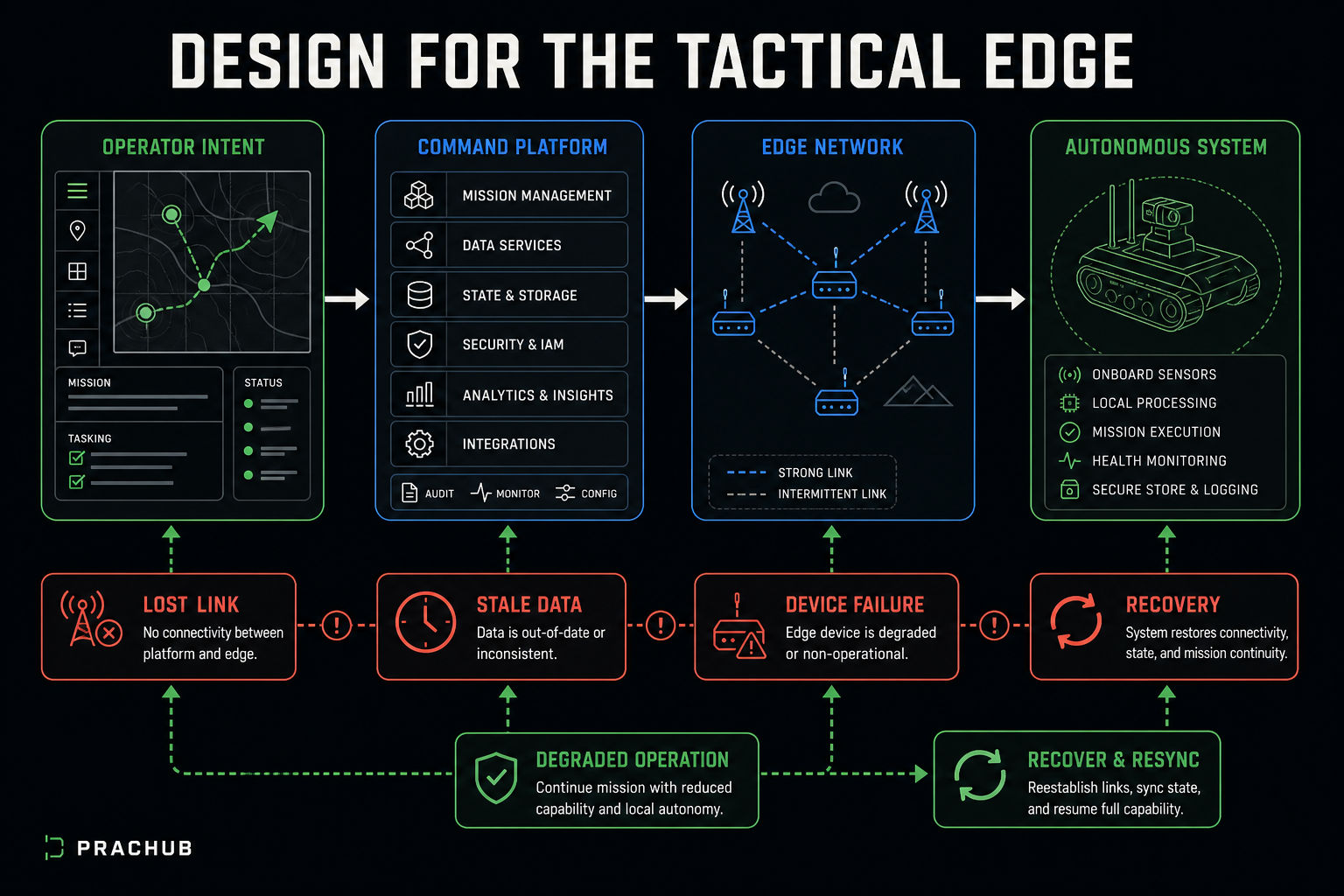
Trace the mission from operator intent to edge execution, then define what happens when every connection or component fails.
| Constraint | Question to answer | Mechanisms to discuss |
|---|---|---|
| Intermittent links | What continues locally when the network disappears? | Store-and-forward, leases, reconciliation, and bounded autonomy |
| Real-time telemetry | Which data must arrive now, and what may be sampled? | Priorities, backpressure, compression, and freshness budgets |
| Unsafe commands | How do you prevent stale or invalid actions? | Validation, state machines, authority, audit logs, and fail-safe modes |
| Hardware integration | How do software versions and devices remain compatible? | Versioned protocols, simulation, hardware-in-loop tests, and rollback |
| Field operations | How will an operator detect and repair failure? | Health metrics, traces, replay, diagnostics, and runbooks |
Practice these trade-offs with PracHub system design questions. Good Anduril-adjacent prompts include command and control, fleet telemetry, distributed tasking, sensor ingestion, and an offline-capable edge platform.
Mission Fit: Give a Real Answer, Not a Slogan
Anduril's careers page foregrounds autonomy, speed, scale, and impact. Its early-career guidance explicitly names initiative, curiosity, collaboration, proven impact, and mission alignment. Candidate reports also say that motivation is revisited across the process.
Build your answer from four pieces
Mission: What problem in national security or defense technology matters to you? User: Which operator or outcome do you want your engineering to help? Evidence: What past choice shows you can handle ownership, ambiguity, or real-world constraints? Team: Why does this specific role match your skills?
A credible answer can acknowledge the stakes of defense work instead of treating the mission as branding. Do not invent conviction. If your honest reasoning does not survive follow-up questions about users, deployment, or trade-offs, that is useful information for both sides.
Rehearse with PracHub's Anduril career, motivation, and project question and the correct behavioral and leadership practice collection.
Prepare One Project Deep Dive That Can Carry the Loop
Choose a project where you owned a difficult decision, not merely a successful launch. Be ready to draw the architecture, identify the most serious failure mode, explain what you personally changed, quantify the outcome, and discuss what you would redesign now.
Anduril's current roles repeatedly emphasize navigating complex codebases, delivering end to end, collaborating across functions, and resolving production issues. Your story should show those behaviors with technical evidence rather than adjectives.
A Focused 7-Day Anduril Preparation Plan
| Day | Focus | Deliverable |
|---|---|---|
| 1 | Map the job description and recruiter packet | Round map plus role-specific skill list |
| 2 | Solve two timed Anduril coding questions | Correct code, tests, and mistake log |
| 3 | Extend one implementation through two follow-ups | Refactored design with explicit invariants |
| 4 | Design an offline-capable command system | Architecture, failure table, and recovery plan |
| 5 | Rehearse one project deep dive | Ten-minute story plus architecture diagram |
| 6 | Pressure-test mission fit | Specific answer with evidence and boundaries |
| 7 | Run a compressed mock loop | Three corrections for interview day |
Common Anduril Interview Mistakes
Overfitting to one candidate's loop: A new-grad report is not a senior robotics, frontend, or mission software process. Let the exact role and recruiter guidance determine your depth.
Designing only for perfect connectivity: Discuss stale data, partitions, lost commands, degraded modes, physical safety, and field recovery.
Giving a generic mission answer: "I like hard problems" can describe any company. Connect Anduril's work to a specific user, outcome, and choice you have made.
Optimizing code before clarifying the model: Multi-part prompts punish early assumptions. Make the contract and invariants visible first.
Frequently Asked Questions
Is the Anduril coding interview LeetCode-style?
It can include algorithms and data structures, but recent reports also describe ambiguous, progressive, and object-oriented implementation. Practice core DSA, then rehearse requirement changes, clean state modeling, tests, and refactoring. Team-specific roles may add deeper language or domain questions.
Does every Anduril software engineer get system design?
No official source confirms one universal loop. Experienced backend, infrastructure, mission software, robotics, and senior candidates are more likely to face system or object-oriented design depth. Ask whether your scheduled round targets distributed systems, OOD, integration, or another specialty.
Do I need defense or robotics experience?
Not for every role. Current postings often accept strong general software backgrounds, but relevant experience can change the interview depth. Study the team's product, operating environment, languages, and failure modes so your existing skills transfer to the actual job.
How should I answer "Why Anduril?"
Connect one mission problem to a user or operational outcome, explain why the specific team is a fit, and support the answer with a past decision or project. Be honest about the stakes and your motivation. A polished slogan without evidence is easy to expose with follow-up questions.
Final Takeaway
The strongest Anduril candidate can adapt code, design for degraded reality, and explain why the work matters to them. Prepare from the role outward: confirm the loop, practice multi-stage implementation, reason about edge failure, and bring evidence to every mission-fit answer.
Begin with Anduril software engineer questions on PracHub. Attempt one cold, study the written solution, and repeat it with a changed requirement. That is closer to interview behavior than collecting another list of questions.
Sources
Related Articles
Codeforces vs LeetCode for Interviews: Competitive Programming or Targeted Prep?
Codeforces vs LeetCode for interviews: compare problem style, difficulty, speed, communication gaps, and the best 2026 prep strategy.
Is Coding Interview University Enough for Technical Interviews in 2026?
Is Coding Interview University enough in 2026? Review its free CS roadmap, time commitment, interview gaps, and the practice you still need.
Interview Cake Review 2026: Is the Coding Interview Course Still Worth It?
Interview Cake review for 2026: current pricing, course strengths, refund terms, limitations, and whether it is still worth buying for coding interviews.
Scale AI Software Engineer Interview Guide 2026: Coding, Systems, and AI Product Sense
Scale AI software engineer interview guide for 2026: prepare for practical coding, system design, AI product sense, Credo, and project rounds.
Comments (0)