Codeforces vs LeetCode for Interviews: Competitive Programming or Targeted Prep?
Quick Overview
This 2026 Codeforces vs LeetCode comparison explains which platform is better for coding interviews, what competitive-programming skills transfer, and where contest practice falls short. It gives beginners, experienced candidates, and competitive programmers a 14-day hybrid plan using LeetCode for targeted DSA patterns, Codeforces for pressure and depth, and PracHub for real company-specific full-loop preparation.
A high Codeforces rating can prove that you are fast, creative, and technically formidable. It does not automatically prove that you interview well. In a contest, the judge cares whether your output is correct. In an interview, a person also evaluates how you clarify the problem, explain trade-offs, write maintainable code, test it, and respond to a follow-up.
For most candidates, LeetCode is the better default for coding interview preparation, while Codeforces is a powerful supplement for speed and algorithmic depth. Before committing to either grind, use real coding interview questions with written solutions on PracHub to diagnose what your target role actually requires.
Disclosure: PracHub publishes this comparison and is recommended as a company-specific practice resource. Platform facts were checked against official Codeforces, LeetCode, Meta, Microsoft, and Amazon materials in August 2026.
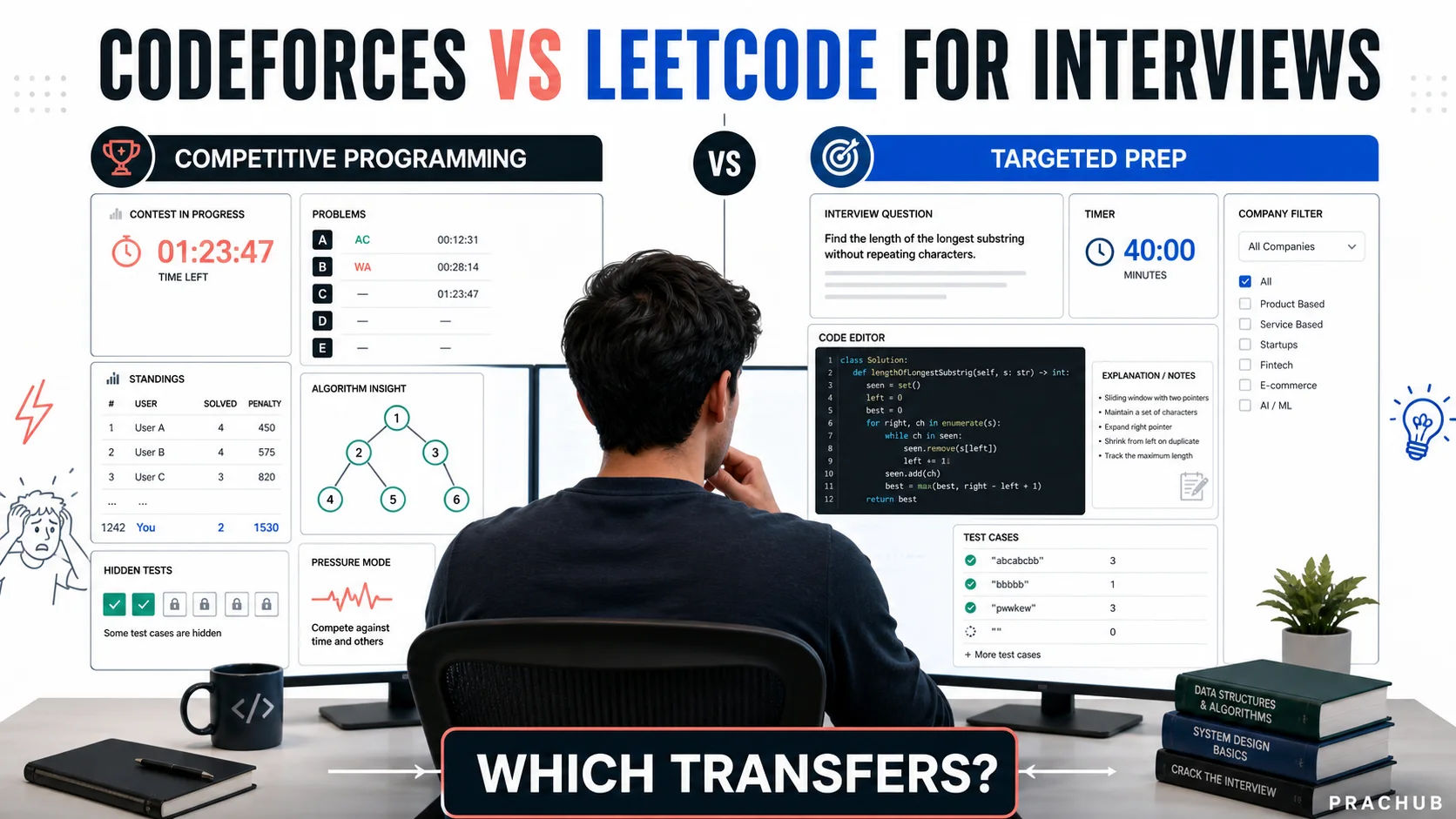
Quick Verdict: Codeforces or LeetCode for Interviews?
Choose LeetCode if an interview is your immediate goal. Its study plans, familiar interview-style prompts, topic progression, editor, and solutions reduce the distance between practice and a standard coding screen.
Choose Codeforces if you want long-term competitive-programming skill or already handle normal interview questions comfortably. Timed rounds, virtual participation, adversarial test cases, and deeper algorithmic twists build speed and resilience that can make conventional coding rounds feel calmer.
| Your situation | Better starting point | Reason |
|---|---|---|
| Interview in 2-8 weeks | LeetCode | Closer question style and more efficient pattern coverage |
| Beginner learning DSA | LeetCode | Gentler progression and easier access to explanations |
| Strong DSA, weak under pressure | Codeforces | Contests force fast decisions and independent debugging |
| Competitive programmer with interviews booked | LeetCode + PracHub | Convert raw skill into interview communication and company targeting |
| No interview date, enjoys algorithms | Codeforces | Better environment for deep, durable competitive skill |
What Each Platform Is Optimizing
Codeforces optimizes for contest performance
The official Codeforces contest archive centers on timed rounds, standings, ratings, divisions, and virtual participation. Its problemset spans topics such as graphs, dynamic programming, constructive algorithms, number theory, combinatorics, and data structures, with problem ratings covering a very wide difficulty range.
The reward function is simple: understand a dense statement, discover the algorithm, implement it quickly, and survive hidden tests. That creates strong instincts for complexity, edge cases, and recovering when the first approach fails.
LeetCode optimizes for interview preparation
LeetCode's official QuickStart Guide explicitly positions its Explore and Problems areas around technical interviews. Its interview cards organize frequently asked company questions, while curated study plans narrow the library into manageable patterns.
The official LeetCode 75 description targets candidates preparing in two months or less. It encourages solving with specified approaches, comparing alternative solutions, and using difficult problems to find knowledge gaps. That is much closer to a deadline-driven interview plan than an open-ended rating climb.
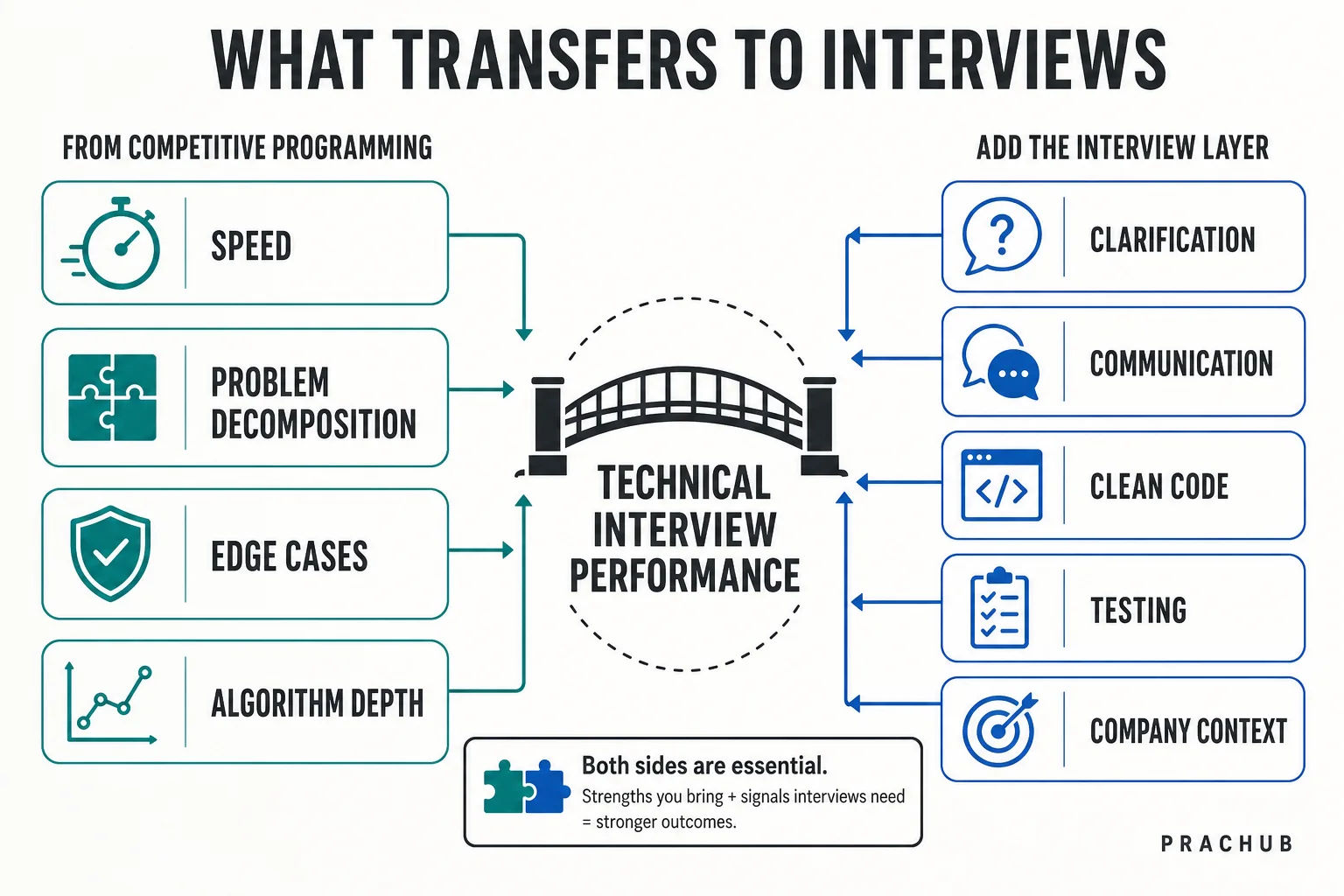
What Codeforces Skills Transfer to Interviews?
Fast decomposition and implementation
Competitive programmers repeatedly turn unfamiliar statements into formal constraints and executable algorithms. Meta Engineering has specifically argued that programming contests help candidates convert ideas into working code, analyze complexity, and account for difficult corner cases.
That transfer is real. A candidate who can calmly solve a Codeforces problem under contest pressure is less likely to freeze when an interviewer changes a constraint or asks for a more memory-efficient solution.
Independent testing and edge-case discipline
Codeforces submissions must pass hidden tests, and failed attempts cost time. Over many rounds, candidates learn to stress their own logic, reason about boundaries, and spot overflow or performance failures before submitting.
Those habits match current employer guidance. Microsoft tells technical candidates to test solutions, identify boundaries and error conditions, and explain complexity. Amazon says SDE candidates should write syntactically correct, robust, well-tested code and validate edge cases.
Where Codeforces Practice Fails to Transfer
Contest code and interview code have different audiences
In a contest, concise variable names, templates, and compressed reasoning can save minutes. In an interview, the code is also a communication artifact. An interviewer needs to follow your choices, assess maintainability, and see whether you can collaborate.
A correct solution delivered silently can therefore underperform. Practice stating assumptions, naming helpers clearly, walking through an example, and explaining why your complexity is acceptable before you type.
Codeforces does not train the complete loop
Modern SWE interviews may include system design, behavioral questions, debugging, project deep dives, and practical implementation. Amazon's current SDE II guidance, for example, describes coding, system design, and behavioral competencies in one loop.
That is why competitive programming should not consume the entire prep budget. Use company-specific interview prep to map the rounds first, then add system design questions and behavioral and leadership practice where the loop requires them.
Why LeetCode Is the Better Default
LeetCode removes much of the competitive-programming overhead. Statements are generally closer to interview prompts, common DSA patterns are easier to sequence, and editorial or community explanations make it faster to repair a gap.
It is also easier to practice the exact rhythm of a coding screen: understand one problem, propose an approach, implement it, test it, and discuss complexity within roughly 30-45 minutes. You can deliberately stop after one clean solution instead of optimizing for a contest rank.
LeetCode is still incomplete. The judge cannot evaluate whether your explanation was clear, your questions were useful, or your design judgment matched the role. Company tags can also encourage memorization if you recognize answers instead of solving unseen variants.
Codeforces vs LeetCode: Detailed Comparison
| Dimension | Codeforces | LeetCode |
|---|---|---|
| Primary objective | Competitive programming performance | DSA learning and interview practice |
| Typical pressure | Several problems, shared contest clock, rank | One problem at a time or interview-style contest |
| Problem style | Dense, novel, often mathematically creative | More recognizable interview patterns |
| Difficulty system | Contest-population problem rating | Easy, Medium, Hard |
| Feedback | Verdict, tests, editorials, standings | Verdict, solutions, discussions, study plans |
| Strongest transfer | Speed, depth, edge cases, pressure | Pattern recognition and interview-format repetition |
| Main blind spot | Communication and full-loop coverage | Company context and non-coding rounds |
Do not translate Codeforces ratings directly into LeetCode difficulty. The systems reflect different problem populations and user behavior. A Codeforces 1500 problem is not reliably a LeetCode Medium, and chasing a rating threshold is not an interview-readiness test.
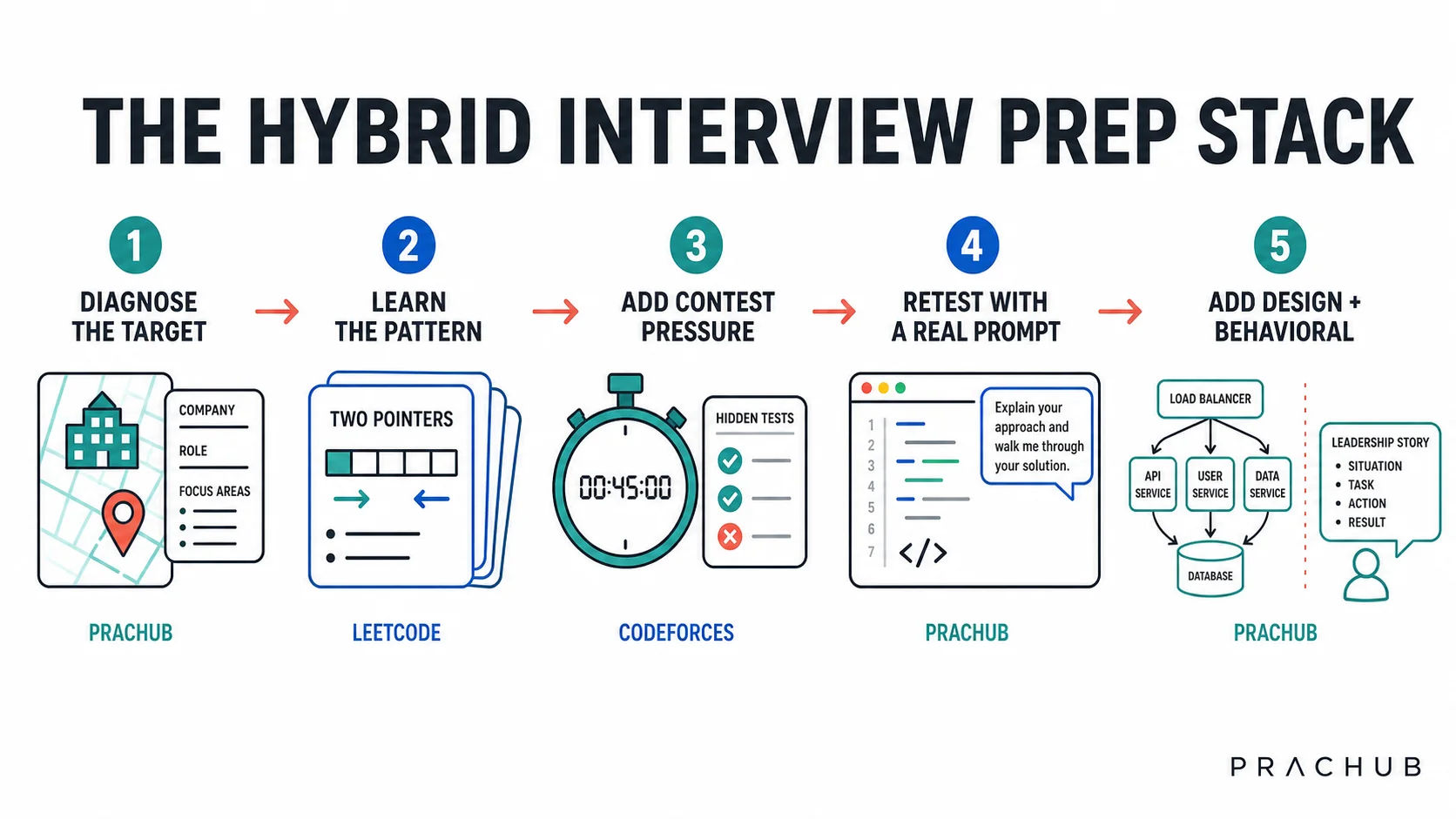
A 14-Day Hybrid Prep Plan
Days 1-2: Diagnose with the target, not the platform. Attempt three unseen PracHub questions for your company and level. Score approach selection, implementation, testing, explanation, and follow-up response separately.
Days 3-6: Repair patterns on LeetCode. Choose the two weakest DSA areas and solve a small progression from easy to medium. Read an editorial only after a genuine attempt, then explain the final solution without looking at the code.
Days 7-9: Add Codeforces pressure. Run one virtual or Educational round at an appropriate level. The goal is not rating; it is making correct decisions under a shared clock and reviewing every wrong submission.
Days 10-12: Convert speed into interview behavior. Re-solve two selected problems with descriptive names, no template, and continuous narration. Ask clarifying questions, test edge cases aloud, and handle one changed constraint.
Days 13-14: Rehearse the real loop. Return to fresh company-specific prompts, then add the non-coding round most likely to affect your result. Review only repeated failures, not every topic you could theoretically study.
A Better Readiness Test Than Rating or Problem Count
Pick one unseen interview-style question and set a 40-minute timer. By the end, you should have clarified ambiguous requirements, compared at least two approaches, written clean runnable code, tested normal and boundary cases, stated complexity, and answered a follow-up without abandoning the structure of your solution.
If the algorithm never appears, use LeetCode to repair the pattern. If implementation collapses under time pressure, use a Codeforces virtual round. If the answer works but the explanation is difficult to follow, practice interview narration. Let the failure mode choose the platform.
Frequently Asked Questions
Is Codeforces better than LeetCode for FAANG interviews?
LeetCode is the more efficient default because its content is organized around interview patterns. Codeforces can create exceptional algorithmic depth, but FAANG-style loops also evaluate communication, testing, system design, and behavioral evidence. Competitive programmers should add those layers rather than doing only harder contests.
Does Codeforces make LeetCode easier?
Often, yes. Regular Codeforces practice can improve speed, complexity analysis, and comfort with unfamiliar twists. The benefit is strongest when you already know the core DSA patterns. You still need to adapt contest habits into clear explanations and readable interview code.
What Codeforces rating is enough for interviews?
There is no reliable cutoff. Rating measures performance against a contest population, not communication or full-loop readiness. Use a realistic mock question and an interview rubric instead of treating a particular Codeforces number as proof that you are prepared.
Should beginners start with Codeforces or LeetCode?
Most beginners should start with a curated LeetCode sequence because the learning path and explanations are easier to control. Add Codeforces later, beginning with approachable Div. 3, Div. 4, or Educational problems once common data structures and algorithms feel familiar.
Can I prepare using only free resources?
Yes. Codeforces provides free contests and practice, LeetCode has many free problems, and PracHub offers free access to interview questions and selected solutions. The important constraint is not price but whether your stack covers the actual coding and non-coding rounds.
Final Verdict
For interviews, LeetCode is the better first tool; Codeforces is the better difficulty amplifier. Use LeetCode to learn and rehearse common patterns, Codeforces to build speed and algorithmic resilience, and PracHub to make the final practice company-specific and full-loop.
The winning metric is not rating, streak, or problem count. It is whether you can solve a relevant unseen problem while making your reasoning easy for an interviewer to evaluate.
Sources
- Codeforces official contest archive, accessed August 2026.
- Codeforces official problemset, accessed August 2026.
- LeetCode official QuickStart Guide, accessed August 2026.
- LeetCode 75 official study-plan announcement, accessed August 2026.
- Meta Engineering: Preparing for a technical interview with programming contests.
- Microsoft Careers: Technical interviewing, accessed August 2026.
- Amazon Jobs: SDE II interview prep, accessed August 2026.
Related Articles
Is Coding Interview University Enough for Technical Interviews in 2026?
Is Coding Interview University enough in 2026? Review its free CS roadmap, time commitment, interview gaps, and the practice you still need.
Interview Cake Review 2026: Is the Coding Interview Course Still Worth It?
Interview Cake review for 2026: current pricing, course strengths, refund terms, limitations, and whether it is still worth buying for coding interviews.
Anduril Software Engineer Interview Guide 2026: Coding, Systems, and Mission Fit
Anduril software engineer interview guide for 2026: prepare for coding, systems design, project depth, role-specific skills, and mission fit.
Scale AI Software Engineer Interview Guide 2026: Coding, Systems, and AI Product Sense
Scale AI software engineer interview guide for 2026: prepare for practical coding, system design, AI product sense, Credo, and project rounds.
Comments (0)