Are Online Assessments Sent in Waves? Why Candidates Receive OAs Days or Weeks Apart
Quick Overview
Online assessments are often sent in batches because recruiters review applications in groups, ATS stages trigger invitations at different times, and teams manage limited review capacity. This guide explains what OA timing can and cannot tell you, plus what to do while waiting.
You applied for the same software engineering role on the same day as a classmate. They received an online assessment on Tuesday. Your inbox is still empty the following Monday.
That gap feels personal, but it often is not. Companies can send online assessments in waves because applications reach the assessment stage at different times, recruiters process candidates in batches, and hiring systems can trigger invitations manually or automatically.
The practical lesson is simple: OA timing is a weak signal, not a ranking. Prepare before the invitation arrives with PracHub interview questions and written solutions, then use the actual invitation, deadline, and application portal as your source of truth.
Quick Answer: Are Online Assessments Sent in Waves?
Yes, they can be. HackerRank allows employers to invite candidates individually or in bulk, set expiration dates, and schedule reminders. CodeSignal also supports single invitations, CSV bulk invitations, private links, and shareable links. Applicant tracking systems such as Greenhouse can trigger an assessment when a candidate enters a configured stage.
Those capabilities make several workflows possible. One employer may send an OA immediately after an eligibility check. Another may wait for a recruiter to review 200 applications, move a shortlist into an assessment stage, and send the next batch several days later.
There is no universal "wave schedule." A company may use daily batches, weekly batches, location-specific groups, or no deliberate waves at all. What candidates call a wave can also be the visible result of normal queue processing.
What an OA Wave Actually Means
An OA wave is a group of assessment invitations sent around the same time. The group may have been created intentionally, or it may emerge because candidates reached the same recruiting stage together.
Consider a role that receives 5,000 applications. The company might first check graduation date, work authorization, location, and minimum qualifications. Recruiters then review smaller groups and send assessments only when the team has capacity to evaluate the results.
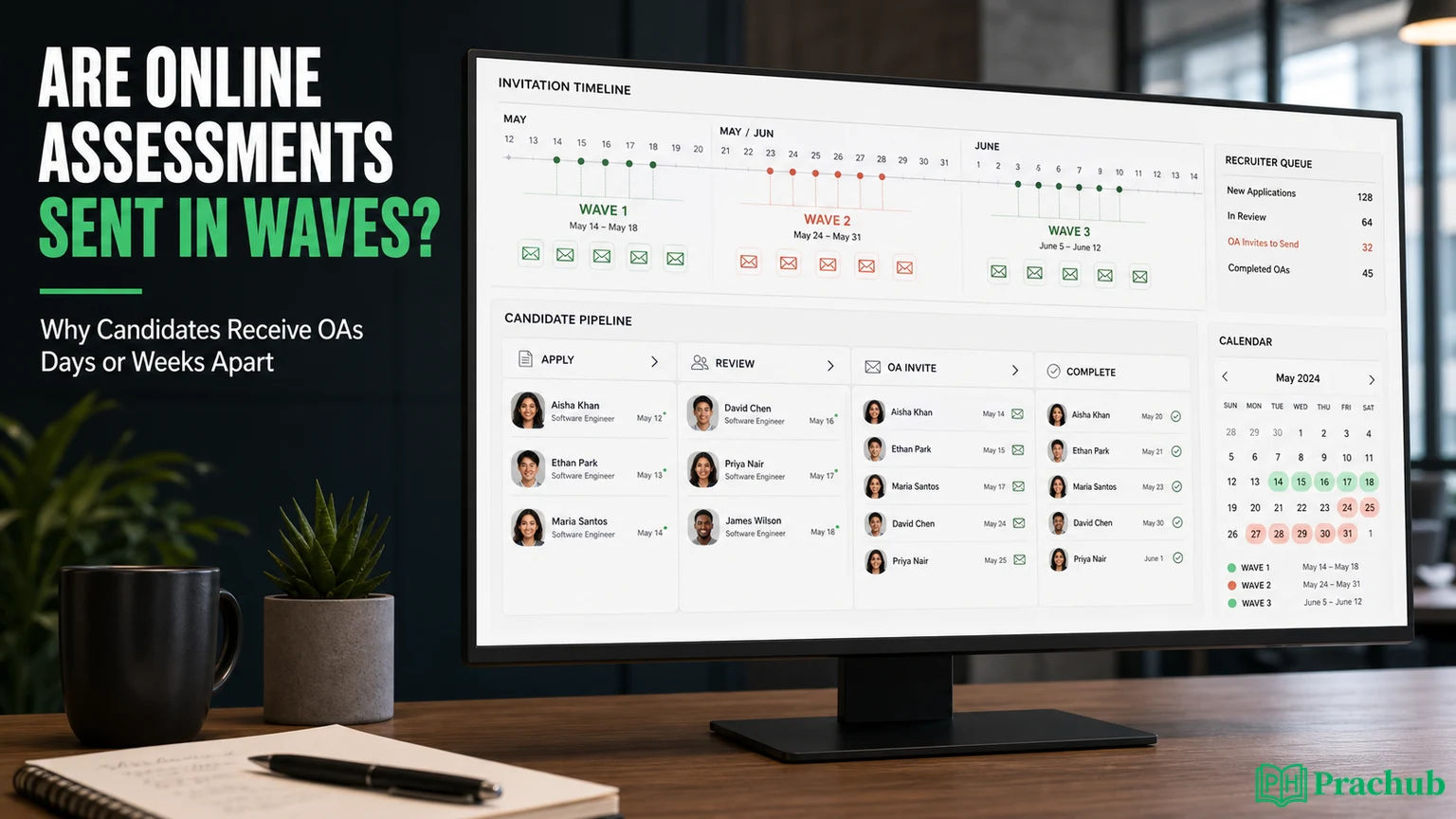
That creates Wave 1, Wave 2, and Wave 3 from the candidate's perspective, even if the recruiting team never uses those labels internally.
Why Two Candidates Receive the Same OA Days or Weeks Apart
The timing difference usually comes from workflow mechanics rather than one secret cutoff. The most common explanations are below.
| Possible cause | What may be happening | What it means for you |
|---|---|---|
| Rolling application review | Recruiters review manageable groups instead of the entire pool at once. | A later application can enter a later review batch without being rejected. |
| ATS stage triggers | An invitation is sent when a candidate is moved into an assessment stage. | Different review times create different invitation times. |
| Manual shortlist | A recruiter screens resumes before clicking Send Test or moving candidates in bulk. | The OA is selective, but timing still may reflect queue order. |
| Role, team, or location buckets | Applications are divided by office, subteam, degree level, or work authorization. | Your comparison with another candidate may not be apples to apples. |
| Reviewer capacity | The team limits new assessments until it can review existing submissions. | A later wave may open after earlier candidates finish or withdraw. |
| Application data or delivery issues | Duplicate applications, an email bounce, missing fields, or integration errors require attention. | Check the portal and spam folder before assuming a decision. |
Automated OAs Can Still Arrive in Waves
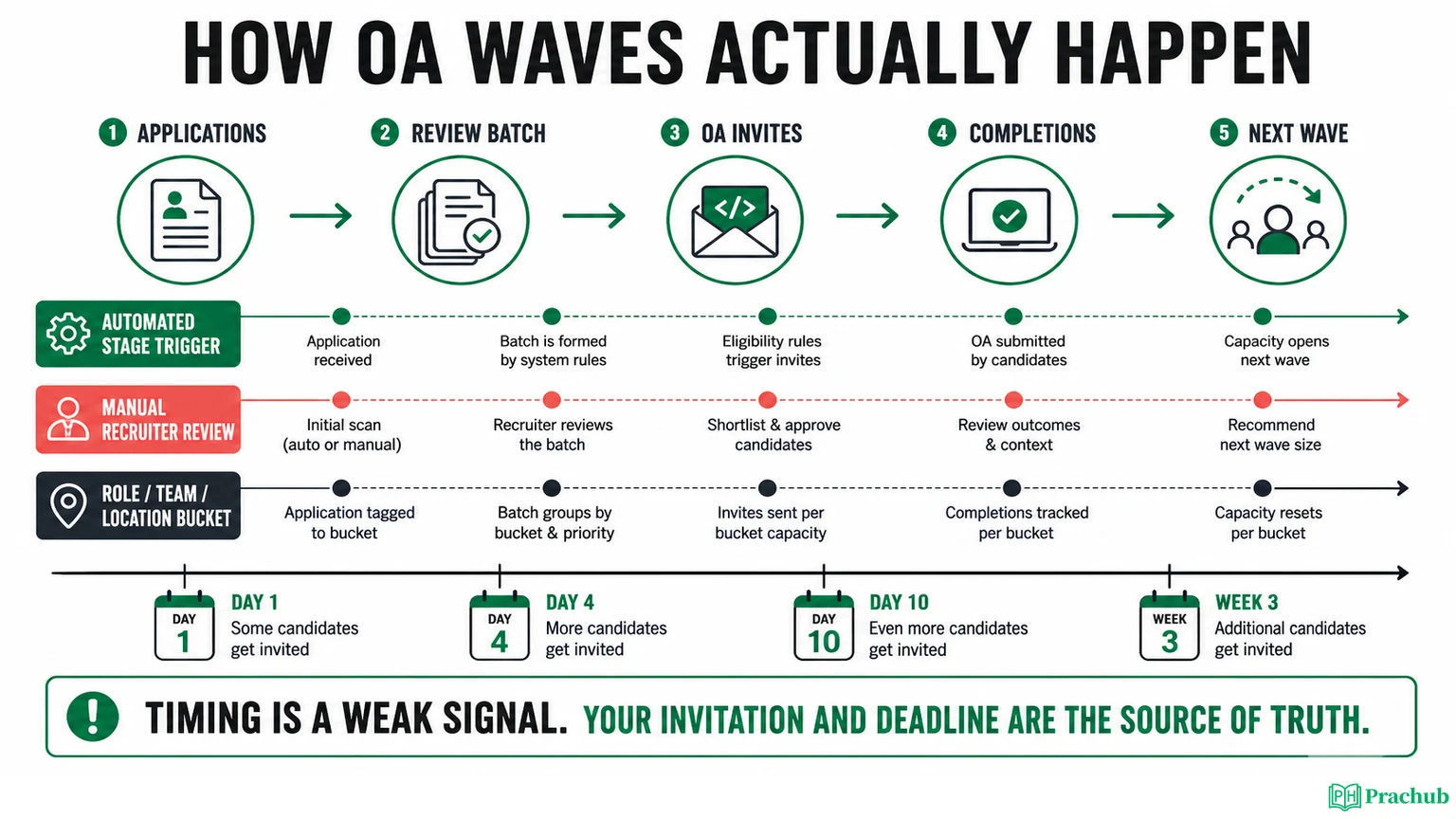
"Automatic" does not necessarily mean "instant for everyone." An employer can configure an assessment to send automatically after a candidate meets a rule or enters a specific stage.
For example, Greenhouse documents stage-transition rules that can send a take-home test when a candidate moves into the relevant stage. Its assessment API also allows a third-party test to be triggered when a candidate reaches a predetermined point in the interview plan.
If recruiters move candidates into that stage in batches, the invitations will also appear in batches. The send action may be automated while the decision that triggers it remains manual.
Bulk invitations create visible clusters
HackerRank and CodeSignal both let employers import or select groups of candidates. HackerRank's iCIMS integration goes further: moving candidates to a Bulk Invite status can automatically send the default assessment linked to a requisition.
This is why ten candidates may post about the same OA within an hour while another qualified applicant receives it four days later. The cluster proves a batch was processed; it does not reveal the employer's complete ranking logic.
Does Receiving an OA Early Mean You Are a Top Candidate?
Not reliably. An early invitation can mean your application cleared the first review batch, matched an automated eligibility rule, or entered through a recruiter or referral queue that was processed sooner.
It may be mildly positive because the company has kept you in the process. But it does not prove that your resume outranks candidates in later waves, and it does not guarantee that a human has completed a detailed resume review.
The strongest signal is not when the OA arrived. It is what happens after the company considers your assessment result together with any resume, eligibility, work-style, or verification review.
Does a Late OA Mean You Have a Lower Chance?
Again, not necessarily. A later OA may come from a later recruiter batch, a reopened headcount plan, a different office, a delayed referral, or capacity becoming available after the first group completes the test.
Rolling recruiting does create one real risk: teams can fill interview slots while later applicants are still waiting. That is a reason to apply early and complete a valid invitation promptly. It is not a reason to treat every two-day difference as a hidden score.
A current 2027 Google internship discussion illustrates the uncertainty. Candidates reported what looked like a second OA wave, while applicants from different dates still had no update. That is useful evidence that invitations can cluster, but it remains candidate observation, not an official Google timing rule.
What OA Timing Can and Cannot Tell You
| Observation | Reasonable interpretation | Do not assume |
|---|---|---|
| You received an OA | Your application reached an assessment workflow. | You passed a full resume review or will receive an interview. |
| Others received it first | At least one batch was processed before yours. | Every earlier recipient is ranked above you. |
| Your OA arrived weeks later | The role was still processing candidates or opened another batch. | The company has no remaining interview capacity. |
| You never received an OA | You may still be pending, ineligible, screened out, or affected by a delivery issue. | One explanation applies to every company and role. |
| Your portal still says submitted | The portal may not expose every internal recruiting action. | No one has reviewed your application. |
A Practical Timeline for Waiting Candidates
Same day to three business days
Do not read much into the silence. Confirm that your application was submitted, check spam and promotions folders, and add the assessment vendor's domain to your safe-sender list if the employer identifies one.
Use the time to map the role on PracHub company interview pages. Practice in the language you would actually use and rehearse input parsing, edge cases, and test-driven debugging.
Four to seven business days
Continue preparing, especially if current candidate reports suggest that the company is sending multiple waves. Compare only candidates who applied to the same role, location, season, and eligibility category.
A post from a different country or a master's-only position may have no predictive value for your application.
One to three weeks
Check the company portal for a status change and verify that you did not receive an invitation from HackerRank, CodeSignal, HireVue, SHL, Criteria, or another vendor. If the posting remains active and a recruiter contact is available, one concise follow-up is reasonable.
Do not pause other applications. Hiring pipelines are noisy, and a delayed OA is not valuable enough to justify losing momentum elsewhere.
After the role closes
Silence becomes less encouraging, but a closed posting still does not tell you whether every candidate has been processed. Keep your records, stop refreshing anonymous timelines hourly, and move your preparation to the next active opportunity.
When and How to Follow Up
Follow the timeline stated in the job posting or recruiter email first. If none exists, wait several business days after the application or after a known wave before contacting a recruiter. Campus programs with very high volume may take longer.
Your note should be short and factual:
Hello [Name], I applied for the [exact role and requisition ID] on [date]. I remain very interested and wanted to confirm whether an online assessment is part of the process and whether any action is needed from me. Thank you for your time.
Do not claim that "everyone else" received an OA. Recruiters can act on your role ID, application date, and delivery question; they usually cannot clarify an anonymous comparison.
What to Do When the Invitation Arrives
Read the invitation before clicking the assessment link. Record the deadline, time limit, permitted languages, identity checks, proctoring requirements, and whether the timer starts when you open the link.
Then make a simple decision. If the deadline is close or recruiting is explicitly rolling, take the earliest slot in which you can be rested and technically prepared. If you have several days and a known weak area, schedule a short diagnostic first instead of waiting until the final hour.
During practice, simulate the full environment. Use a blank editor, explain complexity, test empty and maximum inputs, and leave time to rerun the complete solution. The employer will care far more about your submitted work than whether your invitation arrived in Wave 1 or Wave 3.
How to Prepare Before Any OA Wave Reaches You
The best response to uncertain timing is readiness. Build one reusable routine rather than guessing which company will email next.
- Diagnose: complete a timed set covering arrays, strings, hash maps, sorting, and graphs.
- Review errors: label every miss as a concept gap, implementation bug, parsing issue, or time-management problem.
- Practice company context: use the employer and role filters on PracHub instead of relying only on generic lists.
- Simulate: complete one uninterrupted assessment with hidden-test discipline and no solution checking.
- Prepare logistics: confirm your language, browser, camera, microphone, ID, and quiet workspace before an invitation creates a deadline.
This routine turns a surprise OA into a scheduling problem rather than a preparation emergency.
Frequently Asked Questions
Do all companies send online assessments in waves?
No. Some send an assessment immediately after an application passes automated eligibility checks. Some screen resumes first. Others send individual invitations whenever a recruiter moves a candidate forward. "Waves" describes a common pattern, not a universal policy.
Why did someone who applied later receive an OA before me?
They may be in a different location, degree, team, referral, or recruiter queue. Their application may also have reached the assessment stage through an automated rule sooner. Application order is only one variable.
Does an OA invitation mean my resume passed?
It means your application reached the assessment step. At some companies that follows a human resume screen; at others it follows automated eligibility checks. Some teams review the resume again after the score arrives.
Should I email a recruiter if other candidates received the OA?
Not immediately. Check your portal and spam folder, respect any stated timeline, and allow several business days. If the role remains active and you have a recruiter contact, send one concise status and delivery check.
Should I take the OA immediately?
Follow the stated deadline and any rolling-review guidance. Earlier can help when interview capacity is limited, but taking the assessment exhausted or unprepared can hurt more than waiting one or two days for a focused review.
Final Takeaway
Online assessments can arrive in waves because recruiting systems support bulk invitations, stage-based triggers, and manual batches. A timing difference may reflect operations, team capacity, or candidate segmentation rather than a hidden ranking.
Use timing as context, not as a verdict. Verify your application, follow up once when appropriate, keep applying, and prepare before the inbox changes. PracHub can help you practice interview questions with written solutions and move into company-specific interview preparation while the next wave is still forming.
Sources and Further Reading
- HackerRank: Invite Candidates to a Test
- HackerRank: iCIMS Integration Guide and Bulk Invitations
- CodeSignal: Sending Assessments to Test-Takers
- CodeSignal: Assessments Quick Start Guide
- Greenhouse: Set Up an Assessment API Integration
- Greenhouse: Stage Transition Rules Overview
- Current Candidate Discussion: Google Summer 2027 OA Waves
Research note: This guide was checked on August 20, 2026. Employer workflows can change by role, location, recruiting season, and assessment vendor. Candidate reports are anecdotal and should not replace the instructions in your invitation.
Comments (0)