Database Design Interview Guide: Schemas, Access Patterns, and Trade-Offs
Quick Overview
A practical database design interview guide for software engineers covering requirements, access patterns, schema design, keys and constraints, indexes, consistency, scaling, migrations, trade-offs, and a worked ticket marketplace example.
The fastest way to weaken a database design interview is to draw tables before you know what the product must read, write, protect, and change. A tidy entity-relationship diagram can still be the wrong design if it makes the critical query slow or allows an impossible state.
Start by finding the shape of your target loop through PracHub's company-specific interview prep. Then practice real interview questions with written solutions and system design questions aloud. The goal is not to memorize one schema. It is to show a repeatable decision process under follow-up questions.
This guide gives you that process, plus a worked ticket marketplace example, a practical scorecard, and the trade-offs interviewers expect you to make explicit.

Quick Verdict
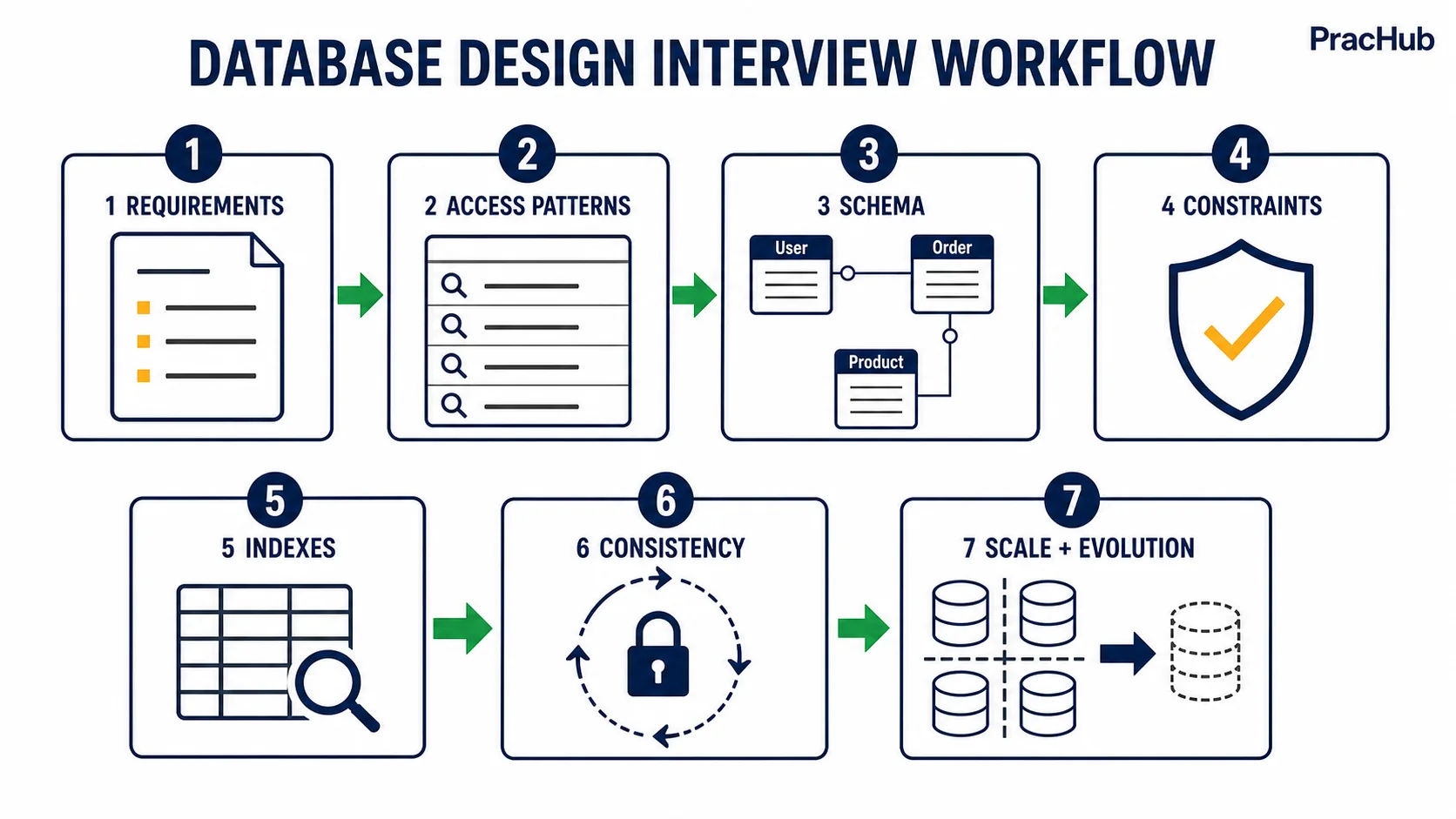
In a strong database design interview, you should be able to move through this chain:
requirements -> access patterns -> entities and invariants -> keys and constraints -> indexes -> consistency -> scale and evolution
The schema is only one output. The real signal is whether every choice serves a workload and whether you can explain what becomes slower, riskier, or harder to change because of that choice.
What Is a Database Design Interview?
A database design interview is an open-ended technical round in which you translate a product scenario into a durable data model. The prompt may ask you to design the database for a marketplace, booking service, chat product, inventory system, social feed, or billing workflow.
Unlike a SQL coding round, you are not mainly being tested on query syntax. Unlike a broad system design round, you usually spend more time on data shape, access paths, integrity, concurrency, and schema evolution than on every service in the architecture.
A typical conversation includes requirements, important reads and writes, tables or collections, keys, indexes, invariants, scale, and a late requirement change.
Use This Seven-Step Database Design Framework
1. Clarify the product boundary
Ask who uses the system, what the core workflow is, and what is out of scope. Quantify only what can change a decision: read-to-write ratio, growth, peak traffic, retention, latency, and geography.
Do not start with "SQL or NoSQL?" Start with the problem. A useful opening is: "I will first identify the invariants and highest-value access patterns, then choose a model that supports them."
2. Write the access patterns
An access pattern is a specific read or write the application must perform, including its filters, ordering, cardinality, and frequency. Write the critical ones before drawing the physical schema.
AWS makes this explicit in its DynamoDB modeling guidance: NoSQL schema design should begin only after the questions the model must answer are known. The habit also improves relational designs by preventing guessed indexes and joins.
| Access pattern | Shape | Design pressure |
|---|---|---|
| Fetch one order by ID | Point read | Stable unique key |
| List a user's recent orders | Filter plus newest-first sort | Composite index and pagination |
| Reserve one seat | Conditional write | Atomicity and uniqueness |
| Search events by city and date | Multi-field search | Read model or search index |
| Expire abandoned holds | Time-based batch update | Expiration index and safe retries |
For each row, state expected result size and whether stale data is acceptable. That last question often changes the entire design.
3. Model entities, relationships, and invariants
Name the durable business objects and their lifecycle before listing every attribute. Then identify one-to-one, one-to-many, and many-to-many relationships.
An invariant is a rule that must remain true under retries and concurrency: an email is unique, an order total is nonnegative, or one seat cannot belong to two confirmed orders. Invariants tell you where constraints or transactions belong.
PostgreSQL's official constraint documentation covers check, not-null, unique, primary-key, and foreign-key constraints. In an interview, using the database to enforce a critical rule is usually stronger than saying every caller will remember to validate it.
4. Choose keys and the source of truth
Explain why each primary key is stable, unique, and suitable for the expected distribution. Natural keys carry meaning but may change; surrogate keys are stable but usually need a separate business-identity constraint.
Also state which table or collection is authoritative. If you duplicate data for faster reads, label it as a derived representation and explain how it is updated, repaired, and rebuilt.
5. Map indexes to queries
Do not say "we will add indexes" as a general performance answer. Name the query, the filter order, the sort order, and the proposed index.
For WHERE user_id = ? ORDER BY created_at DESC LIMIT 20, a composite index such as (user_id, created_at DESC) directly reflects the access pattern. PostgreSQL notes that indexes speed row retrieval but also add system overhead, so they should be used deliberately in its index documentation.
Every index has write, storage, cache, and maintenance cost. Mention that cost rather than indexing every plausible filter.
6. Define consistency and transaction boundaries
Ask what can be eventually consistent and what cannot. A delayed event-search result may be acceptable. Selling the same seat twice is not.
Draw the smallest transaction that protects the invariant. For a seat reservation, that may be a conditional state transition from available to held, a unique ownership rule, and an expiration time. Explain how retries remain idempotent and how concurrent attempts fail safely.
Isolation levels determine which concurrent effects a transaction can observe; PostgreSQL documents the behaviors and anomalies in its transaction isolation guide. You do not need to lecture on every level. Tie the selected behavior to one concrete race condition.
7. Pressure-test scale and evolution
Introduce partitioning, sharding, or denormalization only after identifying the bottleneck. Choose a partition key that supports high-volume access without concentrating traffic.
Google Spanner's schema design guidance shows why monotonically increasing leading keys can create write hotspots. PostgreSQL recommends partition columns that commonly appear in query predicates in its partitioning guide.
Then test a product change: multiple currencies, soft deletion, audit history, multi-tenancy, or a new sort order. A good design can evolve without a risky one-shot rewrite.
Worked Example: Design a Ticket Marketplace Database
Suppose users browse events, choose seats, hold them for five minutes, pay, and review past orders. The most important invariant is that one seat cannot be sold twice.
Core relational schema
Start with these tables:
users(id, email, created_at)with a unique email constraint.events(id, venue_id, starts_at, status).seats(id, venue_id, section, row_label, seat_number)with a unique venue-position constraint.event_seats(event_id, seat_id, price, state, hold_id, hold_expires_at)with(event_id, seat_id)as the key.orders(id, user_id, status, total_amount, currency, created_at).order_items(order_id, event_id, seat_id, unit_price)with a uniqueness rule preventing one confirmed event seat from appearing twice.payments(id, order_id, provider_reference, status, idempotency_key).
Keep price snapshots on order_items. The event price may change later, but a historical order must preserve what the buyer paid.
Access paths and indexes
Use (user_id, created_at DESC) for order history and (event_id, state, section) for filtering available seats. Event discovery by city, text, popularity, and date may outgrow ordinary relational indexes, so treat a search index as a derived read model while the relational database remains authoritative.
The hold path needs a conditional update and expiration cleanup. A worker can query hold_expires_at, but each release must recheck state so a delayed retry cannot reopen a purchased seat.
Trade-offs to say aloud
The normalized core improves integrity and keeps venue seats reusable across events, but it requires joins. The search projection makes discovery faster, but it can be stale and needs replay or repair. Strong consistency protects seat ownership, while event search can tolerate short delays.
That is the level of explanation the interview needs: not a perfect schema, but a coherent set of choices tied to correctness and workload.
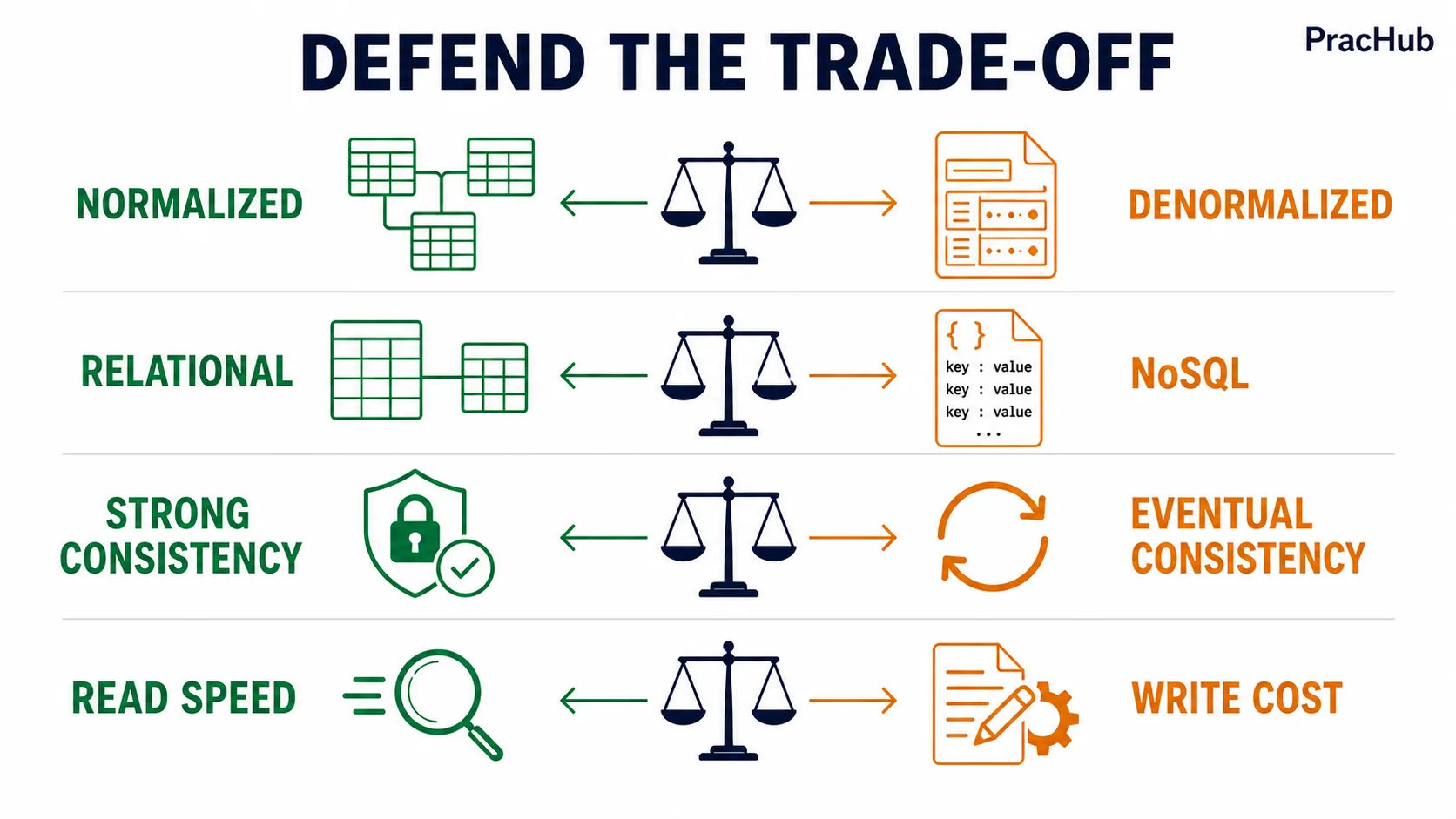
The Trade-Offs You Should Be Ready to Defend
Normalization vs denormalization
Normalize data with one authoritative identity or cross-write consistency needs. Denormalize a measured, high-value read when a join or aggregation is too expensive, then explain update ownership, staleness, and repair.
Relational vs NoSQL
Prefer a relational model when flexible querying, multi-row transactions, and declarative constraints dominate. Key-value or document models can fit predictable, high-volume access, but relationships and duplication move into application logic. This is a workload decision, not a scale slogan.
Strong vs eventual consistency
Use stronger guarantees for money, ownership, inventory, and irreversible transitions. Use eventual consistency for derived search, analytics, counters, or feeds when the product can tolerate lag. State the user-visible failure mode of stale data.
Read speed vs write cost
Indexes, materialized views, caches, and duplicated documents accelerate reads but increase write amplification, storage, invalidation work, and complexity. Pay that cost only for important access paths.
How to Handle Schema Changes in Your Answer
Interviewers often add a new requirement after the first design. Do not erase the diagram and start over. Describe an incremental migration.
A practical expand-and-contract path is to add the new structure, write both old and new forms, backfill existing rows, compare results, move reads, stop old writes, and remove the legacy field after verification. Stripe describes this staged dual-write pattern in its engineering article on online migrations at scale.
Mention batching, observability, rollback, and backward compatibility. Schema evolution is where a plausible whiteboard model becomes a production-minded answer.
A Practical Interview Scorecard
After each practice round, score yourself from 0 to 2 on six dimensions: requirements, access patterns, schema clarity, integrity, performance, and evolution. A zero means missing, one means mentioned, and two means defended with a concrete reason.
The score is less important than the gaps it exposes. If you drew a polished schema but cannot name the top three queries, redo the round. If every read is fast but concurrent writes can violate an invariant, fix correctness before adding scale.
Common Database Design Interview Mistakes
The first mistake is choosing a database brand before understanding the workload. The second is treating normalization as a purity contest instead of a correctness and change-management tool.
Candidates also over-index every column, add sharding without a traffic model, and say "use a transaction" without defining its boundary. Finally, many answers ignore deletion, audit history, retries, and schema migration. One well-chosen follow-up in each area is stronger than a long list of technologies.
Database Design Interview Questions to Practice
Practice prompts that force different trade-offs:
- Design the database for a food-delivery order and courier workflow.
- Model a multi-tenant project-management product with permissions and audit history.
- Design chat conversations, unread counts, edits, and message search.
- Model inventory reservations across warehouses without overselling.
- Design a subscription billing ledger with retries and adjustments.
For every prompt, change one requirement after 20 minutes. Add a new sort order, regional data residency, soft deletion, or a sudden write hotspot. The change tests whether your model is understood or merely memorized.
Database Design Interview FAQ
How much SQL should I write?
Usually enough to make important constraints and queries concrete. Show table definitions, keys, one or two indexes, and the hardest read or write. Do not spend the entire round polishing syntax unless the interviewer explicitly requests executable SQL.
Should I draw an ER diagram?
Yes, when relationships matter. Keep it readable: entity names, primary keys, critical foreign keys, and cardinality. Add secondary attributes only when they affect an access pattern, invariant, index, or migration decision.
Do I need to know every normal form?
Know why duplication can create update anomalies and how to decompose common relationships. Interview performance depends more on applying normalization and deliberate denormalization to the prompt than reciting formal definitions through 5NF.
What if the interviewer asks for NoSQL?
List the access patterns first, then design keys, item groups, secondary indexes, and duplication around them. Explain consistency, item-size limits, hotspots, and how new access patterns would be added. Do not force a relational ER diagram into a key-value model.
Final Takeaway
A strong database design interview answer begins with product behavior and ends with a model you can defend under change. Access patterns explain the schema; invariants explain the constraints; workload explains the indexes; failure modes explain the consistency; growth explains the partitioning.
Use PracHub to practice real interview questions with written solutions, compare the loop across target companies, and rehearse the database portion alongside full system design practice. Draw less by reflex, ask better questions, and make every table earn its place.
Comments (0)