Databricks Interview Questions for Data Engineers: Spark, Delta Lake, and Lakehouse Design
Quick Overview
A practical guide to Databricks data engineer interviews covering Spark execution and tuning, Delta Lake reliability, lakehouse architecture, production debugging, project deep dives, and a focused seven-day preparation plan.
A Databricks data engineering interview rarely stays at the level of definitions. One minute you are explaining lazy evaluation; the next, the interviewer asks why one Spark task runs 40 times longer than the rest, whether a Delta MERGE is safe to retry, and how you would redesign a lakehouse that cannot meet its freshness SLA.
This guide helps you answer those questions as an engineer who has operated pipelines, not as someone reciting a certification glossary. Start with PracHub's Data Engineer interview questions and the Databricks Data Engineer questions, then use the framework below to connect Spark mechanics, Delta Lake reliability, and lakehouse architecture.
Scope matters: interviewing at Databricks Inc. can include algorithms, distributed systems, and customer-facing judgment. Interviewing for a data engineer role that uses Databricks usually emphasizes PySpark, SQL, Delta Lake, pipelines, governance, performance, and project experience. Exact rounds vary by employer, location, seniority, and team.
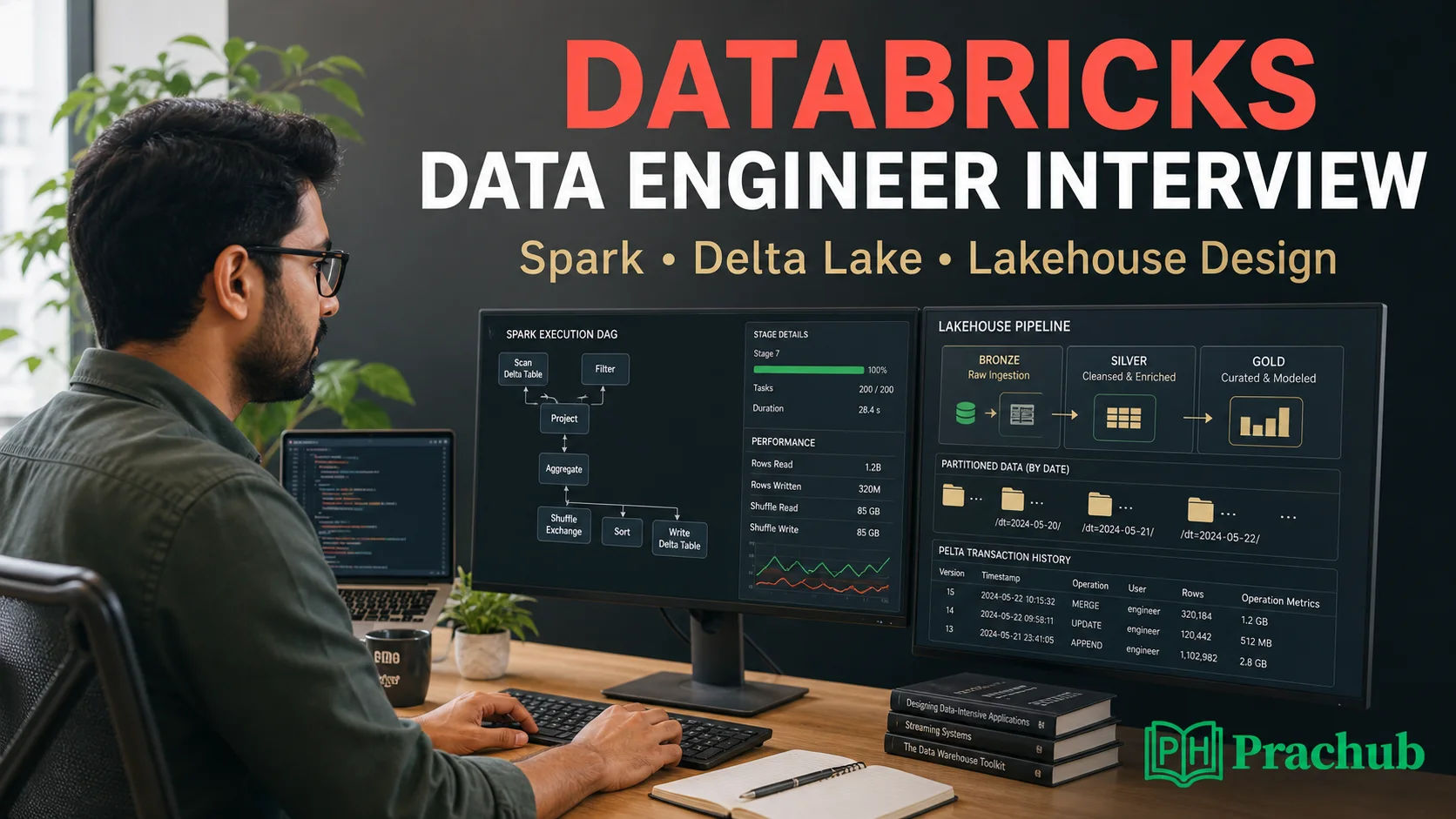
Prepare to connect Spark execution, Delta Lake reliability, and lakehouse design to production decisions.
Quick Verdict: What Strong Candidates Show
Current candidate discussions consistently point to the same pattern: interviewers care about how you reason through a production scenario. They may ask definitions, but the follow-up is usually about scale, failure, cost, or correctness.
| Area | Basic answer | Interview-ready answer |
|---|---|---|
| Spark | Name transformations and actions. | Trace a job through plans, stages, tasks, shuffles, skew, and spill. |
| Delta Lake | Say it adds ACID to a data lake. | Explain transaction-log behavior, idempotent writes, schema controls, maintenance, and recovery. |
| Lakehouse | Draw bronze, silver, and gold boxes. | Define contracts, replay, quality gates, ownership, serving needs, and cost trade-offs. |
| Projects | List tools you used. | Quantify scale, constraints, incidents, decisions, and measurable improvements. |
Spark Interview Questions You Should Be Ready to Answer
1. What does lazy evaluation actually buy you?
Spark transformations build a logical plan; an action triggers execution. Laziness gives Catalyst visibility into the full chain so it can push filters toward the source, prune columns, simplify expressions, and choose a physical plan before the cluster performs the work.
A strong answer uses an example. In a read -> filter -> select -> aggregate -> write pipeline, predicate and projection pushdown can reduce the bytes read before the expensive aggregation begins. The point is not just delayed execution; it is whole-plan optimization and less data movement.
2. How do jobs, stages, tasks, and partitions relate?
An action creates a job. Spark divides the job into stages at shuffle boundaries, and each stage contains tasks that process partitions in parallel. The driver coordinates the plan and scheduling, while executors perform the distributed work.
Then explain why wide transformations matter. Operations such as joins, groupings, distincts, and repartitions can move data across executors, adding network I/O, sorting, disk writes, and spill. This is why a technically correct pipeline can become slow or expensive as data volume grows.
3. When would you broadcast a join?
Broadcast the smaller side when it can fit safely in executor memory and doing so avoids shuffling the larger table. Do not decide from row count alone; serialized size, concurrent tasks, executor memory, and data growth all matter.
If the interviewer says the broadcast caused an out-of-memory failure, acknowledge that the table was not truly small under runtime conditions. Recheck statistics, examine the physical plan, remove unnecessary columns, or use a shuffle-based strategy. Databricks Adaptive Query Execution can change some join strategies at runtime, but it does not remove the need to understand the data.
How to Debug a Slow Databricks Spark Job
Do not answer a performance question with a list of configuration flags. Use a measurement-first sequence that narrows the bottleneck and protects correctness.
Step 1: Establish the regression
Confirm the input size, code version, runtime, cluster shape, data layout, and SLA. Ask whether the slowdown affects the entire job or one stage, whether it is repeatable, and what changed before the regression. A daily pipeline that slowed after one customer grew rapidly suggests a different cause than a job that slowed after a new Python UDF.
Step 2: Inspect the plan and runtime evidence
Use explain(), the Spark UI, and Databricks query or job metrics. Look for unexpected exchanges, scans, join strategies, task-duration outliers, shuffle read and write, spill, input size, and output file counts. If 199 tasks finish quickly and one remains, investigate skew before increasing every executor.
Step 3: Reduce work before adding compute
Filter and project early, preserve partition pruning and data skipping, replace row-by-row UDFs with built-in or vectorized operations where possible, and avoid repeated scans. Select a sensible partition count, compact excessive small files, and use caching only when the same expensive intermediate result is reused enough to justify memory pressure.
Step 4: Fix skew deliberately
Confirm the distribution of keys and partition sizes. Depending on the cause, options include AQE skew handling, salting hot keys, isolating dominant keys, pre-aggregating, or changing the join strategy. State how you will validate the fix: runtime and cost must improve without changing row counts, aggregates, duplicates, or business invariants.
Delta Lake Interview Questions
4. What does the Delta transaction log provide?
Delta Lake stores table changes as ordered commits in a transaction log alongside data files. Readers reconstruct a consistent table version, while writers use optimistic concurrency controls. This supports ACID transactions, schema enforcement, table history, time travel, and reliable batch or streaming reads and writes on object storage.
Move beyond the definition by explaining the operational implication: do not manipulate table files or log entries directly. Use supported table operations so metadata and physical files remain consistent.
5. How would you make a MERGE idempotent?
Define a stable business key and deterministic matching rules. Deduplicate the source for the intended grain, handle late corrections explicitly, and make the same input produce the same target state when retried. Record the source version or batch identifier so operators can audit what was applied.
A strong answer also addresses ambiguity. If multiple source rows match one target row, decide which event wins using a documented sequence or timestamp rule. Validate uniqueness, affected-row counts, and reconciliation totals before and after the merge.
6. OPTIMIZE, Z-ORDER, liquid clustering, or partitioning?
OPTIMIZE compacts files and, depending on the table configuration, can improve layout. Traditional partitioning can help stable, low-cardinality access patterns but creates problems when partitions are too granular. Z-ORDER historically colocated related column values for data skipping.
Current Databricks guidance recommends liquid clustering for many Delta tables because clustering keys can evolve without rewriting all existing data, and automatic liquid clustering can use observed workload patterns. In an interview, do not declare one feature universally best. Ask about table size, update frequency, filter patterns, maintenance cost, and the platform version.
7. What are the risks of VACUUM and schema evolution?
VACUUM removes unreferenced files after a retention period. Aggressive cleanup can break long-running readers or remove versions needed for time travel and recovery. Discuss retention requirements, legal or audit needs, and concurrent workloads before changing the default policy.
Schema enforcement rejects incompatible writes and protects downstream assumptions. Schema evolution can be useful for intentional changes, but uncontrolled auto-merge may allow unexpected columns or types into production. Pair evolution with data contracts, compatibility checks, ownership, and alerts.
Lakehouse Design Questions
8. How would you design bronze, silver, and gold layers?
Bronze preserves source fidelity, arrival metadata, and replayability. Silver applies validation, deduplication, type standardization, privacy rules, and conformed business keys. Gold serves stable business models, aggregates, features, or application-facing products.
The labels are not the design. Define who owns each dataset, what quality contract gates promotion, how late data and corrections flow through the layers, and how consumers discover trusted versions. Databricks describes medallion architecture as a recommended pattern, not a requirement for every workload.
9. Batch, streaming, or both?
Start with latency and correctness requirements. Streaming is appropriate when the business value of lower latency justifies state, checkpoint, replay, and operational complexity. Batch is often simpler for reproducible reporting and large backfills. A hybrid approach may serve near-real-time metrics while producing an authoritative daily result.
Explain event time, watermarks, deduplication, idempotent sinks, checkpoints, and late-event policy. Avoid saying “exactly once” as a magic property; clarify which guarantees come from the source, processor, and sink, and how the end-to-end result is verified.
10. Where do governance and cost enter the design?
Use Unity Catalog or equivalent controls to define ownership, lineage, least-privilege access, masking, and auditability across workspaces and data products. Separate sensitive domains and environments, and make service identities and external locations explicit.
For cost, connect compute choices to workload behavior. Right-size job compute, use autoscaling thoughtfully, reduce unnecessary scans and shuffles, track cost per pipeline or data product, and set budgets and alerts. A production lakehouse is incomplete if it has no recovery objective, freshness SLO, data-quality signal, or accountable owner.
A Production Answer Framework
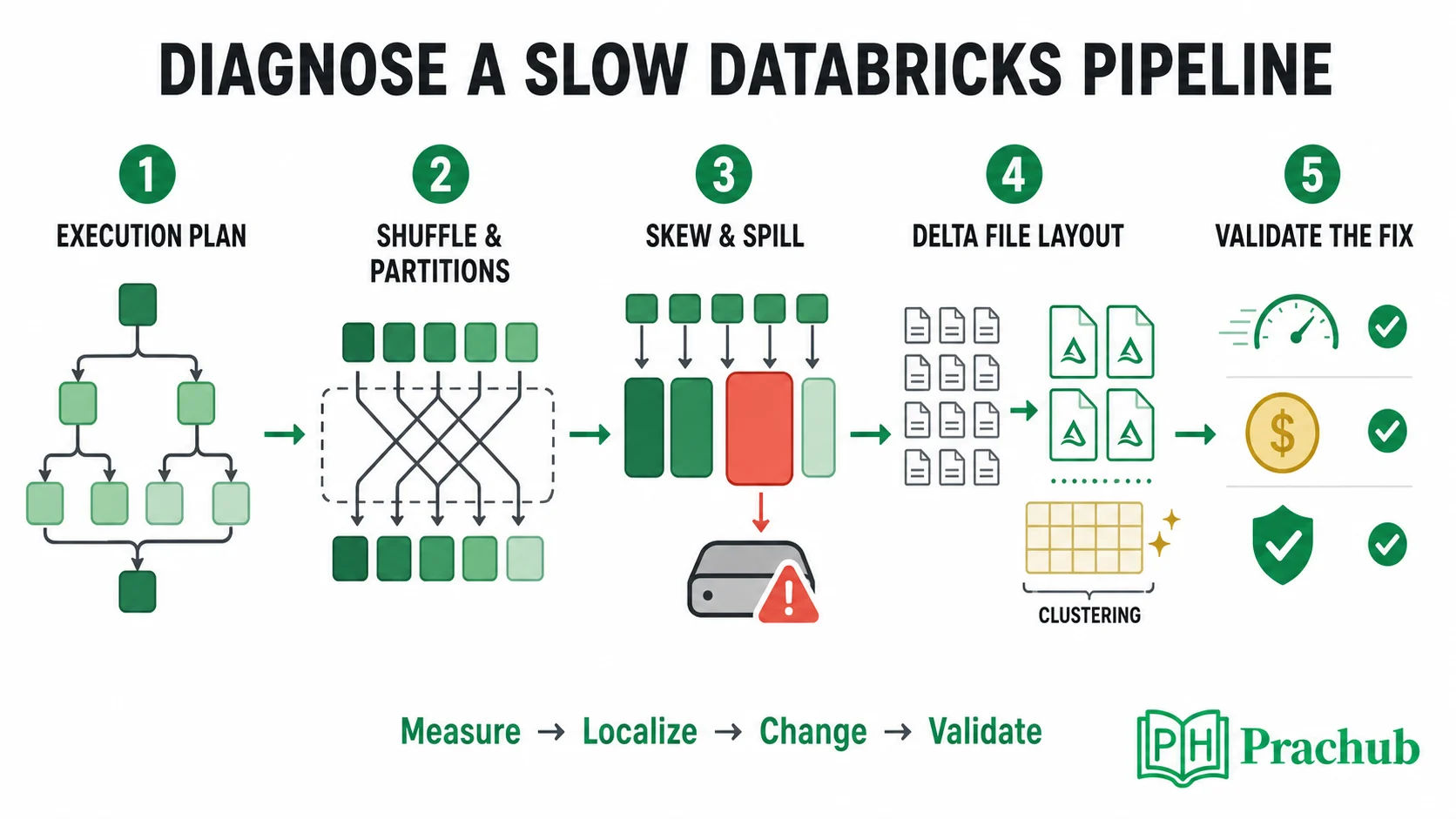
Move from evidence to the smallest safe fix, then validate both speed and correctness.
For any unfamiliar Databricks scenario, use five moves: clarify, measure, localize, change, validate. Clarify the SLA, scale, workload, and correctness requirement. Measure the current behavior. Localize the dominant cost or failure boundary. Choose the smallest change that addresses it. Validate performance, cost, and data correctness together.
For example, suppose a silver-layer pipeline misses its 30-minute SLA after volume doubles. You inspect the plan and find a shuffle join with one heavily skewed customer key, plus hundreds of tiny output files. You isolate the hot key or use AQE-aware skew handling, then compact and cluster the target based on observed filters. Finally, you compare p95 runtime, compute cost, row-level reconciliation, duplicate rate, and downstream freshness before declaring success.
Practice with PracHub Questions
Use these exercises to rehearse the Spark, pipeline, and lakehouse reasoning behind Databricks-focused interviews. They are practice records, not predictions of an exact employer's interview.
| PracHub question | Practice focus | Why it helps |
|---|---|---|
| Diagnose Data Quality and Pipeline Performance Issues | Databricks diagnosis, lakehouse trade-offs | Practices a structured customer and production troubleshooting answer. |
| Explain Spark Execution and Optimization | Plans, stages, shuffles, joins, skew | Connects Spark internals to measurable tuning decisions. |
| Choose Between Batch and Streaming for a Data Pipeline | Latency, replay, late data, correctness | Builds the trade-off reasoning expected in lakehouse design rounds. |
| Design Data Quality and Observability Pipeline | Validation, ownership, alerts, recovery | Turns a working pipeline into an operable production system. |
A Seven-Day Databricks Interview Plan
| Day | Focus | Deliverable |
|---|---|---|
| Day 1 | Spark execution | Explain lazy evaluation, plans, jobs, stages, tasks, and shuffles without notes. |
| Day 2 | Spark tuning | Diagnose two slow-job scenarios using plan and runtime evidence. |
| Day 3 | Delta Lake | Answer transaction log, MERGE, schema, time travel, OPTIMIZE, and VACUUM questions. |
| Day 4 | Lakehouse design | Design bronze, silver, and gold data products with contracts and replay. |
| Day 5 | Streaming and reliability | Defend batch versus streaming and explain late data, checkpoints, and recovery. |
| Day 6 | Projects and SQL | Prepare one quantified project deep dive and complete a timed SQL/PySpark set. |
| Day 7 | Mock round | Run a 45-minute scenario interview and tighten every evidence gap. |
Frequently Asked Questions
Are Databricks data engineer interviews mostly PySpark?
PySpark is common, but strong preparation also covers SQL, Delta Lake, data modeling, batch and streaming design, governance, reliability, and project experience. Senior roles usually probe trade-offs and production incidents more deeply than syntax.
Should I memorize every Databricks command?
No. Know the important operations and what problem each solves, but prioritize behavior and evidence. Explaining why a table has poor data skipping or why a retry duplicates records is more valuable than recalling a command without its failure modes.
Is medallion architecture always the right answer?
No. It is a useful layered design pattern, not a mandatory template. Use it when progressive refinement, replay, and separate consumer contracts add value. Simpler workloads may need fewer layers, while complex domains may need multiple products within each layer.
How should I prepare a Databricks project deep dive?
Be ready to state scale, SLA, architecture, your ownership, the hardest failure, alternatives considered, and measured outcome. Prepare follow-ups on skew, schema changes, retries, backfills, security, observability, and cost. Avoid claiming “we used Databricks” as the design decision.
What if I do not know a Databricks-specific feature?
State what you know, clarify the requirement, and reason from distributed data principles. Describe the evidence you would inspect and the trade-off you would test. A disciplined approach is stronger than inventing product behavior.
Final Takeaway
The best Databricks interview answers connect three layers of reasoning: how Spark executes work, how Delta Lake preserves reliable table state, and how a lakehouse serves governed data products. Start with the workload and SLA, inspect evidence, choose the smallest effective change, and validate correctness alongside speed and cost.
PracHub helps turn that knowledge into interview behavior. Work through the linked questions, write your answer before viewing guidance, and practice defending each choice under follow-up pressure.
Sources and Further Reading
- Databricks Documentation: What Is a Data Lakehouse?
- Databricks Documentation: Medallion Lakehouse Architecture
- Databricks Documentation: What Is Delta Lake?
- Databricks Documentation: Liquid Clustering for Tables
- Databricks Documentation: Adaptive Query Execution
- Databricks Documentation: Optimization Recommendations
- Databricks Documentation: Schema Enforcement
- Candidate Discussion: Databricks Data Engineer Interview Topics, August 2026
- Candidate Discussion: Spark and Delta Lake Interview Focus, May 2026
- Candidate Discussion: Production Data Engineering Interview Gaps, August 2026
Research note: This guide was reviewed on August 20, 2026. Product behavior and interview formats can change, so confirm role-specific expectations with your recruiter and current Databricks documentation.
Related Articles
Airflow Interview Questions for Data Engineers: DAGs, Scheduling, Backfills, and Failures
Prepare for Airflow interviews with practical questions on DAGs, scheduling, catchup, backfills, retries, pools, sensors, and pipeline failures.
Jane Street Data Engineering Internship 2027: Interview Process, SQL, and Systems Questions
Prepare for Jane Street's 2027 Data Engineering Internship with verified process details, SQL and Pandas practice, systems topics, and a 7-day plan.
Snowflake Interview Questions for Data Engineers: Warehouses, Micro-Partitions, and Query Tuning
Prepare for Snowflake data engineer interviews with warehouse sizing, micro-partition pruning, query tuning, ingestion, SQL, and scenario-based questions.
IBM Data Engineer Intern OA 2027: Coding, SQL, and the Recorded Competency Assessment
Prepare for the IBM Data Engineer Intern OA 2027: coding, SQL, recorded video questions, work preferences, timelines, and a 7-day plan.
Comments (0)