DataLemur vs StrataScratch vs Interview Query: Which One Is Best?
Quick Overview
This comparison article evaluates DataLemur, StrataScratch, and Interview Query, covering pricing, question bank scope and limits, where each platform's model breaks down, interview-loop diagnosis, a decision framework tied to specific interview stages, a four-week preparation plan, and common prep mistakes.
If you are preparing for a data analyst, data scientist, data engineer, or product analyst interview, the same three names keep showing up: StrataScratch, DataLemur, and Interview Query. All three are real products with real customers. All three also want a subscription from you before either of you knows what is actually wrong with your interviewing. That is the part these comparisons usually skip, so this one leads with it: what each platform is built to fix, what it charges you in money and in time, where its model breaks down, and where PracHub fits as the broader practice layer you should exhaust before committing to a paid, data-only tool.
The article moves from a side-by-side comparison, to a blunt review of each platform, to a decision framework tied to your specific interview loop, then a four-week plan and the mistakes that waste the most prep time.
Key Takeaways
- Pick the tool that matches your bottleneck, not the one with the longest feature list. A SQL screen next week and a full data science onsite in six weeks call for completely different purchases.
- DataLemur's premium bank is small on purpose. As of this writing, per DataLemur's own pricing page, the subscription gates 100+ SQL questions and 70+ data science questions. A motivated candidate can work through that in a few weeks, after which a monthly plan is renting problems you have already solved.
- Interview Query's 6,000+ company guides cannot all be current. No team keeps thousands of hiring loops verified while those loops change every couple of quarters. Read any company guide as a snapshot of the past, not a description of the round you are walking into.
- StrataScratch's breadth is a cost, not only a benefit. Every session on a platform with that many modules starts with a decision you are not qualified to make yet, and decisions you make badly at 9pm are how prep weeks disappear.
- Diagnose before you buy. Most candidates discover their real gap is not the one they assumed, and a week of untargeted grinding is the most common way to waste prep time.
- PracHub covers real interview questions with written solutions, coding and SQL practice consoles, and company and role filters, with a free tier that covers most of the question bank, which makes it a low-commitment place to find your gap first.
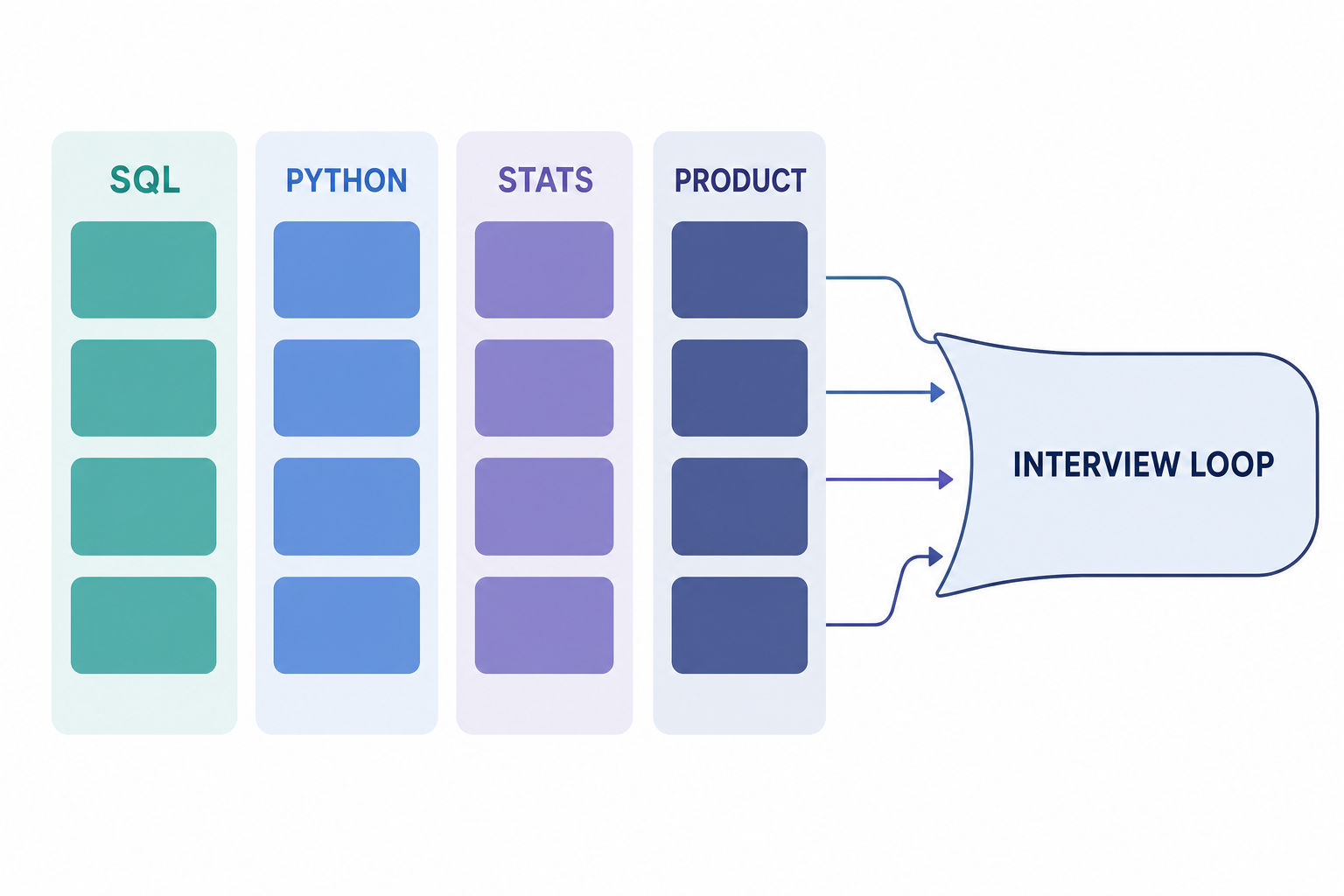
Start With Your Loop, Not the Product Page
Every comparison article wants to end with a winner. That framing fails here because the three platforms are not competing for the same job. The useful first question is which part of your interview loop is weakest, and the tool follows from that answer.
Data loops vary more than software engineering loops do. A product data science loop at a large consumer company may lean on metrics reasoning and experiment design. A BI or analytics engineering loop may lean on SQL depth, data modeling, and warehouse thinking. A machine learning loop may spend most of its time on modeling judgment and statistics. The same generic prep plan cannot serve all three, and no platform's onboarding quiz can tell them apart better than one week of your own failed attempts can.
For instance: two candidates both say "I need SQL practice." The first has an onsite in five weeks and has never written a window function. The second writes clean SQL but froze last month when an interviewer asked why she chose a left join and what happens to the metric when a user has no orders. The first candidate needs volume and a solutions-led platform. The second needs to practice explaining her reasoning out loud against real prompts. Buying the same subscription would help only one of them, and the other would spend six weeks feeling productive while the actual gap sat untouched.
The Platforms Side by Side
With the framing set, here is how the four options compare on the dimensions that actually change your decision. Feature descriptions below reflect what each platform advertises on its own site; those change, so confirm before you subscribe.
| Platform | Built around | Strongest for | What it will not do for you | Pick it when |
|---|---|---|---|---|
| StrataScratch | Interactive practice across SQL, Python, and hosted data projects | Execution reps, company-tagged data questions, project portfolio work, AI mock practice | Anything outside data roles; keeping you focused when you already know your one gap | You want to do the work, not read about it |
| DataLemur | A focused SQL and data science question bank with hints and full solutions | SQL fundamentals, analyst-style prompts, statistics and probability questions, solution-led learning | Python execution, project work, or coverage of a full loop; and the bank is finite enough to exhaust | SQL is clearly your single bottleneck |
| Interview Query | A full data science prep ecosystem: learning paths, lessons, company guides, take-homes, mocks, coaching | Product sense, A/B testing and statistics, take-home practice, structured study paths | Get you ready in two weeks; you will pay for a library you cannot finish | You are preparing for an entire DS loop |
| PracHub | Real interview questions with written solutions, plus coding and SQL practice consoles | Company and role filtering, full-loop coverage beyond data-only topics, low-commitment diagnosis | Hosted portfolio notebooks, paid 1:1 coaching | You want to find your gap before you pay for depth |
A useful way to read that table: the first three columns tell you what you are buying, the fourth tells you what you are still going to be missing afterward, and the last tells you whether you need any of it yet.
StrataScratch: Reps If You Can Stay Focused
StrataScratch is the most hands-on option in this comparison, and that is its whole identity. Per StrataScratch's own homepage as of this writing, the product is built around 1,000+ real coding and concept questions from top companies, an interactive editor for SQL and Python, concept coverage spanning system design, product sense, business cases, statistics, probability, modeling, and technical behavioral, plus cloud-hosted Data Labs notebooks for projects and AI-powered mock interviews.
Where it wins. Breadth within data interviews. If you genuinely do not know whether your loop will be pure SQL, Python and pandas work, or a broader analytical case, having those under one login removes a decision you do not have enough information to make. The interactive editor also exercises the thing that actually fails in a live round: typing a correct query under a clock, not recognizing one on a page.
Where it costs you. That same surface area is the problem. A platform with interview questions, analytical questions, algorithm questions, visualization questions, concept questions, Data Labs, Strata Projects, notebooks, mock interviews, and a tools section hands you a new decision every time you sit down, and candidates two weeks from a screen consistently spend that decision badly. If your gap is already known and narrow, breadth is not a feature you are using; it is a feature you are financing.
Two more things to be clear-eyed about. First, the AI mock interviews and AI feedback are practice, not a verdict. A model responding to your answer is a rehearsal aid, and a good one for getting used to talking while you think, but it has never sat on a hiring committee and its feedback is not evidence you would pass. Treat it as motivational, not diagnostic. Second, a portfolio project you build from the platform's hosted project catalog is a project every other subscriber can build from the same catalog. It is genuinely better than having no project at all. It is not the differentiator the pitch implies.
The original framing of this platform holds up: it is data-role-specific. If your loop includes rounds outside data work, StrataScratch covers none of them, and you will be paying for a second thing anyway.
When StrataScratch is the better fit. When your gap is execution speed and you learn by doing. If you fumble in a live editor, no amount of reading solutions fixes that, and hands-on reps in SQL and Python under a clock will. Worth knowing before you pay anyone: per their own homepage, the SQL and Python learning paths are advertised as free with no premium required. If you are still at foundations level, take them up on that before you put a card down anywhere.
Example scenario: an analytics candidate with an onsite that includes a live coding round in Python and a case discussion. She spends two weeks alternating between Python prompts and concept questions, then builds one small project she can reference when asked "tell me about an analysis you owned end to end." That is StrataScratch used well, because it exercises execution rather than recognition.
DataLemur: A Tight SQL Loop, and a Bank You Will Finish
Where StrataScratch spreads out, DataLemur narrows down, and for a large group of candidates that is exactly right. It is built by Nick Singh, author of Ace the Data Science Interview, and as of this writing, per DataLemur's own pricing page, Premium runs $15 per month or $60 per year, with a separate $300 bundle that combines a one-hour video call with the founder, a signed copy of the book, and lifetime access. The same page states what the subscription gates: 100+ SQL interview questions with multiple hints and full solutions, and 70+ data science questions spanning statistics, probability, and machine learning.
Where it wins. The hint ladder. Being able to take one nudge instead of jumping straight to the answer is genuinely good pedagogy, because the moment you get unstuck is where the learning happens. At $15 for a month, if SQL is your one gap and your screen is in ten days, that is a cheap, well-aimed purchase and you should stop reading and go do it.
Where it costs you. The catalog is small, and you should price it that way. A hundred-odd SQL problems is a few focused weeks, not a season. If you are three months into a search on the monthly plan, you are paying repeatedly for a bank you finished in week three; the yearly tier is the honest one, and the monthly tier quietly bets on you not noticing. Buy the year or buy one month and finish it.
The book overlap deserves saying out loud too. Per their own pricing page, the data science questions come from Ace the Data Science Interview, and the founder's own explanation is that DataLemur exists because readers wanted an interactive way to practice the book's questions. If you already own the book, a chunk of what you are paying for is a nicer interface on material sitting on your shelf.
Then the $300 bundle. What it buys, per their own page, is one hour of video call, one book, and lifetime access to a bank of 250+ questions. We think that is a bad trade for most engineers. One hour of anyone's time does not fix an interview loop, and paying five years of the annual price up front converts a small recurring decision into a single large bet placed before you know what is wrong with you. If the hour is what you want, buy it after you have exhausted the $60 tier and can name the exact thing you would ask about.
One last note on their own sales logic. DataLemur's pricing FAQ argues the product is worth it because data jobs pay $120,000 and up. That reasoning justifies any price for anything, which is why it is popular in prep marketing and why it should not move you. The relevant question is not whether $15 is small next to a salary; it is whether this particular bank closes your particular gap.
When DataLemur is the better fit. When SQL is the single thing between you and an offer, you want structured hints rather than instant answers, and your window is short. That is a real and common situation, and the narrow scope serves it better than anything broader would.
Example scenario: a product analyst candidate with a SQL screen in ten days works through progressively harder aggregation and window-function problems, uses at most one hint per problem, and writes a one-sentence note after each on what he missed. Ten days, one skill, one month of subscription, measurable progress. Adding a second platform to that plan would have diluted it.
Interview Query: A Curriculum You Will Not Finish
If DataLemur is a drill and StrataScratch is a gym, Interview Query is a curriculum. Its site advertises a large bank of questions alongside thousands of company guides, learning paths, hundreds of lessons, take-home challenges, mock interviews, coaching, and a job board, covering product intuition, SQL and analysis, Python scripting, statistics and A/B testing, machine learning, modeling, and probability.
Where it wins. Data science loops are messy in a way that pure SQL practice does not prepare you for. One round asks you to design an experiment for a feature launch, the next asks how you would detect a broken metric, the next is a take-home you have 48 hours to finish. Sequencing through those topics in a sane order is worth real money when you have weeks rather than days, and that sequencing is the actual product.
Where it costs you. Do the arithmetic on the library. Nine learning paths, hundreds of lessons, dozens of take-home challenges: nobody clears that in the four to six weeks they actually have before an onsite. You are buying a library and using a small slice of it, and the unused remainder is not free, because every module you have not opened is a low-grade reason to feel behind. Breadth two weeks out from a SQL-heavy screen is worse than useless; it invites you to study the wrong things thoroughly.
The company guides need a harder look. A catalog of 6,000+ company guides cannot be a set of verified, current descriptions of 6,000 hiring loops. Interview processes get rewritten every few quarters, and aggregated guides at that scale are compiled from whatever was reported whenever it was reported. Use them for orientation. Do not walk in believing a guide has told you what your round will be, and do not skip checking recent first-hand accounts because a guide already gave you a confident-sounding answer.
Coaching carries the same structural warning as anywhere else: it converts a diffuse problem into one expensive session, and it only pays off if you arrive with a specific question. Buy it last, not first.
When Interview Query is the better fit. When you are six weeks out from a genuine full data science loop, your weak areas are conceptual rather than mechanical, and you want someone else to decide the order you learn things in. That is a narrow case, and inside it the platform is the right answer.
Example scenario: a candidate six weeks from a product data science onsite follows a learning path for experimentation and metrics, completes two take-home challenges under a real time limit, and books one mock interview in week five specifically to practice thinking out loud. The value came from sequencing, not from any single question, and she ignored roughly 90% of the library on purpose.
Where PracHub Fits
Everything above assumes you already know your bottleneck. Most candidates do not, and that is the gap PracHub fills.
PracHub is built around real interview questions with written solutions, coding and SQL practice consoles you can run answers in, and filters by company and role. Most of the question bank sits on the free tier, which matters here for one practical reason: you can find out where you actually break before you spend money on depth in the wrong direction. We think you should not pay for any of the platforms above before you have exhausted a free bank and can name your gap in one sentence.
Three concrete uses:
- Diagnose. Work through a mixed set from the question bank and note whether you fail on syntax, on logic, or on explaining the answer. Those three failure modes point to three different purchases, and two of them point to no purchase at all.
- Target a company. If your interview is at a specific employer, start from that company's page, for example Google or Meta, rather than from a generic data science plan. PracHub filters by company and by role; before you commit money elsewhere, check that whatever you are about to buy lets you do the same, and how recent its company material actually is.
- Cover the whole loop. Filter by role, such as data scientist, or by category, such as SQL and Python, system design, or behavioral and leadership, so that the non-technical rounds get attention too, not just the technical screen. Longer-form walkthroughs live under interview guides and resources.
Example: a candidate convinced she needed a SQL subscription attempts eight real questions cold. She solves six correctly but cannot articulate why her joins are safe on any of them. Her gap was explanation, not syntax. The right next step was practicing out loud against written solutions, not buying 200 more SQL problems. The subscription she almost bought would have made her better at something she could already do.
To be fair about the tradeoff: PracHub does not offer hosted portfolio notebooks or paid one-on-one coaching. If those are specifically what you need, one of the platforms above is the better purchase and you should make it.
Which One Should You Choose?
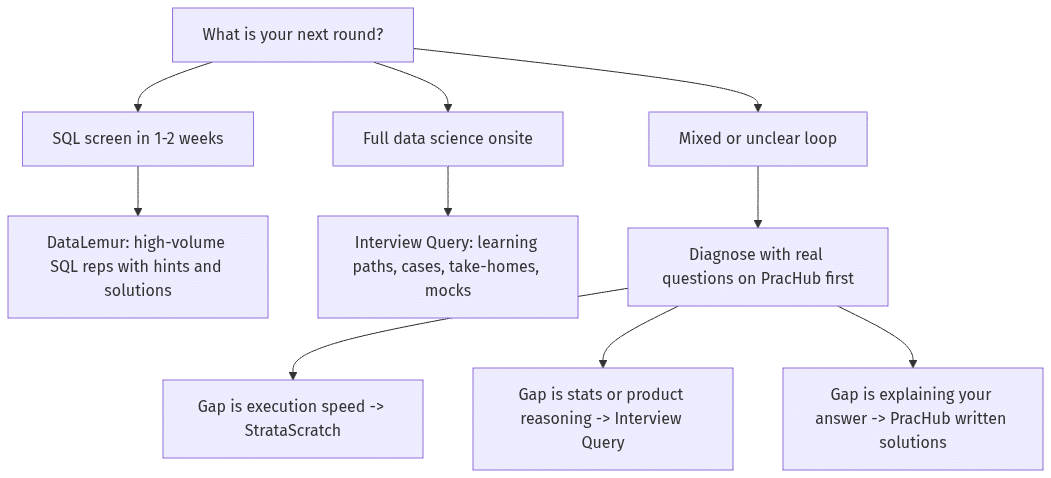
Map the symptom to the fix rather than the brand to the budget.
| Your symptom | What it usually means | Where to go |
|---|---|---|
| You stall on syntax and forget window function structure | Volume gap | DataLemur, or SQL and Python practice on PracHub |
| You solve slowly and fumble in a live editor | Execution gap | StrataScratch |
| You cannot design an experiment or reason about a metric drop | Concept gap | Interview Query |
| You solve correctly but cannot explain your choices | Communication gap | Written solutions plus out-loud practice, not another subscription |
| You do not know which of the above you are | Diagnosis gap | Free-tier questions on PracHub first, and buy nothing this week |
| You are strong technically but vague on impact stories | Behavioral gap | Behavioral and leadership questions on PracHub |
If two rows describe you, fix the one that appears earliest in your loop. A brilliant onsite performance never happens if the screen filters you out.
A Four-Week Plan That Works on Any of Them
Tools do not create progress; the loop you run inside them does. This sequence works regardless of which platform you land on.
- Week 1, diagnose. Attempt 10 to 15 real questions cold with a timer. Record each failure as syntax, logic, or explanation. Buy nothing. A purchase made this week is a guess.
- Week 2, drill the top gap. Pick the single most frequent failure type and do daily reps on it. This is the week where a narrow paid tool earns its money, if you need one at all.
- Week 3, widen to the loop. Add the rounds you have been avoiding, usually product sense, statistics, or behavioral stories.
- Week 4, simulate. Full-length timed attempts, spoken aloud, no pausing to look things up. Mocks are worth more here than they are in week one.
The per-question loop matters as much as the weekly one:

Worked example of week 1 output: twelve attempts produce four syntax failures, two logic failures, and six cases where the answer was right but the explanation was thin. The plan writes itself. Week 2 is spoken explanation practice, not more problems, and not a subscription.
Common Mistakes to Avoid
The plan above fails in predictable ways. These are the failures worth naming.
Buying the broadest platform first. More features does not mean better preparation. Coverage you do not need is time you do not have and money you spent on modules you will never open. Decide the loop first, then the tool.
Paying for a question bank before you have exhausted a free one. This is the single most common wasted purchase in data interview prep. Every platform in this comparison sells access to questions, and none of them can tell you which questions you need. No prep site is completely free, but you can get far enough on free material to know what you are buying before you buy it.
Mistaking an AI score for a hiring bar. AI mock interviews and automated answer grading are useful rehearsal. They are not a pass/fail signal, and a high score is not evidence that a human panel would have advanced you. Use them to get comfortable talking, then get a real human to push back on you.
Practicing SQL as pure syntax. Interviewers rarely stop at "does it run." They ask why the join is correct, what duplicates do to the result, how nulls change the output, and how the number connects to a business decision.
Example, weak answer: "I joined orders to users and grouped by month."
Example, stronger answer: "I aggregated orders per user before joining, because a user can have many orders and joining first would fan out the user rows and double-count. I excluded canceled orders since the metric is completed revenue, and I used a left join so months with zero orders still appear as zero instead of dropping out of the series."
Same query, completely different signal.
Trusting a company guide as current. Guides at scale are compiled, not verified, and hiring loops change. Read them for orientation, then check recent first-hand reports before you build a study plan on top of one. Starting from a company page such as Google is more useful when you know how fresh what you are reading is.
Underpreparing behavioral rounds. Data candidates over-index on technical work and then struggle to describe ambiguity, tradeoffs, and stakeholder pushback. Those rounds are graded, and they are frequently where borderline candidates are decided. Behavioral and leadership questions are worth the same structured practice as SQL, and no data-only platform in this comparison is built to give you that.
Treating solutions as reading material. Reading a solution feels like progress. Re-solving it cold 24 hours later is what proves the learning stuck. If you skip the second pass, you are collecting recognition, not skill.
FAQ
Is StrataScratch better than DataLemur?
Neither is better in the abstract, and the honest answer depends on your window. StrataScratch is better if you want SQL, Python, project work, and mock-style practice in one place and you learn by doing; the cost is a large platform that keeps asking you to choose what to work on. DataLemur is better if your single bottleneck is SQL and you want focused questions with hints and full written solutions; the cost is a bank small enough to finish, and nothing outside data questions.
Is Interview Query better than StrataScratch?
They optimize for different things and both oversell breadth. Interview Query gives you learning paths, company guides, take-home challenges, mocks, and coaching, which suits a full data science loop several weeks out and is far too much machinery for anything shorter. StrataScratch is more execution-focused, which suits candidates who need hands-on reps in a coding environment. Time until your interview is usually the deciding factor.
Is DataLemur enough on its own for SQL interviews?
For many analyst and early-career data science screens, yes, provided you also practice explaining your reasoning out loud. Be realistic about size: per their own pricing page the subscription covers 100+ SQL questions and 70+ data science questions as of this writing, which is enough for a focused sprint and not enough for a long search. If your loop adds Python, product sense, or behavioral rounds, DataLemur does not cover them and is not trying to.
Is the DataLemur $300 lifetime and coaching bundle worth it?
For most engineers, no. Per DataLemur's own pricing page it bundles one hour of 1:1 coaching, a signed copy of the book, and lifetime access. That is a single large payment placed before you know your gap, and one hour of conversation does not restructure a preparation plan. Start with the $60 annual tier, work the bank, and only consider the bundle if you end up with a specific question that one hour of expert time would genuinely answer.
Is there a free alternative to StrataScratch, DataLemur, and Interview Query?
No prep site is completely free, but PracHub is a reasonable starting point because most of its question bank is on the free tier, with real interview questions, written solutions, coding and SQL practice consoles, and company and role filters. It is most useful before you commit money, since it helps you identify which paid platform, if any, matches your actual gap. StrataScratch also advertises free SQL and Python learning paths on its homepage, which are worth using before you subscribe to anything.
Can I use PracHub alongside one of these platforms?
Yes, and that is usually the better setup. Use PracHub to diagnose weak areas and practice real questions with written solutions, then add StrataScratch for hands-on SQL, Python, and projects, DataLemur for concentrated SQL reps, or Interview Query for a structured full-loop data science curriculum. What you should not do is run two paid subscriptions at once; that is a symptom of not having diagnosed the gap.
Which platform is best for data analyst interviews specifically?
Analyst loops usually weight SQL heavily, so focused SQL practice tends to pay off fastest, whether through DataLemur or SQL and Python practice on PracHub. Add StrataScratch if the role also tests Python. Interview Query is usually more curriculum than an analyst loop needs unless it includes product cases or take-home work.
How do I know when I am ready?
You are ready when you can solve a question you have never seen, inside the real time limit, while narrating your reasoning, and then defend your choices when the interviewer pushes back. Volume of problems completed is a poor readiness signal on its own, and it is the metric every paid platform is happiest to show you.
Final Verdict: Diagnose, Then Specialize
StrataScratch, DataLemur, and Interview Query each solve a real problem for a specific candidate. StrataScratch is the choice for hands-on SQL, Python, and project practice, if you can resist its breadth. DataLemur is the choice when SQL is the one thing standing between you and an offer, on the annual tier, ignoring the $300 bundle. Interview Query is the choice when you have weeks and an entire data science loop to prepare for, and you accept that most of the library will go unread.
What none of them can do is tell you which candidate you are, and all three are structured to sell you a subscription before that question gets answered. Solve it first, cheaply, with real questions and written solutions from the PracHub question bank, filtered to your target company and role. Spend a week finding out where you actually break, then buy depth in exactly that direction, or find out you did not need to buy anything at all. It is a slower start and a much shorter path.
Comments (0)