Does a Referral Help After an Online Assessment? What Changes and What Does Not
Quick Overview
A practical guide to whether an employee referral still helps after an online assessment, what it can influence, and what remains unchanged.
You finish an online assessment, close the coding editor, and then hear the sentence you wish had arrived earlier: "I can refer you." Is the opportunity already gone?
A referral can still help after an online assessment, but its influence is narrower than many candidates expect. It may add a trusted source, useful context, or recruiter visibility while your application is active. It generally cannot rewrite your score, erase failed tests, remove an integrity flag, bypass eligibility rules, or guarantee an interview.
Keep preparing while the application moves. The PracHub question bank lets you practice coding, design, and behavioral questions instead of treating a referral as a substitute for interview readiness.
Quick answer: does a referral help after an online assessment?
Sometimes, yes. The useful question is not simply whether referrals "work." It is which part of the hiring process is still open to new information.
An online assessment creates evaluation evidence: test-case results, code, timing, and sometimes integrity signals. A referral creates sourcing and context evidence: who knows you, how they know your work, and why they believe you fit the role. Those records may sit in the same recruiting system, but they do different jobs.
| Your current stage | Likely value of a referral | Best next move |
|---|---|---|
| Before applying | Highest chance of clean source attribution | Use the official referral link, then submit one accurate application |
| Applied but OA not started | May add attribution and relevant context | Ask promptly; follow the employer's stated process |
| OA complete and application active | Can still add context or internal advocacy | Ask once, give the job ID, and mention that the OA is complete |
| Rejected or requisition closed | Usually little leverage for that decision | Thank the employee and discuss a future suitable opening |
This table is a practical framework, not a universal policy. Employers configure referral systems differently, and the invitation, candidate portal, or recruiter remains the source of truth.
First separate three things candidates call a referral
Candidates often use one word for three different actions. That creates unrealistic expectations.
Referral attribution
This is the ATS source record that says an employee referred you. In Greenhouse, for example, an authorized user can update the referrer under a candidate's source and responsibility details. That shows that some systems can attach or correct referral attribution after a candidate record exists, although each employer decides whether and when to do so. Greenhouse documents the referrer field here.
Employee advocacy
This is more valuable than a name in a field. An employee who has worked with you can tell a recruiter, in a few specific sentences, what you built, how you handled ambiguity, and why your experience matches the role. That is new information about your candidacy, not a request to ignore the assessment.
A stranger clicking "refer"
If someone cannot describe your work, the referral may amount to source attribution and little more. It can still be legitimate, but it should not be presented as a personal endorsement. The difference matters because recruiters can distinguish a credible work-based signal from a generic request.
What a referral can change after the OA
It may correct or add the application source
If the company permits it, recruiting operations may connect an existing candidate to an employee referrer. Greenhouse's current documentation shows that referrer information is a candidate-source field and can be updated by authorized users. That makes a post-application referral technically possible in some ATS configurations, not guaranteed at every employer.
It can add context the assessment does not contain
An OA cannot explain that you owned a migration, debugged a production incident, or collaborated effectively with design and product. A short internal note can connect those facts to the job requirements. This is especially useful when the assessment was automatically distributed before a detailed resume review.
It may make a recruiter aware of an active application
An employee can sometimes point a recruiter to an application that is already in the system. That does not promise priority, but it can reduce ambiguity about whether the correct role, location, or requisition was used. The clean request is "Could you add relevant context if company policy allows?" rather than "Can you push me through?"
It can help with a future role
Even when the current decision is effectively complete, a genuine professional relationship can matter later. An employee may know which adjacent team fits your background, when a new requisition opens, or which experience gap to fix before reapplying.
What a referral does not change
It does not recalculate the OA
Assessment evidence remains assessment evidence. HackerRank's employer documentation describes reports containing assigned scores, test-case outcomes, time and memory data, code playback, and suspicious-activity information. A referral is not part of that scoring mechanism. HackerRank explains the detailed candidate report.
It does not erase integrity or verification signals
If the platform or employer reviews code similarity, pasted code, identity verification, or session activity, an employee referral does not remove those records. If you believe a technical error affected the attempt, use the assessment provider's support channel or contact the recruiter with precise evidence. Do not ask the referrer to contest data they cannot verify.
It does not waive minimum qualifications
Location, work authorization, graduation date, degree requirements, and role-specific qualifications may be hard constraints. Microsoft, for example, says a referral does not replace submitting an application, and candidates must still complete the normal process. Microsoft's hiring FAQ describes that boundary.
It does not control the hiring decision
Greenhouse's referral FAQ says hiring decisions remain the responsibility of the hiring team, while the displayed referral stage changes only when that team advances or rejects the candidate. Microsoft similarly states that referrals are not required and referred candidates receive equal consideration during each recruiting stage. These examples are useful precisely because they reject the idea that a referral is an override. Read Microsoft's university recruiting FAQ.
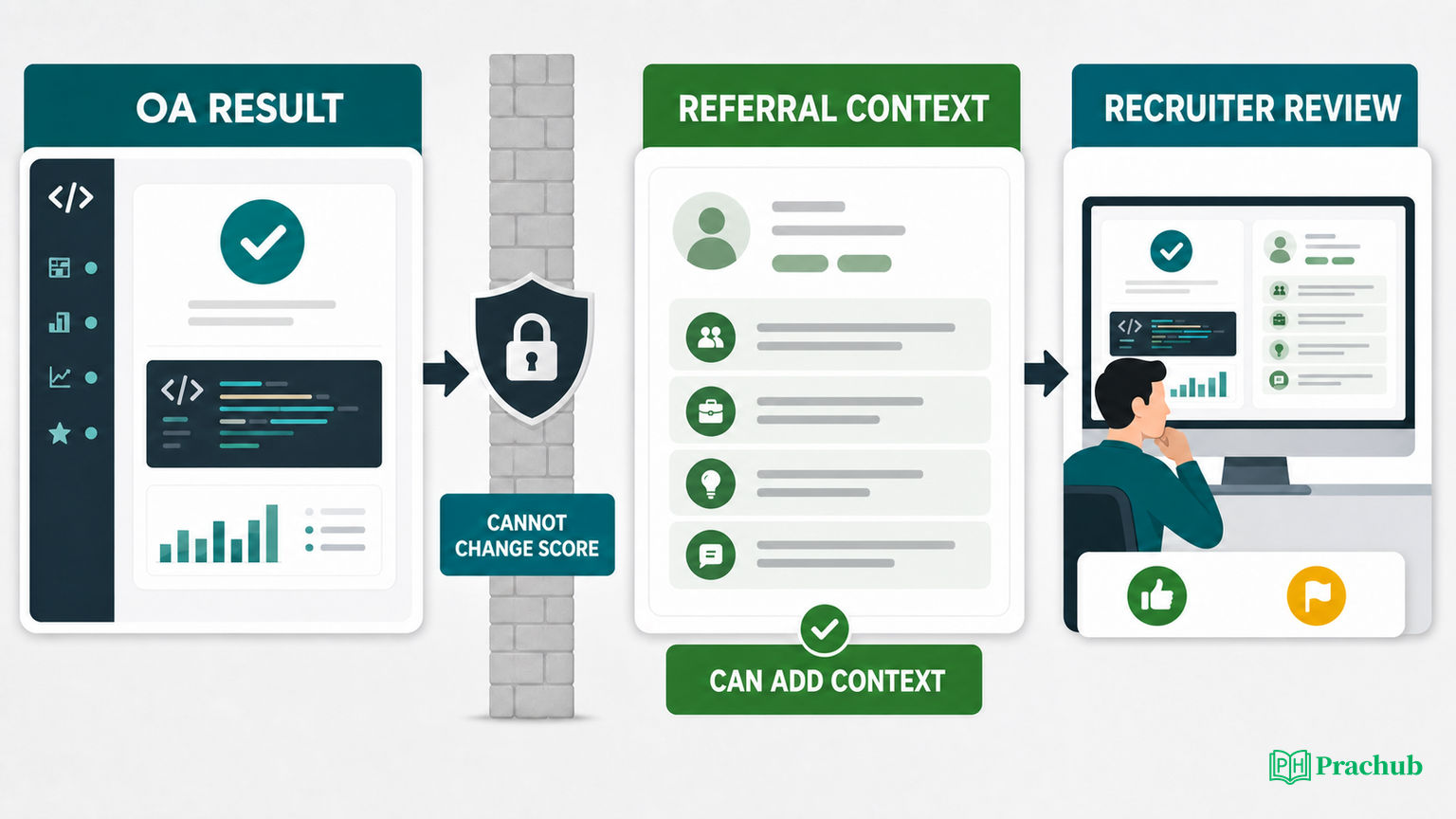
The practical boundary is simple: a referral can add context around the result; it cannot change the result itself.
When timing makes a referral more or less useful
Before applying is the cleanest time. The employee can use the employer's official workflow, the ATS records the source correctly, and you avoid asking recruiting operations to modify an existing record.
After applying but before the OA is still reasonable. Give the employee the exact title, location, and requisition ID. Do not withdraw and resubmit merely to force a referral into the system; duplicate applications can create more confusion than signal.
After the OA, act while the application remains active. A concise referral may still supply context before recruiter review or final shortlisting. If the portal already shows rejection, assume the decision stands unless a recruiter says otherwise.
Should you ask for a referral now?
Use four checks before sending a message.
- The application is active. "Assessment complete" or "under review" leaves more room than "not selected" or a closed requisition.
- The employee can speak credibly. A former teammate, class-project partner, mentor, or collaborator has useful evidence. A stranger usually does not.
- You can name the role exactly. Include the job title, location, requisition ID, application email, and OA completion date.
- Your request respects the process. Ask the employee to add context or follow the internal referral policy, not to override a score or pressure a recruiter.
If all four are true, ask once. If two or more are missing, your time is usually better spent preparing for the next round and continuing other applications.
How to ask an employee after completing the OA
Keep the note easy to evaluate and easy to decline. Do not send a biography or a request for a guaranteed outcome.
Hi Maya, thank you for offering to help. I applied to Software Engineer, Requisition 12345, and completed the online assessment on August 24. If the company allows referrals after an application is active, would you be comfortable attaching a referral or sharing brief context about our work on the payments migration? I completely understand if the process no longer permits changes. Here is my resume and the job link.
This message works because it states the current stage, identifies the role, gives the employee a truthful basis for advocacy, and does not imply that the OA should be ignored.
What the employee can send internally
A useful internal note is specific and modest. It gives the recruiter evidence without pretending to know the candidate's assessment result or the hiring bar.
I worked with Jordan for eighteen months on our payments platform. They owned the idempotency redesign, wrote the migration plan, and coordinated the rollout across two teams without a customer-impacting incident. Jordan has already applied to Requisition 12345 and completed the OA. If policy allows, I would like to be listed as the referrer and add this work context for the recruiting team's review.
The employee should use the official referral tool or recruiter channel available to them. They should not promise an interview, request confidential score details, or repeatedly escalate after receiving an answer.
If your OA felt weak, do this instead of seeking an override
A referral cannot turn a failed test case into a passing one. First, write down what happened while the attempt is fresh: misunderstood requirements, slow debugging, input parsing, complexity, language friction, or time management. Convert each failure into one deliberate practice target.
Then prepare for the possibility that the process continues anyway. Some employers review more than the headline score, and recruiters may examine code quality or resume fit. You do not need to predict that decision; you need to be ready for a technical screen while continuing to apply elsewhere.
Practice while your application is under review
These PracHub question-bank records train reusable implementation and reasoning skills. They are practice material, not predictions of your exact assessment or interview.
| PracHub question | Practice focus | Why it helps |
|---|---|---|
| Implement a Ring Buffer | Arrays, circular indexing, invariants | Builds precise state management and boundary testing |
| Traverse All Reachable Pages With Parallel BFS | Graphs, BFS, concurrency | Trains traversal correctness and bounded parallel work |
| Solve Array Distance and Wiki Navigation | Arrays, graph search, edge cases | Practices switching cleanly between two problem models |
| Implement Topological Sort and Tree Boundary Traversal | DAGs, trees, correctness | Develops ordering, cycle handling, and clear explanation |
| Design an In-Memory Filesystem and Circular Queue | Object design, APIs, data structures | Turns requirements into maintainable code and tests |
Complete one question under time pressure, then review the written solution and explain one trade-off aloud. That sequence improves both implementation and the communication signal a referral cannot provide.
Common mistakes after the OA
Do not withdraw and reapply without recruiter instructions. Do not ask several employees to submit competing referrals. Do not imply that a high score entitles you to an interview, and do not ask a referrer to investigate confidential hiring data.
The strongest follow-up is calm: one accurate referral request, one recruiter message if you have a legitimate question, and continued preparation. Repeated escalation rarely creates new evidence.
Frequently asked questions
Can someone refer me after I already took the online assessment?
Yes, at some employers, if the application is still active and the ATS or recruiting team allows the referrer to be added. The referral may change source attribution or add context, but policies differ. Give the employee the exact requisition and clearly state that you already completed the OA.
Will a referral improve or replace my OA score?
No. A referral is not part of the assessment's test-case scoring, code report, or integrity review. It can help a recruiter understand your background, but it should not be treated as a way to recalculate a score or bypass a required assessment.
Should the employee contact the recruiter directly?
The employee should follow the company's internal referral process first. If they genuinely know your work and the company permits recruiter outreach, a short evidence-based note can be useful. It should identify the role and relevant experience without asking for preferential scoring or a guaranteed interview.
Does a referral help after a rejection?
Usually not for the rejected application. Once the hiring team has closed the record, a referral rarely reverses the decision. The relationship can still help you identify a better-matched future role, understand reapplication timing, and prepare stronger evidence before applying again.
Is a referral from a stranger worth getting?
A stranger referral may add source attribution, but it carries less credible context than an endorsement from someone familiar with your work. Do not pressure employees or misrepresent the relationship. A strong application, relevant experience, and interview preparation still have to support the referral.
Final takeaway
A referral after an online assessment is neither useless nor a rescue button. It is most helpful when the application is active, the employee can describe your work, and the request adds honest context without challenging the assessment record.
Use the referral for what it can do, then prepare for everything it cannot do. Continue with company-specific interview prep, practice complete answers in PracHub, and keep other applications moving until a recruiter confirms the next step.
Sources and Further Reading
- Microsoft Hiring Process FAQs
- Microsoft Global University Internships FAQ
- Greenhouse: Who Gets Credit field
- Greenhouse Referrals FAQ
- HackerRank: Viewing a Candidate's Detailed Test Report
Research note: This guide was checked on August 25, 2026. Referral policies, assessment workflows, and recruiter access vary by employer and requisition.
Comments (0)