Golang Interview Questions for Backend Engineers: Goroutines, Channels, Interfaces, and Performance
Quick Overview
Prepare for Golang backend interviews with production-focused questions on goroutine lifecycle, channel ownership, context cancellation, interfaces, data races, profiling, and performance.
Golang interview questions for backend engineers test whether you can make concurrency correct, keep goroutines bounded and cancellable, design small interfaces, and improve performance from evidence rather than intuition. Syntax matters, but production judgment is the stronger signal.
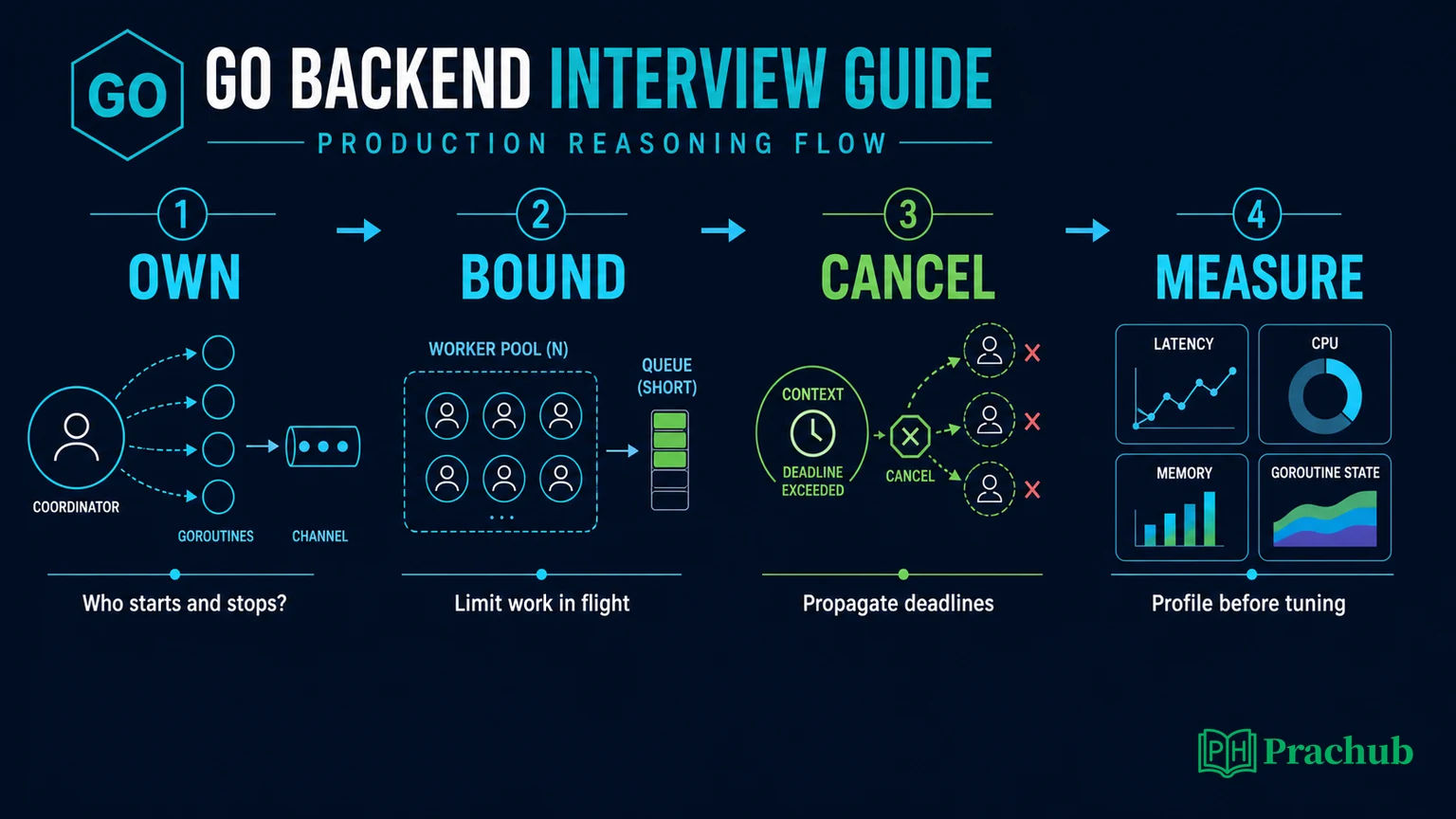
A strong answer follows four steps: name the owner, bound the work, define cancellation, and measure the result. This guide uses the official name “Go”; “Golang” is the common search term. It was checked against Go 1.27, released in August 2026, while keeping runtime-version and implementation details explicit.
Use these Backend Engineer interview questions on PracHub to practice explaining decisions aloud. PracHub question-bank records are practice material, not predictions of your exact interview.
What Go backend interviewers are actually testing
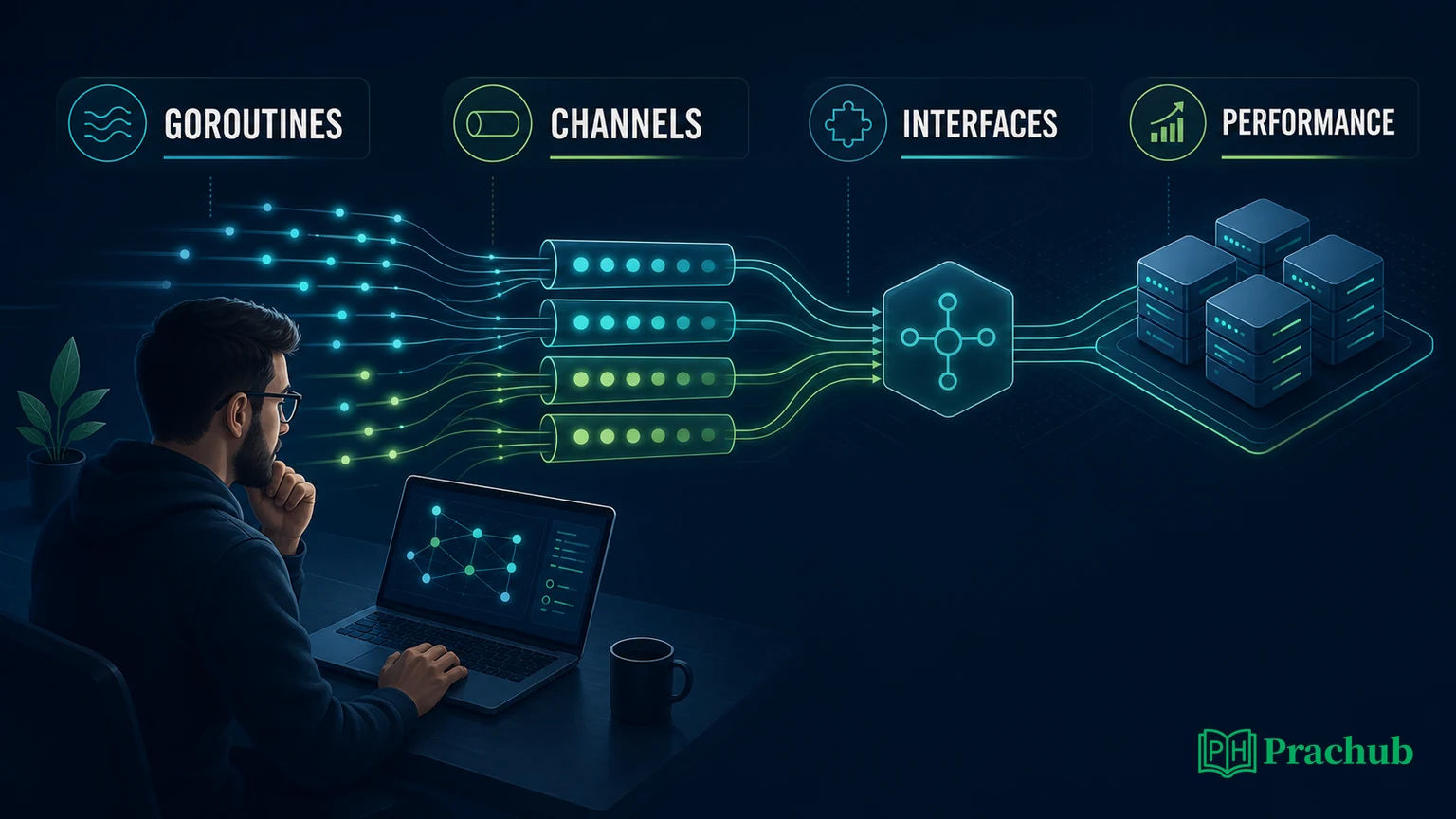
Go interviews reward a simple mental model: correctness first, then lifecycle, then cost. Interviewers often turn a small code sample into a production discussion about overload, shutdown, observability, and failure.
| Area | Baseline knowledge | Strong interview signal |
|---|---|---|
| Goroutines | go statement, blocking, scheduling | Names who starts, stops, waits for, and limits each goroutine |
| Channels | Send, receive, close, buffering, select | Defines ownership, backpressure, and shutdown semantics |
| Interfaces | Implicit satisfaction, method sets, nil behavior | Keeps contracts narrow and catches typed-nil traps |
| Performance | Complexity, allocation, GC, profiling | Starts from an SLO and chooses the tool that tests the hypothesis |
Goroutine interview questions
A goroutine is an independently executing Go function managed by the Go runtime. It is cheaper to create than a typical OS thread, but it still consumes memory, scheduler work, and any resources captured by the function.
How is a goroutine different from an OS thread?
A goroutine is a language/runtime abstraction; a thread is scheduled by the operating system. The runtime multiplexes runnable goroutines over threads. Its G, M, and P scheduler concepts are an implementation model, not an application-correctness contract. Always explain who waits for a goroutine, what can block it, and what limits creation.
What causes a goroutine leak?
A goroutine leaks when it cannot make useful progress or exit—for example, it waits on a send with no receiver, a receive nobody will close, an unreleasable lock, or a request without cancellation. Leaks retain stacks, referenced objects, and sometimes sockets or timers.
Design an exit path before starting the goroutine. Propagate cancellation, avoid orphaned senders, and wait for owned work during shutdown. Go 1.27 added a goroutineleak profile for some permanently blocked goroutines; it cannot detect every leak.
How would you build a bounded worker pool?
Use fixed workers reading from a jobs channel, or acquire a semaphore before launching each task goroutine. Acquiring inside the goroutine limits active work but can still leave unbounded goroutines waiting. When capacity is full, block, reject, shed, or time out deliberately. Propagate cancellation, collect errors, and wait for workers.
Channel interview questions
When should you use a channel instead of a mutex?
Use a channel when the design is naturally about transferring ownership, coordinating stages, or signaling events. Use a mutex when several operations must protect a shared invariant. Either can be correct; forcing all shared state through channels can make a simple critical section harder to understand, while using a mutex as a job queue can obscure backpressure.
The Go memory model defines synchronization edges for channel operations and locks. State the invariant and required ordering first, then choose the smallest primitive that makes those edges clear.
Buffered or unbuffered channel?
An unbuffered send completes with a corresponding receive, providing a direct handoff. A buffered channel permits up to its capacity to wait. It can absorb a burst and cap queued values; when used as a semaphore, it can cap active work. It may also delay overload signals and increase queued latency. Explain the capacity and full-buffer policy from a measured workload.
Who should close a channel?
Normally, the sending side or a coordinating owner closes a channel when it knows no more values will be sent. Receivers should not close a shared channel just because they are finished. Sending on or closing a closed channel panics, and closing from multiple producers needs explicit coordination.
Closing signals that no future sends will occur; it is not general cleanup or required for garbage collection.
What does a nil channel do inside select?
Send and receive on a nil channel block forever. In select, nil can deliberately disable a case. An accidental nil channel looks like a deadlock, while a default loop can become a CPU-burning poll.
Context, cancellation, and shutdown
The context package carries deadlines, cancellation signals, and request-scoped values across API boundaries. Pass a context as the first parameter, do not use it for optional configuration, and call the returned cancel function so timers and child contexts can be released.
For request fan-out, derive a child context, start bounded work, and make blocking operations observe ctx.Done(). Cancel siblings on failure and still join owned work. The Go team’s pipelines guide shows how an early consumer exit can strand upstream senders.
For graceful shutdown, stop admission, cancel or drain by contract, and wait with a deadline. Avoid storing context in a struct because it hides lifetime and can share the wrong deadline.
Interface interview questions
How does implicit interface satisfaction help Go design?
A type satisfies an interface by implementing its method set; it does not declare the relationship. Define the smallest capability at the point of use instead of mirroring every concrete method in a broad interface.
Why do pointer and value receivers affect interface satisfaction?
The method set rules determine which methods belong to T and *T. Pointer-receiver methods belong to the pointer type’s method set. Automatic address-taking can make a direct call compile even when assigning the value to an interface fails; explain that distinction.
Why can an interface be non-nil while holding a nil pointer?
An interface value contains a dynamic type and a dynamic value. It compares equal to nil only when both are unset. If a function returns a typed nil pointer as an error or other interface, the interface still has a dynamic type and is therefore non-nil. The Go FAQ recommends returning an explicit nil interface when there is no error.
Data races and memory-model questions
For broader patterns, see PracHub’s concurrency interview questions guide. In Go, a data race is conflicting concurrent memory access with at least one write and no ordering synchronization. Race-free programs receive a sequential-consistency guarantee; sleeping or “probably finished” does not create ordering.
Run go test -race and exercise realistic paths. The official race-detector documentation says it only detects races that execute; it also documents typical overhead of 5–10x memory and 2–20x execution time. That makes it valuable in tests, integration environments, and selected realistic workloads—not evidence that unexecuted paths are safe.
Go performance interview questions
How should you investigate a slow Go service?
Define the symptom first: p99 latency, CPU, allocation rate, heap growth, GC pauses, blocking, mutex contention, or goroutine count. Reproduce it under representative load, capture evidence, form one hypothesis, change one thing, and verify the SLO plus correctness.
The official diagnostics guide separates profiles, execution traces, debugger data, and runtime statistics. CPU and heap profiles answer different questions; block and mutex profiles target waiting; go tool trace explains scheduling, syscalls, network blocking, and GC interactions.
Does returning a pointer always allocate on the heap?
No. Escape analysis follows how values flow, not a simple “pointer means heap” rule. The compiler may keep a value on a goroutine stack, move it to the heap, or eliminate the allocation. Inspect decisions with go build -gcflags=-m, then verify the hot path with allocation profiles and benchmarks. Do not turn a compiler diagnostic into a permanent language guarantee.
How do you write a trustworthy Go benchmark?
Use the testing package’s benchmark support, report allocations, exclude setup, prevent dead-code elimination, and compare multiple samples. A microbenchmark does not automatically reproduce queueing, I/O, GC interaction, or production skew.
How do you discuss garbage-collection trade-offs?
Connect GC to allocation rate, live heap, CPU, and latency. Object pools may retain memory or add contention. Go’s GC guide explains the GOGC CPU-memory trade-off; tune only when profiles show GC is the constraint.
A production-grade Go answer framework
Use O-B-C-M for concurrency and performance questions:
- Ownership: Who creates, writes, closes, waits for, and cleans up each resource?
- Bound: What limits goroutines, queue length, memory, retries, and downstream work?
- Cancellation: Which deadline or failure stops blocked operations, and how are children joined?
- Measurement: Which race test, profile, trace, benchmark, or service metric verifies the claim?
This framework turns “use a channel” into an operational answer. For example: “One coordinator owns and closes the jobs channel; a fixed worker count matches the database pool; every send and query observes the request context; shutdown waits with a deadline; and load tests verify queueing and p99 latency.”
Practice with PracHub Go and backend questions
The first three verified records are explicitly Go-focused; the final two are transferable backend-concurrency exercises. They are practice material, not a forecast of a particular employer’s questions.
| PracHub question | Practice focus | Why it helps |
|---|---|---|
| Explain Go concurrency and database choices | Scheduler, goroutines, channels, performance | Connects runtime costs and concurrency choices to a backend workload |
| Explain sync/async, Go concurrency, SQL vs NoSQL | Channels, locks, leaks, races | Tests trade-offs and common Go concurrency failure modes |
| Design a Go music player with playlists | Go API design and concurrent state | Exercises synchronization, persistence, and complexity in a Go design |
| Identify and handle race conditions | Race diagnosis, locks, atomics | Transfers directly to Go’s race detector and synchronization primitives |
| Design a Thread-Safe Bounded Blocking Queue | Backpressure and cancellation | Maps to buffered channels, select, deadlines, shutdown, and worker pools |
Common Golang interview mistakes
Avoid saying goroutines are free, channels are always better than mutexes, or a buffer automatically improves throughput. Do not close a channel from whichever receiver happens to finish first. Do not treat time.Sleep as synchronization, a clean race-detector run as proof, or pointer syntax as proof of heap allocation. For interfaces, always check method sets and typed nils.
Frequently asked questions
Is it called Go or Golang?
The language’s official name is Go. The Go FAQ explains that “Golang” arose from the original golang.org website. In an interview, say Go; using “Golang interview questions” in a search query is normal.
How deep should I know the Go scheduler?
Know that the runtime schedules goroutines over operating-system threads and understand blocking, preemption, GOMAXPROCS, and why unbounded runnable work hurts latency. G/M/P internals can strengthen a backend or infrastructure answer, but identify them as implementation details rather than language guarantees.
Are channels always more idiomatic than mutexes?
No. Channels fit ownership transfer, pipelines, and coordination. Mutexes fit small shared invariants. Idiomatic Go favors clarity and correctness, not one primitive everywhere. Explain the state being protected, required ordering, contention shape, cancellation needs, and how you would test the choice.
How do I find goroutine leaks in a Go service?
Track goroutine counts, inspect goroutine profiles and stack dumps, reproduce shutdown or cancellation paths, and look for blocked sends, receives, locks, and I/O. Go 1.27’s goroutine-leak profile helps detect some permanently blocked goroutines, but reachability limitations mean it cannot find every leak.
What makes a strong Go performance answer?
Start with a measurable symptom and a representative workload. Choose the matching profile, trace, race test, or benchmark; state one hypothesis; make one change; and verify correctness plus the target metric. Mention allocation and GC only when evidence connects them to the observed bottleneck.
Final takeaway
Golang interview questions for backend engineers reward lifecycle thinking. Own every goroutine and channel, bound every queue and fan-out, propagate cancellation, design interfaces from the consumer’s need, create explicit synchronization, and profile before optimizing. Practice until every answer names a correctness boundary, a trade-off, and a verification method.
Sources and Further Reading
- Go 1.27 release notes
- The Go Programming Language Specification
- The Go Memory Model
- Go Concurrency Patterns: Context
- Go Concurrency Patterns: Pipelines and cancellation
- Go context package documentation
- Go MethodSets reference
- Go FAQ: Why is my nil error value not equal to nil?
- Go Data Race Detector
- Go diagnostics guide
- Go garbage-collection guide
- Go compiler optimizations and escape analysis
- Go runtime scheduler implementation notes
- Go runtime/pprof documentation
- Go testing benchmark documentation
Research note: This guide was checked on August 31, 2026. Runtime behavior and performance vary by Go version, architecture, operating system, compiler, and workload; confirm the interview and production environment before relying on version-specific details.
Comments (0)