Google Early Career SWE 2027: OA, Technical Interviews, Direct Consideration, and Timeline
Quick Overview
A current, evidence-backed guide to Google Early Career SWE 2027, including who may receive an OA, how Direct Consideration differs, technical interview stages, and realistic timeline uncertainty.
The Google Early Career SWE 2027 process is active, but there is no evidence that every applicant receives the same online assessment or moves on the same schedule. Google's current U.S. Early Career Campus posting confirms a broad software-engineering role and says that, in most instances, the hiring process includes in-person interviews. It does not publish a guaranteed OA format, question count, cutoff, or response time.
Current August 2026 candidate reports suggest Google is processing some Direct Consideration candidates before many regular applicants. That route does not necessarily skip the OA: one Direct Consideration candidate reported completing an assessment before the first interview. Treat every reported format as a snapshot, and let your own recruiter email control.
Use the Google Software Engineer questions on PracHub to practice role-relevant coding and behavioral skills while you wait. These records are preparation material, not a prediction of your exact assessment.

Google Early Career SWE 2027: the quick answer
As of August 29, 2026, the safest reading is that Google is using more than one entry path. Regular applicants may wait for resume review, an OA, or recruiter contact. Candidates selected through Direct Consideration may be contacted earlier, but the label is not a public promise of an interview or offer. A current candidate report indicates that at least one Direct Consideration applicant still completed an OA.
| Question | Best current answer | Evidence level |
|---|---|---|
| Is the OA automatic? | No public evidence shows that every applicant receives it automatically. | Google does not publish a universal rule; current applicants report different outcomes. |
| Does Direct Consideration skip the OA? | Not necessarily. | One current Direct Consideration candidate reported an OA before round one. |
| How many technical interviews are there? | The 2027 count is not publicly fixed. | Google confirms interviews; recent prior-cycle candidates commonly reported staged coding and behavioral rounds. |
| How quickly does Google respond? | From days to months, depending on the path and hiring demand. | Current non-Direct applicants are still waiting, while some Direct Consideration interviews are being scheduled. |
What Google officially confirms about the current role
The current U.S. posting is titled Software Engineer, Early Career, Campus. It lists multiple U.S. locations and says the application window will remain open until at least August 30, 2026, although business needs may change the closing date. The page labels the experience level as Early and says that most instances require in-person interviews.
Minimum qualifications include a bachelor's degree or equivalent practical experience, experience with data structures or algorithms, and software development in at least one language such as Python, C, C++, Java, or JavaScript. The posting also mentions experience using AI productivity tools to streamline development or business workflows.
That last qualification does not grant permission to use AI during an assessment or interview. Google's current virtual-interview guide says candidates should not use AI to answer interview questions and that submitted work must be their own. The invitation, assessment rules, and recruiter instructions remain the authority for every stage.
Early Consideration and Direct Consideration are different
The terms are easy to confuse. An Early Consideration posting is a public job application that candidates can find and submit themselves. Direct Consideration, based on current candidate descriptions, is a recruiter or campus-engagement route in which Google contacts a candidate and may open an application on the candidate's behalf.
Google does not publish a public Direct Consideration eligibility rubric. Current reports mention prior internships, a current Google Careers profile, or recruiter discovery, but those anecdotes do not establish a formula. A referral is also not the same thing as Direct Consideration.
Direct Consideration should be interpreted as a different sourcing path, not a guaranteed pass. It may lead to earlier contact, a questionnaire, an OA, or interview scheduling. The candidate still has to complete whatever evaluation Google assigns.
Does Google send an OA for Early Career SWE 2027?
Google has not published a universal 2027 OA policy for this role. In an August 2026 new-grad discussion, several applicants who applied around August 10 or 11 reported that they had not received an OA by August 21. By August 28, candidates in a separate timeline thread were still reporting no update. Those reports show that silence for one or two weeks is not proof of rejection.
At the same time, one candidate identifying as Direct Consideration reported receiving an OA on August 17-18 and then moving toward a first-round interview. That is evidence that an OA exists in at least one current path, but it is not evidence that every applicant gets it, that Direct Consideration always goes first, or that the same test is reused across locations.
The practical conclusion is simple: prepare for an OA without treating the absence of one as a final decision. Keep the Google Careers profile, resume, transcript, email, and spam folder current while continuing other applications.
What may appear on the Google Early Career OA
The only detailed 2027 report currently available is one person's account. That candidate described difficult algorithmic work involving dynamic programming, trees, and iterative depth-first search, plus an AI-assisted repository integration and bug-fixing task. The report is useful as a preparation signal, but it is not an official blueprint.
Prepare around transferable competencies rather than memorizing that list:
- Arrays, strings, hash maps, sorting, intervals, trees, graphs, and traversal.
- Dynamic programming only after you can define states, transitions, base cases, and complexity clearly.
- Reading an unfamiliar repository, locating the relevant code path, reproducing a bug, and making a narrow fix.
- Testing edge cases and explaining why the implementation is correct.
- Following the assessment's explicit rules for AI tools, documentation, and external resources.
Do not infer a fixed difficulty or cutoff from a single candidate. Google may vary the assessment by pipeline, recruiter, location, degree, and hiring need.
What the technical interview process may look like
The current job page confirms that interviews are part of the process and says they are often in person, but it does not publish a 2027 round count. Google's official virtual-interview guide explains the logistics for remote interviews: candidates receive a Google Meet link from a recruiting coordinator, should test equipment, and may be asked to work in a shared document or drawing surface.
Prior U.S. Early Career candidates in the 2026 cycle commonly reported a staged process: an OA, an online round combining coding with a behavioral or Googliness interview, and a later round with two technical interviews. Some candidates reported an additional technical interview when the evidence was mixed. This is historical candidate evidence, not a guarantee for 2027.
| Stage | What to prepare | What remains variable |
|---|---|---|
| Recruiter or campus contact | Graduation date, location, work authorization, transcript, and a concise resume walkthrough. | Whether contact happens before an OA. |
| Online assessment | Correct code, edge cases, complexity, repository navigation, and permitted-tool discipline. | Format, question count, provider, timing, and cutoff. |
| Initial interview stage | One complete coding problem, clear communication, and behavioral stories. | Number and order of interviews. |
| Later technical stage | Trees, graphs, intervals, dynamic programming, testing, and follow-ups. | Remote versus in-person and whether an extra round is needed. |
| Review and alignment | Updated documents, location flexibility, and team interests. | Committee, team-matching, and offer timing. |
How long can the 2027 process take?
There is no reliable single timeline. Current regular applicants show that the first update may take weeks. Historical 2026 reports range from fast sequences to several months between application, OA, interviews, hiring review, team alignment, and offer.
A delay can reflect application volume, recruiter assignment, interview capacity, headcount, location, or team demand. It does not reveal a hidden cutoff. Use a simple rule: follow up when a recruiter gave a date and that date has passed, or when a scheduled stage has been silent for roughly one business week. Otherwise, avoid weekly messages that ask only for status.
If your portal still says submitted, keep the application active and continue interviewing elsewhere. Google can move slowly enough that pausing the rest of a job search is costly.
A focused two-week preparation plan
The best plan covers both likely coding work and the uncertainty of a repository-style task. It also reserves time for behavioral evidence and interview logistics.
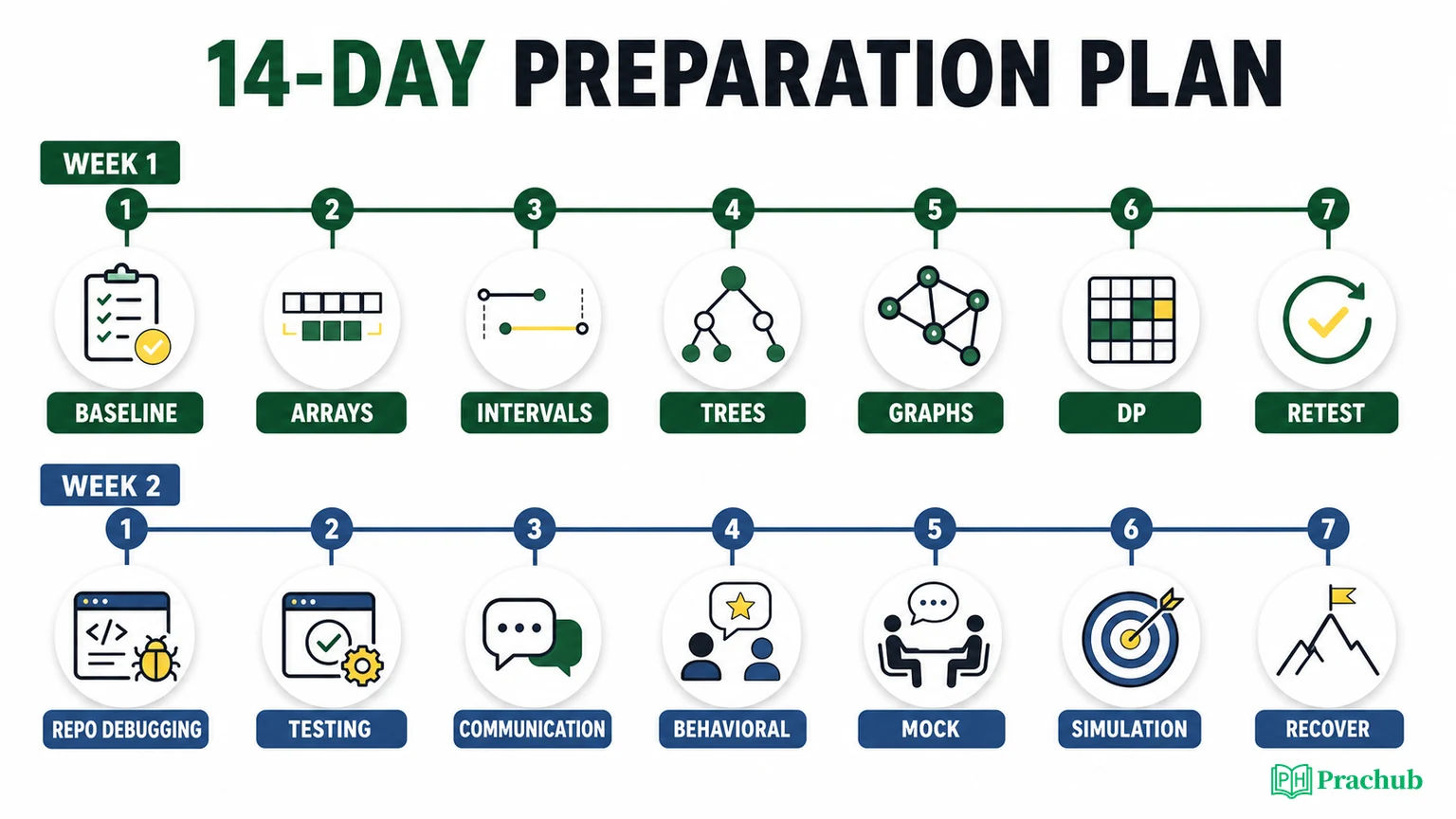
| Day | Focus | Deliverable |
|---|---|---|
| Day 1 | Baseline | Complete one timed coding set and record every failure. |
| Day 2 | Arrays and strings | Practice invariants, parsing, and boundary cases. |
| Day 3 | Hashing and intervals | Explain complexity and endpoint semantics aloud. |
| Day 4 | Trees | Implement recursive and iterative traversals. |
| Day 5 | Graphs | Practice BFS, DFS, visited-state design, and cycles. |
| Day 6 | Dynamic programming | Write states and transitions before code. |
| Day 7 | Retest | Resolve every mistake from Days 1-6 without notes. |
| Day 8 | Repository debugging | Trace one unfamiliar codebase and fix one reproducible bug. |
| Day 9 | Testing | Add focused tests for regressions and hidden-edge cases. |
| Day 10 | Communication | Solve in a plain editor while narrating decisions. |
| Day 11 | Behavioral | Prepare five stories on collaboration, ambiguity, failure, leadership, and learning. |
| Day 12 | Mock interview | Run one coding and one behavioral simulation. |
| Day 13 | Full simulation | Complete a timed mixed assessment under the actual rules. |
| Day 14 | Recovery and logistics | Review errors, test equipment, and stop cramming. |
Practice with Google Software Engineer questions from PracHub
These PracHub question-bank records build relevant coding and behavioral skills. They are not predictions of your exact Google OA or interview, and the stored round may differ from your 2027 path.
| PracHub question | Practice focus | Stored round |
|---|---|---|
| Assign the Minimum Fleet to Rental Reservations | Heaps, intervals, deterministic tie-breaking | Onsite |
| Calculate Highway Tolls from Ordered Checkpoint Logs | Prefix sums, maps, ordered state | Onsite |
| Deduplicate and Order Batch and Streaming Logs | Hash maps, heaps, streaming correctness | HR Screen |
| Check an Interval Against Existing Intervals for Conflicts | Boundary conditions and early exit | Technical Screen |
| Work Effectively with a Difficult Colleague | Collaboration, conflict, and reflection | Onsite |
What to do while your application is quiet
First, verify that the application appears in Google Careers and that your resume, transcript, graduation date, and contact details are current. Second, keep two preparation tracks moving: timed algorithms and practical repository debugging. Third, prepare behavioral stories now, because a recruiter may schedule interviews before you feel ready.
Do not try to manufacture Direct Consideration through repeated applications or unsolicited messages. Keep your profile accurate, attend legitimate campus or recruiting events, and maintain evidence of strong projects and internships. Most importantly, continue applying elsewhere.
Frequently asked questions
Is the Google Early Career SWE 2027 OA automatic?
No public Google source says it is automatic. Current applicants report different timelines, and some regular applicants have waited without receiving an OA. An invite confirms that Google wants an assessment for that application; it does not prove that every resume was screened in the same order.
What does Direct Consideration mean at Google?
Current candidates use Direct Consideration to describe an invite-driven campus or recruiter path in which Google contacts the candidate and may open an application. It is not the same as a referral or a public Early Consideration posting, and it does not guarantee an interview or offer.
Can Direct Consideration candidates skip the OA?
Possibly in some paths, but not as a general rule. At least one current 2027 Direct Consideration candidate reported completing an OA before the first interview. Follow the steps in your own email.
Will Google ask system design for an Early Career role?
The current posting does not publish an interview rubric. Early-career loops are usually more coding-heavy in candidate reports, while system design is more common at higher levels. Still, be ready to discuss project architecture, data choices, APIs, and trade-offs if an interviewer follows up on your resume.
Does passing a Google interview guarantee an offer?
No. Candidate reports describe additional review, location or team alignment, document checks, and headcount constraints after positive interviews. A passed stage is progress, not an offer, until Google sends the final written terms.
Final takeaway
The Google Early Career SWE 2027 process is moving, but it is not moving uniformly. Direct Consideration candidates appear to be receiving earlier attention, while many regular applicants are still waiting. An OA may be part of either path, and one current report suggests candidates should be ready for both algorithmic and repository-based work.
Prepare for variability: strengthen core data structures, practice debugging unfamiliar code, rehearse clear behavioral stories, and follow only the rules in your invitation. The Google Software Engineer question bank can keep that preparation company-specific without turning one candidate report into a promise.
Sources and Further Reading
- Google Software Engineer, Early Career, Campus job posting
- Google Candidate Guide for virtual interviews
- Google Candidate Guide for technical virtual interviews
- Google Early Career 2027 application and interview timeline discussion
- Google New Grad 2027 OA and Direct Consideration discussion
- Candidate-reported 2027 Direct Consideration OA timeline
- Google Early Career 2026 candidate timeline archive
Research note: This guide was checked on August 29, 2026. Google can change application windows, OA formats, interview stages, locations, and hiring timelines by role and recruiting path.
Comments (0)