Hello Interview vs DesignGurus Grokking: Which System Design Course Fits Your Prep?
Quick Overview
Compare Hello Interview and DesignGurus Grokking using their current curricula and public URL-shortener samples. Identify differences in analytics scope, practice, and access, then choose a learning path from an independent design attempt.
Hello Interview and DesignGurus Grokking can both give your system design preparation an ordered path. Choose Hello Interview when you want to connect its delivery framework, pattern lessons, and AI practice. Choose DesignGurus when its explicit trade-off chapters and case-study approach make your missing fundamentals easier to work through. That is an editorial recommendation based on the current public curriculum and samples, not a measured ranking of interview outcomes.
Start with what you cannot yet explain when the lesson is closed. Before buying, try one unfamiliar prompt from PracHub’s System Design questions. Keep the drawing and your unresolved decisions so you can choose lessons that address an observed weakness.
This comparison checks public material on October 14, 2026. We inspected the two URL-shortener lessons and course interfaces; we did not complete either paid curriculum or run a paid mock interview.

Hello Interview vs Grokking: compare the right products
Here, Grokking means Grokking the System Design Interview on DesignGurus.io. Educative’s similarly named offering is a different product. DesignGurus explains that distinction on its course ownership page. Verify the provider and exact course title before applying any review, coupon, or syllabus comparison.
Hello Interview also has more than one entry point. Its public System Design in a Hurry guide offers an interview-oriented reading route. Its current System Design Course organizes lessons, quizzes, and practice into a recommended sequence. Premium includes that course; the existence of free articles does not mean every course component is free. Official introduction, course outline.
A system design course teaches you to turn an underspecified problem into requirements, interfaces, data, and infrastructure, then explain the consequences of your choices. Finishing the reading and producing that explanation independently are separate milestones. Use the second milestone to evaluate either product.
Map your missing skill to the curriculum
The current public outlines support this comparison. Counts and estimated study hours are provider descriptions, not equivalent units of difficulty, so they are not the basis for the recommendation.
| Preparation need | Hello Interview route | DesignGurus Grokking route |
|---|---|---|
| Keep an answer moving | In a Hurry’s Delivery Framework; course Orientation | How to Approach a System Design Interview |
| Rebuild fundamentals | Foundations and Thinking in Scale | Glossary of System Design Basics, plus relevant trade-off lessons |
| Connect concepts to problems | Pattern modules such as Scaling Reads and Dealing with Contention | System Design Trade-offs and System Design Problems |
| Attempt before reviewing | Course practice/review pairings, including Bitly | TinyURL sample’s attempt-first brief and sketch area |
| Obtain personalized practice feedback | Separate Guided Practice and Live Practice products | Do not infer mock feedback or coaching access from the course syllabus alone |
Sources: Hello Interview course and DesignGurus course.
Our interpretation of these outlines is that the useful distinction is how you prefer to revisit a mistake. Suppose you drew a cache but cannot explain what happens after a link expires. Hello Interview’s route lets you return from a problem to a pattern and its underlying concept. DesignGurus’s organization offers a trade-off or glossary entry alongside a full case. Whichever route you use, explain the decision in your own words.
Try each route using the same unanswered question: should an expired cached link still redirect? If you can find the explanation, restate the assumption, and revise your drawing without copying it, the material is doing useful work. If you keep reading unrelated chapters because that decision feels difficult, pause and write down the exact uncertainty before buying another subscription.
The matched sample: Bitly and TinyURL
We inspected Hello Interview’s Bitly breakdown and DesignGurus’s TinyURL lesson. These are comparable problem families, but their stated requirements differ. Comparing final component counts would therefore reward different scope rather than better teaching.
| What we checked in the public text | Hello Interview Bitly | DesignGurus TinyURL |
|---|---|---|
| Click analytics | Explicitly outside the core scope | Included in the core requirements |
| Initial learning task | Requirements, entities, API, then a working design and deep dives | Attempt-first brief requests estimates, API, data model, and a diagram |
| Additional design pressure | Optional aliases and expiration; uniqueness and read scaling | Analytics, difficult-to-guess keys, and an extended private-link requirement |
| Useful self-check | Can you complete the basic redirect flow before expanding? | Can you trace each added component back to a requirement? |
This is an audit of the public written samples delivered by the pages. DesignGurus also displayed a registration prompt; we did not create an account or test saved canvas work. It does not establish the quality of every paid lesson, the consistency of every video with its text, or the accuracy of personalized feedback.
Our inference is that the scope difference makes a useful diagnostic. If a larger diagram impresses you but you cannot explain why analytics changes the design, study requirements and consequences. If you understand those changes but cannot get a basic design onto the board, practice delivery and prioritization.
Do not combine both examples into one giant answer. That would conceal the very skill the comparison should test: deciding which requirements belong in this interview and which should wait for a follow-up.
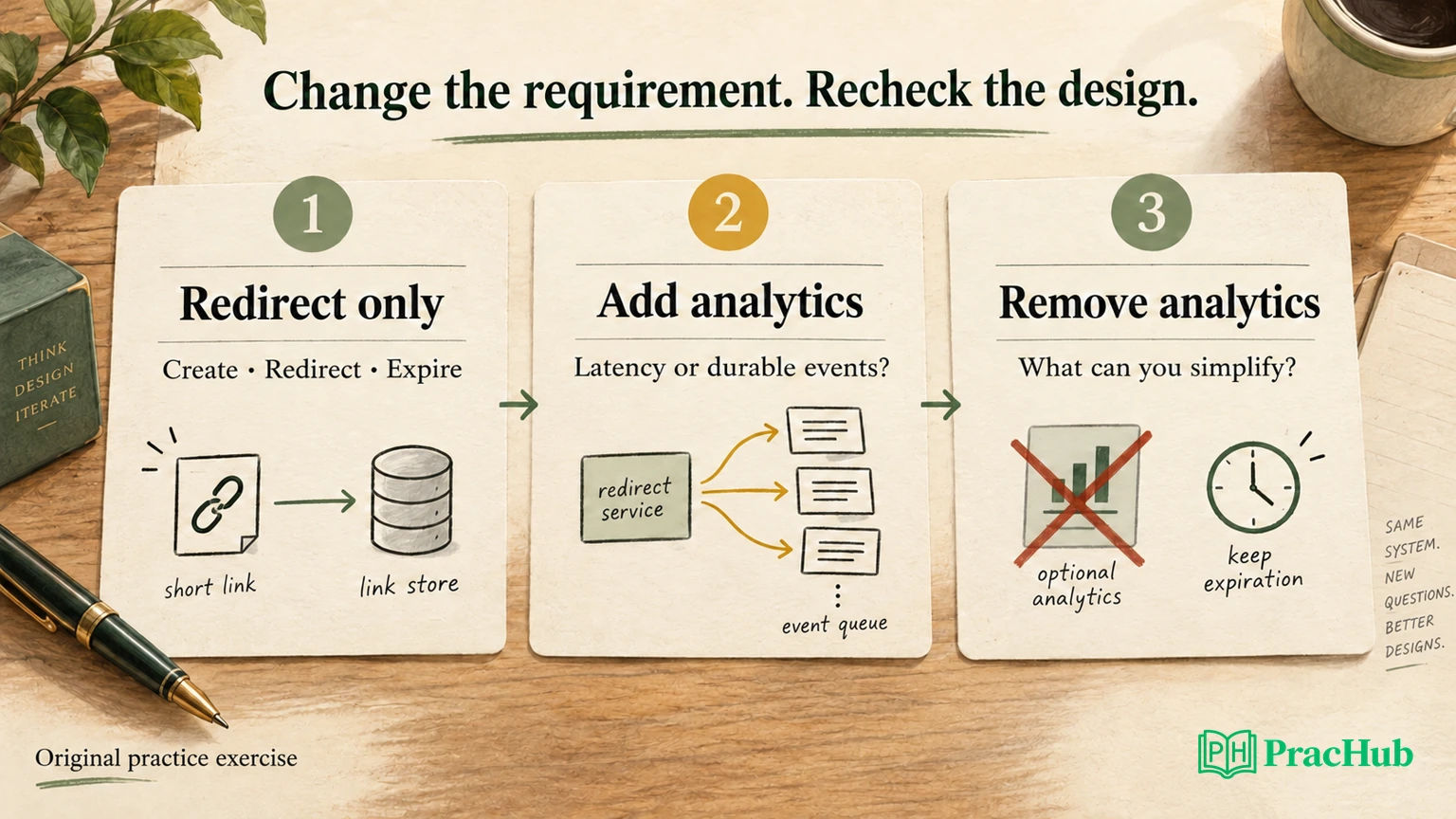
An original exercise: change analytics, keep the rest fixed
Use this independent exercise after reading either sample. It is a PracHub editorial exercise, not a copied lesson or a claimed employer question.
Start with a service that creates short links, redirects readers, and stops serving expired links. Assume destinations cannot be edited after creation. Draw the create and redirect paths, mark the stored expiration time, and explain what happens when the cache is unavailable. Keep authentication and analytics outside the initial scope.
Now add one requirement: link owners need click totals that can arrive a few minutes late. Ask three concrete questions. Where is a click event created? What happens if the event queue is unavailable? What would you tell an owner if some events were lost?
An asynchronous analytics pipeline may protect redirect latency, but “put it on a queue” does not settle the durability question. Publishing an event after returning the redirect can lose an event if the process crashes between those actions. Waiting for durable acceptance has latency and availability costs. Your answer needs an explicit priority, such as best-effort counts or a stronger collection contract.
Next, explain caching at two different boundaries. A server-side cache can accelerate the lookup while the redirect service still observes requests. A browser or intermediary that reuses a redirect may bypass that service. Do not assume that writing “302” on the board alone proves every click will reach your analytics pipeline; response headers matter. MDN documents the behavior of Cache-Control directives.
Finally, remove analytics again. Identify which decisions you can simplify and which remain because of expiration or another requirement. If you cannot remove anything, you may have memorized a diagram instead of maintaining a model of the problem.
Choose from the failure you can actually observe
If you cannot explain the components, compare the foundational routes before tackling more cases. Work through one concrete question, such as why cache invalidation differs from eviction. Then show the distinction on your own drawing. DesignGurus’s trade-off chapters may suit someone who wants an explicit catalog of alternatives; Hello Interview’s foundations and pattern sequence may suit someone who wants the concept attached to a recurring design situation.
If you know the components but ramble, try Hello Interview’s Delivery Framework. Its sequence gives you a route through the conversation. Test it by recording an answer without the framework visible. A checklist is helping only if you can adapt it when a useful follow-up arrives early.
If familiar cases feel easy but changes derail you, stop collecting new explanations temporarily. Reuse the analytics exercise above, then change a different constraint: links may now be disabled immediately for abuse. Describe the consequences for cached entries and availability. The point is to make your existing knowledge flexible.
If your interview is senior or staff level, use either course as a starting resource and add constraint-driven depth. In an original practice scenario, explain migration, operational ownership, failure isolation, and the most expensive rejected alternative. Seniority cannot be established by selecting more boxes from a catalog or purchasing a course whose name says “advanced.”
These routes are editorial judgments. We have no controlled evidence that one platform produces a higher pass rate for a given experience level.
Compare access before comparing prices
Hello Interview’s Premium page lists one-month, one-year, and lifetime access. At the check date, the month and year options explicitly said they did not auto-renew. The offering combines course content with Guided Practice and other preparation resources. Live Practice uses interview credits; its access rules should be checked separately.
DesignGurus’s course page offers lifetime access to the individual course and separately points to broader plans. Its Fundamentals and advanced courses are distinct listings. Do not assume an individual course purchase includes the whole catalog or a human mock.
Prices can change with region and promotions. The meaningful comparison is the access you will actually use before your interview, including any separate practice credits. Check the current access duration, included practice, and total price for the exact product before paying.
For example, an engineer who has already studied the concepts and wants two realistic rehearsals has a different purchase decision from a beginner who expects to revisit lessons over several months. A larger bundle is not automatically better value for either person.
What candidate opinions can and cannot settle
Candidate discussion is useful for discovering frustrations to investigate. A Reddit preparation discussion includes a beginner questioning whether the resources cover enough fundamentals. That is candidate-reported uncertainty, not evidence that a provider lacks those topics today.
Seller-hosted success stories are also selected testimonials. They cannot isolate the effect of a course from prior experience, other preparation, interviewer variation, or repeated attempts. We therefore use current official pages for product facts and the public-sample exercise for the recommendation, rather than turning anecdotes into a winner’s score.
Test learning on a different PracHub question
Use these question-bank records as practice material, not predictions of your next interview. Choose one you have not studied, answer before opening its explanation, and keep a short decision log.
| PracHub question | What to demonstrate independently |
|---|---|
| Design a URL Shortener (High-Level and Low-Level Design) | Distinguish the architecture discussion from implementation details. |
| Design a Pastebin Service: Requirements, Entities, APIs and End-to-End Architecture | Explain how stored content changes the URL-shortener model. |
| Design a generic key-value store | Defend consistency and failure behavior from the interface contract. |
| Design a scalable news feed system | Choose a read/write strategy from the workload. |
| Design a Venue Rental and Booking System (HLD) | Explain a correctness requirement that caching alone cannot solve. |
Your log should connect each important choice to a requirement and a rejected alternative. “Redis is fast” is insufficient; explain what is cached, when it becomes invalid, and how the system behaves without it. That record gives you a precise reason to reopen a lesson.
Make one course earn the next study session
Choose Hello Interview if its sequence and practice integration make your next weak decision easier to correct. Choose DesignGurus Grokking if its trade-off organization and case treatment help you produce stronger independent explanations. Both deserve a public-sample trial before a purchase.
Then return to PracHub’s System Design questions, choose a new case, and defend one changed requirement without either course open. Buy additional material only when that attempt reveals a gap your current resources cannot address.
Sources and Further Reading
- Hello Interview: System Design in a Hurry
- Hello Interview: System Design Course
- Hello Interview: Delivery Framework
- Hello Interview: Bitly breakdown
- Hello Interview Premium
- DesignGurus: Grokking the System Design Interview
- DesignGurus: TinyURL lesson
- DesignGurus: distinguishing the Grokking products
- MDN: Cache-Control
- Candidate discussion: selecting system design preparation
Public information checked October 14, 2026. Access, curriculum, and pricing may change. Recommendations and the transfer exercise are editorial analysis; no comparative pass-rate study or paid-course completion is claimed.
Comments (0)