How Long After an Online Assessment Do Companies Respond? Timelines, Delays, and Next Steps
Quick Overview
How Long After an Online Assessment Do Companies Respond? Timelines, Delays, and Next Steps now pairs its existing format and process guidance with a clearly sourced PracHub practice set. The added section shows each question's actual company, stored round, difficulty, prompt shape, and a timed workflow without claiming guaranteed assessment reuse.
Updated August 15, 2026: You finish the last hidden test, click Submit, and receive a confirmation email. Then the harder timer starts: the one with no countdown, no visible score cutoff, and often no promised response date.
If you are wondering how long after an online assessment companies respond, the honest answer is that there is no universal deadline. While you wait, do not let the next round catch you cold. Use real interview questions with written solutions on PracHub to keep practicing the skills your assessment probably tested and the skills a live interviewer may test next.
For planning purposes, one to three weeks is a reasonable working range, not a measured industry average or a guarantee. Some candidates hear back in two days; others wait four to six weeks. The useful question is not only “How many days has it been?” but also “Which part of the process could still be running?”

After you submit an OA, platform processing, human review, and hiring logistics may each run on a different clock.
Quick Answer: How Long Does It Take to Hear Back After an OA?
Many candidates hear back within one to three weeks after an online assessment, but there is no standard response time. A proctored result may need platform verification before the employer reviews it, and the hiring team may then evaluate candidates in batches. If no timeline was promised, a polite follow-up after 7–10 business days is reasonable.
Use this as a practical decision guide:
| Time since submission | What may be happening | What you should do |
|---|---|---|
| Day 0–3 | Submission confirmation, automated scoring, integrity review, or proctoring verification | Confirm the test shows as completed and save the receipt |
| Day 4–7 | Score review, resume review, cutoff checks, or batch assembly | Keep preparing and avoid reading silence as a decision |
| Day 8–10 business days | The team may still be reviewing, but a concise follow-up is reasonable if no date was promised | Email the recruiter or hiring contact once |
| Week 2–3 | Hiring-manager review, interview capacity, or a hold may be slowing the process | Continue other applications and prepare for a possible next round |
| Week 3+ | The application may still be active, but the timing is less predictable | Keep the door open without planning your search around this role |
Why There Is No Universal Online Assessment Response Time
“Submitted” feels like one event to a candidate. Inside the hiring system, it can start three separate clocks.
Clock 1: The assessment platform processes the attempt
Your result may not be ready for the employer the instant you click Submit. CodeSignal says it verifies a proctored assessment within one to three business days after checking identification and session rules.
HackerRank also distinguishes "test completed; reports not ready" from "reports ready for consumption." Its documentation lists evaluation, integrity checks, and report generation as intermediate stages. Submission time and decision-ready time are not always the same timestamp.
Clock 2: The company evaluates the result
Once a report is available, the employer still decides what the score means. Some workflows automatically advance or reject candidates at a configured cutoff. Others require a recruiter to update the application manually.
The team may review more than a visible score: hidden tests, code quality, section-level performance, work-style answers, integrity signals, and the resume can all matter.
Clock 3: The hiring team decides when it can move
A qualified result does not create an interviewer or calendar slot. Teams may wait for a candidate batch, compare applicants by location, or slow down when interview capacity is full.
This is also why receiving an assessment and receiving a response are different search intents. Our guide to why companies send automatic OAs explains what the invitation may signal. This guide begins after you submit it.
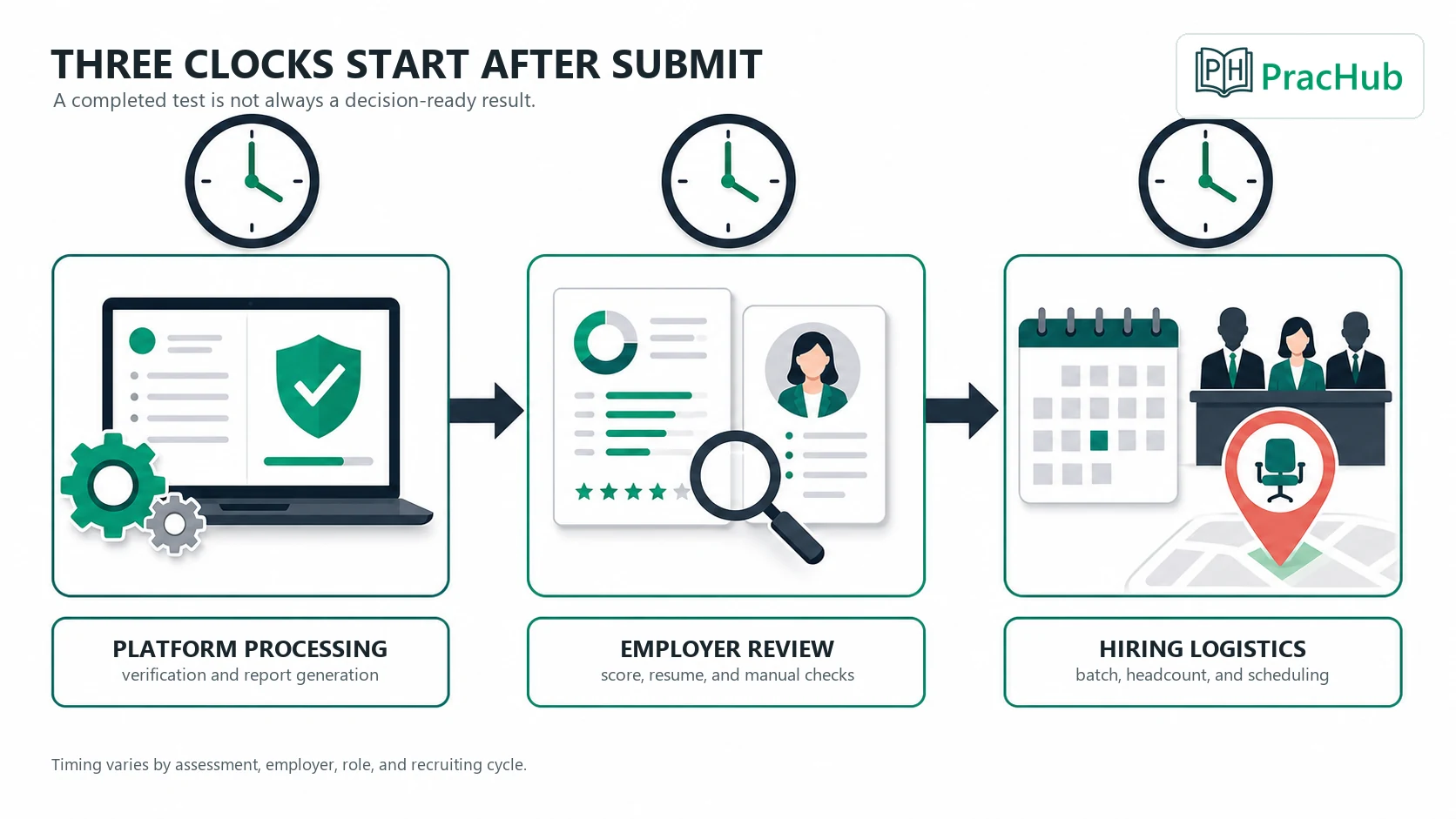
The recruiter may not be able to make a decision until all three clocks have moved.
What Current Candidate Reports Actually Show
Recent candidate discussions show a wide range, even within the same company and recruiting cycle. These reports are anecdotes, not service-level agreements, but they are useful evidence against the idea that one delay length always has one meaning.
| Candidate report | Reported wait | What it can and cannot tell us |
|---|---|---|
| Amazon SDE I discussion, August 2026 | One rejection in 2 days; one next step in 4 days | Fast decisions happen, but another candidate’s result does not predict yours |
| Amazon new-grad timeline discussion, 2026 | One candidate reported roughly 40 days before an interview invite | A long delay can still end in advancement, but this is an individual report |
| Visa SWE intern discussion, 2026 | About 1 week in one report | A week is plausible, not a company-wide promise |
| Applied Materials new-grad discussion, 2026 | Roughly 3.5 weeks from OA to interview invitation | Batch timing can stretch beyond the common one-to-three-week planning range |
The useful pattern is that quick rejection, quick advancement, and delayed advancement can all occur after an OA. Use candidate reports to understand the range, not as a countdown clock; your own email remains more authoritative.
What Silence Means at Each Stage
Silence is weak evidence early and somewhat more informative later, but it is rarely a clean verdict.
Before the promised response date
It means almost nothing. Wait until the stated window ends, then allow roughly two business days for scheduling or system delays.
After one week with no promised timeline
This is still a plausible review window, especially after a weekend. Keep preparing and do not pause other applications.
After two weeks
The application may be in a batch, manual review queue, or capacity hold. A single follow-up is appropriate if you have not sent one.
After three or more weeks
Confidence in a fast next step should fall, but the application is not necessarily dead. Treat the role as an open possibility rather than an expected outcome.
How to Read Common Application Statuses
Applicant tracking systems use different labels and configurations. Read status text literally, not optimistically or catastrophically.
| Portal status | Sensible interpretation |
|---|---|
| Completed or Submitted | The platform received your attempt; it does not promise human review is complete |
| Results pending or Verification pending | Processing or integrity review may still be underway |
| In progress or Under consideration | The application remains active, but the label may cover several internal stages |
| On hold | The team has paused movement; the reason may be capacity, headcount, or comparison with another batch |
| No longer under consideration | Treat this as an explicit rejection unless a recruiter tells you it was an error |
HackerRank's workflow illustrates the distinction: a completed test can still show "evaluation required," and a recruiter may manually move the candidate forward. Attempt status and hiring status are not the same thing.
When Should You Follow Up After an Online Assessment?
Start with the employer’s timeline. HackerRank’s own guidance encourages hiring teams to include next steps and response expectations in post-test confirmation messages. When your email gives a date, that date is more relevant than any generic internet rule.
If no timeframe was provided, PracHub recommends this practical cadence:
- Wait 7–10 business days after submission. Then send one short status request to the recruiter or person who invited you.
- Wait another 7–10 business days before a final follow-up. A second note makes sense when you have an established recruiter contact, a material deadline, or a reason to believe the role is still active.
- Continue your search throughout. A follow-up is a request for information, not a reason to stop applying.
This cadence is advice, not employer policy. Follow up earlier for a competing-offer deadline, missing completion confirmation, or a technical problem that may have affected your submission.
A concise follow-up email template
Hi [Name], I completed the online assessment for the [Role] position on [Date] and wanted to confirm whether there is an updated timeline for next steps. I remain very interested in the opportunity and am happy to provide any additional information. Thank you, [Name]
Keep it that short. Do not argue for your score or message several people on the same day.
Who Should You Contact About OA Results?
For a hiring decision, contact the employer, not the assessment platform. SHL explicitly directs candidates to the organization that requested the assessment because the employer controls the results and feedback.
Contact the vendor only for a technical issue, such as a missing submission, delayed verification, crash, or incorrect account. The platform usually cannot tell you whether the company plans to interview you.
When You Should Contact the Recruiter Immediately
Do not wait 7-10 business days when a fixable problem or real deadline exists. Reach out promptly if:
- the platform never displayed a completion receipt;
- a crash, outage, or accommodation issue materially affected the attempt;
- you received a second invitation that appears to conflict with the first;
- the recruiter asked you to confirm completion; or
- you have a genuine competing-offer deadline.
For technical problems, include the job title, assessment name, submission time, account email, and support case number. Do not reproduce proprietary questions.
What to Do While Waiting for an OA Response
The best post-OA strategy is not refreshing the portal. It is converting a completed test into useful preparation for the next stage.
First, write a private debrief while your reasoning is fresh. Record the skill categories, where time disappeared, which edge cases you missed, and what you would explain differently in a live interview. Do not publish or share exact proprietary prompts.
Next, map the likely interview loop. Use PracHub’s company-specific interview prep to look for the employer’s common stages, then practice software engineer interview questions that match the role. If implementation speed was the weak point, focus on coding and algorithms practice rather than passively rereading solutions.
Finally, prepare two or three stories through behavioral interview practice. Teams sometimes move from an OA to a recruiter screen or live interview with little notice. Your technical result gets less useful if you cannot explain a project, conflict, failure, or trade-off clearly.
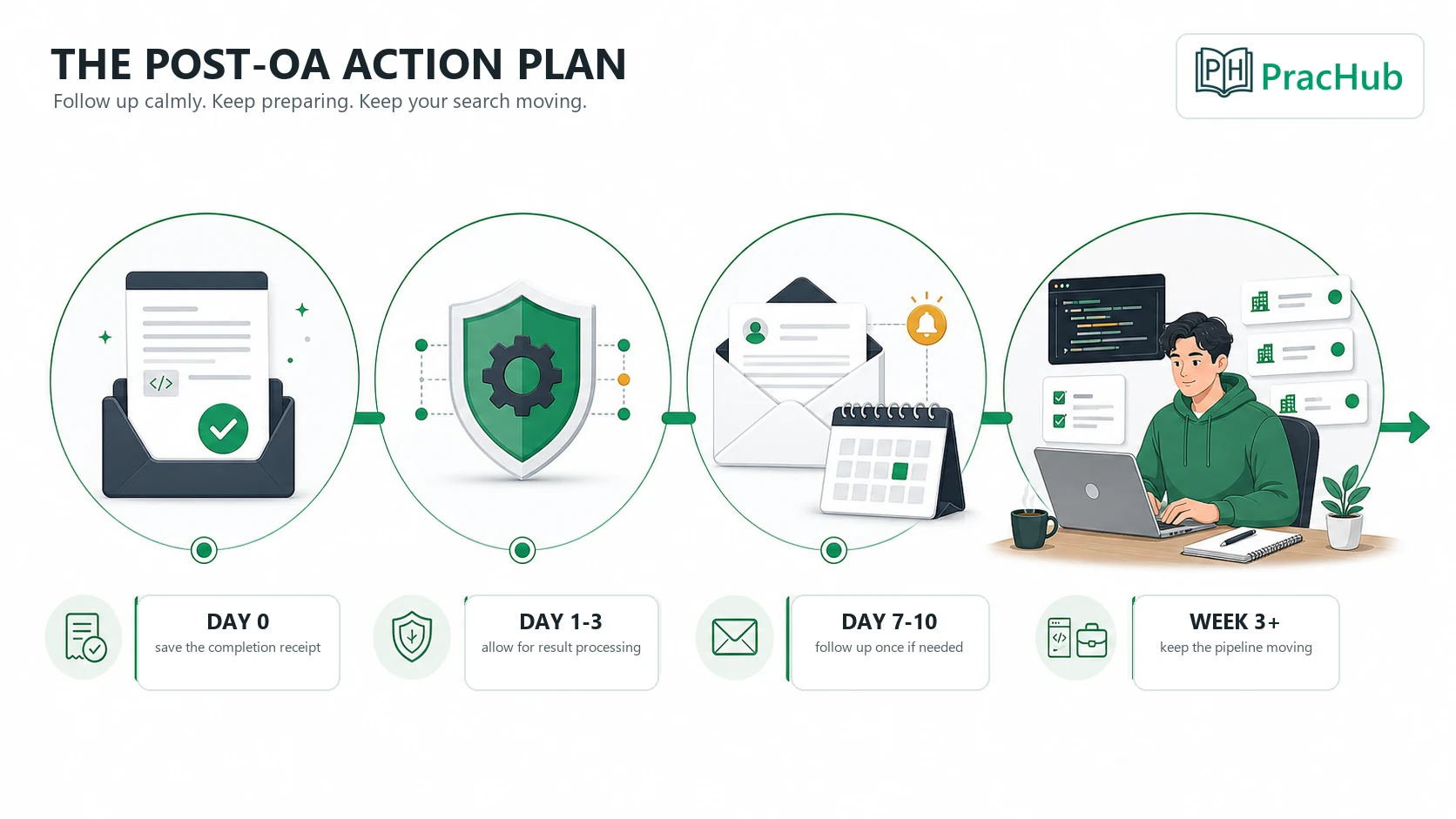
A calm follow-up cadence keeps the application alive without letting one company control your search.
Prepare for the Most Likely Next Step
The next stage varies, but your waiting-period preparation can stay focused:
| Possible next round | Best use of your preparation time |
|---|---|
| Recruiter screen | Re-read the role, confirm logistics, and summarize one strong project in under two minutes |
| Live coding | Narrate assumptions, test incrementally, and practice recovering from a mistake |
| System or product design | Review the product, likely scale constraints, and clarifying questions |
| Behavioral or hiring manager | Turn resume claims into stories with actions, judgment, impact, and trade-offs |
Practice with real questions from PracHub
A platform or process article cannot honestly attribute one company's question to every employer that uses the format. This set therefore uses real cross-company PracHub questions to rehearse common OA patterns. Each row shows its actual company and stored round; none is claimed to be supplied by this platform.
| Question | Evidence | Difficulty | Main pattern |
|---|---|---|---|
| Q1: Design a restaurant waitlist system | Google · Technical Screen | Medium | Core algorithms |
| Q2: Write SQL using joins and window functions | Capital One · Technical Screen | Medium | Strings |
| Q3: Compute minimum rooms for meeting schedule | IBM · Technical Screen | Medium | Intervals |
| Q4: Traverse org chart level by level | Microsoft · Technical Screen | Easy | Trees |
What the prompts actually ask
Q1. Design a restaurant waitlist system
Bank evidence: Google, Technical Screen, Medium. You are implementing the waitlist system for a restaurant. Parties arrive over time, can cancel, and get seated when a table becomes available. Rules - Each party has a unique partyId, a name, and a size (number of people). - Parties are seated in arrival order, but only if they fit the available table.
Q2. Write SQL using joins and window functions
Bank evidence: Capital One, Technical Screen, Medium. SQL Coding: Rank within Groups with Joins You are given two tables: accounts - accountid (string) - customerid (string) - segment (string) — e.g., "prime", "subprime" transactions - transactionid (string) - accountid (string) - amount (numeric) - txnts (timestamp) Task For each segment, find the top 3.
Q3. Compute minimum rooms for meeting schedule
Bank evidence: IBM, Technical Screen, Medium. Problem You are given a list of meetings, where each meeting is represented as a pair of integers [start, end] (with start , where each inner list has exactly two integers [start, end]. Output - An integer: the minimum number of rooms required.
Q4. Traverse org chart level by level
Bank evidence: Microsoft, Technical Screen, Easy. Problem You are given an organization chart as manager relationships. Each employee is represented by: - employeeid (string/int) - managerid (string/int or null), where null indicates the CEO/root Assume the org chart forms a valid tree (exactly one root, no cycles), but employees may appear in any order.
Run the set like an assessment
- Read all four prompts first. Give each a difficulty estimate and choose an order before coding.
- Hide the solution. Write the invariant, complexity target, and three edge cases before opening the editor.
- Use one timer. Preserve five minutes at the end for boundary, tie, scale, and output-format tests.
- Log the failure mode. Record the broken invariant or missed edge case, not merely the question title.
Online Assessment Response Time FAQ
Do companies always respond after an online assessment?
No. Some employers leave applications pending or close a role without an individual update. Check the portal and follow up once or twice; after that, continue your search rather than waiting for closure.
Does a perfect OA score guarantee a response or interview?
No. Hidden tests, code quality, integrity review, resumes, work-style sections, candidate ranking, and interview capacity may all matter. A visible perfect score is not an interview confirmation.
Is a slow response after an OA a rejection?
Not necessarily. Platform processing, batch review, headcount, and scheduling can all create silence. As the wait grows, reduce your expectations, but do not infer a final decision until the employer communicates one.
Can candidates from a later batch hear back before me?
Yes. Different roles, offices, recruiters, hiring managers, or score-review paths can move at different speeds. Hiring pipelines are not always first-in, first-out, so another candidate’s faster update does not prove that your application has been rejected.
Should I contact CodeSignal or HackerRank for my hiring status?
Contact the assessment vendor for technical or verification issues. Contact the recruiter or hiring company for application status and next steps. The platform can confirm whether an attempt processed; it generally cannot decide or disclose whether the employer will interview you.
How many times should I follow up?
One follow-up is usually enough; a second can be appropriate after another 7–10 business days when the role appears active or you know the recruiter. Daily messages rarely help. A competing deadline is the main reason to contact the team sooner and state the exact date.
Final Takeaway
How long after an online assessment companies respond depends on more than your score. The platform may still be verifying the result, the employer may be reviewing candidates manually, and the hiring team may be waiting for capacity or a complete batch.
Use one to three weeks as a planning range, not a promise. Follow the employer’s stated timeline, send a concise note after 7–10 business days when no timeline exists, and keep moving through other applications.
Most importantly, prepare as though the next email could be an interview invitation. Practice real interview questions on PracHub, use written solutions to close the gaps your OA exposed, and turn waiting time into readiness for the next company too.
Sources and Methodology
This guide was researched on August 15, 2026. Platform mechanics come from current CodeSignal proctored-assessment documentation, HackerRank candidate-status documentation, HackerRank post-test communication guidance, and SHL candidate support.
The range examples come from 2026 candidate discussions about Amazon SDE I, Amazon new-grad hiring, Visa internships, and Applied Materials. They are labeled as individual reports and are not used to calculate an industry average. Employer processes can change by role, region, and recruiting cycle; your invitation and recruiter are the final authority.
Comments (0)