InterviewReady vs ByteByteGo: Which System Design Course Is Better in 2026?
Quick Overview
Compare InterviewReady and ByteByteGo for system design interview preparation in 2026. This guide reviews current pricing, access, course structure, visual explanations, case-study depth, quizzes, practice features, strengths, limitations, and how to combine either course with real company questions on PracHub.
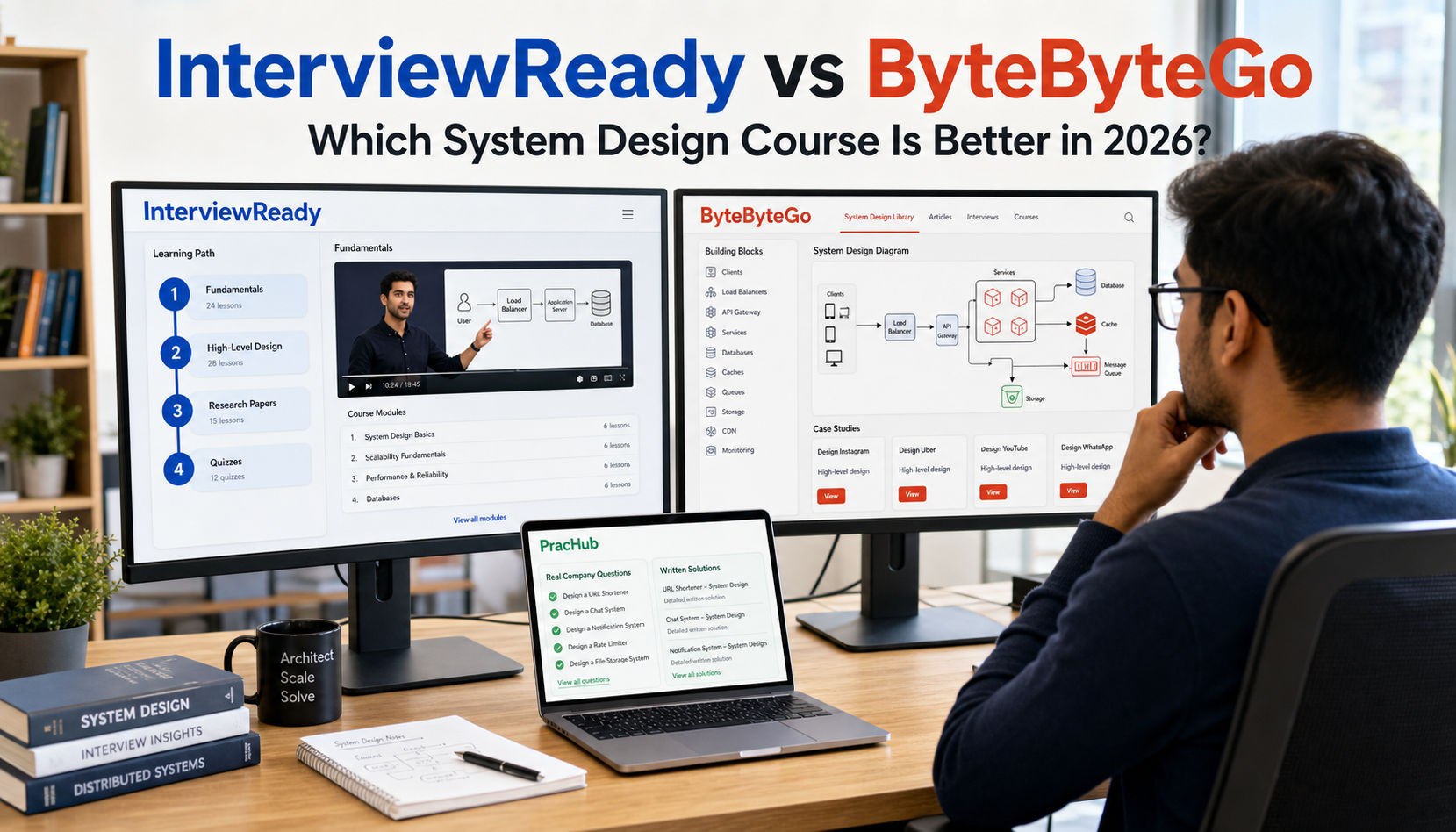
Two respected instructors can teach the same system design idea in completely different ways. InterviewReady is a structured video course; ByteByteGo is a visual, text-first library and broader interview bundle. The better choice depends less on brand popularity and more on how you learn.
Before paying for either, try two real system design questions on PracHub. If you cannot build a coherent design, you probably need a curriculum. If you know the concepts but forget components or trade-offs, a fast visual reference may be the better purchase.
Quick Verdict
Choose InterviewReady if you want an A-to-Z video path, quizzes, downloadable resources, and deeper walkthroughs of distributed-systems research. Its current System Design Simplified page lists a promotional price of $85 for one year.
Choose ByteByteGo if you prefer polished diagrams, concise reading, a large case-study library, and access to a broader interview-prep bundle. Its current pricing page lists $189 for one year or $499 for lifetime access during a 50% launch sale.
Neither should be your only practice environment. A course can explain a strong design, but an interview asks you to create one from an ambiguous prompt. Use PracHub's real interview questions with written solutions to test whether the knowledge transfers.
InterviewReady vs ByteByteGo at a Glance
| Category | InterviewReady | ByteByteGo |
|---|---|---|
| Primary format | Video lessons, quizzes, resources, Online Judge | Text-based lessons with detailed visual diagrams |
| Current price | $85 promotional price, one-year access | $189 yearly or $499 lifetime promotional price |
| System design scope | Fundamentals, high-level designs, research papers | 31-chapter system design course with fundamentals and case studies |
| Best for | Sequential learners who want explanation and depth | Visual learners who want breadth and fast review |
| Main gap | Less useful for quick scanning | Not a video-led course; no refunds listed |
Prices and promotions were checked in August 2026 and can change. Verify the checkout page before purchasing.
What InterviewReady Offers in 2026
Gaurav Sen's System Design Simplified is designed like a traditional course. The official page currently lists 242+ video lessons, 37+ quizzes, 58+ downloadable resources, and 61+ Online Judge questions, with continuous updates and one-year access.
A Clear Learning Sequence
The curriculum moves from routing, databases, caching, networking, consistency, security, observability, Paxos, and rate limiting into high-level designs. Case studies include Gmail, Tinder, WhatsApp, Google Docs, Uber, Google Maps, and recommendation systems.
The research-paper section is a genuine differentiator. It covers systems such as Facebook Memcached, Google Zanzibar, Meta TAO, Google Dremel, Kafka, Spark, and Milvus. That depth can help senior candidates explain why a design works instead of repeating a memorized diagram.
Where InterviewReady Fits Best
InterviewReady is strongest when you need a teacher to connect the ideas. It is especially useful if terms such as consistency, replication, consensus, or observability still feel disconnected.
The trade-off is time. Video is slower to search and revisit than a diagram or written chapter. Candidates with interviews next week may not finish enough of the course to justify a broad start-to-finish approach.
What ByteByteGo Offers in 2026
Alex Xu's System Design Interview course is text-based and illustration-heavy. Its 31-chapter outline begins with scaling, estimation, and an interview framework, then moves through rate limiting, consistent hashing, key-value stores, news feeds, chat, search autocomplete, YouTube, Google Drive, maps, queues, payments, and more.
Visual Breadth and Fast Review
ByteByteGo's advantage is information density. A strong diagram can refresh load balancing, caching, replication, queues, or storage choices in minutes. That makes it useful both for initial learning and for the final days before an interview.
The purchase also covers more than one system design course. The current all-in-one bundle lists coding patterns, behavioral interviews, object-oriented design, machine learning system design, mobile system design, generative AI system design, and resume guidance.
What to Know Before Buying
ByteByteGo's own FAQ says the courses are text-based with detailed illustrations, not video-based. It also says refunds are unavailable, so preview the free chapters before paying.
The breadth is valuable, but it can encourage passive recognition: a diagram looks obvious after you see it. The interview challenge is producing and defending that diagram without the reference in front of you.
Which Course Wins by Use Case?
| Your Need | Best Starting Point | Why |
|---|---|---|
| Structured beginner-to-advanced path | InterviewReady | Video sequence, quizzes, and explicit progression |
| Fast visual review | ByteByteGo | Concise explanations and memorable diagrams |
| Research-paper depth | InterviewReady | Dedicated internals and paper-analysis section |
| Broad interview bundle | ByteByteGo | Coding, behavioral, OOD, ML, mobile, and GenAI topics |
| Real company-question practice | PracHub | Company and topic filters with written solutions |
| Full-loop preparation | PracHub plus one course | Combines knowledge building with interview-specific practice |
The Gap Both Courses Share
System design interviews are conversations, not content-recall tests. You must clarify requirements, estimate scale, choose boundaries, defend trade-offs, respond to follow-ups, and adjust when the interviewer changes a constraint.
That is why course completion is a weak readiness signal. A better signal is whether you can take a new prompt, speak for 45 minutes, and produce a defensible design. Add company-specific interview prep so your practice reflects the companies and roles you actually target.
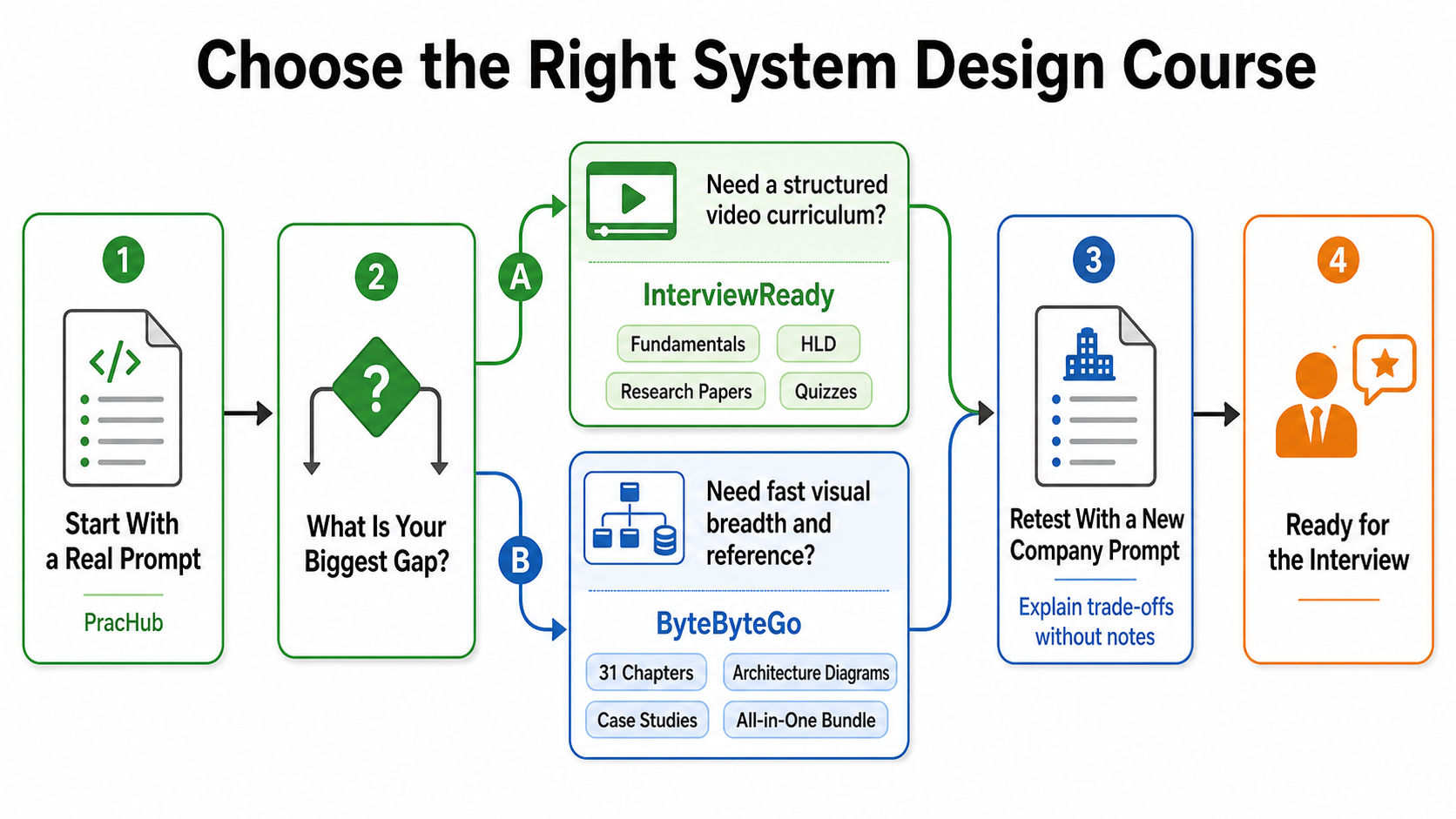
A Better Hybrid Prep Workflow
1. Diagnose With a Real Prompt
Choose a system design question you have not seen. Spend 35 to 45 minutes clarifying scope, sketching APIs and data models, building the architecture, and discussing bottlenecks.
2. Match the Resource to the Gap
If you lacked a repeatable process or could not explain core components, use InterviewReady's structured lessons. If you understood the problem but needed faster recall, review the matching ByteByteGo chapter and redraw its architecture from memory.
3. Retest Without Notes
Attempt a different prompt with similar constraints. Explain every major choice aloud, including one rejected alternative. A cleaner second attempt is evidence that the course helped; more completed lessons are not.
For a full hiring loop, combine this with behavioral and leadership practice. Senior system design performance is often judged alongside communication, ownership, and influence.
Who Should Choose InterviewReady?
InterviewReady is the better fit for engineers who want a guided video instructor, need to rebuild distributed-systems fundamentals, value quizzes and downloadable materials, or want deeper research-paper explanations. At the current promotional price, it is also the cheaper one-year purchase.
Who Should Choose ByteByteGo?
ByteByteGo is the better fit for visual learners, experienced engineers who need a searchable reference, candidates preparing for several interview types, and people who want lifetime access. Its higher price makes more sense when you will use the full bundle, not only one system design course.
FAQ
Is InterviewReady better than ByteByteGo?
InterviewReady is better for a structured video curriculum and research-paper depth. ByteByteGo is better for visual explanations, rapid review, and broader interview coverage. The right choice depends on your learning gap.
Can either course replace system design practice?
No. Both can improve your knowledge, but you still need unseen prompts, timed explanations, follow-up questions, and feedback. Use PracHub to turn the material into active practice.
Which is better for senior engineers?
Senior engineers may prefer InterviewReady for internals and research papers or ByteByteGo for fast breadth. Staff-level candidates should prioritize trade-offs, failure modes, product constraints, and clear communication over memorizing a single reference design.
Final Verdict
InterviewReady wins for structured video learning. ByteByteGo wins for visual breadth and reference value. Neither wins every category, and neither proves you are interview-ready on its own.
Start with PracHub, find the exact weakness, and buy only the resource that fixes it. Then return to a new real question and confirm that you can design, explain, and adapt without notes. That practice-first loop is more valuable than simply finishing another course.
Related Resources
Related Articles
Code Review Interview Guide: How to Find Bugs and Explain Trade-Offs
Code review interview guide: learn how to find bugs, propose tests, prioritize feedback, and explain technical trade-offs with a practical example.
Parakeet AI Review 2026: Pay-Per-Interview Copilot vs Real Preparation
Parakeet AI review 2026: examine credits, live copilot features, privacy and detection risks, then compare pay-per-interview help with real prep.
Palantir Decomposition Interview Guide: How to Structure Ambiguous Problems
Palantir Decomposition Interview guide: learn a six-step framework for ambiguous problems, trade-offs, MVPs, practice examples, and common mistakes.
Coding Assessment Hidden Test Cases: Why Solutions Fail and How to Debug Them
Coding assessment hidden test cases explained: common failure causes, edge-case checklist, performance traps, and a repeatable debugging workflow.
Comments (0)