Is Ace the Data Science Interview Enough in 2026?
Quick Overview
Ace the Data Science Interview remains one of the strongest single-book foundations for Data Scientist interviews in 2026, with broad coverage of probability, statistics, SQL, Python, machine learning, product sense, and behavioral preparation. This review explains what the 2021 book still does well, where static practice falls short, which roles need more depth, and how to combine the book with PracHub's current company-specific questions and written solutions.
Ace the Data Science Interview is often described as the data-science version of Cracking the Coding Interview. That comparison makes sense: it puts a wide interview syllabus and hundreds of worked questions into one approachable book.
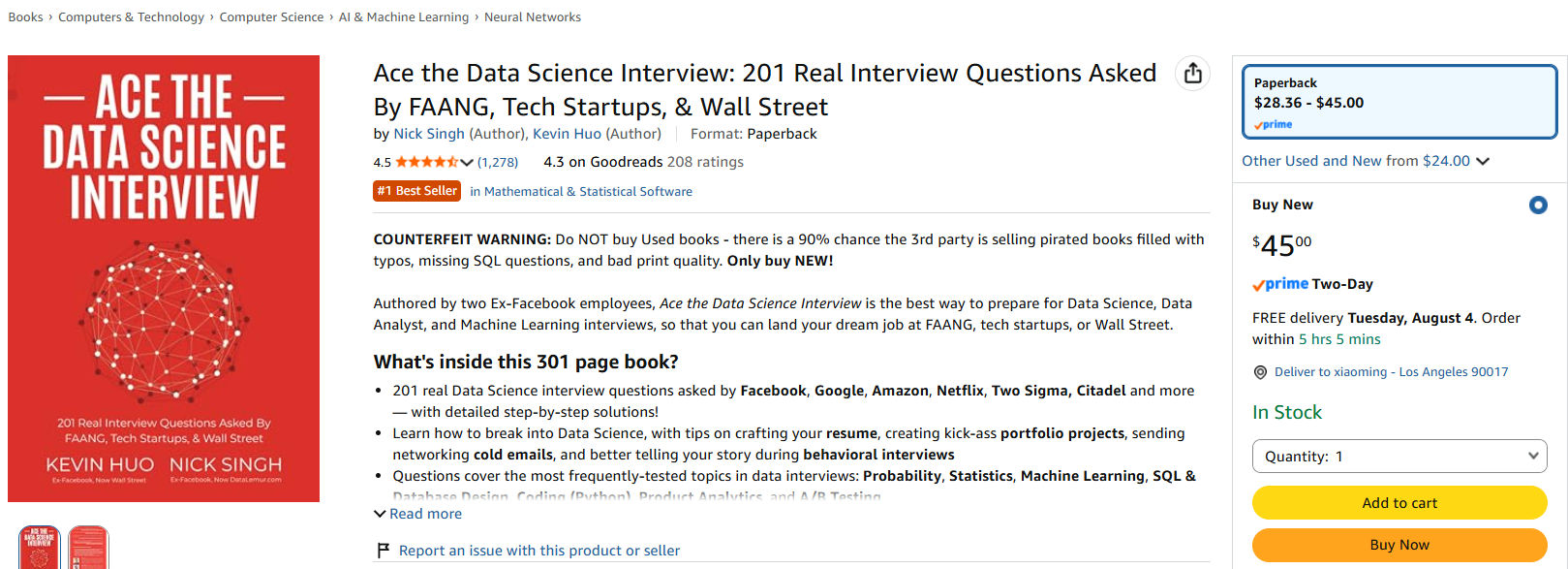
But a strong reference book and a complete 2026 preparation system are not the same thing. Data Scientist loops now vary sharply by company, level, and team, and reading solutions does not automatically create speed under pressure.
Before rereading every chapter, diagnose your actual gaps with real Data Scientist interview questions on PracHub. Then use the book for concepts and PracHub for company-specific, timed practice with written solutions.
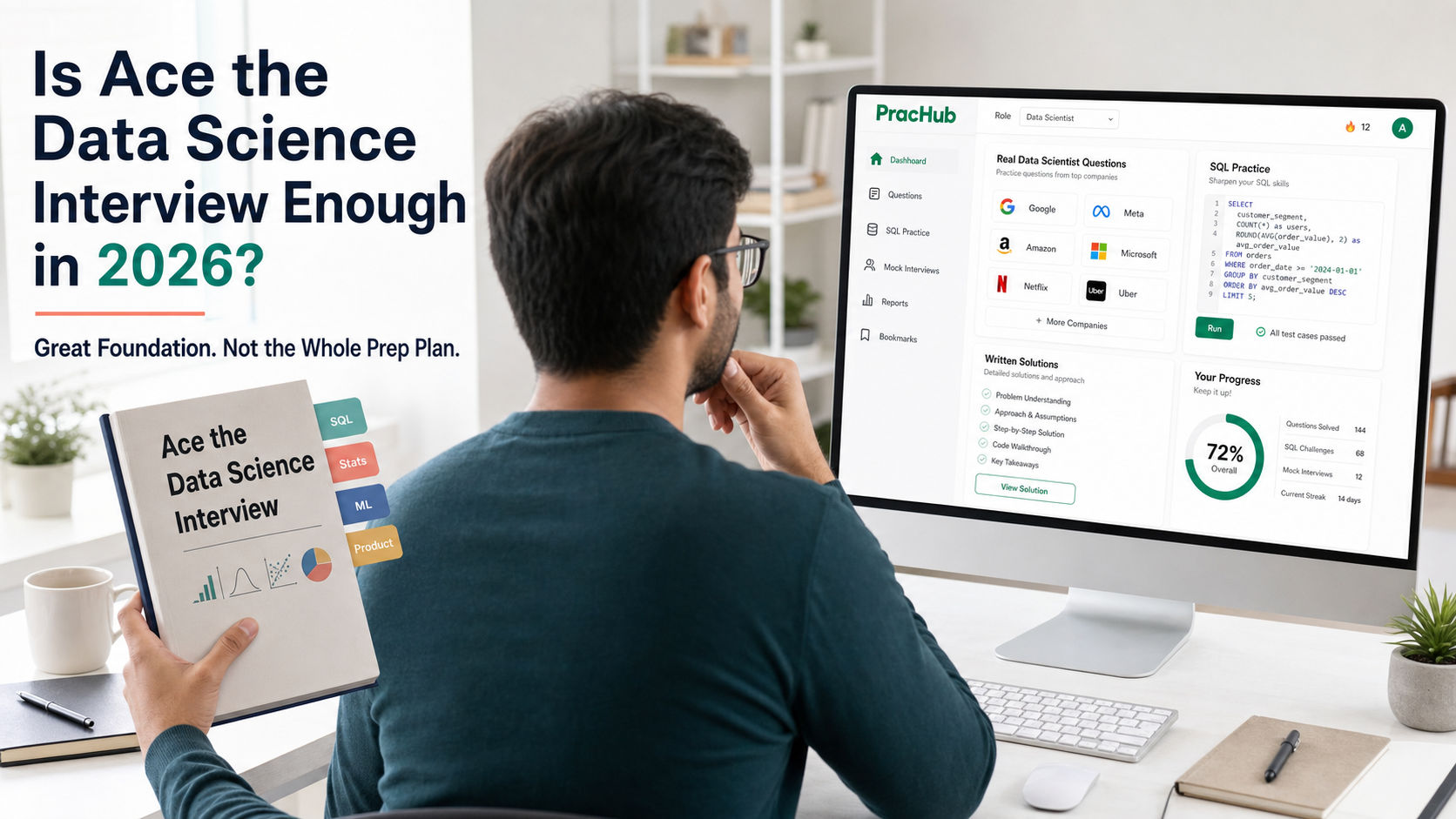
Quick Verdict
Ace the Data Science Interview is still worth using in 2026, but it is not enough by itself for most candidates. It remains an excellent structured review of probability, statistics, machine learning, SQL, Python, product sense, behavioral interviews, resumes, and job-search strategy.
Its main limitation is the format. A static book cannot adapt to your target company, run your SQL or Python, expose weak timing, update from recent candidate reports, or simulate follow-up questions. Use it as a foundation, then add live practice and mocks.
What Is Ace the Data Science Interview?
The book was written by Kevin Huo and Nick Singh and published in 2021. Its official website describes 11 chapters, 301 pages, and 201 interview questions with solutions drawn from companies including Google, Meta, Amazon, Microsoft, Netflix, Stripe, Uber, Two Sigma, and Citadel.
The official site positions it for Data Scientist, Data Analyst, and Machine Learning interviews. It also covers the job hunt, including resumes, portfolio projects, networking, and behavioral preparation.
As of August 2026, the official site does not advertise a second edition. It also says there is no authorized e-book, Kindle edition, or downloadable PDF, although some questions are available online through DataLemur.
What the Book Covers
| Area | What the Book Provides | What You Still Need to Practice |
|---|---|---|
| Probability and statistics | Core concepts, intuition, and interview questions | Explaining assumptions and choosing methods in ambiguous cases |
| SQL and databases | Query patterns and database fundamentals | Writing and debugging queries under a real timer |
| Machine learning | Modeling fundamentals and conceptual questions | Production tradeoffs, modern ML systems, and team-specific depth |
| Product sense | Frameworks for metrics and open-ended cases | Company products, current business context, and live follow-ups |
| Python and coding | Common coding ideas and solved examples | Hands-on implementation, data manipulation, and edge cases |
| Behavioral and job search | Resume, portfolio, networking, and story guidance | Role-specific stories with concise delivery and feedback |
What the Book Still Does Exceptionally Well
It Gives You One Coherent Syllabus
Data Science interview preparation is fragmented. Candidates often jump among SQL sites, statistics notes, ML courses, and product-case videos without knowing what matters. The book creates a sensible map and explains how the categories connect.
It Teaches Interview-Friendly Explanations
The strongest sections do more than state formulas. They model how to communicate intuition, assumptions, and tradeoffs. That is useful because an interviewer may care less about memorized notation than whether you can explain why a method fits the problem.
Its Core Material Has Aged Well
Conditional probability, hypothesis testing, regression, model evaluation, SQL joins, window functions, and product metrics are not obsolete. These foundations still support many analytics and product Data Science loops.
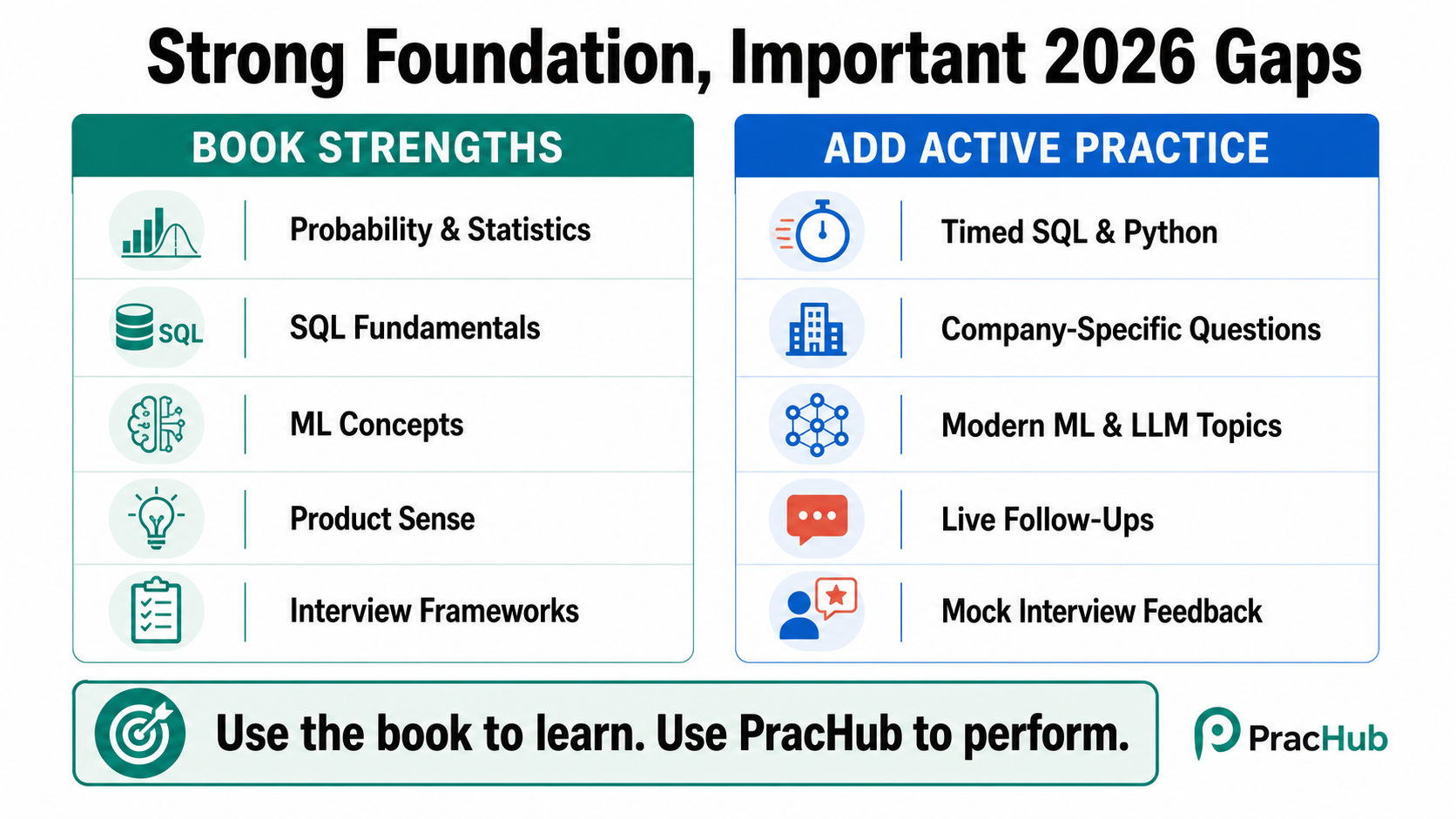
Where It Falls Short in 2026
Reading Is Not Timed Execution
Recognizing a SQL solution on paper is different from building it from a blank editor, handling NULLs, and fixing a broken window function in 25 minutes. Pair the SQL chapter with interactive SQL and data-manipulation practice.
The same applies to Python. Attempt each prompt cold, run examples, and explain complexity before reading the solution. Passive familiarity can create false confidence.
A Static Book Cannot Match Your Target Loop
A product analytics role may emphasize SQL, experiments, metrics, and stakeholder judgment. A modeling role may add feature engineering and error analysis. An ML-heavy role may test coding, deployment, monitoring, or system design.
The book gives breadth, but you still need company-specific interview prep to decide what deserves most of your limited study time.
Modern ML Depth Can Exceed the Book
For ML-focused teams in 2026, candidates may need deeper practice in production ML, ranking, recommendation, model monitoring, data quality, or LLM evaluation. The fundamentals remain valuable, but the book should be supplemented with current machine learning interview questions.
Worked Answers Do Not Push Back
Real interviewers ask why your metric is appropriate, what could bias the result, how you would validate the data, and what changes at scale. A written solution cannot respond to your assumptions or challenge a vague recommendation.
Is the Book Enough for Your Role?
| Target Role | Is the Book Enough? | What to Add |
|---|---|---|
| Entry-level Data Analyst | Strong foundation, but usually not enough | Timed SQL, dashboard cases, and business communication |
| Product Data Scientist | Useful core resource | Company metrics, experimentation cases, and product mocks |
| Modeling Data Scientist | Good review, limited practical depth | Python implementation, modeling cases, and error analysis |
| Machine Learning Engineer | Not enough as the primary resource | Coding, ML system design, production tradeoffs, and deployment |
| Senior Data Scientist | Helpful refresher only | Leadership stories, ambiguous cases, strategy, and influence |
A Better Book Plus PracHub Workflow
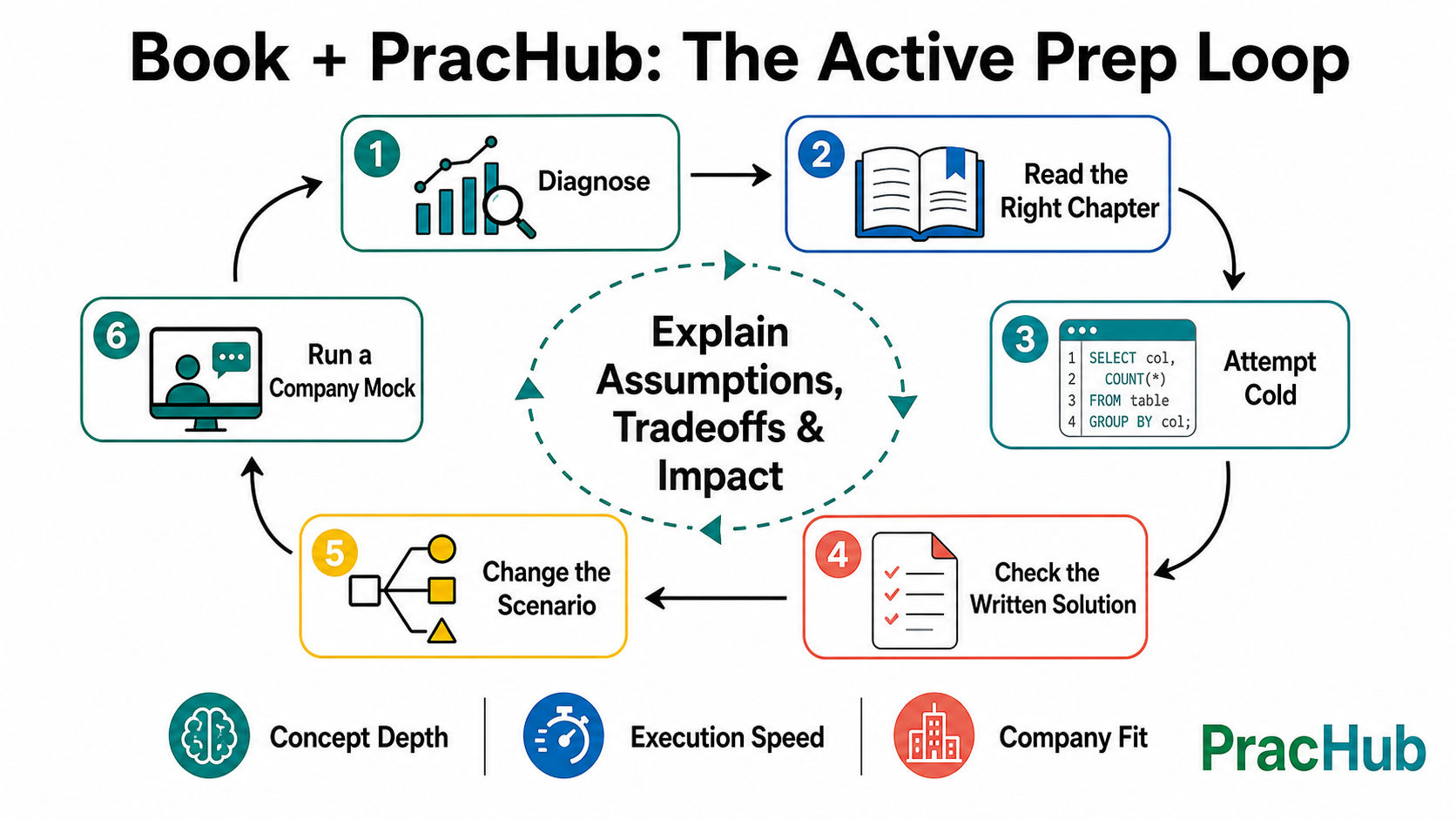
1. Diagnose Before You Read
Attempt one SQL question, one statistics prompt, one product case, one ML question, and one Python task. Score correctness, speed, and explanation quality. Your weakest two areas determine the first chapters to review.
2. Read for Concepts, Not Completion
Do not measure progress by pages. After each section, close the book and explain the idea from memory. Write down the assumptions, failure modes, and one example where the method should not be used.
3. Convert Every Solution Into a New Attempt
After reviewing a solution, solve a related question without notes. Change the dataset, metric, constraint, or business goal so you cannot repeat the answer mechanically.
4. Finish With Company-Specific Mocks
Use recent questions from your target companies and answer aloud. Add behavioral and leadership practice so technical preparation does not crowd out project stories and stakeholder communication.
A Practical 7-Day Readiness Test
Day 1 is a mixed diagnostic. Days 2 and 3 cover your weakest technical chapters. Day 4 is timed SQL and Python. Day 5 is statistics plus a product case. Day 6 is a company-specific mock. Day 7 is error review and behavioral rehearsal.
If you can solve new questions under time, explain assumptions clearly, and respond to follow-ups, the book has done its job. If you only recognize the printed solutions, you need more active practice before the interview.
Who Should Use This Book?
The book is a strong choice for career changers, students, and candidates who want one organized overview before specializing. It is also useful for experienced Data Scientists who need a fast refresher across topics they have not used recently.
It is less suitable as the only resource for candidates with an interview in a few days, applicants targeting ML systems or specialized research roles, and anyone whose main gap is coding speed rather than conceptual coverage.
Frequently Asked Questions
Is Ace the Data Science Interview outdated?
No. Most probability, statistics, SQL, product sense, and ML fundamentals remain relevant. The limitation is not that the book became useless; it is that a 2021 static resource cannot reflect every current company loop, emerging ML topic, or recent candidate report.
Does the book include real interview questions?
Yes. The official site says it contains 201 questions with solutions from well-known technology and finance companies. Treat them as practice material rather than a promise that the exact prompt will repeat.
Is there an official PDF or Kindle edition?
No. The authors' official site says there is no authorized PDF, e-book, or Kindle version. Avoid unofficial downloads. Some questions and related practice are available online through the authors' other resources.
Should I use the book or PracHub?
Use both for different jobs. The book supplies a structured conceptual syllabus. PracHub supplies current interview questions with written solutions, company filters, and a better path from diagnosis to targeted practice.
Final Verdict
Ace the Data Science Interview is one of the best single-book foundations for Data Science interviews, but it is not a complete 2026 prep plan. Read it selectively, practice every important skill in an editor or aloud, and finish with current company-specific questions.
Start on PracHub with a mixed Data Scientist diagnostic. Use the book to repair the concepts you miss, then return to new questions and timed mocks. That loop turns a useful reference into interview performance.
Sources and Further Reading
Ace the Data Science Interview official website | Google Books publication record | Official e-book and PDF FAQ
Related Articles
Ace the Data Science Interview vs DataLemur: Book or Interactive Practice?
Ace the Data Science Interview vs DataLemur: compare coverage, learning style, and the best PracHub workflow for data interview prep in 2026.
LeetCode SQL vs DataLemur: Which Is Better for Data Interviews?
LeetCode SQL vs DataLemur: compare question style, difficulty, data-role relevance, and the best PracHub workflow for SQL interview prep.
Is DataLemur Enough for Data Science Interviews? Honest Review
Read this DataLemur review for data scientists. See where it shines for SQL practice, where it falls short, and how PracHub broadens prep.
Interview Query Review for Data Scientists: Is It Worth It?
Read this Interview Query review for data scientists. Compare SQL, ML, product sense, question depth, pricing, and when to use PracHub first.
Comments (0)