DataLemur vs LeetCode SQL (2026): Which Is Better for Data Interviews?
Quick Overview
LeetCode SQL and DataLemur build different parts of data-interview readiness. LeetCode SQL 50 provides a structured basic-to-intermediate foundation, while DataLemur offers a larger library of company-labeled analytics scenarios for Data Analysts and Data Scientists. This comparison covers question style, difficulty, role fit, common gaps, a seven-day platform test, and how to add PracHub for company-specific full-loop preparation.
A SQL query can be technically correct and still fail a data interview. The interviewer may care just as much about how you define the metric, interpret incomplete data, explain edge cases, and connect the output to a business decision.
That is why LeetCode SQL and DataLemur feel different even when both test joins, aggregations, CTEs, and window functions. LeetCode is a clean route through SQL mechanics. DataLemur is built around the language and scenarios of Data Analyst and Data Scientist interviews.
Before choosing either, try several SQL and data-manipulation interview questions on PracHub. A short diagnostic will show whether your gap is query syntax, analytical reasoning, company-specific preparation, or the broader data interview loop.
Quick Verdict
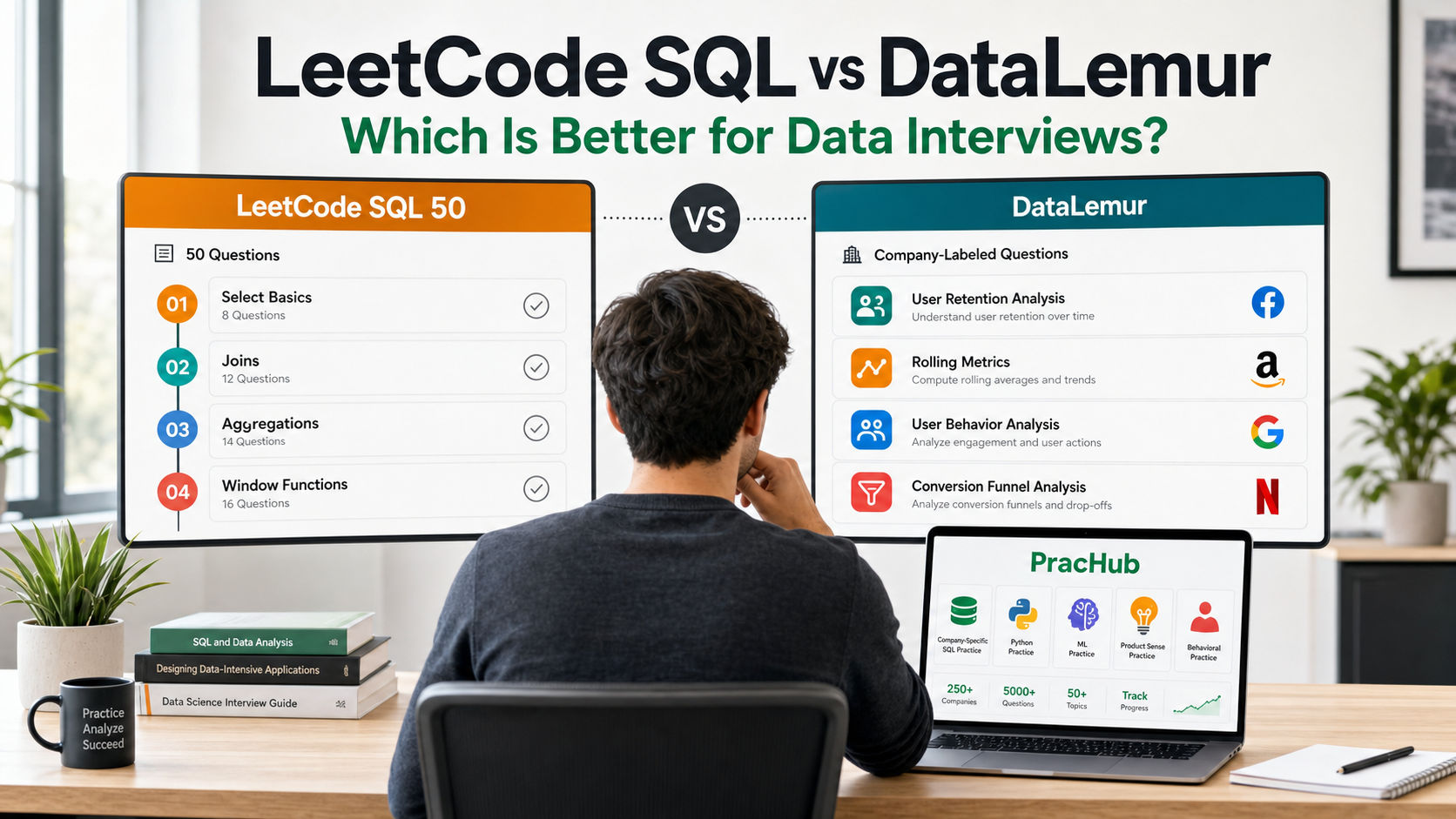
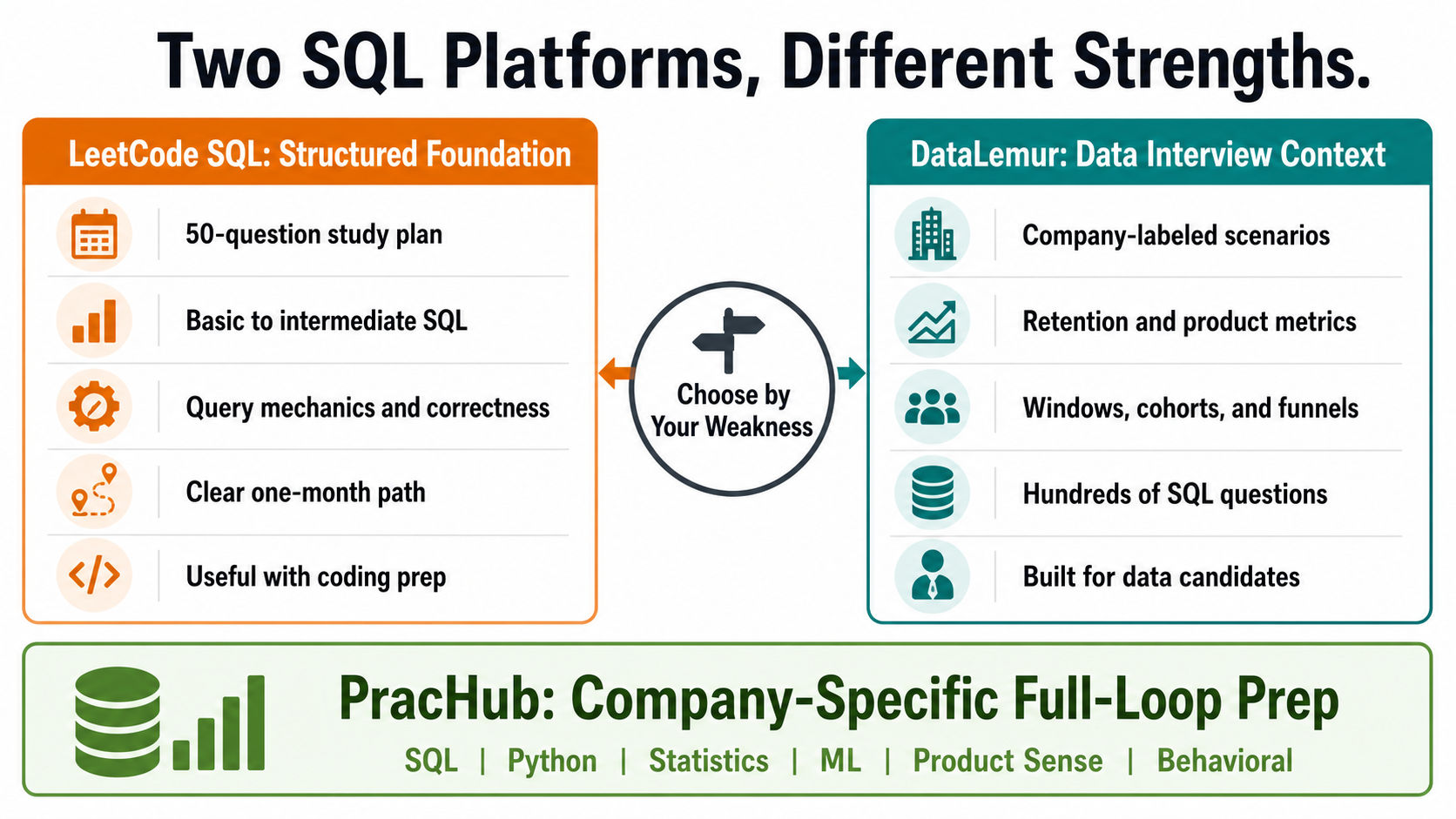
DataLemur is the better first choice for most Data Analyst and Data Scientist candidates. Its questions use recognizable company and product-analytics contexts, and its SQL library is organized around data-interview patterns such as retention, ranking, rolling metrics, user behavior, and business reporting.
LeetCode SQL is better for a compact, structured SQL foundation. The official SQL 50 plan contains 50 essential basic-to-intermediate questions and is designed for about one month of preparation. It is especially convenient if you already use LeetCode for coding interviews.
Neither is a complete data-interview plan. SQL is only one part of many loops, so use PracHub to add current company questions, Python, statistics, machine learning, product sense, and behavioral practice.
What LeetCode SQL Offers
LeetCode's clearest SQL path is the official SQL 50 Study Plan. It gives beginners a defined finish line and covers common database-query mechanics without requiring them to assemble a curriculum from a large problem list.
The main strength is deliberate repetition. You practice filtering, joins, grouping, subqueries, CTE-style reasoning, ranking, and related patterns in the same judge-driven workflow used for coding problems. Progress is easy to track, and wrong answers force you to handle exact output requirements.
The limitation is interview context. A correct query does not always teach you how to clarify a metric, challenge a table definition, discuss data quality, or explain what the result means to a product stakeholder.
What DataLemur Offers
DataLemur presents itself as an interactive SQL and analytics interview platform. Its current SQL page contains hundreds of questions grouped by company, difficulty, and tags such as aggregate functions, date-time operations, CTEs, window functions, joins, user behavior, and conditional logic.
The prompts often resemble business-analysis work: measuring activation, finding rolling averages, calculating retention, ranking products, or summarizing transactions. That makes the practice feel closer to Data Analyst and product Data Scientist screens.
DataLemur also links to Python, statistics, and machine-learning questions. That breadth is useful, but the platform's strongest identity remains SQL. Candidates still need company-specific full-loop practice and live explanation.
LeetCode SQL vs DataLemur: Side-by-Side
| Factor | LeetCode SQL | DataLemur |
|---|---|---|
| Best use | Build a structured SQL foundation | Prepare for analytics-focused SQL interviews |
| Question style | Concise database problems with exact outputs | Company-labeled business and product scenarios |
| Learning path | SQL 50 provides a clear one-month sequence | Larger library filtered by difficulty, company, and topic |
| Strongest skill | Syntax, query construction, and correctness | Analytical patterns and interview relevance |
| Broader ecosystem | Algorithms and general software interview practice | SQL plus selected Python, statistics, and ML questions |
| Main gap | Less emphasis on business interpretation | Not a complete company-specific data loop |
Which Platform Has Better SQL Questions?
LeetCode Is Better for Query Fundamentals
If you regularly forget join behavior, grouping rules, NULL handling, or the order in which a query should be built, LeetCode's smaller plan is useful. Completing a fixed sequence prevents you from jumping only to familiar topics.
LeetCode also works well for candidates whose loop includes both algorithmic coding and SQL. Keeping both skill tracks in one familiar interface reduces friction.
DataLemur Is Better for Analytics Patterns
If your syntax is already comfortable, DataLemur provides more situations where the hard part is translating a business question into a query. Cohorts, retention, rolling windows, funnels, ranking, and time-based comparisons are closer to the work many data candidates must discuss.
Company labels are useful for motivation and topic discovery, but do not assume an exact question will repeat. Treat each problem as practice in recognizing a pattern and explaining the assumptions behind it.
Which Is Better for Your Role?
| Target Role | Start With | What to Add |
|---|---|---|
| Entry-level Data Analyst | LeetCode SQL 50, then DataLemur | Business metrics and dashboard interpretation |
| Experienced Data Analyst | DataLemur | Company cases and stakeholder communication |
| Product Data Scientist | DataLemur | Experiments, product sense, statistics, and behavioral stories |
| Modeling Data Scientist | DataLemur selected SQL | Python, ML fundamentals, modeling, and error analysis |
| Analytics Engineer | Both | Data modeling, transformations, testing, and warehouse design |
| Software Engineer with a SQL round | LeetCode SQL | Role-specific coding and system design |
Question Count Is Not the Best Metric
A large library helps only when it changes what you can do. Solving 100 near-identical aggregation questions is less valuable than mastering joins, windows, time logic, NULL behavior, deduplication, and metric definitions across unfamiliar schemas.
Track three outcomes instead: whether the query is correct, how long it takes, and whether you can explain it. Add a fourth score for data roles: can you state what the result means and identify a limitation in the metric?
A 7-Day Platform Test
On Days 1 and 2, solve ten SQL 50 questions without looking at solutions. Record syntax errors, incorrect assumptions, and time spent. On Days 3 and 4, solve six DataLemur questions across easy, medium, and hard levels, including at least one window-function and one retention-style problem.
On Day 5, choose two unfamiliar questions from PracHub's Data Scientist interview bank and explain the metric before writing SQL. On Day 6, redo every missed problem from a blank editor. On Day 7, run a 45-minute mock and compare accuracy, speed, and explanation quality.
If query construction is still the bottleneck, continue LeetCode SQL 50. If translating business logic is harder, prioritize DataLemur. If the SQL is solid but company context or non-SQL rounds are weak, move more time to PracHub.
The Best Workflow: Learn, Diagnose, Broaden
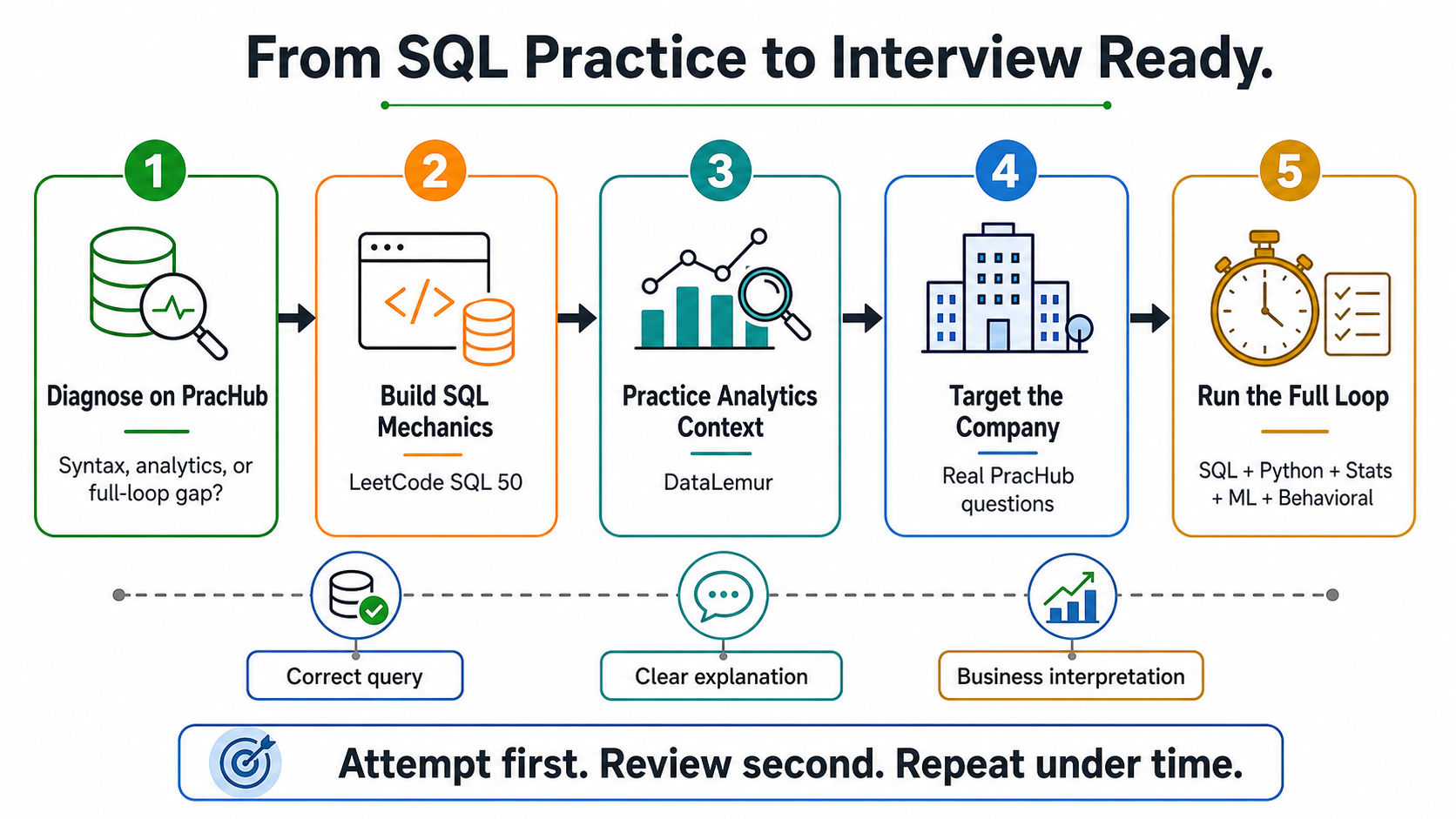
Use LeetCode to establish reliable mechanics, DataLemur to practice analytics-shaped prompts, and PracHub to turn those skills into company-specific preparation. This sequence avoids treating every platform as a complete solution.
After each SQL problem, write one sentence defining the metric, one edge case, and one alternative query. Then add machine-learning questions or behavioral and leadership practice based on the actual interview loop.
Common SQL Prep Mistakes
The most common mistake is reading solutions until they look familiar. Recognition is not recall. Attempt every important problem from a blank editor and test edge cases before checking the editorial.
Other weak habits include memorizing syntax without understanding row grain, ignoring NULLs and duplicate records, skipping verbal explanations, and spending all preparation time on SQL when the target loop also includes statistics, product sense, Python, ML, or behavioral questions.
Frequently Asked Questions
Is DataLemur harder than LeetCode SQL?
It depends on the problem. DataLemur can feel harder because many prompts require translating business language into query logic. LeetCode also has challenging database problems, but SQL 50 is officially positioned around basic-to-intermediate topics.
Is LeetCode SQL 50 enough for a Data Analyst interview?
It is a strong foundation, not a complete plan. Add analytics scenarios, metric interpretation, data-quality reasoning, and company-specific questions.
Can DataLemur replace LeetCode?
For a SQL-heavy Data Analyst or Data Scientist interview, it may cover more relevant practice. Candidates who also face algorithmic coding rounds will still benefit from LeetCode's broader problem ecosystem.
Where does PracHub fit?
PracHub is the bridge from generic SQL practice to the actual interview loop. Use it for company-specific interview prep, written solutions, and coverage beyond SQL.
Final Verdict
Choose DataLemur for data-interview relevance and LeetCode SQL for a structured foundation. Beginners can complete SQL 50 first, while candidates who already write joins and windows comfortably should move directly into DataLemur's analytics scenarios.
Then test both against real interview conditions on PracHub's SQL and data-manipulation questions. The winning platform is not the one with the longest list. It is the one that fixes the exact failure you would otherwise carry into the interview.
Comments (0)