Is DataLemur Enough for Data Science Interviews? Honest Review
Quick Overview
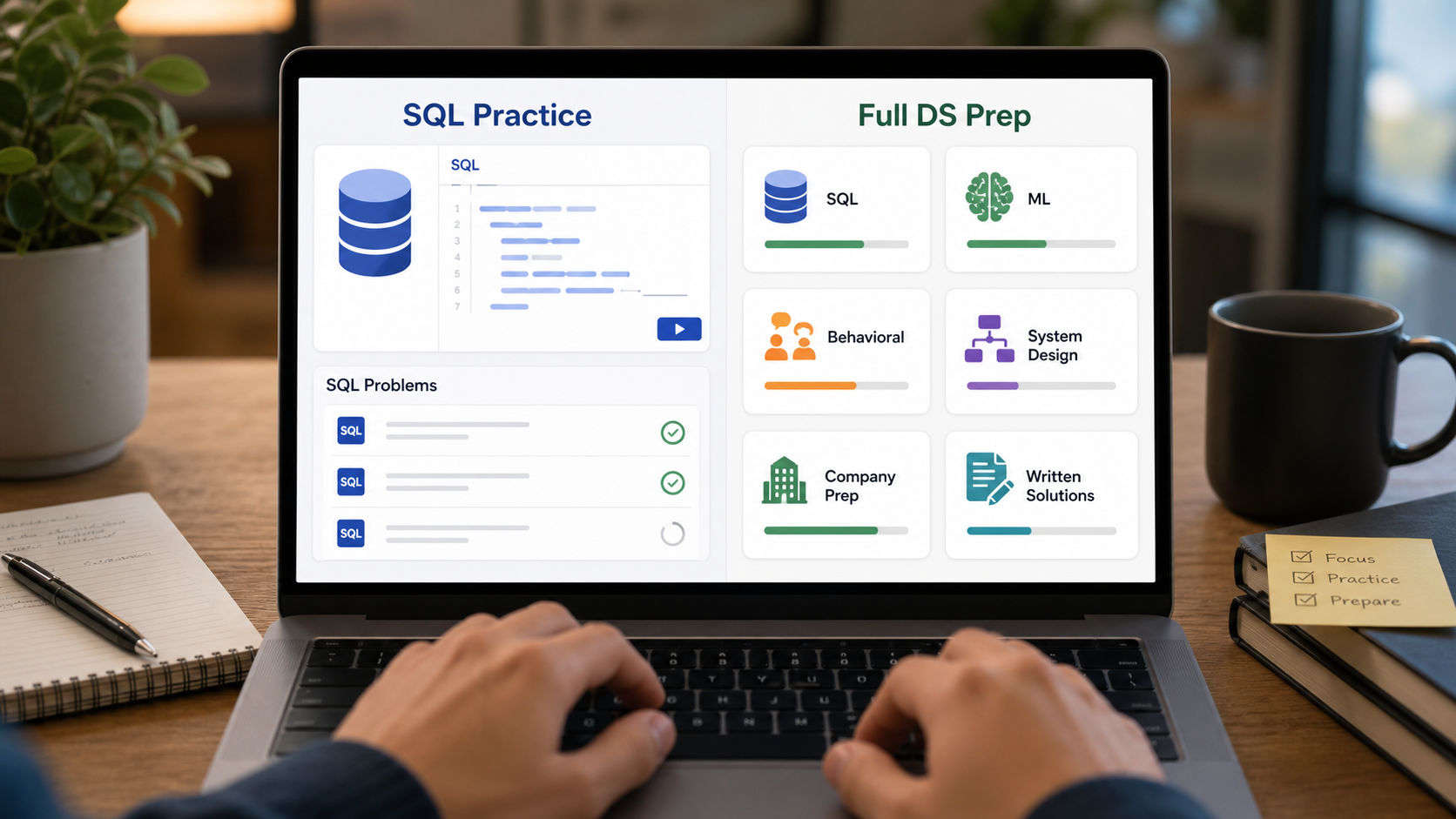
DataLemur is a strong SQL-first platform for data analyst and data science interview practice, with company-style SQL questions, hints, solutions, and additional statistics, probability, machine learning, and Python questions. But SQL practice is only one part of full data science interview prep. Candidates also need company-specific preparation, ML reasoning, product sense, system design, behavioral stories, take-home readiness, and full-loop practice. PracHub helps broaden prep beyond SQL by giving candidates real interview questions with written solutions, company-specific prep, SQL practice, system design questions, ML-related questions, and behavioral interview practice.
DataLemur solves a real problem.
Most data candidates know SQL matters, but they do not always know how to practice it in an interview-like way. Reading syntax tutorials is not enough. Watching SQL videos is not enough. You need to write queries, handle edge cases, read schema carefully, and learn how companies phrase analytics questions.
That is why DataLemur became popular.
It gives data candidates a clean way to practice SQL and analytics-style interview problems. For many data analysts and data scientists, that alone is useful.
But here is the catch:
SQL practice is not the same as full data science interview prep.
A data science loop can include SQL, product sense, statistics, A/B testing, machine learning, Python, modeling, take-homes, behavioral interviews, hiring manager conversations, and company-specific product scenarios.
So the real question is not:
"Is DataLemur good?"
The better question is:
"Is DataLemur enough for the interview loop I actually have?"
For many candidates, the answer is: use DataLemur for SQL, but start with PracHub for full-loop prep.
Before going deep on any single SQL platform, use real interview questions with written solutions and company-specific interview prep to understand what your target companies actually ask. Then add SQL interview practice, system design questions, and behavioral interview practice based on the full loop.
Quick Verdict: Is DataLemur Worth It?
DataLemur is worth it if SQL is your main weakness.
It is especially useful for data analyst, analytics engineer, business intelligence, and data science candidates who need interactive SQL reps with company-style prompts.
But DataLemur should not be your only prep resource if your interview loop includes ML, product sense, experimentation, behavioral rounds, or company-specific cases.
Choose DataLemur if:
-
You want focused SQL practice.
-
You like short, company-style data questions.
-
You need hints and full solutions.
-
You are preparing for data analyst or DS screens with SQL.
-
You want an affordable paid SQL-focused tool.
-
You already know your biggest weakness is query writing.
Start with PracHub if:
-
You want real interview questions with written solutions.
-
You are preparing for a specific company.
-
You need more than SQL.
-
You want DS, ML, system design, behavioral, and company prep in one workflow.
-
You are not sure which part of the loop is your weakness.
-
You want a free diagnostic before paying for a narrower tool.
The practical recommendation:
Use PracHub to map the full interview loop. Use DataLemur when SQL is the gap you need to drill.
What Is DataLemur?
DataLemur is an interview prep platform for SQL and data interview practice.
Its homepage describes it as a place to practice SQL interview and data science interview questions, and the founder describes the product as an interactive SQL and analytics interview platform for the data community.
DataLemur is closely tied to the book Ace the Data Science Interview by Nick Singh and Kevin Huo. The site says the book helped 16,000+ readers prepare for statistics, ML, and business-sense portions of data interviews, and DataLemur was created as an interactive way to practice the questions.
On the question page, DataLemur lists categories including:
-
SQL
-
Statistics
-
Machine Learning
-
Python
On the pricing page, DataLemur advertises:
-
100+ SQL interview questions from companies like Facebook, Google, and Amazon
-
Multiple hints and full solutions
-
70+ data science interview questions spanning statistics, probability, and machine learning
-
A yearly plan, monthly plan, and a coaching/book/lifetime bundle
So DataLemur is not literally only SQL.
But it is still best understood as SQL-first.
Its strongest use case is helping candidates get faster and sharper at SQL interview problems.
Where DataLemur Is Strong
DataLemur is strong because it does one important thing clearly.
It helps data candidates practice SQL in a way that feels closer to interviews than generic SQL tutorials.
Strong SQL Practice
SQL interviews reward repetition.
You need to recognize patterns quickly:
-
Joins
-
Aggregations
-
Window functions
-
Common table expressions
-
Date logic
-
Ranking
-
Retention
-
Funnels
-
Duplicate handling
-
Null handling
-
Filtering order
-
Edge cases
DataLemur is useful because the questions are short enough to practice in volume but realistic enough to feel like interview prompts.
That is a good match for candidates who know SQL syntax but struggle to turn business questions into correct queries.
Company-Style Prompts
DataLemur's homepage and question list show prompts tied to companies like LinkedIn, Facebook, Tesla, New York Times, Robinhood, Snapchat, Twitter, Google, Walmart, Amazon, Wayfair, Stripe, and others.
This company-style framing matters.
SQL interviews often sound like product or business questions, not textbook exercises.
For example, you may be asked to calculate retention, find duplicate listings, rank users, compare device usage, identify active users, or compute rolling averages.
That is much closer to real data work than writing isolated syntax examples.
Helpful for Data Analyst and Analytics Roles
DataLemur is especially relevant for:
-
Data analysts
-
Product analysts
-
BI engineers
-
Analytics engineers
-
Entry-level data scientists
-
Data scientists with SQL-heavy interviews
If your target role has a SQL screen, DataLemur can be a solid practice layer.
But if your target role goes beyond SQL, you need a broader plan.
The SQL-Only Gap
Here is the main issue.
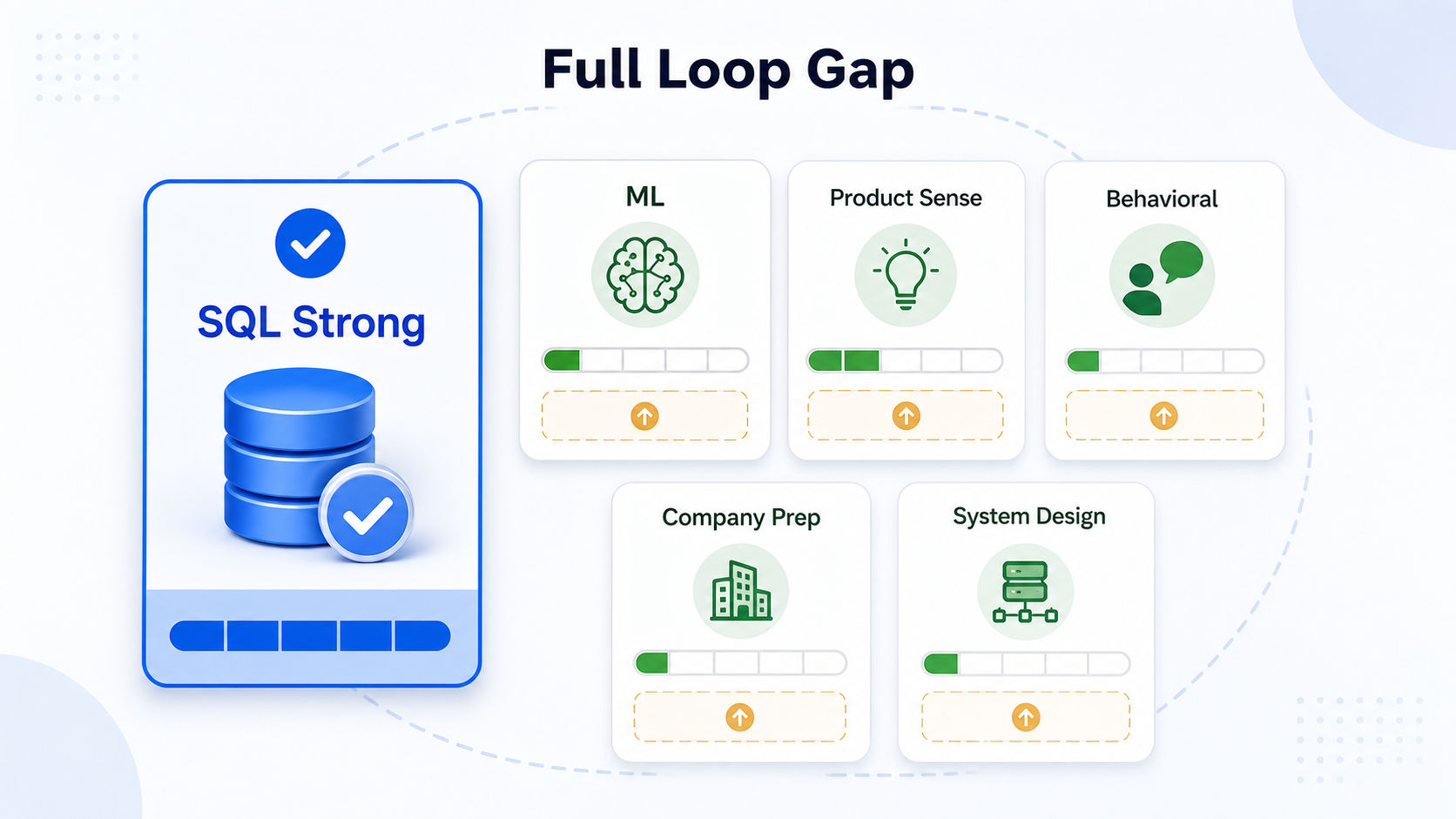
DataLemur is strongest where the interview is SQL-heavy. But many DS loops are not SQL-only.
Even when SQL is the first screen, later rounds can test very different skills.
A full data science loop may include:
-
SQL
-
Product sense
-
Metrics
-
Statistics
-
A/B testing
-
Probability
-
Machine learning
-
Modeling
-
Python or Pandas
-
Take-home analysis
-
System design or ML system design
-
Behavioral interviews
-
Hiring manager discussion
-
Company-specific product scenarios
Practicing SQL alone will not prepare you for all of that.
This is the gap PracHub fills.
PracHub helps candidates move from one-skill practice to full-loop prep by combining real interview questions with written solutions, company-specific interview prep, SQL interview practice, system design questions, and behavioral interview practice.
That broader context matters.
You do not want to discover after a strong SQL screen that your onsite includes product metrics, ML tradeoffs, and behavioral stories you never practiced.
DataLemur for SQL Practice
DataLemur is a strong SQL practice option.
It works best when your goal is simple:
Get better at solving SQL interview questions.
Use DataLemur if you need to improve:
-
Query speed
-
Schema reading
-
Join logic
-
Aggregation logic
-
Window functions
-
Business-to-query translation
-
Company-style SQL prompts
-
Confidence before a SQL screen
For SQL-specific prep, DataLemur is easy to recommend.
But pair it with PracHub if you want company targeting.
For example:
-
Use company-specific interview prep to identify whether your target company asks SQL.
-
Use SQL interview practice to practice real questions with written solutions.
-
Use DataLemur for extra SQL reps if SQL is still the bottleneck.
-
Re-solve misses without hints.
-
Add product sense, ML, and behavioral prep before onsite.
That sequence is stronger than randomly grinding SQL.
DataLemur for Data Science Prep
DataLemur does include data science content beyond SQL.
Its pricing page mentions 70+ data science questions spanning statistics, probability, and machine learning. Its question page also lists statistics, machine learning, and Python categories.
That makes it more useful than a pure SQL worksheet.
But the coverage still does not replace full DS prep.
Why?
Because data science interviews are not only topic coverage. They are interview loops.
You need to practice:
-
How the company asks questions
-
Which rounds appear at your level
-
How to explain tradeoffs out loud
-
How to connect analysis to product decisions
-
How to discuss failed experiments
-
How to talk through model assumptions
-
How to handle ambiguous prompts
-
How to tell behavioral stories with impact
DataLemur can help with some technical data topics.
PracHub helps you build the full loop around the company and role.
DataLemur Pricing
DataLemur is relatively affordable compared with coaching-heavy programs.
As of July 29, 2026, DataLemur's pricing page showed:
-
Monthly plan: $15
-
Yearly plan: $60, shown as $5 per month
-
Coaching plus signed book plus lifetime access bundle: $300
-
Premium access to 100+ SQL interview questions with hints and full solutions
-
70+ data science questions spanning statistics, probability, and machine learning
-
A yearly bonus video course for data job hunting
DataLemur's terms also state that prices may change without notice and that paid subscription fees are generally non-refundable except where required by law or approved case by case.
So before buying, check the live pricing page.
The price is not the main concern.
The main concern is fit.
DataLemur can be a good value if your problem is SQL.
It is less useful if your problem is:
-
ML system design
-
Product sense
-
Behavioral stories
-
Company-specific interview targeting
-
Senior-level communication
-
Take-home strategy
-
Full-loop sequencing
That is why the better question is not "Is DataLemur cheap?"
It is:
"Is SQL the thing blocking me?"
DataLemur vs PracHub
DataLemur and PracHub solve different problems.
DataLemur is best for SQL-first data interview practice.
PracHub is better for broader, company-specific, real-question interview prep.
Use DataLemur when you need:
-
SQL reps
-
Analytics-style query practice
-
Hints and full SQL solutions
-
Extra practice before a SQL screen
-
Affordable data interview drilling
Use PracHub when you need:
-
Real interview questions with written solutions
-
Company-specific prep
-
SQL plus DS/ML/system design coverage
-
Behavioral prep
-
Full-loop planning
-
Fresh company interview context
-
A free starting point before buying a niche tool
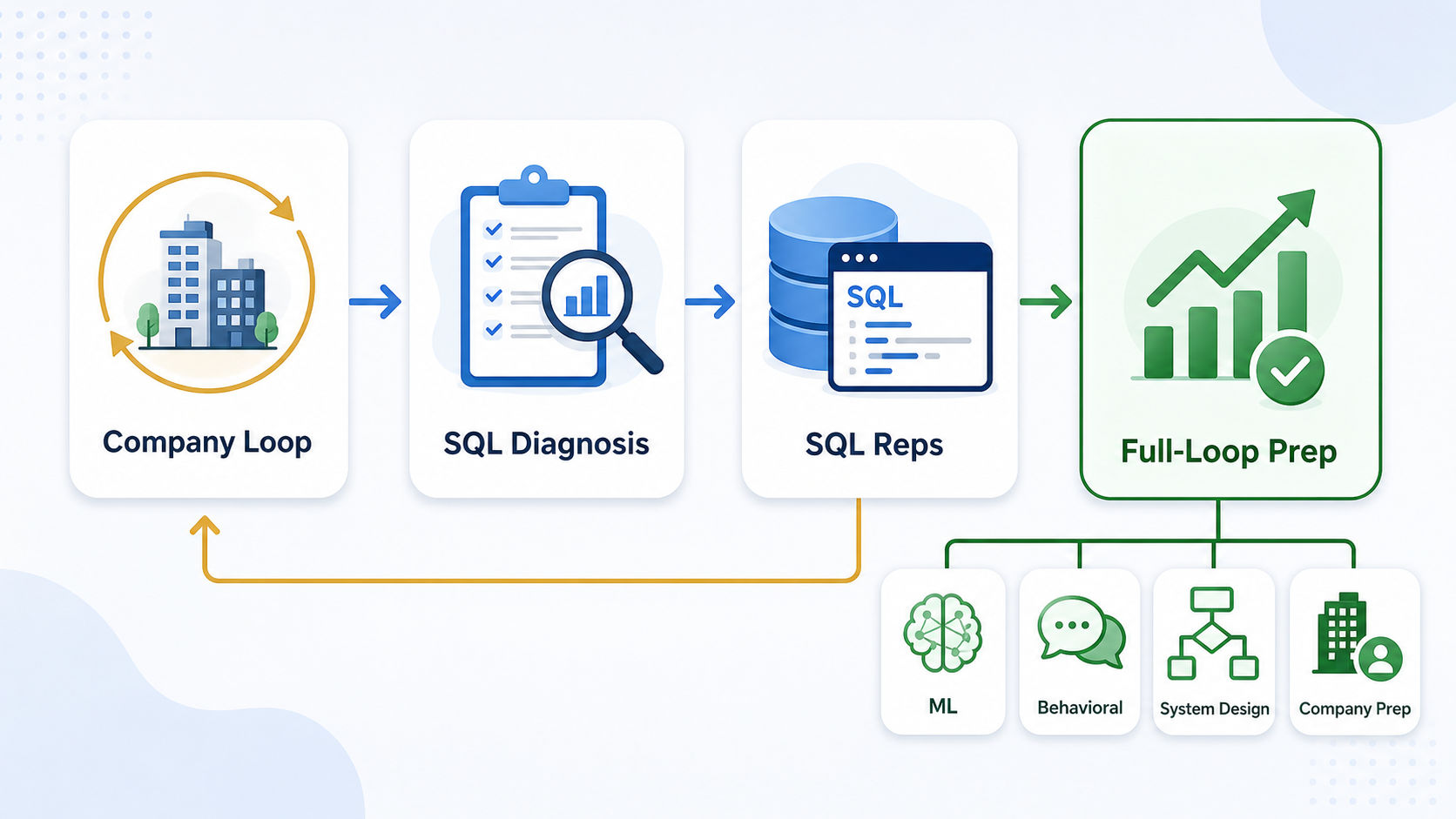
The best workflow is:
-
Start with PracHub.
-
Pick the company and role.
-
Identify whether SQL is actually the main screen.
-
Practice real questions with written solutions.
-
Use DataLemur if SQL is the gap.
-
Return to PracHub for ML, system design, behavioral, and company prep.
That gives you both depth and coverage.
DataLemur vs Interview Query vs StrataScratch
Data candidates often compare DataLemur with Interview Query and StrataScratch.
Here is the simple breakdown.
DataLemur is best if you want affordable SQL-focused practice with some statistics, ML, and Python content.
Interview Query is better if you want broader data science interview prep across SQL, product sense, statistics, ML, modeling, company guides, mock interviews, and take-homes.
StrataScratch is strong if you want lots of SQL and Python data task practice with company-style questions.
PracHub is better if you want real interview questions, written solutions, company-specific prep, behavioral practice, and broader full-loop coverage before choosing a paid specialist.
If you are unsure, use this decision rule:
-
If SQL is the only gap, DataLemur is a good option.
-
If product sense and ML are also gaps, consider broader DS prep.
-
If company targeting is unclear, start with PracHub.
-
If behavioral prep is weak, do not buy another SQL tool and hope it fixes communication.
-
If your loop includes system design or ML system design, add PracHub system design practice.
Who Should Use DataLemur?
DataLemur is a good fit for candidates who know they need SQL practice.
It is especially useful for:
-
Data analyst candidates
-
Product analyst candidates
-
BI engineer candidates
-
Analytics engineer candidates
-
Data science candidates with SQL screens
-
Students preparing for entry-level data roles
-
Candidates who need more company-style SQL questions
It is also useful if you have an upcoming SQL assessment and want focused repetition.
If your goal is to become faster and more accurate at SQL, DataLemur makes sense.
Who Should Skip DataLemur for Now?
Skip DataLemur for now if SQL is not your main blocker.
Start with PracHub instead if:
-
You do not know which companies you are targeting.
-
You do not know which rounds are coming.
-
You need real interview questions before buying a tool.
-
You need ML or system design practice.
-
You need behavioral prep.
-
You need product sense practice.
-
You need a full DS prep plan, not just SQL reps.
This is not a criticism of DataLemur.
It is about sequencing.
SQL is important.
But SQL alone rarely covers the full DS loop.
A Better Data Science Prep Workflow
Use this workflow before deciding whether DataLemur is enough.
Step 1: Map the Company and Role
Start with the role:
-
Data Analyst
-
Product Analyst
-
Business Intelligence Engineer
-
Analytics Engineer
-
Data Scientist
-
Machine Learning Engineer
-
Data Engineer
Then use company-specific interview prep to understand the likely loop.
Step 2: Identify the Round Types
Write down what you expect.
Look for:
-
SQL screen
-
Python screen
-
Product sense round
-
Statistics or A/B testing
-
ML modeling
-
Take-home challenge
-
System design
-
Behavioral interview
-
Hiring manager round
If the list has more than SQL, your prep should have more than SQL.
Step 3: Run a 7-Day Diagnostic
Spend one week testing the full loop.
Day 1: Solve SQL questions.
Day 2: Review written solutions and re-solve SQL misses.
Day 3: Try a product sense or metrics question.
Day 4: Try statistics, probability, or A/B testing.
Day 5: Try ML or modeling.
Day 6: Practice company-specific questions.
Day 7: Prepare behavioral stories and review weak areas.
If SQL is clearly the bottleneck, add DataLemur.
If the weakness is broader, keep your prep broader.
Step 4: Add DataLemur Only for the SQL Gap
Use DataLemur with a purpose.
Do not just solve questions until you feel busy.
Track your misses:
-
Did you misunderstand the schema?
-
Did you choose the wrong join?
-
Did you aggregate at the wrong level?
-
Did you forget nulls?
-
Did you miss date boundaries?
-
Did you use a window function incorrectly?
-
Did your result answer the wrong metric?
Then re-solve similar questions.
Step 5: Return to Full-Loop Prep
After SQL improves, do not stop.
Return to:
That is how SQL practice becomes interview readiness.
Common Mistakes to Avoid
Mistake 1: Thinking SQL Practice Equals DS Prep
SQL is important, but it is not the whole loop.
A data scientist may also need product sense, statistics, ML modeling, experimentation, behavioral stories, and company-specific preparation.
Use DataLemur for SQL. Use PracHub for the broader map.
Mistake 2: Practicing SQL Without Company Context
SQL questions vary by company and role.
Some companies ask analytics metrics. Some ask product funnels. Some ask heavy joins. Some ask Python and SQL together.
Use company-specific interview prep before choosing your SQL practice path.
Mistake 3: Ignoring Product Sense
Many DS interviews test whether you can translate data into product decisions.
Practice metric definition, experiment design, launch decisions, retention analysis, and tradeoff communication.
DataLemur helps with analytics thinking, but product sense needs broader practice.
Mistake 4: Under-Preparing Behavioral Rounds
Behavioral prep matters for data roles.
You need stories about ambiguous analysis, stakeholder conflict, failed experiments, model limitations, business impact, and communication with non-technical teams.
Use behavioral interview practice before the final week.
Mistake 5: Buying Tools Before Diagnosing the Gap
Buying a tool feels productive.
But the better move is to diagnose first.
If your weakness is SQL, DataLemur is useful.
If your weakness is ML reasoning, product sense, system design, or storytelling, another SQL tool will not solve it.
Related: DataLemur pricing explained · DataLemur vs PracHub (2026) · Best DataLemur Alternatives (2026)
FAQ
Is DataLemur worth it?
DataLemur is worth it if SQL is your main interview weakness and you want affordable company-style practice with hints and solutions. It is less complete as a full data science prep platform because DS loops can also include ML, product sense, statistics, system design, behavioral, and company-specific rounds.
Is DataLemur only for SQL?
No. DataLemur includes SQL, statistics, machine learning, and Python categories, and its pricing page mentions 70+ data science questions across statistics, probability, and machine learning. Still, its strongest and clearest use case is SQL-first analytics interview practice.
Is DataLemur enough for data science interviews?
DataLemur may be enough for a SQL-heavy screen, but it is usually not enough for a full DS interview loop. Many data science interviews include product sense, A/B testing, ML, modeling, behavioral, take-homes, and company-specific scenarios. Use PracHub to broaden the plan.
How much does DataLemur cost?
As of July 29, 2026, DataLemur's pricing page showed $15 monthly, $60 yearly, and a $300 coaching plus signed book plus lifetime access bundle. Prices can change without notice according to DataLemur's terms, so check the live pricing page before buying.
DataLemur vs PracHub: which should I use first?
Use PracHub first if you are not sure what your interview loop includes. PracHub helps you practice real interview questions, prepare by company, and cover SQL, system design, behavioral, and broader technical topics. Use DataLemur after that if SQL is the specific gap.
What should I use with DataLemur?
Pair DataLemur with PracHub. Use DataLemur for SQL repetition. Use PracHub for real interview questions with written solutions, company-specific prep, system design questions, ML-related prompts, and behavioral interview practice so your DS prep covers the full loop.
Related Resources
-
PracHub homepage: https://prachub.com/
-
PracHub questions: /questions
-
PracHub company prep: /companies
-
PracHub SQL interview practice: /questions?category=SQL
-
PracHub system design questions: /questions?category=System%20Design
-
PracHub behavioral interview practice: /categories/behavioral-and-leadership
Final Verdict: Use DataLemur for SQL, Use PracHub for the Full Loop
DataLemur is good at what it is known for.
It is a strong SQL-first practice tool for data candidates.
If SQL is your bottleneck, it can help.
But SQL practice is not full DS interview prep.
If you are preparing for a real data science loop, start with PracHub. Use real interview questions with written solutions to practice current interview-style prompts. Use company-specific interview prep to target the company. Add SQL interview practice, system design questions, and behavioral interview practice based on the loop.
Then add DataLemur if the diagnosis is clear:
You need more SQL reps.
That is the right order.
Comments (0)