Is Chip Huyen's Designing Machine Learning Systems Enough for MLE Interviews?
Quick Overview
Chip Huyen's Designing Machine Learning Systems is one of the strongest books for production ML and ML system design, but it is not a complete MLE interview course. This review explains what the 11-chapter, 386-page book covers, where it falls short for coding, SQL, ML fundamentals, company-specific questions, behavioral rounds, and modern AI engineering, and how to combine selective reading with PracHub's real interview questions and written solutions.
Many machine learning engineer candidates finish a respected 386-page book and still freeze when an interviewer asks, “Design a recommendation system for 100 million users.” The problem is not the quality of the book. It is the gap between understanding production ML and delivering a complete answer under interview pressure.
Chip Huyen’s Designing Machine Learning Systems is one of the strongest foundations for ML system design. But before making it your entire study plan, use real interview questions with written solutions and company-specific interview prep to see what your target MLE loop actually tests.

Quick Verdict
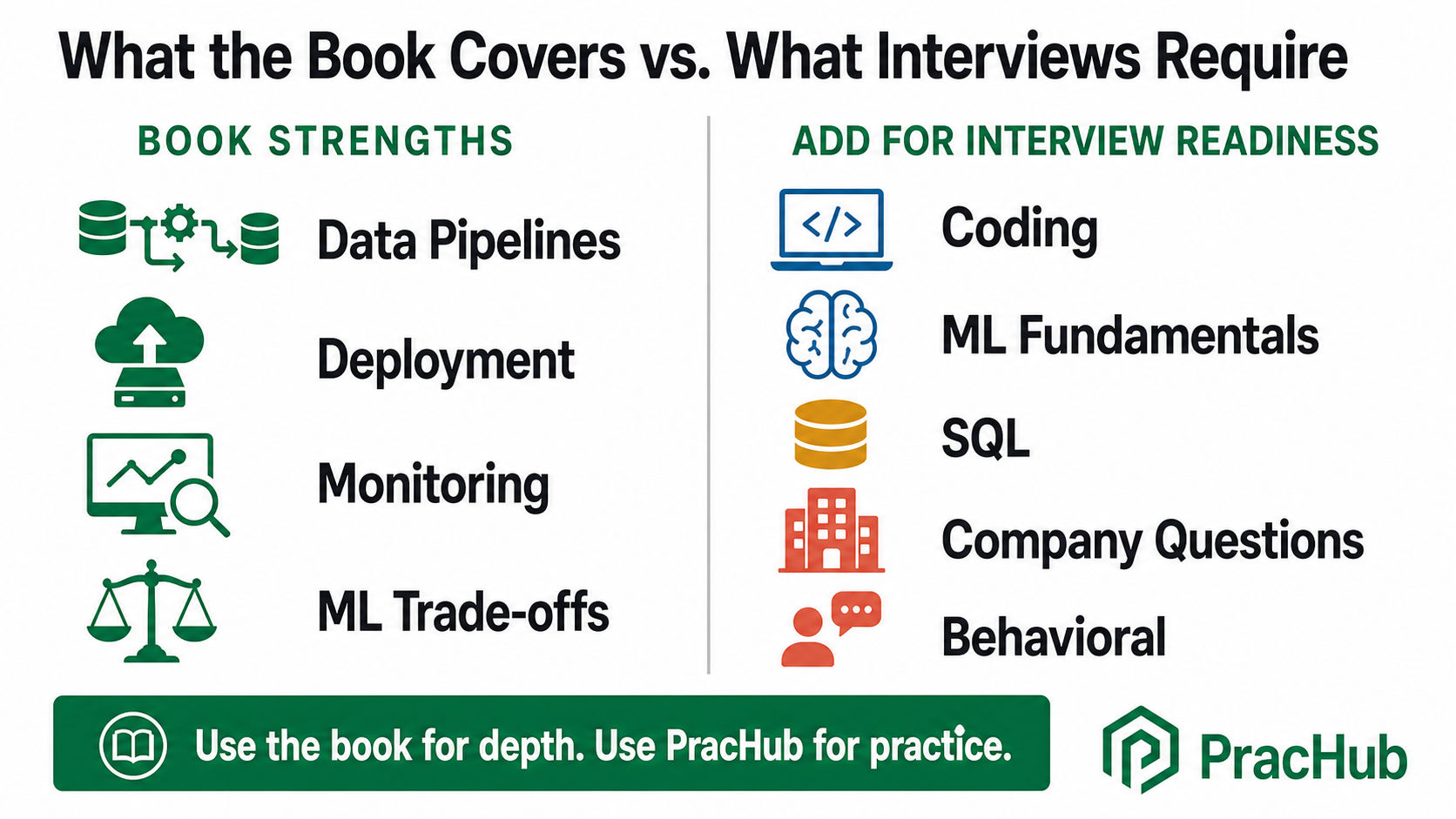
No, Designing Machine Learning Systems is not enough by itself for most MLE interviews. It is excellent for learning how data, models, infrastructure, deployment, monitoring, and business goals fit together. That makes it especially valuable for ML system design and production-focused discussions.
However, it is deliberately not a coding tutorial or interview course. It does not provide enough timed Python practice, data structures and algorithms, SQL repetition, ML theory review, company-specific questions, behavioral preparation, or full mock interviews. Treat it as the system-design backbone of your plan, then use PracHub to turn those concepts into realistic interview practice.
What Does Designing Machine Learning Systems Cover?
O’Reilly published the book in May 2022 and classifies it as intermediate to advanced. Its 11 chapters move from defining business and ML objectives through data engineering, training data, feature engineering, model evaluation, deployment, monitoring, continual learning, MLOps infrastructure, and responsible ML.
The scope is broader than “how to train a good model.” It asks how a model behaves after launch, how quickly a team can detect failure, when retraining is justified, and which platform decisions can support multiple use cases. Those are exactly the trade-offs that separate a production MLE answer from a classroom answer.
What the book is not
The author’s official companion repository states that this is not a tutorial book and does not contain many code snippets. That is an important feature, not a flaw: the book focuses on durable design decisions instead of one framework. It also means reading alone will not build implementation speed.
Why the Book Is Excellent for ML System Design Interviews
It teaches end-to-end thinking
Weak candidates jump straight to a model. Strong candidates first clarify the product objective, define offline and online metrics, identify data and labeling constraints, and then connect training, serving, monitoring, and feedback loops. The book repeatedly reinforces that complete-system perspective.
For a feed-ranking prompt, for example, accuracy is not enough. You may need to discuss freshness, latency, feedback bias, feature availability, cold starts, drift, experimentation, and retraining cadence. The book gives you language and mental models for those follow-up questions.
It makes trade-offs easier to explain
MLE interviews rarely have one correct architecture. Interviewers want to hear why you chose batch or online prediction, a simple model or a complex one, immediate updates or periodic retraining. Chip Huyen’s framework helps you connect each choice to reliability, scalability, maintainability, adaptability, and business impact.
How Much of the MLE Interview Loop Does It Cover?
| Interview area | Book coverage | What you still need |
|---|---|---|
| ML system design | Strong: objectives, data, serving, monitoring, retraining, and infrastructure | Timed prompts, diagrams, estimates, and interviewer follow-ups |
| Production ML and MLOps | Strong: deployment, distribution shift, testing in production, and tooling | Examples tied to your target company and role |
| ML fundamentals | Moderate: metrics, evaluation, features, and modeling decisions | Probability, statistics, optimization, model theory, and concise derivations |
| Python and DSA | Light: not designed as an implementation workbook | Timed coding, tests, complexity analysis, and debugging |
| SQL and data manipulation | Light: data systems are discussed conceptually | Hands-on queries and data transformation exercises |
| Project deep dive | Moderate: strong vocabulary for discussing production decisions | A rehearsed story based on systems you personally built |
| Behavioral and leadership | Light: one chapter covers human and responsible-ML concerns | Impact, conflict, ownership, failure, and collaboration stories |
| LLM and AI engineering | Limited: the book predates the current foundation-model application stack | RAG, model selection, evaluation, safety, latency, cost, and agent workflows |
Where the Book Falls Short for Interviews
You do not get enough active practice
Recognizing a monitoring concept on a page is different from choosing signals for a fraud model while an interviewer challenges your assumptions. To close that gap, practice system design questions with a timer. State requirements, draw the data flow, defend two major trade-offs, and finish with failure detection and iteration.
The same applies to implementation. MLE loops often include general coding, ML coding, or both. You still need to write correct code, test edge cases, explain complexity, and sometimes implement a metric or simplified model without relying on a library.
It is not company-specific
An MLE title can describe very different jobs. One team may emphasize ranking and experimentation; another may test data pipelines, distributed training, platform architecture, or backend coding. The book gives you reusable principles, but it cannot tell you which combination your specific loop prioritizes.
Start with recent company and role reports, then choose chapters based on the evidence. If the loop includes a data round, add hands-on SQL interview practice. If it includes leadership or cross-functional execution, prepare examples with behavioral and leadership questions.
Is Designing Machine Learning Systems Still Current in 2026?
Its core production-ML principles remain highly relevant. Data quality, leakage, offline-online mismatch, model serving, monitoring, drift, experimentation, retraining, and organizational trade-offs have not disappeared. Because the book focuses on fundamentals rather than one tool, much of it has aged well.
The main gap is foundation-model application development. Chip Huyen’s 2025 book AI Engineering focuses on building applications with foundation models and is presented by the author as a companion to Designing Machine Learning Systems. Candidates interviewing for LLM, RAG, multimodal, or agent-heavy roles should supplement rather than discard the earlier book.
Designing Machine Learning Systems vs. PracHub
| Need | Designing Machine Learning Systems | PracHub |
|---|---|---|
| Build production-ML judgment | Core strength | Reinforced through realistic prompts and solutions |
| Learn a coherent framework | Detailed, chapter-based explanation | Practice-first rather than textbook-first |
| Prepare for a specific company | General principles | Company and role filters |
| Practice full-loop questions | Not the primary format | Coding, SQL, ML, system design, and behavioral coverage |
| Review written solutions | Conceptual examples and case studies | Question-level written solutions |
| Use under a deadline | Best for deep study | Useful for diagnosis and targeted repetitions |
The best choice is not book or practice platform. Read the book to improve the quality of your decisions, then use PracHub to practice making those decisions quickly on questions close to the interview you expect.
A Better Book-to-Interview Workflow
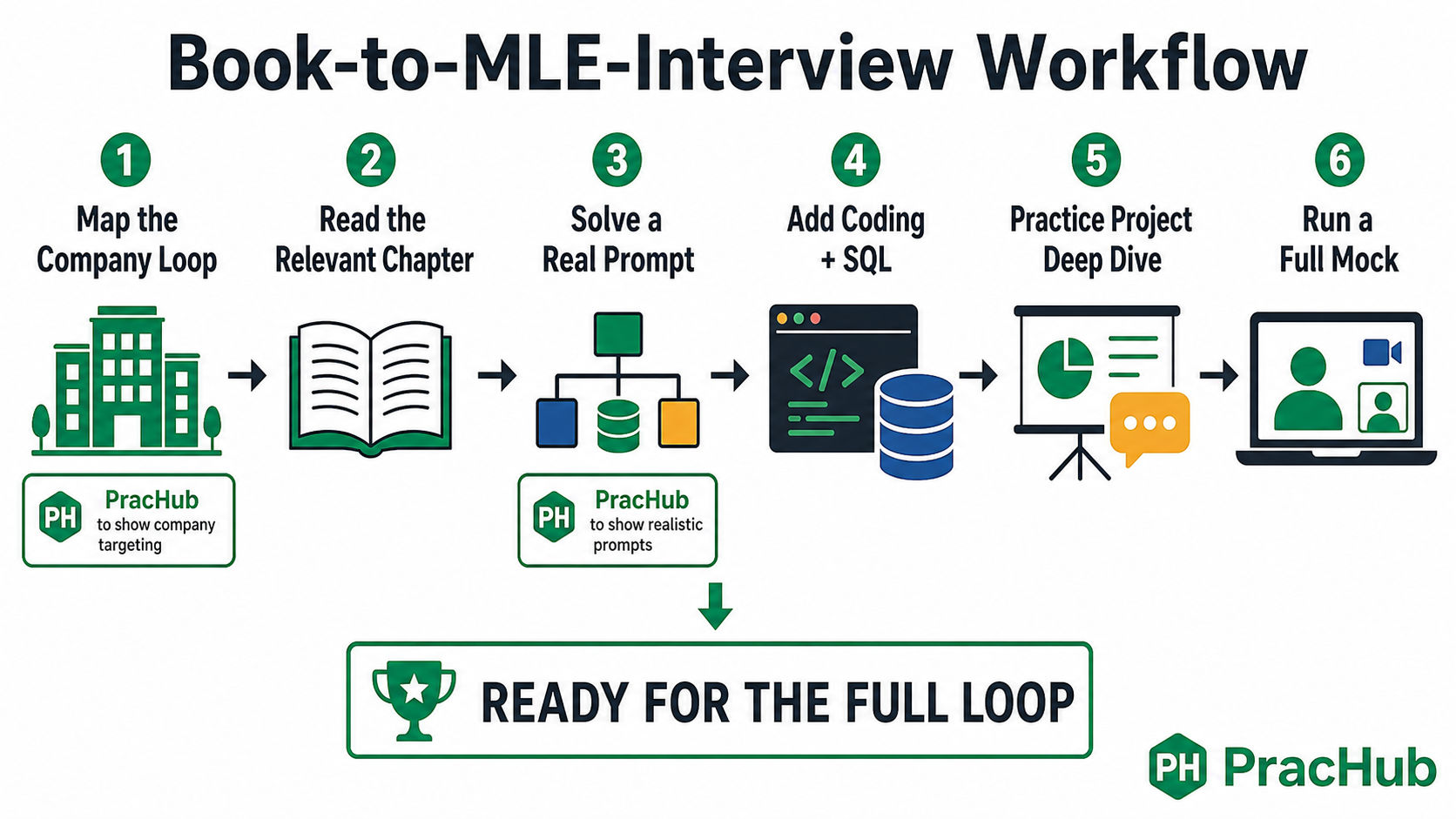
First, map your target loop by company, level, and round. Attempt one realistic question from each expected area before studying. Your mistakes will show whether you need more work on ML fundamentals, coding, SQL, system design, or communication.
Next, read selectively. For an ML system design gap, prioritize objectives and requirements, training data, evaluation, deployment, monitoring, and continual learning. After each chapter, answer one prompt aloud without notes. A useful response sequence is: product goal, constraints, metrics, data, modeling, serving, experimentation, monitoring, and iteration.
Finally, return to practice. Draw the architecture, estimate scale where relevant, handle follow-ups, and compare your answer with a written solution. Add a coding or SQL round and a project deep dive so your preparation resembles a real loop rather than a book report.
Who Should Read the Book?
The book is especially valuable for MLEs, data scientists, data engineers, ML platform engineers, and engineering managers who understand basic ML and want stronger production judgment. It is also a good choice for candidates moving from modeling work into end-to-end ownership.
It is less suitable as a first ML textbook or as your only resource one week before an interview. Beginners may need a fundamentals course first. Candidates with an imminent loop should diagnose the interview, read only the highest-value chapters, and spend most of the remaining time answering questions.
FAQ
Is Designing Machine Learning Systems good for ML system design interviews?
Yes. It is one of the strongest books for understanding production ML systems end to end. It covers objectives, data, evaluation, deployment, monitoring, retraining, infrastructure, and human considerations. You still need timed practice to turn that knowledge into a concise interview answer.
Does the book include coding interview questions?
Not as a core feature. The official companion repository explicitly says the book is not a tutorial and contains few code snippets. Use a separate coding environment for Python, algorithms, testing, complexity analysis, and ML implementation exercises.
Should I read every chapter before an MLE interview?
Not necessarily. Map the loop first and prioritize chapters that address your weak rounds. Candidates short on time will usually get more value from selective reading plus repeated practice than from rushing through every page without applying the framework.
What should I use for LLM or AI engineer interviews?
Keep the earlier book for production-ML fundamentals, then add current foundation-model material. Chip Huyen describes her 2025 AI Engineering book as a companion focused on applications built with foundation models. You will also need current prompts covering evaluation, RAG, inference, safety, cost, and agents.
Final Verdict
Designing Machine Learning Systems is enough to make your ML system design thinking substantially better. It is not enough to prove coding speed, ML fundamentals, SQL fluency, company knowledge, or behavioral readiness across a complete MLE loop.
Use the book for depth andPracHub for realistic interview practice. Diagnose your target loop first, read the chapters that close real gaps, and immediately apply each concept to a timed question. That combination is far more interview-ready than finishing the book and hoping the ideas appear on demand.
Official references: O’Reilly’s Designing Machine Learning Systems page and table of contents, the author’s official companion repository, the author’s earlier ML systems design booklet and exercises, and the official AI Engineering companion repository. Scope and publication details were checked on August 2, 2026.
Related Articles
MLInterview.org Review 2026: Question Bank vs Real Company ML Interviews
Read our MLInterview.org review comparing its ML question bank and explanations with real company interviews, plus a better PracHub practice workflow.
Generative AI System Design Interview Book Review 2026: Is It Still Enough?
Generative AI System Design Interview book review for 2026: strengths, missing topics, best readers, and how to combine it with PracHub practice.
Deep-ML Review 2026: Is It the LeetCode for Machine Learning?
Deep-ML review for 2026: compare its ML coding problems, free and Premium plans, interview coverage, and whether it is truly LeetCode for ML.
Generative AI System Design Interviews: How to Design LLM Applications That Work in Production
Prepare for GenAI system design interviews with a practical guide to LLM apps, RAG, agents, evaluation, safety, latency, and cost.
Comments (0)