Is Striver's A2Z DSA Sheet Enough for Coding Interviews in 2026?
Quick Overview
An honest 2026 review of Striver's A2Z DSA Sheet, its 474-problem roadmap, interview-readiness gaps, and a practical A2Z plus PracHub workflow.
Finishing 474 DSA problems feels like it should make you interview-ready. Then a recruiter sends a 45-minute coding screen, the problem does not look like any familiar sheet heading, and knowing the algorithm is suddenly only half the job.
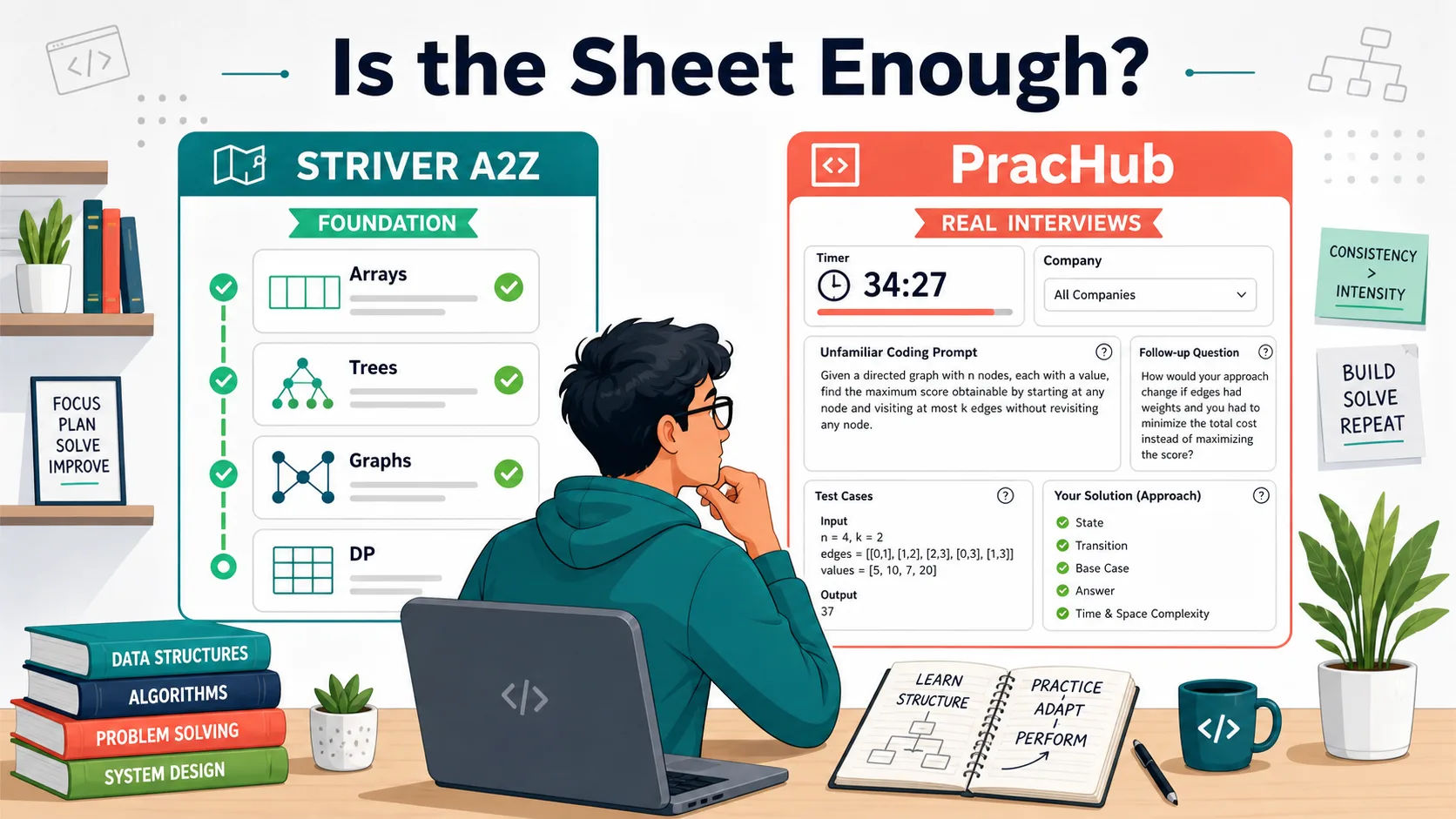
So, is Striver's A2Z DSA Sheet enough for coding interviews in 2026? It is one of the strongest free ways to build a complete DSA foundation. It is not, by itself, a complete interview simulation. The best next step is to test that foundation against real interview questions with written solutions and use company-specific interview prep to find out whether you can solve unfamiliar prompts under realistic conditions.
This review is based on Take U Forward's public A2Z Sheet and candidate discussions available on August 7, 2026. PracHub is the alternative recommended in this article; we are not affiliated with Take U Forward.
Quick Verdict
Striver's A2Z DSA Sheet is enough to build broad DSA knowledge. It is not enough to prove that you can pass a real coding interview.
Use A2Z when you need an ordered curriculum, topic coverage, and a large set of progressively harder problems. Move beyond the sheet when you can explain the core patterns but still need practice with cold questions, time pressure, follow-ups, edge cases, and company-specific expectations.
If your interview is several months away, A2Z can be your main learning roadmap. If it is four to six weeks away, do not wait to complete every problem. Learn the highest-priority weak topics, then spend at least half of your practice time on unseen interview questions and verbal explanation.
What Is Striver's A2Z DSA Sheet?
Striver's A2Z DSA Sheet is a free, structured curriculum from Take U Forward. As of August 7, 2026, the official tracker contains 474 problems: 152 easy, 186 medium, and 136 hard.
The roadmap spans 18 sections, beginning with programming basics and sorting before moving through arrays, binary search, linked lists, recursion, stacks and queues, trees, graphs, dynamic programming, tries, and strings. The page also provides progress tracking plus separate All Problems and Revision views.
That scale is both its advantage and its trap. A2Z is a curriculum, not a requirement to collect 474 checkmarks before applying for a job.
What A2Z Does Especially Well
It gives beginners a real sequence
Random LeetCode practice often fails because the learner does not know what prerequisite is missing. A2Z gives that learner a starting point and an order. Arrays come before harder graph and dynamic programming work, while each section moves from easier exercises toward more demanding variations.
This structure is especially useful for students, career switchers, and engineers returning to DSA after a long gap. You spend less time choosing the next resource and more time developing a connected mental model.
It builds breadth without a paywall
The official sheet reaches well beyond the most common array and hash-map patterns. Graphs and dynamic programming alone account for more than 100 tracked problems, while trees, heaps, greedy algorithms, recursion, bit manipulation, and tries all receive dedicated coverage.
That breadth makes A2Z a better foundation course than a short interview list. It can expose a weak topic before an online assessment exposes it for you.
It makes revision visible
Progress tracking and a revision view help turn a large syllabus into manageable work. However, the useful metric is not percentage completed. It is whether you can recover the approach after a delay and implement it without reopening the explanation.
Why Finishing the Sheet Still May Not Be Enough
Topic labels make pattern recognition easier
When you open a problem inside the binary search or graph section, you already received a major hint. In an interview, the prompt arrives without a chapter name. You must identify the pattern from constraints, examples, and interviewer feedback.
This transfer problem also appears in candidate discussions about struggling with similar problems after working through the sheet. That anecdotal experience is not a measured success rate, but it highlights the missing skill: cold recognition.
Real interviews score the path, not only the final code
Interviewers may evaluate how you clarify ambiguity, choose a data structure, explain complexity, test edge cases, and respond when a requirement changes. A correct solution with silent reasoning can still be weaker than a slightly incomplete solution that shows disciplined engineering judgment.
A sheet can teach the algorithm. It cannot automatically create the habit of narrating trade-offs while a clock is running.
Company and role context changes the target
A campus online assessment, a Meta coding loop, and a senior backend interview do not demand the same preparation mix. The relevant difficulty, repeated patterns, expected communication, and non-DSA rounds differ.
Senior candidates also need to prepare beyond algorithms. That often includes system design questions, project deep dives, code review, and behavioral interview practice. Completing A2Z cannot cover a full interview loop that was never purely about DSA.
A2Z Coverage vs. Real Interview Readiness
| Capability | What A2Z provides | What you must validate separately |
|---|---|---|
| DSA knowledge | Broad, ordered topic coverage | Recall after a delay without notes |
| Pattern practice | Many variations grouped by topic | Recognizing the pattern in an unlabelled prompt |
| Implementation | Repeated coding practice | Clean, tested code under a fixed time limit |
| Explanation | Solutions and learning material | Thinking aloud and defending complexity choices |
| Follow-ups | Harder variations across the roadmap | Adapting live when constraints change |
| Company fit | General interview-relevant DSA | Actual company, role, and round patterns |
| Full-loop prep | Primarily DSA | Design, behavioral, project, and domain rounds |
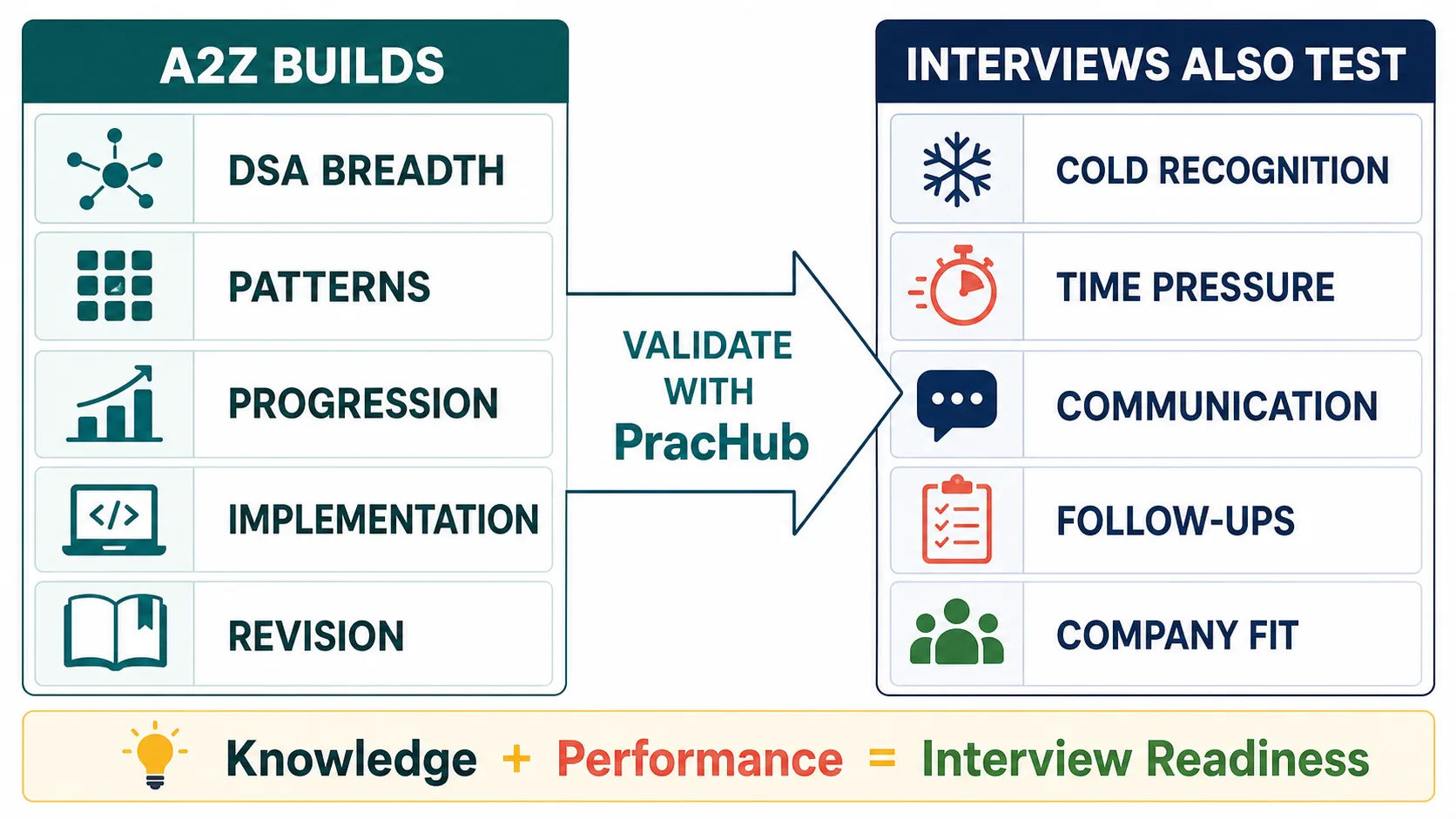
The table explains the central answer: A2Z covers the knowledge layer better than the performance layer. Interview readiness requires both.
The Three-Test Readiness Check
Do not use "I finished the sheet" as your graduation rule. Use these three tests instead.
1. The cold-problem test
Choose five medium questions that are not labelled by topic and that you have not seen before. Give yourself 35 to 40 minutes per question. If you can reach a correct approach on at least four, your pattern recognition is becoming portable.
2. The explanation test
Solve one problem while speaking aloud. Before coding, state the brute-force option, the better approach, the invariant, and the expected complexity. After coding, walk through a normal case and two edge cases without waiting for a prompt.
Record yourself or ask a partner to interrupt with "why?" and "what changes if...?" If the reasoning falls apart when interrupted, the pattern is not yet interview-ready.
3. The company-fit test
Open a set of company-specific interview questions for your target role. Attempt them without filtering by topic. Your results will reveal whether the remaining gap is a weak algorithm, slow implementation, poor explanation, or simply the wrong preparation mix.
A Better Four-Week Workflow: A2Z + PracHub
You do not have to choose between a learning sheet and real-question practice. They work best in sequence.
| Week | Primary work | Exit condition |
|---|---|---|
| 1 | Diagnose with unseen PracHub questions, then identify two weak A2Z topics | You know exactly why each attempt failed |
| 2 | Study those A2Z sections and re-solve missed problems after 48 hours | You can recover the approach without a video or notes |
| 3 | Attempt mixed company questions under a timer and explain aloud | You can recognize patterns without topic labels |
| 4 | Run mock coding rounds, review edge cases, and prepare the rest of the loop | Your performance is consistent across multiple sessions |
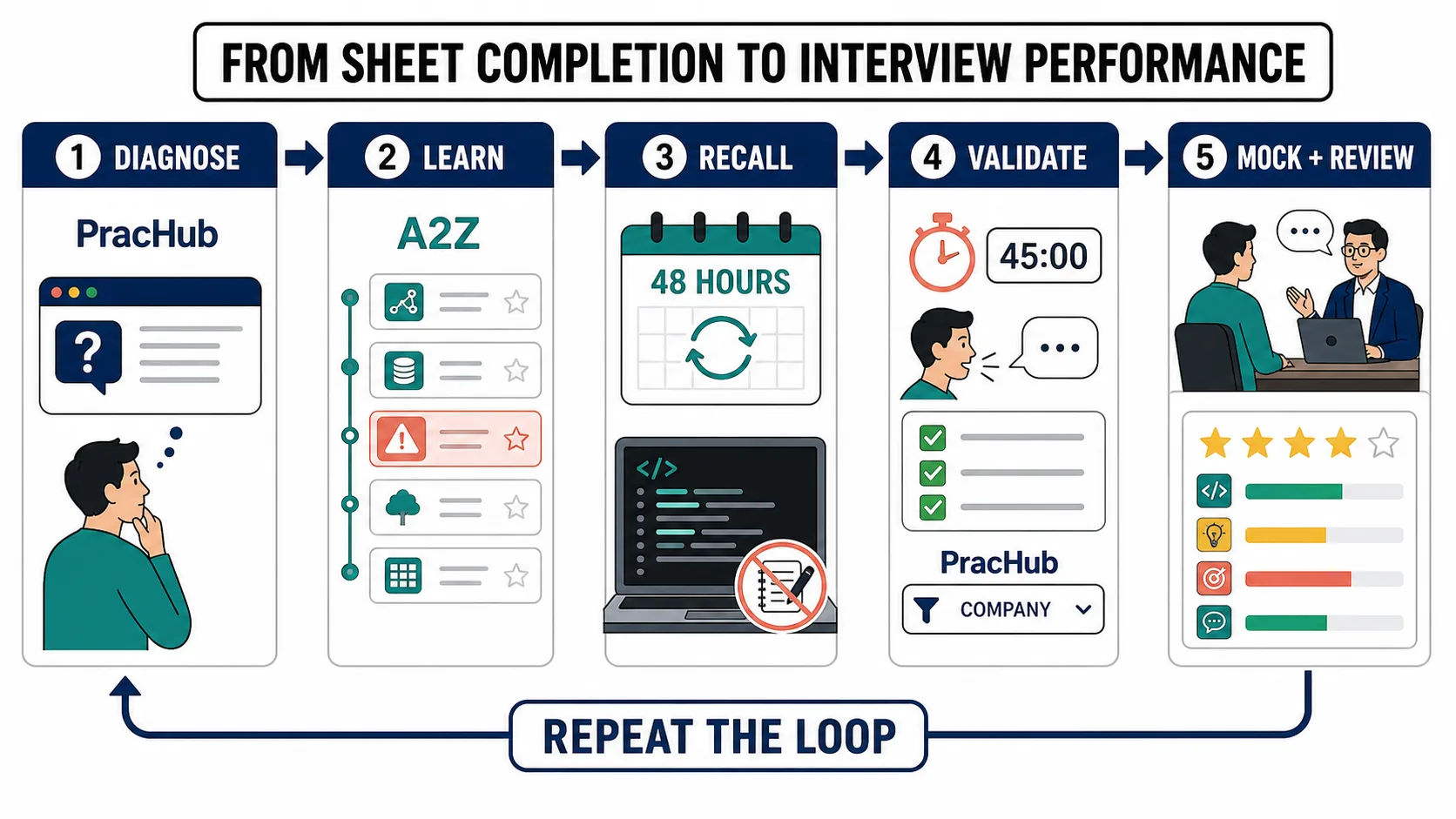
The key loop is diagnose, learn, retest. Do not spend four weeks passively moving forward through the sheet if your interview requires a narrower set of skills now.
Who Should Use Striver's A2Z Sheet?
Use A2Z as your main roadmap if you are learning DSA from scratch, have three or more months, or keep finding gaps in foundational topics. Its breadth and sequence are difficult to beat at a free price.
Use it selectively if your interview is close. Diagnose first, then study only the sections connected to your failures. A shorter list of independently solved problems is more valuable than racing through dozens of familiar solutions.
Move beyond it if you can solve section problems but freeze on mixed sets, cannot explain your choices, or are targeting senior roles. At that point, more topic-grouped repetition has diminishing returns.
Frequently Asked Questions
How many problems are in Striver's A2Z DSA Sheet in 2026?
The official Take U Forward tracker displayed 474 problems on August 7, 2026: 152 easy, 186 medium, and 136 hard. The total can change as the curriculum is updated, so check the live sheet before planning around an exact number.
Do I need to solve all 474 problems?
No. Beginners may benefit from the complete sequence, but interview candidates should prioritize weak topics and measure performance on unseen questions. Completing every item is less important than retaining patterns, writing correct code under time pressure, and explaining the solution clearly.
Is Striver A2Z enough for FAANG interviews?
It can provide much of the DSA foundation, but no general sheet guarantees readiness for a specific company. Add unlabelled timed questions, company-specific practice, mock interviews, and preparation for design or behavioral rounds required by your level.
Should I do Striver A2Z or LeetCode first?
Use A2Z when you need to learn topics in order. Use a mixed problem platform when you already know the fundamentals and need to test recognition. A strong workflow learns a pattern in A2Z, then validates it on unseen questions rather than waiting until the entire sheet is complete.
What should I do after finishing Striver A2Z?
Stop measuring volume and start measuring transfer. Attempt cold company questions, explain your reasoning aloud, practice follow-ups, and simulate the actual time limit. Use PracHub to identify where your A2Z knowledge survives realistic interview conditions and where it still needs work.
Final Verdict
Striver's A2Z DSA Sheet is an excellent free curriculum, and its 474 problems can take a learner from basic syntax to advanced algorithmic patterns. Calling it "not enough" would undersell the quality of the foundation it provides.
But coding interviews do not ask whether you completed a curriculum. They ask whether you can recognize an unfamiliar problem, communicate a sound approach, produce reliable code, and adapt when the interviewer changes the rules.
Use A2Z to learn the map. Then use PracHub's real interview questions with written solutions to prove that you can navigate without the chapter title. That combination is far more useful than chasing a perfect completion percentage.
Related Articles
Notion Software Engineer Interview Guide 2026: Process, Questions, and Preparation
Prepare for the Notion software engineer interview in 2026: current rounds, practical coding, system design, career history, questions, and a focused plan.
Database Design Interview Guide: Schemas, Access Patterns, and Trade-Offs
Prepare for a database design interview with a practical framework for schemas, access patterns, indexes, consistency, scaling, migrations, and trade-offs.
Software Engineer Hiring Manager Interview: Questions, Signals, and Seniority
Prepare for a software engineer hiring manager interview with common questions, scoring signals, seniority expectations, story frameworks, and practice tips.
LeetCode Interview Crash Course Review 2026: Course or Question Practice?
Is LeetCode's Interview Crash Course worth $89.99 in 2026? Compare its DSA curriculum with real-question practice and choose the right next step.
Comments (0)