Software Engineer Hiring Manager Interview: Questions, Signals, and Seniority
Quick Overview
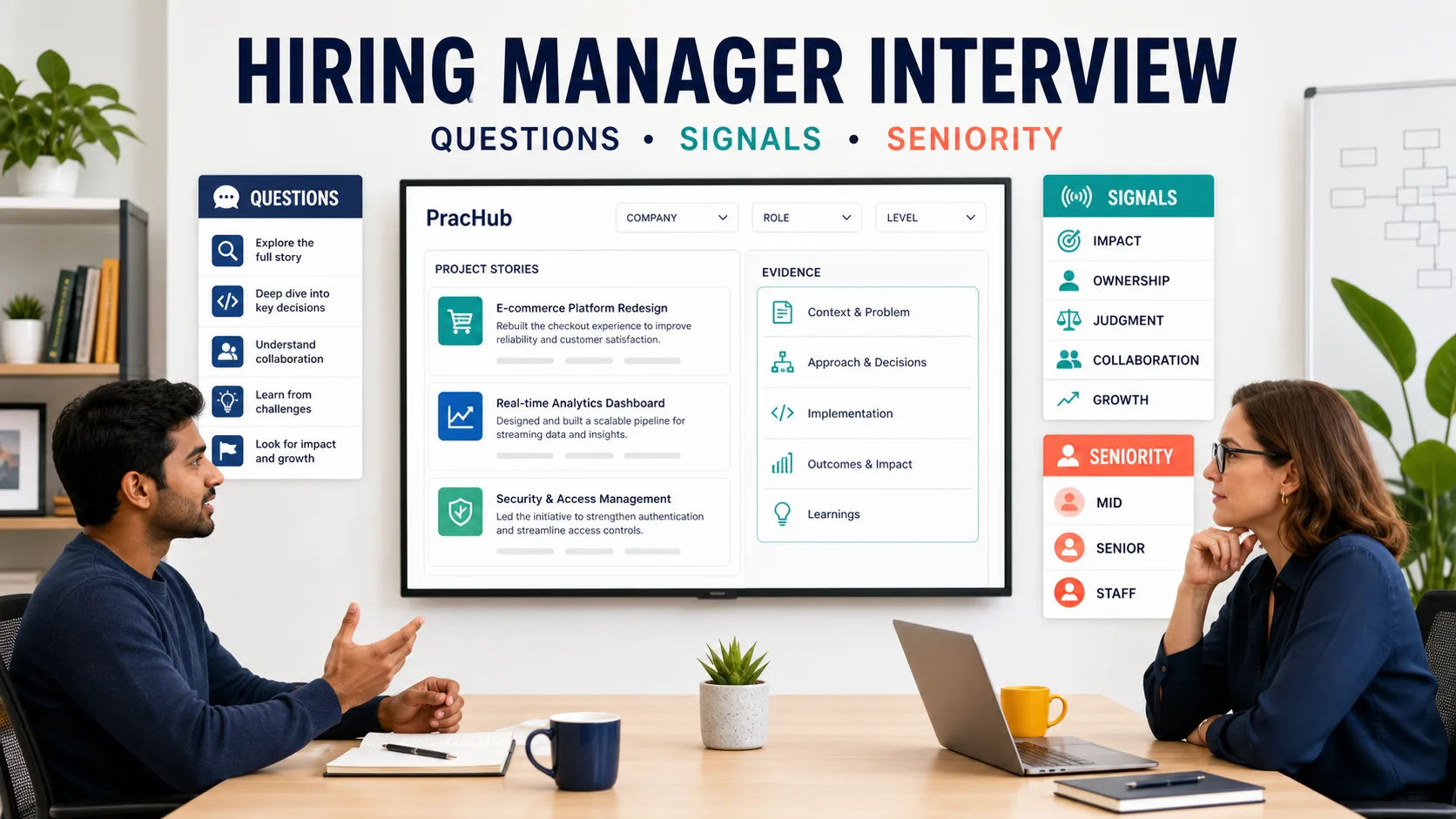
A practical software engineer hiring manager interview guide covering common questions, scoring signals, seniority calibration, strong project stories, and a focused preparation plan.
You can pass the coding screen and still lose the role in a conversation with the hiring manager. The reason is simple: technical rounds show whether you can solve problems; the hiring manager tests whether your experience matches this team's problems at the expected level.
Start by mapping the role with PracHub's company-specific interview prep, then rehearse real interview questions with written solutions in the context of your own projects. A strong answer does not sound like a memorized leadership speech. It gives the manager enough evidence to picture you making decisions on their team.
This guide is based on public engineering interview and career-framework materials from Atlassian, GitLab, Dropbox, Amazon, and Microsoft. Formats and level definitions vary, so confirm the exact round with your recruiter.
Quick Verdict
The hiring manager is usually trying to answer four questions:
- Can you deliver the work this role actually owns?
- How do you make decisions when requirements, people, or systems disagree?
- Is your demonstrated scope consistent with the target seniority?
- Do your motivations and working style fit the team's current needs?
Prepare six deep stories, not twenty shallow ones. For each story, know the scope, your personal ownership, the hardest decision, the alternatives you rejected, the measurable result, and what you would change now.
What Is a Software Engineer Hiring Manager Interview?
The hiring manager interview may be an early screen, a final-loop round, or both. It can include resume depth, technical judgment, behavioral questions, team fit, motivation, and leveling. It is not a universal format.
One public example is Atlassian's Frontend Engineering Interview Guide, which describes a 60-minute management interview built around scenario-based project examples. Its stated areas include driving outcomes across the software lifecycle, applying lessons, managing conflict, taking initiative, and collaborating for meaningful outcomes.
That is a useful preparation model even when another company calls the round a manager screen, project deep dive, experience interview, or leadership conversation.
The Signals Hiring Managers Actually Score
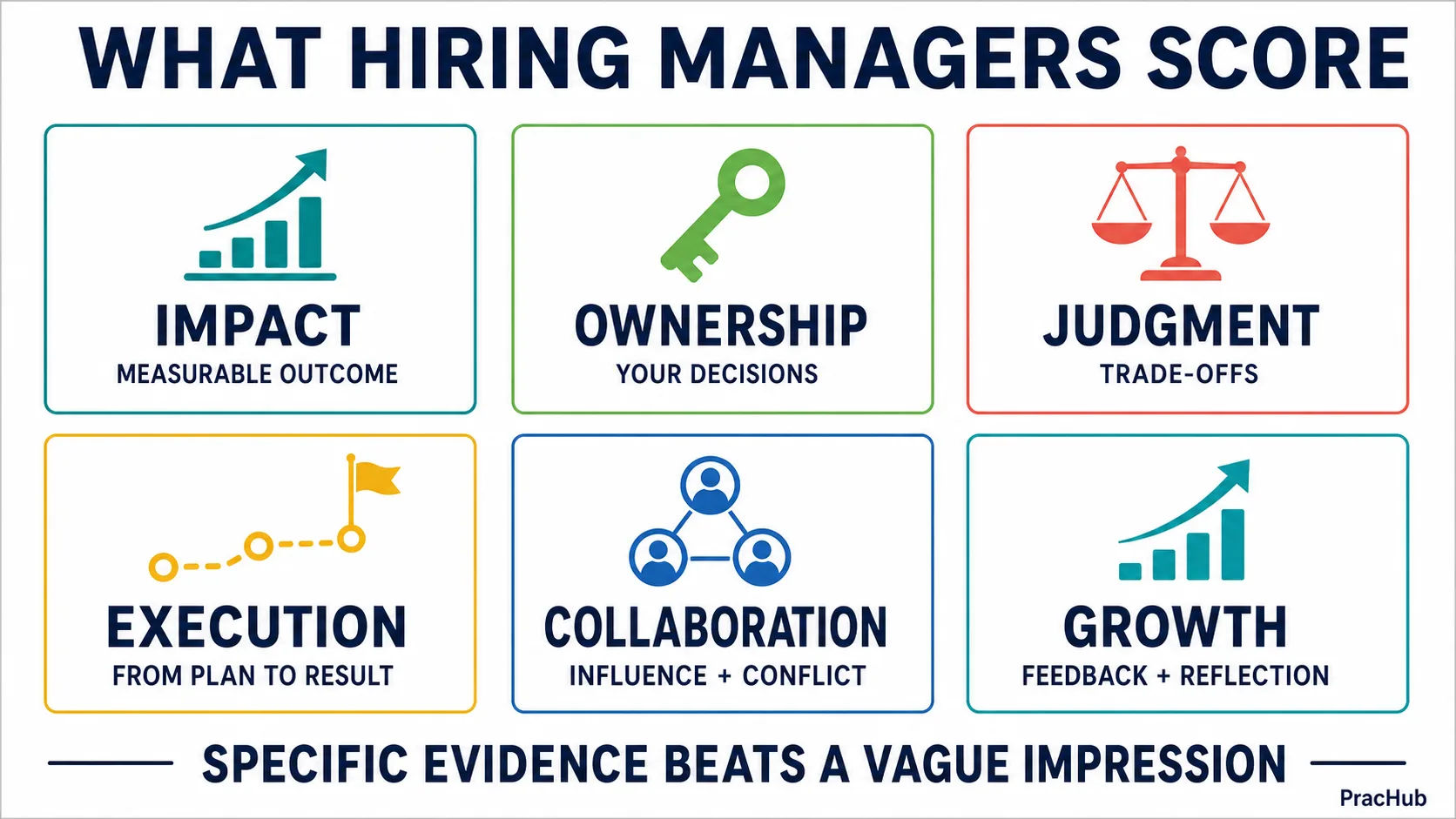
Structured interviewers write evidence into a scorecard. GitLab's public candidate evaluation guidance asks interviewers to record specific strengths and weaknesses against skills and values, rather than relying on a vague impression.
| Signal | What strong evidence sounds like | Weak answer pattern |
|---|---|---|
| Impact | A customer, business, reliability, cost, or team outcome changed | "We shipped it" with no result or success measure |
| Ownership | Your decisions and responsibilities are distinct from the team's | Repeated "we" answers that never identify your contribution |
| Judgment | You explain constraints, alternatives, trade-offs, and why the choice fit | Only describing the final architecture |
| Execution | You moved from ambiguity to milestones, handled risk, and finished | A heroic last-minute save with no planning or follow-through |
| Collaboration | You changed an outcome through listening, conflict, or influence | Agreement is treated as the only sign of teamwork |
| Growth | You can name a mistake, feedback, and subsequent behavior change | A failure story that quietly blames someone else |
| Role fit | Your interests connect to the team's actual work and constraints | Generic enthusiasm that could apply to any company |
The manager may like you personally and still lack enough evidence to hire you. Your goal is not maximum charm or maximum detail. It is specific, job-relevant evidence at the right level.
10 Common Hiring Manager Interview Questions
1. Walk me through the project most relevant to this role
Choose a project with enough complexity to reveal decisions, not merely technologies. Open with the user or business problem, your scope, and the result before entering implementation detail.
2. What did you personally own?
Separate team success from your contribution without erasing collaborators. Explain the decisions you drove, the work you executed, and where another person had final authority.
3. Tell me about an ambiguous problem
Show how you created clarity. A strong answer names the missing information, the first reversible step, the people consulted, and the signal used to adjust direction.
4. Describe a difficult technical trade-off
Compare at least two credible options. Discuss time, correctness, reliability, maintainability, cost, and customer impact only where they actually affected the choice.
5. Tell me about a disagreement
The signal is not that you won. Explain the shared goal, why perspectives differed, how evidence changed the discussion, and how the group committed after a decision.
6. What went wrong on a project you owned?
Name the consequence and your responsibility early. Then show mitigation, communication, root cause, and the mechanism that reduced recurrence.
7. How did you prioritize competing work?
State the decision rule. Managers want to know how you balance customer urgency, business value, engineering risk, dependencies, and work that can safely wait.
8. How have you improved engineers around you?
Use an observable change: faster onboarding, stronger design reviews, reduced incidents, better ownership, or a teammate who became independent. Mentorship is an outcome, not the number of meetings held.
9. What feedback changed how you work?
Microsoft recommends the STAR(R) model, adding reflection to Situation, Task, Action, and Result. The important evidence is what you did differently afterward.
10. Why this team, role, and timing?
Connect your next growth problem to the role's work. Mention a product, system, customer, or team challenge you researched, while being honest about what you still need to learn.
How Follow-Up Questions Expose Seniority
The first answer is rarely the full evaluation. Expect a manager to keep narrowing:
How large was the problem? What made it hard? What did you decide? Who disagreed? What alternative did you reject? How did you know it worked? What happened six months later?
Prepare a one-sentence headline, then let follow-ups control depth. This is better than delivering an uninterrupted eight-minute monologue. Keep architecture diagrams, metrics, stakeholder details, and failure modes available one layer below the opening answer.
Use Context -> Scope -> Tension -> Decision -> Execution -> Impact -> Reflection. This extends STAR with the two signals engineering managers often need most: the boundaries of your ownership and the quality of your judgment.
Mid-Level vs Senior vs Staff Signals
Job titles do not map cleanly across companies. Calibrate against the target job description and recruiter guidance, not one universal ladder.
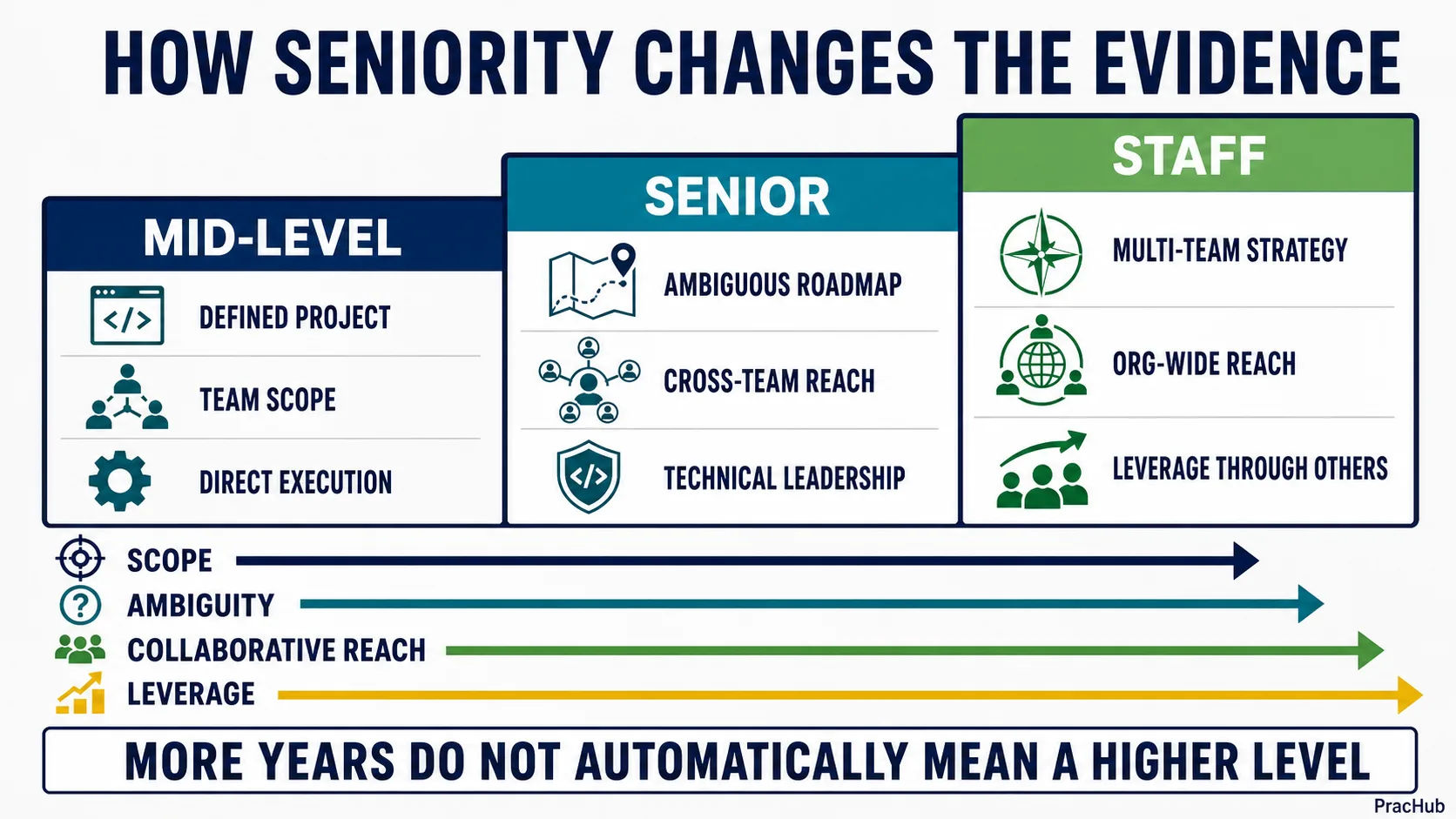
Still, public frameworks reveal a useful pattern. Dropbox's engineering career framework differentiates levels using scope, autonomy, collaborative reach, and levers for impact. Its examples progress from defined team projects, to ambiguous team and cross-functional work, to cross-team roadmaps, and eventually multi-year technical strategy.
| Mid-level | Senior | Staff |
|---|---|---|
| Owns a defined project and selects the solution | Defines an ambiguous roadmap and its trade-offs | Shapes multi-team strategy amid conflicting goals |
| Works mainly within the team through direct execution | Drives cross-team dependencies through technical leadership | Influences roadmaps and creates leverage through others |
| Produces a measurable project result | Sustains customer or business impact across a team area | Optimizes for wider organizational impact over local wins |
The same project told at three levels
Imagine a checkout migration. A mid-level engineer may show independent ownership of one service, a safe rollout, and a measurable latency improvement. A senior engineer should also explain the migration roadmap, dependencies, operational risk, and how the team made better decisions.
A staff-level answer must go wider without becoming vague: why multiple teams needed a common direction, which local preference was rejected for the organization, how alignment was created, and what durable capability existed after the engineer stepped away.
More years and more technical nouns do not automatically raise the level. Broader accountable impact, harder ambiguity, stronger judgment, and leverage through others do.
Build a Six-Story Interview Bank
Prepare one story for each of these themes: major delivery, ambiguous decision, disagreement, failure or incident, mentorship or influence, and prioritization under constraint.
For every story, make a one-page evidence card:
- Headline: problem, action, and result in one sentence.
- Scope: users, systems, timeline, teams, and your authority.
- Decision: two real alternatives and the deciding constraint.
- Impact: baseline, outcome, and how it was measured.
- Reflection: mistake, feedback, or what you would change.
Amazon's public Senior SDE interview guidance similarly recommends specific details, metrics where applicable, and examples that include risks, successes, failures, and growth. The company-specific principles will differ, but evidence travels well.
Practice each story in a 90-second opening and a five-minute deep dive. Ask a mock interviewer to interrupt with "What did you do?", "Why?", and "How do you know?" until every unsupported claim is exposed. PracHub's behavioral interview practice can help you rehearse full-loop communication instead of reading model answers passively.
Questions to Ask the Hiring Manager
The final minutes are part of the interview and a real chance to evaluate the job. Ask questions that reveal operating reality:
- What problem makes this hire important now?
- What would strong performance look like after six and twelve months?
- Which technical or organizational trade-off is the team currently navigating?
- How are difficult engineering decisions made and revisited?
- What distinguishes engineers who succeed at the target level on this team?
Listen for specific ownership, constraints, and success measures. The manager's answers should also help you decide whether the advertised seniority matches the actual role.
Common Mistakes
The most common mistake is giving a project tour instead of an evidence-based answer. Architecture can establish context, but the manager still needs your decision, influence, result, and learning.
Another is inflating ownership. Experienced managers notice when a candidate claims every decision yet cannot explain dependencies, disagreement, or implementation detail. Precise credit is more credible than total credit.
Finally, avoid perfectly polished stories with no uncertainty. Senior engineers are trusted because they can make and revisit decisions under imperfect conditions, not because nothing ever went wrong around them.
Hiring Manager Interview FAQ
Is the hiring manager interview technical?
It can be. Even without live coding, expect technical follow-ups on architecture, trade-offs, incidents, and your exact contribution. Ask the recruiter whether the round includes a formal technical exercise.
Can this interview affect leveling?
Yes, it may contribute evidence about scope, autonomy, influence, and impact. The final leveling process varies by company, and no single story guarantees a level.
How long should each answer be?
Aim for a 60- to 120-second opening, then pause for follow-ups. Keep enough detail ready for a deeper five-minute discussion.
How many project stories should I prepare?
Six adaptable stories are usually more useful than dozens of scripts. A strong project can support questions about ownership, conflict, trade-offs, failure, and growth from different angles.
Should I use STAR for technical project stories?
Use STAR as a baseline, then add scope, alternatives, technical judgment, and reflection. Those details help the manager calibrate both engineering quality and seniority.
Final Verdict
A strong software engineer hiring manager interview is not a personality test and not a second resume walkthrough. It is a structured argument, built from real projects, that you can own the target team's work at the expected level.
Use PracHub to map the company's loop, practice real interview questions with written solutions, and pressure-test your six stories with follow-ups. When every answer makes scope, decision, impact, and learning visible, the manager no longer has to guess what hiring you would look like.
Comments (0)