JPMorgan Chase 2027 Software Engineer Program OA: HackerRank, Code for Good, and Timeline
Quick Overview
This evidence-checked guide explains the JPMorgan Chase 2027 Software Engineer Program OA, current HackerRank reports, how Code for Good fits different regional tracks, what to practice, and a seven-day plan.
Updated August 17, 2026.
You finish a JPMorgan Chase HackerRank, pass every visible test case, and then discover that the next step may not be a standard technical interview at all. For some 2027 candidates, the assessment is a gateway to Code for Good, the firm's team-based social-impact hackathon. For others, the sequence includes a recorded interview, a conventional interview process, or a different regional program.
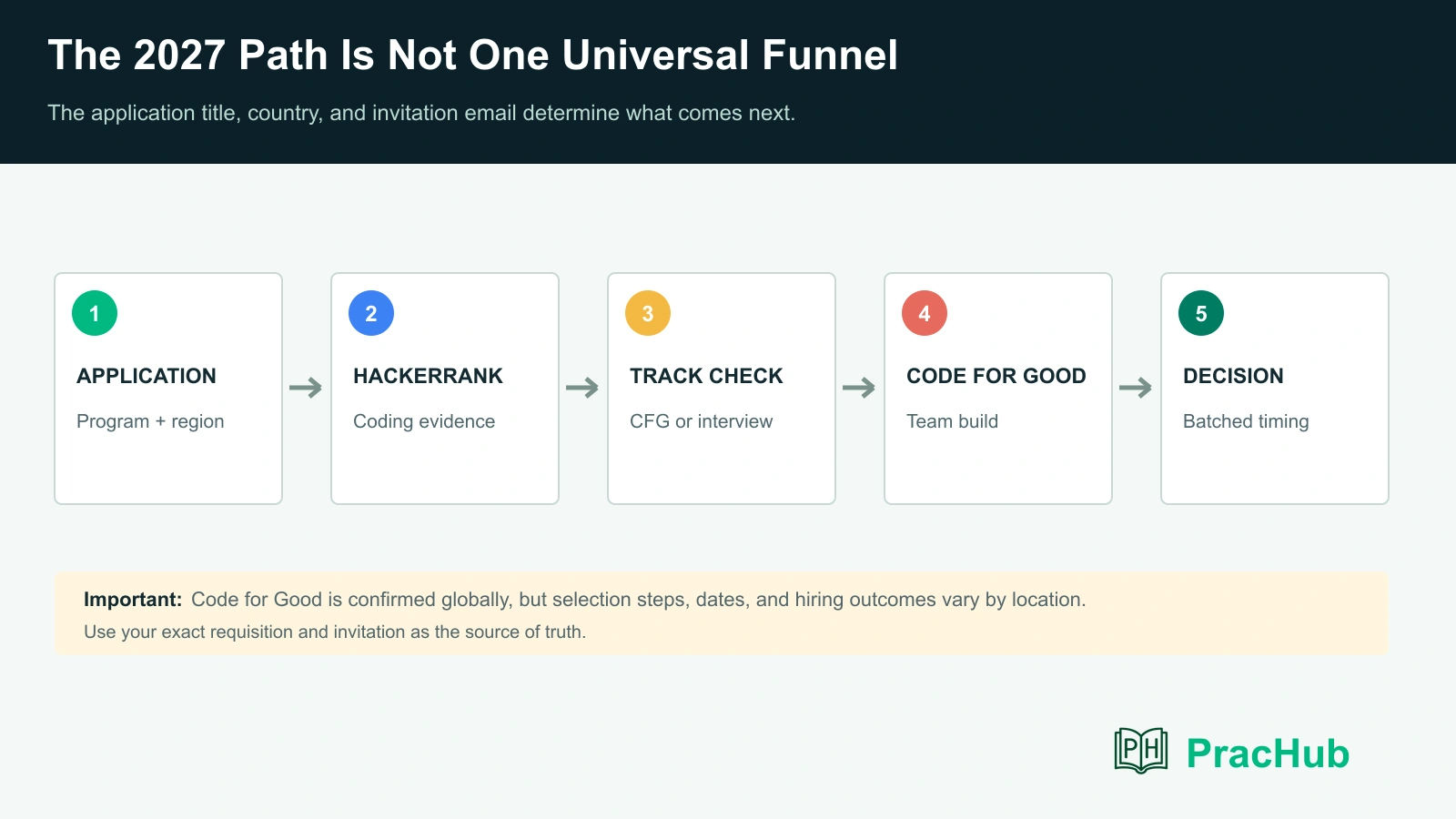
That is the central challenge of the JPMorgan Chase 2027 Software Engineer Program process: the same company name does not mean the same recruiting funnel. Your country, exact requisition, graduation year, and invitation email matter more than a generic timeline copied from another candidate.
Start with J.P. Morgan Software Engineer questions to practice company-specific coding and behavioral prompts. This guide then shows how to interpret the HackerRank, prepare for the most defensible question patterns, understand Code for Good, and decide what to do while you wait.
Quick verdict
Prepare for a HackerRank-style coding screen, but do not assume a fixed 2027 question count, passing score, or next round. Current candidate reports confirm that JPMorgan Chase is using HackerRank in 2027 Software Engineer Program recruiting. A North America candidate also clarified that their HackerRank was used to move applicants toward Code for Good.
JPMorgan Chase officially describes Code for Good as a team experience in which students work with firm technologists to solve a problem for a social-impact organization. That makes it closer to a collaborative engineering sprint than an extended LeetCode contest.
| Question | Best current answer |
|---|---|
| Is HackerRank part of the 2027 process? | Yes, current North America and India candidate reports confirm HackerRank use. |
| How many coding questions are there? | No universal 2027 count is published. Older candidates often report two, but use your invitation as the authority. |
| Is the OA automatically sent? | Some invitations arrive quickly, but neither speed nor receipt proves that every applicant receives one. |
| What comes after the OA? | Depending on the track: Code for Good, a recorded interview, another technical stage, or a wait for regional decisions. |
| How long does a response take? | There is no official fixed window. Current reports range from days to weeks, and decisions may arrive in batches. |
First identify which JPMorgan Chase program you applied to
Before comparing scores, copy the exact job title, requisition number, country, and location from your portal. A post about "JPMC SEP 2027" can describe a different population from yours even when the acronym is identical.
| Track | What current evidence shows | Do not assume |
|---|---|---|
| North America Software Engineer / Code for Good path | An August 2026 candidate report says the HackerRank was used to screen for Code for Good. | That every North America application follows the same sequence or receives the OA. |
| U.S. Summer 2027 internship applications | A current candidate reported an on-demand video interview with behavioral and AI-judgment prompts. | That HireVue always comes before or after HackerRank for every office. |
| India 2027 full-time campus process | Candidates reported HackerRank and HireVue, followed by long Code for Good uncertainty. In August, applicants shared a notice that this specific full-time requisition would no longer be filled. | That the India full-time update applies to U.S. internships or other open applications. |
| India summer internship / later graduation cohort | Candidate reports describe separate Code for Good shortlists and location-specific event dates. | That a portal status or another school's shortlist predicts your outcome. |
| Full-time Software Engineer Program | The official page describes a two-year development program with engineering, training, and team-based delivery. | That its selection route is identical to the summer internship. |
The safe rule is simple: treat your invitation as a contract for the current stage. It controls the deadline, duration, permitted tools, retake rules, and support contact. Use candidate reports to understand possibilities, not to overwrite those instructions.
What is officially confirmed
JPMorgan Chase says technical assessments may be online tests or live technical interviews and are designed to measure job-relevant skills. The firm also warns that many assessments cannot be retaken for a designated period. That is a good reason to test your environment and take the assessment only when you can protect the full time window.
The official Software Engineer Summer Internship page emphasizes one programming language, the software development lifecycle, collaboration, secure coding, and understanding how software components work together. It now also highlights responsible use of AI tools and the ability to validate AI-generated output.
What the official pages do not publish is equally important: no universal HackerRank question count, duration, 2027 cutoff, or guaranteed response time. Any article that presents one exact number for every region is compressing several recruiting tracks into one.
What to expect from the HackerRank OA
Current 2027 reports establish the platform, but the public evidence does not support one fixed format. Historically, many JPMorgan Chase candidates have described two coding questions, often around easy-to-medium arrays, strings, maps, sorting, or implementation. Treat that as a useful simulation baseline, not a promise.
Arrays, strings, and hash maps
Be ready to count frequencies, group values, find complements, scan windows, and preserve order while transforming an array. These problems are rarely difficult because of an obscure theorem. They become difficult when a rushed solution mishandles duplicates, empty input, or an off-by-one boundary.
Sorting, intervals, and scheduling
Sorting can turn a complicated search into one linear scan. Practice merging overlaps, comparing neighboring records, and explaining why your ordering produces a correct greedy decision. If a problem models dependencies, recognize when it has become a graph and when cycle detection is required.
Parsing and multi-part implementation
JPMorgan question-bank records include prompts that combine two smaller tasks or require careful input transformation. Separate parsing from core logic, name intermediate values clearly, and write a small helper when it makes the invariant obvious. Clean structure protects you when the second part changes one assumption from the first.
Hidden tests and code quality
Before submitting, test the smallest input, all-equal values, duplicates, negative or zero values when allowed, already-sorted input, and a case that reaches the largest stated constraint. Then re-read the return type and output format. A correct idea can still fail because it prints debug text, mutates forbidden input, or uses quadratic work at the upper bound.
| Preparation area | What strong execution looks like |
|---|---|
| Problem reading | Restate the input, output, constraints, and one ambiguous edge case before coding. |
| Complexity choice | Use constraints to choose the data structure instead of optimizing by instinct. |
| Implementation | Keep parsing, algorithm, and output responsibilities visibly separate. |
| Testing | Build adversarial examples rather than repeating the sample with different numbers. |
| Submission | Remove debug output and verify the required function signature and language version. |
How the score is likely used
Passing every visible test case is valuable, but it does not guarantee Code for Good or an interview. The firm can still consider hidden-test performance, code quality signals, eligibility, resume fit, preferred location, and event capacity. A candidate report of receiving no response after a perfect result is evidence that the OA is not the entire decision, not evidence of a secret universal cutoff.
Do not spend the waiting period reverse-engineering an invisible score threshold. Save the completion email, confirm that the portal reflects submission, and continue preparing and applying elsewhere. JPMorgan Chase says student-program applications are reviewed on a rolling basis and that it cannot accelerate a decision because of another offer deadline.
What Code for Good actually evaluates
JPMorgan Chase officially says Code for Good lets students showcase technical skills while working as a team, guided by the firm's technologists, to solve a problem for a social-good organization. The program operates in multiple countries, including the United States, United Kingdom, India, Singapore, Hong Kong, and Argentina.
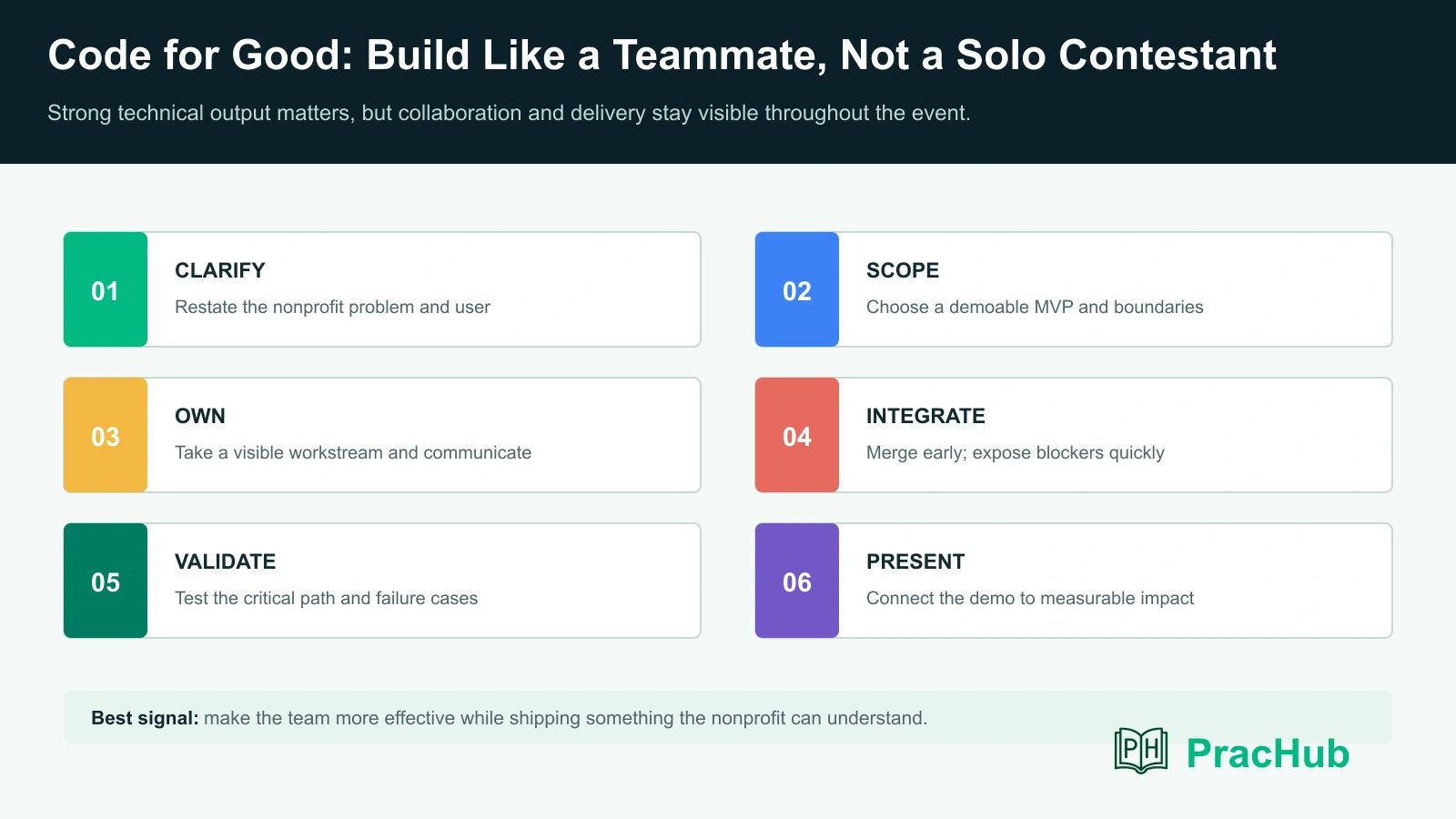
Candidate accounts add useful texture. Teams receive a nonprofit problem, divide work, build under time pressure, integrate a demo, and present the result. Team size, technology, event length, and offer process can vary. Reports of how many people on one team received offers are anecdotes, not a company-wide acceptance rate.
Translate the problem before choosing the stack
Ask who will use the product, what action matters most, what data exists, and what can be demonstrated by the deadline. A smaller workflow that solves the nonprofit's core problem is stronger than a broad architecture whose critical path never works.
Own a visible piece without disappearing into it
Volunteer for a workstream, state your interface, and give short updates. If you are blocked, surface it early. If another teammate is blocked, help remove the dependency. The event gives evaluators more evidence when your technical contribution and your effect on the team are both visible.
Integrate before the final hour
Agree on data contracts, repository structure, and a basic end-to-end path early. Merge small increments and keep a working branch that can be demonstrated. A polished slide deck cannot rescue a product that was never integrated.
JPMorgan Chase 2027 timeline: what happens next?
The current evidence points to batched, track-specific timing. In an August North America discussion, candidates were still waiting several days after HackerRank and estimated one to two weeks based on experience. A separate Summer 2027 applicant described waiting after an on-demand interview. Neither thread establishes a service-level agreement.
For Code for Good, a detailed U.S. participant account from the prior cycle described receiving the event invitation roughly three weeks before the hackathon and decisions arriving in batches afterward. Use that only as planning context. The official Code for Good page does not promise a fixed interval.
| Stage | Reasonable action | When to follow up |
|---|---|---|
| OA invitation received | Read the exact rules, test the environment, and schedule a focused attempt before the deadline. | Contact the support address immediately for access or accommodation problems. |
| OA submitted | Save confirmation, check spam, and prepare for both Code for Good and a conventional interview. | Use the contact in the invitation if a stated response window passes. |
| Portal says under review | Keep the application active and avoid treating another candidate's result as your rejection. | A concise check-in is reasonable after a meaningful interval, not every few days. |
| Code for Good invitation | Confirm location and logistics, then practice team delivery, Git, APIs, testing, and a short demo. | Reply within the RSVP deadline because capacity is event-specific. |
| No update after the event | Continue interviewing; outcomes can be batched by team and location. | Follow the event team's stated timeline before asking for status. |
Practice with JPMorgan Chase questions from PracHub
These question-bank records are useful for the skills seen across JPMorgan coding rounds; they are not predictions of your exact 2027 HackerRank. Each complete title in the first column links directly to the question and written solution.
| PracHub question | Practice focus | Why it helps |
|---|---|---|
| Minimize Operations to Balance Shipments | Arrays, invariants, and edge cases | This is stored as a J.P. Morgan Software Engineer Intern coding record and rewards careful state reasoning. |
| Count Substrings and Generate TOC | String grouping and structured parsing | Trains a two-part prompt, precise output, and clean separation of logic. |
| Group Strings That Are Anagrams | Hash maps, canonical keys, and duplicates | Builds the frequency and grouping patterns common in timed coding screens. |
| Merge Overlapping Intervals | Sorting, scanning, and boundary conditions | Tests whether you can turn a broad comparison problem into one ordered pass. |
| Answer Common Behavioral Prompts | Collaboration, failure, conflict, and motivation | Prepares evidence-based stories for HireVue, Code for Good conversations, and later interviews. |
A seven-day preparation plan
| Plan day | Focus | What to do |
|---|---|---|
| Day 1 | Track and baseline | Confirm the exact program and region, then complete a two-question timed coding set. |
| Day 2 | Arrays and strings | Practice frequency maps, two pointers, windows, grouping, and duplicate-heavy tests. |
| Day 3 | Sorting and intervals | Solve merging and scheduling problems; explain the invariant after sorting. |
| Day 4 | Implementation quality | Complete a multi-part prompt with clean helpers, input parsing, and explicit edge cases. |
| Day 5 | Full simulation | Use the duration in your invitation; test, submit, and review every mistake afterward. |
| Day 6 | Code for Good | Build one small API or UI with a partner, integrate through Git, and rehearse a two-minute demo. |
| Day 7 | Behavioral and logistics | Prepare concise teamwork stories, verify equipment and rules, and stop heavy practice early. |
Frequently asked questions
Does everyone get the JPMorgan Chase HackerRank?
JPMorgan Chase does not publicly say that every applicant receives it. A fast invitation may be automated for an eligible group, but it is not proof that no screening occurred or that the next round is guaranteed.
How many questions are on the 2027 Software Engineer Program OA?
No universal current count is published. Two coding questions is a sensible practice simulation based on historical reports, but the number, duration, and format in your invitation control your assessment.
Is Code for Good the final interview?
It can be a decisive hiring event for some student tracks, but the label "final interview" oversimplifies the process. Outcomes and additional steps depend on country, program, office, and recruiting year.
What if I passed every HackerRank test case and heard nothing?
Confirm submission, monitor your portal and spam folder, and keep applying elsewhere. Technical performance is only one input, and event capacity or resume review can still affect progression.
How long after the OA should I expect a response?
There is no official fixed window. Current candidates report waits from several days to multiple weeks. Follow a stated timeline when one exists; otherwise, send one concise inquiry through the invitation contact after a reasonable interval.
Are the U.S. and India processes the same?
No. Current evidence shows different campus schedules, recorded-interview steps, Code for Good dates, and program decisions. Always match advice to the exact country and requisition.
Final preparation advice
The best response to an ambiguous recruiting process is not more rumor collection. It is a two-track plan: prepare for a clean, tested HackerRank submission and prepare to collaborate visibly at Code for Good. That covers the strongest current evidence without pretending every office uses one script.
Use J.P. Morgan Software Engineer questions to practice the company's stored coding and behavioral records with written solutions. Start with the linked table above, diagnose the patterns that cost you time, and turn each mistake into one concrete test you will run before the real submission.
Sources and Further Reading
- JPMorgan Chase: Tech for Social Good Hackathons and Code for Good
- JPMorgan Chase: Software Engineer Summer Internship Program
- JPMorgan Chase: Full-Time Software Engineer Program
- JPMorgan Chase: Hiring and Assessment FAQs
- Current North America Candidate Discussion: HackerRank and Code for Good
- Current Summer 2027 Candidate Discussion: Recorded Interview and Timeline
- U.S. Code for Good Participant Overview
- India 2027 SEP Candidate Timeline and Program Update Discussion
Research note: This guide was checked on August 17, 2026. JPMorgan Chase can change assessment vendors, question counts, event capacity, and regional steps. Your official invitation and portal are the source of truth for your application.
Comments (0)