Plum Assessment Guide 2026: 25-Minute Talent Survey, Problem Solving, and Match Scores
Quick Overview
A practical guide to the Plum Discovery Survey covering its 25-minute format, problem-solving tasks, Talent Match Scores, employer reports, and focused preparation.
Receiving a Plum assessment invitation can be confusing because “25-minute talent survey” sounds like a short timed aptitude test. It is not. Plum says its Discovery Survey usually takes around 25 minutes, but it is untimed and combines personality choices, visual problem-solving puzzles, and workplace judgment scenarios.
This guide explains every section, how Match Scores work, what the employer can see, and how to prepare without trying to invent a “perfect” personality. Plum is only one hiring signal, so continue preparing for later rounds with PracHub's interview questions with written solutions while you complete the survey accurately and honestly.
Plum Assessment: Quick Answer
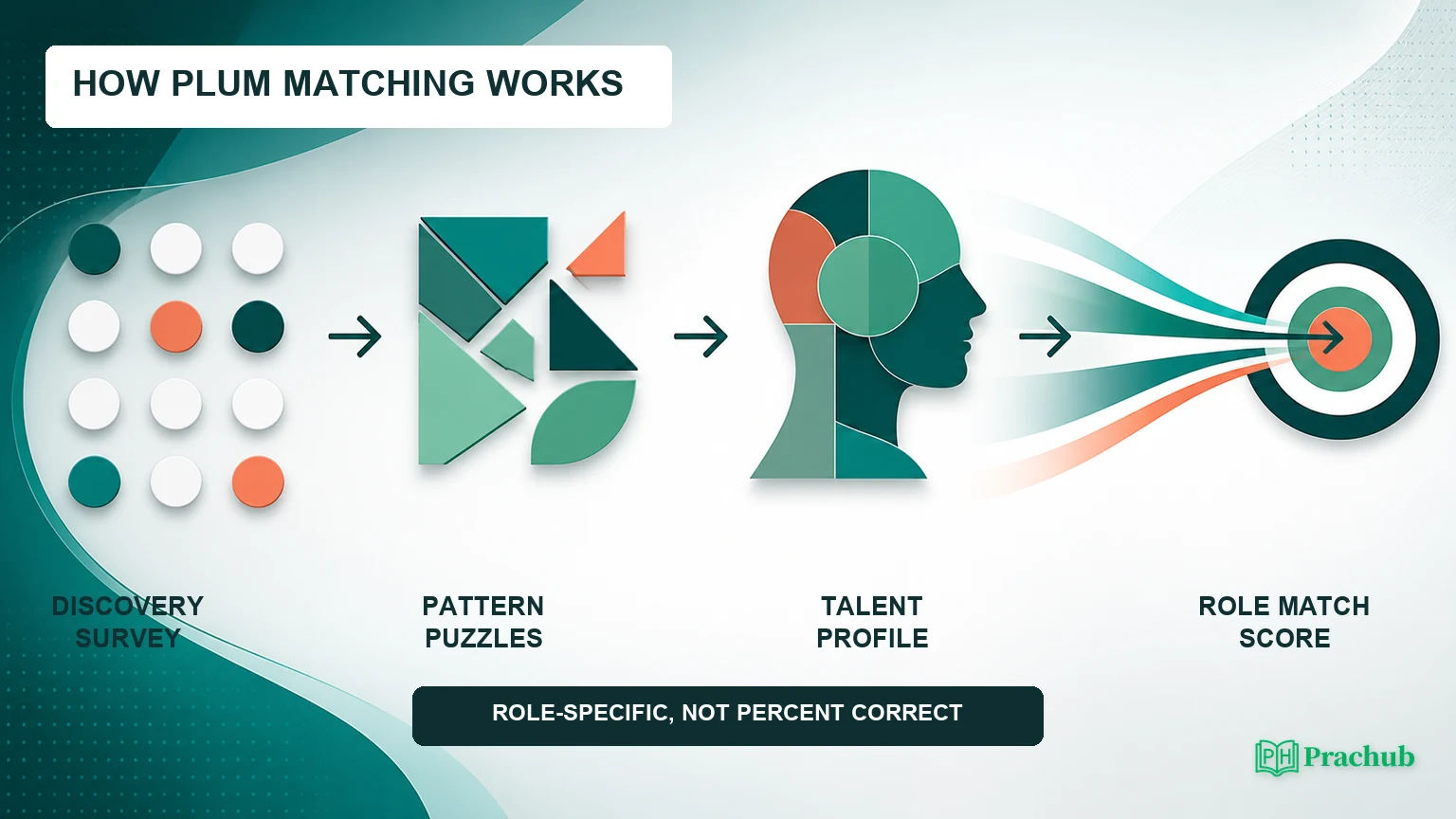
The Plum Discovery Survey is an untimed, five-section assessment of personality, problem solving, and social intelligence. It generally takes about 25 minutes. Your responses create a Plum Profile, while the employer can compare your Talents with role-specific Match Criteria to generate a Match Score.
| Candidate question | Practical answer |
|---|---|
| Is the 25-minute survey timed? | No. Plum describes 25 minutes as an approximate completion time and says the time you take is not recorded. |
| What questions appear? | Two personality sections, two missing-piece puzzle sections, and one workplace-scenario section. |
| Is there a passing score? | Plum does not publish a universal cutoff. Match Scores are role-specific, not percent correct. |
| Can I pause it? | Yes. You can exit and continue later, although the employer's completion deadline still applies. |
| What will I receive? | You receive a Plum Profile. Employers with platform access can see the role-specific Match Score and contributing Talent information. |
What Is the Plum Discovery Survey?
Plum is a pre-employment assessment platform built around Talents: recurring patterns of thought, feeling, and behavior. The Discovery Survey measures personality, cognitive problem solving, and social intelligence, then organizes the results into ten Talents and related competencies.
This makes Plum different from a coding assessment or knowledge exam. You will not be asked to implement an algorithm, recall a framework, or explain a system design. Instead, the survey asks how you prioritize competing descriptions, whether you can infer visual patterns, and how you judge workplace responses.
The employer defines what matters for a role through Match Criteria. Plum compares those requirements with your profile. The same person can receive different Match Scores for different jobs because each job may emphasize a different Talent combination.
What the Five Sections Include
Plum's official candidate FAQ describes five sections in a fixed sequence.
| Section | Format | What it measures |
|---|---|---|
| 1 | Choose statements that are most and least like you | Personality priorities |
| 2 | Select the missing piece in a visual sequence | Problem solving and fluid reasoning |
| 3 | Choose adjectives that are most and least like you | Personality priorities from another format |
| 4 | Complete another short series of visual puzzles | Problem solving across varied difficulty |
| 5 | Select the most and least effective workplace responses | Social intelligence and situational judgment |
The survey may feel uncomfortable when several statements sound positive or none describes you perfectly. That is intentional: forced-choice questions require a priority instead of letting every desirable statement receive the highest rating. You can review answers at the end, but Plum says review returns you to the beginning and requires moving through the full survey again before submission.
Plum Problem-Solving Questions
Sections 2 and 4 use short visual puzzle series. You see a sequence or matrix with one piece missing and select the option that completes the pattern. These questions focus on relationships and pattern recognition, not learned vocabulary or job-specific facts.
Test one dimension at a time: object count, rotation, position, shading, size, symmetry, or movement. Compare rows and columns before assuming a complex rule. State a candidate rule, check every transition, and discard it if one cell breaks it.
Plum says the puzzle set contains different difficulty levels, including intentionally challenging items, and results are interpreted relative to a larger population. A difficult puzzle is therefore not evidence that you are failing. Because the survey is not timed, accuracy and calm rule-testing matter more than racing through the section.
Practice should make the format less distracting, not memorize a puzzle bank. Isolate one visual feature, test a rule, and only then combine features.
Personality and Workplace Judgment Questions
Sections 1 and 3 ask you to rank statements or adjectives as most and least like you. Similar wording may reappear in different groups; because the comparison set changes, the relative priority can also change.
The strongest strategy is honest consistency, not guessing what a recruiter wants. Plum says attempts to fake a preferred profile are unreliable because the forced-choice design creates trade-offs across overlapping behaviors. Over-optimizing one imagined trait can flatten or distort the profile instead of improving role fit.
Section 5 presents workplace situations and asks which response is most and least effective. Identify the objective, stakeholders, authority, policy constraints, and consequences. Prefer proportionate actions that protect people and information; avoid choices that ignore the issue, create a violation, or over-escalate.
Do not confuse these questions with a behavioral interview. You are selecting among provided actions, not telling a STAR story. However, the same judgment themes may return later in interviews, so PracHub's behavioral and leadership questions can help you explain your reasoning aloud after the assessment.
How Plum Match Scores Work
A Plum Match Score is a role-specific fit measure, not an exam grade. Plum says the score combines your natural ability across the five Talents identified as most important for that role. Those role requirements come from Match Criteria created by employer experts or other configured role-analysis methods.
Plum documents a Match Score range of 30 to 99. A score of 80 does not mean 80% of your answers were correct, and it is not a percentile. It means your measured Talent pattern has a particular level of alignment with the criteria assigned to that job.
There is no responsible universal answer to “What Plum score passes?” Employers choose their own workflow, may combine Plum with resumes and other assessments, and can evaluate different roles against different criteria. The same profile can align strongly with one job and weakly with another without any underlying answer changing.
| Common interpretation | What is accurate |
|---|---|
| “My Match Score is my test accuracy.” | No. It is generated from Talent scores and role Match Criteria. |
| “A fixed score guarantees the next round.” | No public universal cutoff or guarantee exists. |
| “A lower score means I performed badly.” | Not necessarily. It indicates lower alignment with that role's selected Talents. |
| “I should answer like the ideal employee.” | Plum recommends honest responses; forced choice is designed to make deliberate gaming difficult. |
What You See and What the Employer Sees
After completing the survey, the candidate receives a personalized Plum Profile. It describes ten Talents, the competencies that contribute to them, and patterns that may feel energizing or draining at work. That profile can be reused when applying to another role through Plum.
The Match Score is different. Plum's official FAQ says candidates and employees do not see it. Platform administrators can receive the score plus a summary of the candidate Talents contributing to it.
When you enter through an employer's unique application link, your profile is normally shared with that employer for the application. If you are uncertain whether submission worked, check the Applications area in your Plum account. A completed assessment without an immediate recruiter message is not proof of either progression or rejection.
How to Prepare for the Plum Assessment
Preparation should reduce avoidable friction rather than change who you are. Confirm the employer deadline, preferred language, and any accommodation need. Choose a quiet period even though the survey is untimed.
For visual puzzles, practice missing-piece matrices and sequences. Name the rule: “shape count increases by one,” “the shaded object rotates clockwise,” or “the third cell combines the first two.” Testing a rule beats relying on intuition alone.
For forced-choice items, answer according to your normal work behavior, not the behavior you think sounds most impressive. For workplace scenarios, identify the binding constraint first, then compare responses by effectiveness and harm. Honest, considered answers produce a more useful profile than a manufactured persona.
Keep preparing for stages Plum does not test. A strong Talent Match does not replace coding, technical communication, project depth, or interviews.
Practice with PracHub Questions
These PracHub question-bank records train relevant reasoning and judgment skills. They are not predictions of your exact Plum assessment. Each complete title in the first column opens the question and written solution.
| PracHub question | Practice focus and why it helps |
|---|---|
| Solve Aptitude Test: Logical, Numerical, Verbal Reasoning | Mixed reasoning, careful reading, and disciplined switching between formats. |
| Find Patterns in Numeric Sequences Quickly | Simple-rule testing and a calm reset strategy when a pattern is unclear. |
| Select MOST/LEAST Appropriate Actions (SJT) | Workplace judgment, policy constraints, and consistent most-versus-least decisions. |
| Demonstrate Decision-Making and Collaboration Behaviors | Connects judgment choices to concrete collaboration and ownership examples. |
| Answer Common Behavioral Questions Using STAR | Prepares concise evidence for interviews that may follow the survey. |
A Seven-Day Plum Preparation Plan
| Day | Preparation task |
|---|---|
| Day 1 | Read the invitation, confirm the deadline, language, account email, and accommodation needs. |
| Day 2 | Complete a short visual-pattern diagnostic and classify misses by rotation, count, position, or combination rule. |
| Day 3 | Practice missing-piece matrices slowly, explaining one rule for every answer. |
| Day 4 | Review workplace scenarios by objective, stakeholder, policy, authority, and consequence. |
| Day 5 | Complete a mixed reasoning set, then stop; do not cram personality responses. |
| Day 6 | Test the browser and connection, and prepare a quiet environment. |
| Day 7 | Take the survey honestly, review only if needed, and verify the application appears as completed. |
Technical Setup, Pausing, and Retakes
Plum recommends a stable connection and a current browser, with Chrome performing best. Enable JavaScript, and use the survey's navigation instead of the browser Back button.
You can exit and resume in another session; answers are saved. This flexibility does not override an employer's deadline, so leave time for technical support. Plum says candidates normally complete the Discovery Survey once and may become eligible to retake it one year later. Reapplying through a new employer link generally does not require an immediate retake because the existing profile can be linked to another application.
If a disability affects access, request an accommodation before the deadline. Plum publishes accessibility commitments and directs candidates to its support channel. Do not wait until submission day to raise a known access need.
Frequently Asked Questions
Is the Plum assessment really only 25 minutes?
Plum says the Discovery Survey takes around 25 minutes, but that is an estimate rather than a countdown. The assessment is not timed, the amount of time you take is not recorded, and taking longer does not affect your result.
What kinds of problem-solving questions are on Plum?
Sections 2 and 4 use short visual puzzle series in which you select the missing piece. They test pattern and relationship recognition across varied difficulty. Practice rotations, counts, position changes, shading, symmetry, and row-or-column combination rules.
What is a good Plum Match Score?
Plum documents Match Scores from 30 to 99, but there is no universal good score or public passing cutoff. The score reflects alignment with the five Talents prioritized for a particular role, not percent correct. Employers decide how to use it alongside other hiring evidence.
Can I pause or retake the Plum assessment?
You can leave the Discovery Survey and return later with your prior answers saved, subject to the employer's deadline. Plum says the survey generally needs to be completed only once and becomes eligible for a retake one year after the previous assessment.
Can the employer see my Plum results?
Yes. When you complete the survey through an employer's application link, your profile is shared for that application. The candidate sees a Plum Profile, while administrators can see the role-specific Match Score and a summary of the Talents contributing to it.
Final Takeaway
The Plum assessment is easiest to understand as one untimed survey feeding two different outputs: a reusable candidate profile and a role-specific employer Match Score. Prepare by learning the five formats, practicing visual reasoning, answering forced-choice items honestly, and checking your technical setup.
Then move forward to the rest of the hiring process. Use PracHub's interview questions with written solutions to build the coding, analytical, and communication evidence that a talent survey cannot measure.
Sources and Further Reading
- Plum Discovery Survey FAQs
- What Does the Discovery Survey Measure?
- Introduction to Plum FAQ: Match Scores and Candidate Visibility
- How Will My Plum Profile Be Used?
- Can I Re-Do the Plum Assessment?
- Plum Forced-Choice Assessment Guidance
- Plum Technical Troubleshooting
- Plum Accessibility Commitments
- How Plum Uses and Controls Artificial Intelligence
Research note: This guide was checked on August 26, 2026. Employer deadlines, Match Criteria, and hiring workflows can vary; your invitation and employer communication are the source of truth.
Comments (0)