System Design Interview: The Complete 2026 Prep Guide
Quick Overview
This guide covers system design interview fundamentals and a 2026 prep framework, including requirements scoping, entity and API data modeling, storage choices, scalability components such as queues, caching and load balancing, trade-off analysis, and a practice plan for whiteboard prompts like "Design Twitter.
You spend weeks grinding coding problems, finally pass the LeetCode rounds, and then land in a system design interview with a blank virtual whiteboard and a prompt that says, "Design Twitter."
The silence that follows is not an algorithm problem. It is not solvable by memorizing more patterns. And it is not going to fix itself by watching another YouTube video about message queues.
System design interviews are where most mid-level and senior candidates stall. The questions are open-ended by design. There is no single correct answer. You are being evaluated on how you think, how you communicate under ambiguity, and how deeply you understand the trade-offs in large-scale distributed systems. That is a different skill set from coding, and it requires a different kind of preparation.
This guide covers what system design interviews actually test in 2026, how the evaluation bar has shifted across Google, Meta, and Amazon, the specific frameworks and building blocks you need to master, and how to practice in a way that actually transfers to the real interview.
What System Design Interviews Actually Test
The prompt is rarely the point. "Design Uber" is not asking you to describe how Uber works. It is asking you to demonstrate structured thinking: how you break down ambiguous problems, how you reason about constraints, how you make defensible trade-offs, and how you adapt when the interviewer changes the requirements mid-session.
In 2026, the evaluation bar at top tech companies has shifted significantly. Simply drawing a standard three-tier architecture (load balancer, API servers, database) and naming a few AWS services is not enough to pass. Strong candidates are expected to drive the conversation, proactively raise concerns, and go deep on specific components when pushed.
Company-specific evaluation criteria
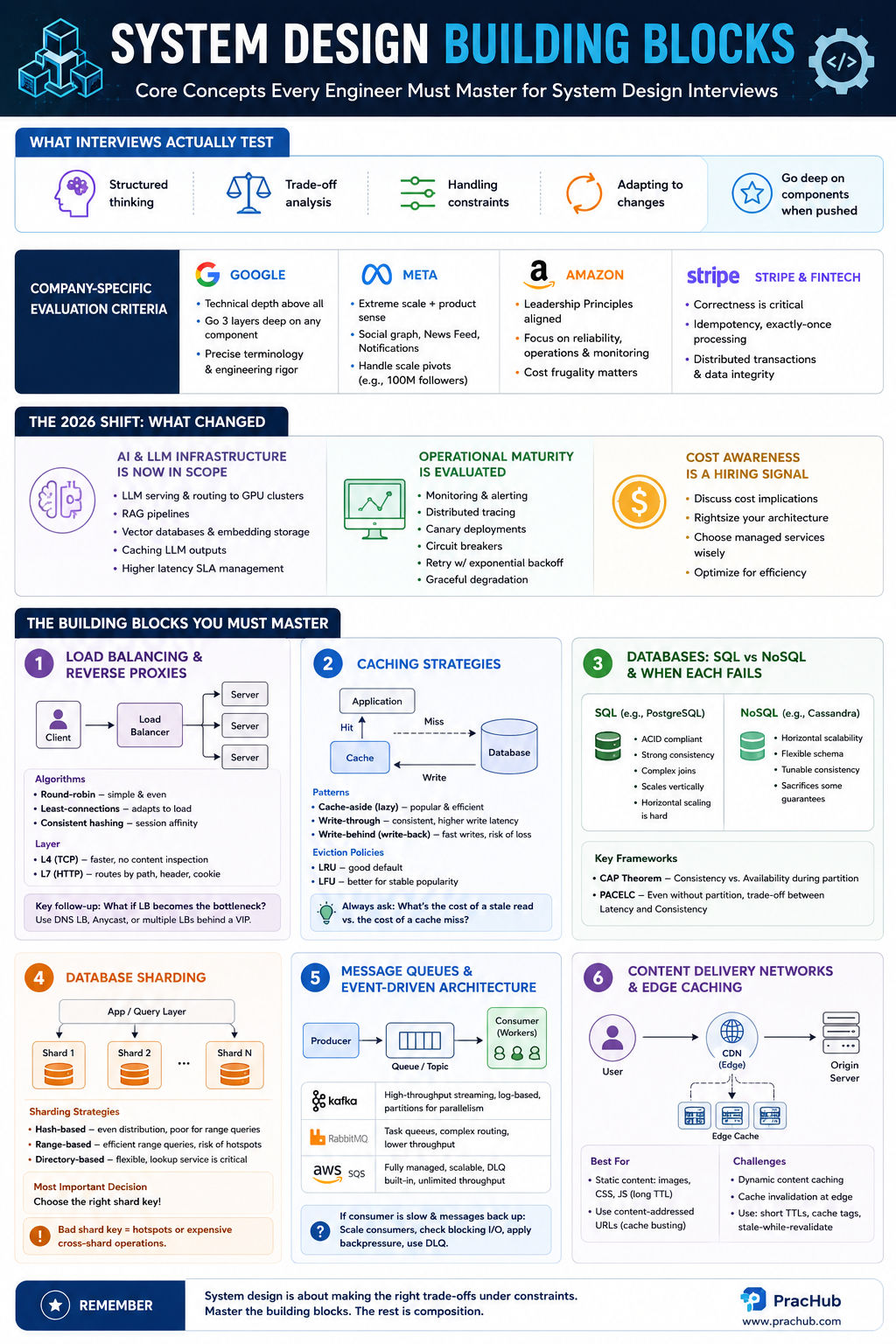
Google prizes technical depth above nearly everything else. If you mention a component, you will be asked to go three layers deep into it. Say you will use consistent hashing for your distributed cache: be ready to explain how virtual nodes work, how rehashing affects active connections, and what happens when a node fails mid-request. Google interviews reward candidates who use precise terminology correctly and who can defend architectural choices with engineering rigor, not just high-level diagrams.
Meta focuses on extreme scale and product sense simultaneously. The most common questions involve social graph operations, news feed generation, and notification delivery systems. Meta interviewers will frequently pivot: "Okay, now your system needs to support celebrities with 100 million followers. How does your fan-out model break, and how do you fix it?"
Amazon is explicitly engineering-leadership-principles-aligned in system design. Expect heavy emphasis on operational concerns: how does your system behave when a database node goes down, how do you handle partial failures, what does your monitoring and alerting strategy look like, and how does the design reflect cost frugality.
Stripe and other fintech companies add a correctness dimension that social platforms do not. Idempotency keys, exactly-once payment processing, and distributed transaction handling become first-class concerns. Designing a payment system at Stripe is fundamentally different from designing one at Instagram because the cost of a duplicate charge is catastrophically higher than the cost of a duplicated like.
The 2026 shift: what changed
Three developments have meaningfully raised the bar since 2023:
AI and LLM infrastructure is now in scope. Even for general software engineering roles at companies that have integrated AI features, you may be asked to design a system that serves an LLM, routes inference requests to GPU clusters, or implements a RAG (Retrieval-Augmented Generation) pipeline. This includes understanding vector databases, embedding storage, cache strategies for LLM outputs, and how to handle latency SLAs that are an order of magnitude higher than traditional API calls.
Operational maturity is explicitly evaluated. Senior and staff candidates are expected to unprompted discuss monitoring, distributed tracing, canary deployments, circuit breakers, retry logic with exponential backoff, and graceful degradation under load. Candidates who only talk about the "happy path" consistently fail at L5 and above.
Cost awareness is a hiring signal. At AWS-native companies especially, candidates who discuss the cost implications of their design choices signal the kind of engineering judgment that distinguishes senior from staff.
The Building Blocks You Must Master
System design interviews are not testing your memorization of specific architectures. They are testing whether you have internalized a set of composable building blocks well enough to assemble them correctly under a novel prompt. A candidate who truly understands five components can handle twenty different questions. A candidate who memorized twenty specific system designs often fails the twenty-first.
Load balancing and reverse proxies
Load balancers distribute incoming requests across a pool of servers. Round-robin distributes evenly but ignores server state. Least-connections routes to the server with the fewest active connections, adapting better to variable request duration. Consistent hashing maps requests to servers deterministically, which is critical for session-based routing and cache affinity.
Layer 4 (TCP-level) load balancers are faster but cannot inspect HTTP content. Layer 7 (application-level) load balancers can route based on URL path, headers, or cookies, which is essential for API gateway patterns and canary deployments.
The most common follow-up: "What happens if your load balancer becomes the bottleneck?" The answer involves DNS-level load balancing, Anycast routing, or deploying multiple load balancer instances behind a VIP (Virtual IP) with heartbeat failover.
Caching strategies
Caching is one of the highest-leverage performance tools in distributed systems and one of the most nuanced.
Cache-aside (lazy loading) is the most common pattern: the application checks the cache before hitting the database, and populates the cache on a miss. This keeps the cache lean but creates cold-start latency after a cache flush.
Write-through caching writes to both cache and database simultaneously on every write, keeping the cache fully consistent but adding write latency.
Write-behind (write-back) caching writes to the cache immediately and asynchronously flushes to the database. This is fast for write-heavy workloads but risks data loss if the cache node fails before the flush.
Cache eviction policies matter as much as the write strategy. LRU (Least Recently Used) is the default but can flush a hot cache during periodic batch operations. LFU (Least Frequently Used) is better for stable popularity distributions.
The critical question for any caching decision: what is the cost of a stale read, and what is the cost of a cache miss?
Databases: SQL vs. NoSQL and when each fails
SQL databases (PostgreSQL, MySQL) provide ACID guarantees, support complex joins, and enforce schema consistency. They scale well vertically but have a well-known horizontal scaling ceiling. Once your write throughput exceeds what a single primary can handle, you need replication lag management, read replicas, or a sharding strategy that makes joins much harder.
NoSQL databases sacrifice some consistency guarantees for horizontal scalability. Cassandra uses a peer-to-peer ring architecture with configurable replication and consistency levels. You can tune each query from ONE (fastest, weakest) to QUORUM (majority of replicas must acknowledge) to ALL (strongest, slowest).
The CAP theorem and PACELC are the framework that belongs in every database discussion. CAP states that in the event of a network partition, a system must choose between Consistency and Availability. PACELC extends this: even without a partition, every distributed system faces a latency vs. consistency trade-off. Senior candidates are expected to reason through this without prompting.
Database sharding
Sharding is the horizontal partitioning of a database across multiple nodes.
Hash-based sharding uses hash(shard_key) % num_shards for even distribution but makes range queries require scatter-gather operations across every shard.
Range-based sharding partitions by a key range. Range queries are efficient, but skewed workloads create hotspots on the shard holding the most active data.
Directory-based sharding maintains a lookup table that maps keys to shards. This is most flexible for rebalancing but makes the lookup table a critical dependency.
The most important interview decision around sharding is shard key selection. A bad shard key creates hotspots or forces cross-shard operations on your most common queries.
Message queues and event-driven architecture
Kafka is the default at scale for high-throughput event streaming. Its log-based architecture means messages are retained and can be replayed. The partition model determines throughput: more partitions enable more consumer parallelism.
RabbitMQ is better suited for traditional task queues with complex routing rules and lower throughput.
SQS (AWS Simple Queue Service) is the managed default for most AWS-native architectures, with effectively unlimited throughput and built-in dead-letter queues.
The interview question that separates candidates: "Your consumer is slow and messages are backing up. What do you do?" The answer involves scaling consumers horizontally, checking for blocking I/O, implementing backpressure, and setting up dead-letter queues for messages that exceed the retry limit.
Content delivery networks and edge caching
CDNs cache static and dynamic content at edge nodes geographically close to end users.
Static content (images, CSS, JS bundles) can have long TTLs because the content is immutable. Cache-busting via content-addressed URLs ensures users always get the latest version.
Dynamic content is harder to cache because the response varies by user or real-time state.
Cache invalidation at edge is notoriously hard. Standard approaches: short TTLs with frequent revalidation, cache-tag-based invalidation, and stale-while-revalidate headers that serve cached content immediately while fetching a fresh version in the background.
The System Design Framework That Actually Works
The most common failure mode in system design interviews is not a wrong answer. It is a structurally chaotic answer. Candidates who start drawing boxes immediately, jump to specific technologies before understanding access patterns, or run out of time before discussing failure modes consistently underperform candidates who think more slowly but more systematically.
Step 1: Clarify requirements (5 to 8 minutes)
Before touching the whiteboard, spend five to eight minutes gathering requirements. This signals to the interviewer that you think like an engineer who has shipped production systems, not like someone who memorized a textbook.
Functional requirements (what the system does):
- Who are the primary users and what are the core user actions?
- Which features are in scope for this session vs. out of scope?
- What is the expected read-to-write ratio?
- Are there latency-sensitive operations vs. background jobs?
Non-functional requirements (how well the system performs):
- What is the expected scale? (DAU, peak QPS, data volume per day)
- What are the latency SLAs? (P50, P99)
- What consistency model is required?
- What is the availability target? (99.9%, 99.99%?)
A practical example: for "Design a URL shortener," the functional requirements seem obvious. But non-functional requirements determine the entire architecture. A URL shortener with 100 reads per day needs a SQLite database and a single server. A URL shortener handling 100,000 reads per second serving global traffic needs a CDN-first design, read replicas, and a caching layer with a hit rate above 98%.
Step 2: Estimate scale (3 to 5 minutes)
Back-of-the-envelope calculations ground your design in real numbers and identify which components need to be scaled.
Standard approximations worth memorizing:
- 1 million requests/day ≈ 12 requests/second
- Read-heavy systems are typically 80%+ reads
- A tweet is ~280 characters ≈ 280 bytes; a photo is ~200KB; a video minute is ~100MB
- A typical server handles ~10K to 100K requests/second depending on request complexity
- PostgreSQL can handle ~10K writes/second before replication lag becomes problematic
A worked example for "Design Instagram":
Assumptions: 500 million DAU, average user views 20 posts per day, posts 1 photo every 10 days.
Traffic estimates:
- Feed reads: 500M x 20 / 86,400 ≈ 115,000 read QPS
- Photo uploads: 500M x 0.1 / 86,400 ≈ 580 write QPS
- Peak QPS (3x multiple): 345,000 reads, 1,740 writes
Storage estimates:
- 580 uploads/second x 200KB = 116 MB/second ≈ 10 TB/day
- With 5-year retention: ~18 PB of raw photo storage
These numbers immediately tell you: this is a massively read-heavy, storage-intensive system. Your architecture needs a CDN to offload the 115K read QPS, an object storage layer for 18 PB, and likely a precomputed feed generation strategy rather than real-time query assembly.
Step 3: High-level design (10 to 15 minutes)
Sketch the core components and data flow. The goal is to establish a working baseline before going deep on any single component.
A minimal viable high-level design covers:
- Client layer: Mobile app, web browser, or API consumer
- API gateway / load balancer: Entry point, authentication, rate limiting
- Application servers: Stateless service tier, horizontally scalable
- Databases: Primary storage, schema at a high level
- Cache: What is cached, at which layer, with what TTL
- Message queue: If async operations exist
- CDN: For static assets or cacheable API responses
The data flow narration matters as much as the diagram. Walk the interviewer through a single user action end-to-end: "A user taps Post on their phone. The request hits our API gateway, which validates the auth token and routes to the post service. The post service writes the post metadata to PostgreSQL, sends the image to our media upload service which offloads to S3, and publishes a post.created event to Kafka..."
Step 4: Deep dives (15 to 20 minutes)
This is where the interview is won or lost. Go deep on the parts of the system that are most complex or most interesting to the interviewer.
Strong deep-dive areas typically include:
- The database schema and query access patterns
- Cache invalidation strategy and consistency
- Handling hot users or hot keys (the celebrity problem)
- Failure handling: what happens when a service goes down mid-request?
- Idempotency: how do you prevent duplicate operations?
- Horizontal scaling bottlenecks in your design
The celebrity problem (or hot key problem) is worth understanding well because it appears across many social and content platforms. A standard fan-out-on-write model breaks when a user with 10 million followers posts: you cannot write 10 million records synchronously. The standard solution is a hybrid fan-out model: precompute feeds for average users on write, compute in real-time for celebrities, and blend the two at read time.
Step 5: Trade-offs and bottlenecks (5 minutes)
Reserve time at the end to explicitly name the limitations of your design:
- What breaks first as traffic grows 10x?
- What trade-offs did you make, and what did you sacrifice?
- What would you do differently with 6 more months of engineering time?
- What monitoring and alerting would you set up on day one?
The willingness to critique your own design is often more impressive to experienced interviewers than the design itself. Engineers who have shipped production systems know every architecture has failure modes. Candidates who present their design as perfect signal inexperience.
The 15 Most Common System Design Questions in 2026
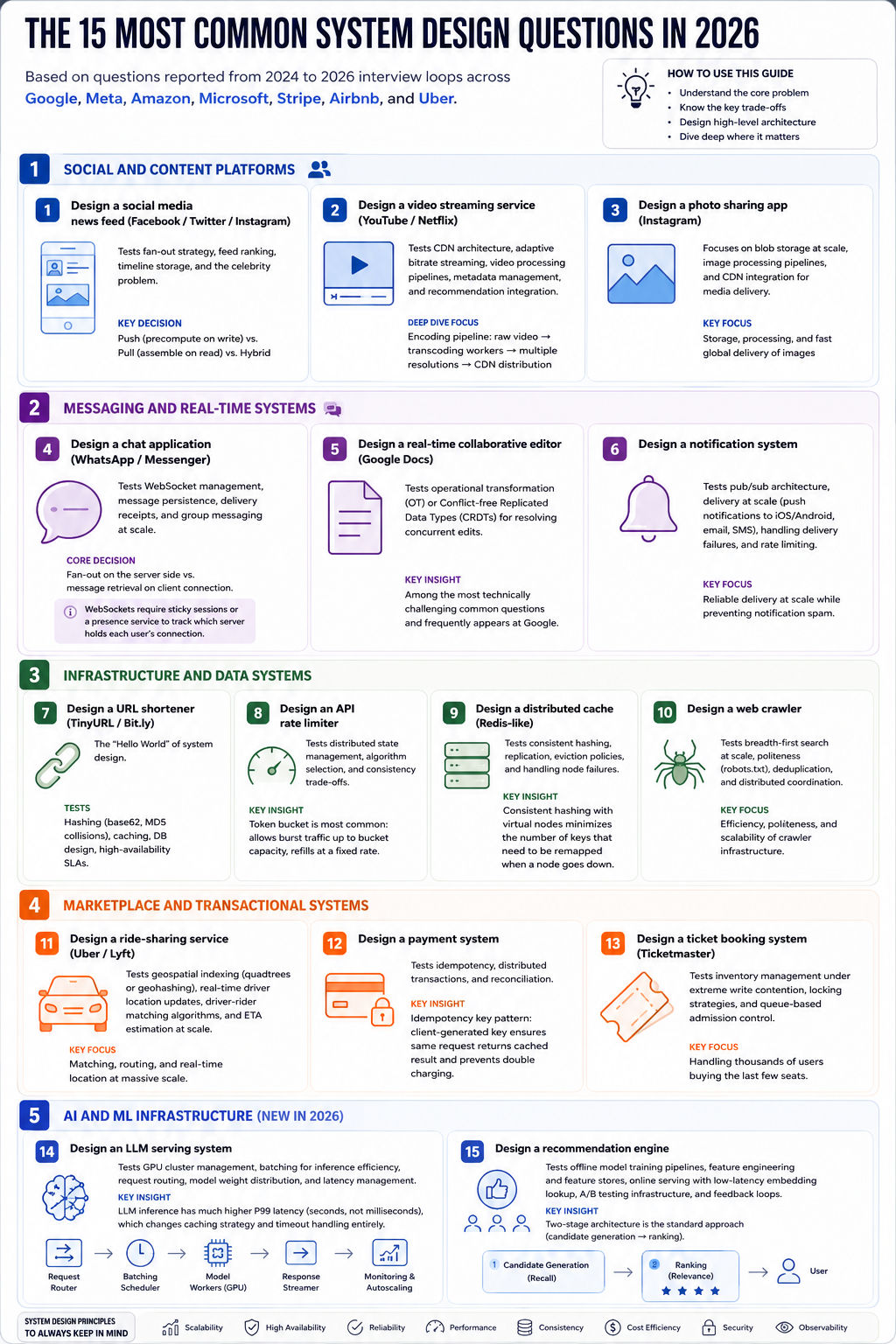
Based on questions reported from 2024 to 2026 interview loops across Google, Meta, Amazon, Microsoft, Stripe, Airbnb, and Uber, these categories appear most frequently:
Social and content platforms
Design a social media news feed (Facebook / Twitter / Instagram) - Tests fan-out strategy, feed ranking, timeline storage, and the celebrity problem. The core decision: push (precompute on write) vs. pull (assemble on read) vs. hybrid.
Design a video streaming service (YouTube / Netflix) - Tests CDN architecture, adaptive bitrate streaming, video processing pipelines, metadata management, and recommendation integration. The encoding pipeline is a frequent deep-dive target: raw video to transcoding workers to multiple resolution outputs to CDN distribution.
Design a photo sharing app (Instagram) - Focuses on blob storage at scale, image processing pipelines, and CDN integration for media delivery.
Messaging and real-time systems
Design a chat application (WhatsApp / Messenger) - Tests WebSocket management, message persistence, delivery receipts, and group messaging at scale. The fundamental decision: fan-out on the server side vs. message retrieval on client connection. WebSockets require sticky sessions or a presence service to track which server holds each user's connection.
Design a real-time collaborative editor (Google Docs) - Tests operational transformation (OT) or Conflict-free Replicated Data Types (CRDTs) for resolving concurrent edits. This is among the most technically challenging common questions and frequently appears at Google.
Design a notification system - Tests pub/sub architecture, delivery at scale (push notifications to iOS/Android, email, SMS), handling delivery failures, and rate limiting to prevent notification spam.
Infrastructure and data systems
Design a URL shortener (TinyURL /Bit.ly) - The "Hello World" of system design. Tests hashing strategies (base62 encoding, MD5 collision handling), caching at high read volume, database design, and high-availability SLAs.
Design an API rate limiter - Tests distributed state management, algorithm selection (token bucket vs. sliding window log vs. sliding window counter), and consistency trade-offs. Token bucket is the most common correct answer: allows burst traffic up to bucket capacity, refills at a fixed rate.
Design a distributed cache (Redis-like) - Tests consistent hashing, replication strategies, eviction policies, and handling node failures. Key insight: when a cache node goes down, consistent hashing with virtual nodes minimizes the number of keys that need to be remapped compared to simple modular hashing.
Design a web crawler - Tests breadth-first search at scale, politeness constraints (respecting robots.txt), deduplication (URL normalization, fingerprinting), and distributed coordination across crawler workers.
Marketplace and transactional systems
Design a ride-sharing service (Uber / Lyft) - Tests geospatial indexing (quadtrees or geohashing for efficient proximity queries), real-time driver location updates, driver-rider matching algorithms, and ETA estimation at scale.
Design a payment system - Tests idempotency (how do you prevent charging a customer twice if the network fails?), distributed transactions, and reconciliation. The idempotency key pattern is the correct answer: each payment request includes a client-generated idempotency key, and the server stores the result of the first request so identical requests return the cached result without re-executing.
Design a ticket booking system (Ticketmaster) - Tests inventory management under extreme write contention (thousands of users simultaneously purchasing the last available seat), optimistic vs. pessimistic locking strategies, and queue-based admission control for high-demand events.
AI and ML infrastructure (new in 2026)
Design an LLM serving system - Tests GPU cluster management, batching strategies for inference efficiency, request routing, model weight distribution, and latency management. Key insight: LLM inference has much higher P99 latency than traditional APIs (seconds, not milliseconds), which changes caching strategy and timeout handling entirely.
Design a recommendation engine - Tests offline model training pipelines, feature engineering and feature stores, online serving with low-latency embedding lookup, A/B testing infrastructure, and feedback loops. The two-stage architecture (candidate generation then ranking) is the standard approach at companies like YouTube and Spotify.
How to Practice System Design Effectively
The mistake most candidates make is treating system design practice as passive reading. Watching videos about how Twitter's feed works or reading engineering blog posts is research, not practice. Practice is designing the system yourself, out loud, under time pressure, and getting feedback.
The structured practice loop
For each practice session, use this sequence:
- Set a 45-minute timer. Real system design interviews are 45 to 60 minutes. Practicing without time pressure trains the wrong behavior.
- Read the prompt once, then close any references. The interview is closed-book.
- Clarify requirements out loud, even if you are practicing alone. Narrating forces clarity.
- Draw the high-level design before going deep on anything.
- Explicitly name two or three trade-offs before the timer ends.
- Review against a rubric after the session.
What to look for in each practice session
After each session, score yourself against these signals:
| Signal | Strong | Needs work |
|---|---|---|
| Requirement gathering | Spent 5+ minutes clarifying before designing | Jumped directly to the design |
| Scale estimation | Calculated QPS, storage, and bandwidth | Skipped or guessed without math |
| Component selection | Justified each component with a trade-off | Added components without explanation |
| Failure handling | Named at least 2 failure modes | Only designed the happy path |
| Communication | Narrated reasoning throughout | Worked in silence, explained at the end |
| Trade-off discussion | Named what you sacrificed for your choices | Presented design as optimal |
The pattern you are looking for over time: as sessions progress, the "needs work" column should shrink. If requirement gathering is consistently weak, spend an entire session doing nothing but practicing clarifying questions across five different prompts. Isolate the weakness, drill it, then reassess.
Solo vs. peer practice
Solo practice builds the foundational framework. Peer and mock practice is irreplaceable for the communication layer. System design interviews are conversations. The interviewer will redirect you, add constraints mid-session, push back on specific decisions, and ask clarifying questions that require you to defend your thinking in real time. None of that is replicable in solo practice.
The optimal preparation structure for candidates with 6 to 8 weeks:
- Weeks 1 to 2: Build foundational understanding of all core components. No timed practice yet.
- Weeks 3 to 4: Solo timed practice on classic questions. One question per day, full 45-minute session.
- Weeks 5 to 6: Mixed solo practice and mock interviews. Add company-specific questions that match your target roles.
- Final week: Review weakest areas, run 2 to 3 additional mocks, and do a final review of core component trade-offs.
Using company-specific question banks
Generic system design practice does not account for the specific flavor of each company's evaluation. Google prioritizes technical depth; Amazon prioritizes operational rigor; Stripe prioritizes correctness semantics. If you have an interview at a specific company in four weeks, your final two weeks of practice should skew heavily toward questions that company has historically asked, not a random selection from a general list.
PracHub organizes its question bank by company, role, difficulty, and round, which means you can filter specifically for system design questions asked at your target company in recent interview loops. With 5,900+ real questions across 303 companies and role-specific filters for SDE, Data Science, ML, and PM roles, it is particularly useful in the company-specific targeting phase of prep. The system design questions from actual candidates who recently interviewed at Google or Meta carry different signal than generic textbook examples.
The Components That Trip Candidates Up Most
Some building blocks appear simple on the surface but consistently expose knowledge gaps in interviews. These are worth extra focus.
Consistent hashing
The naive sharding approach (hash(key) % N) means that when you add or remove a server, almost every key remaps to a different node. In a distributed cache, this invalidates the entire cache on every scaling operation.
Consistent hashing places both servers and keys on a ring. When a server is added or removed, only the keys in the range between the new server and its predecessor need to be remapped. Virtual nodes (multiple positions per physical server on the ring) smooth out the distribution. Most candidates can describe consistent hashing conceptually but cannot explain virtual nodes or what happens to in-flight requests during node addition.
Idempotency
An operation is idempotent if executing it multiple times produces the same result as executing it once. HTTP GET is naturally idempotent. HTTP POST is not.
In distributed systems, idempotency is essential for safe retries. When a network call times out, you do not know if the server processed the request or not. Without idempotency, retrying can cause duplicate records, duplicate charges, or duplicate messages.
The standard implementation: the client generates a unique idempotency key (UUID) per logical operation. The server checks whether this key has been seen before processing the request. If it has, it returns the result of the original operation without re-executing. The idempotency key is stored with a TTL (e.g., 24 hours).
Distributed transactions and two-phase commit
Two-phase commit (2PC) is the classic solution for atomic updates across multiple services. A coordinator sends a "prepare" message to all participants, collects acknowledgments, then sends a "commit" or "rollback" message.
The problem: 2PC is blocking. If the coordinator crashes after sending "prepare" but before sending "commit," participants are stuck in a prepared state until the coordinator recovers. This makes 2PC impractical for high-availability, high-throughput systems.
The alternative is the Saga pattern: break the transaction into a sequence of local transactions, each with a compensating transaction if it needs to be rolled back. Sagas are more complex to implement but avoid the blocking coordination problem of 2PC.
Knowing that 2PC exists but understanding why real systems typically avoid it in favor of Sagas or event-driven eventual consistency separates senior candidates from junior ones.
Your 6-Week System Design Study Plan
| Week | Focus | Daily Activity | Milestone |
|---|---|---|---|
| 1 | Core components | Study one component per day: load balancers, caching, databases, message queues, CDNs, consistent hashing | Can explain any component and its trade-offs without notes |
| 2 | Scale reasoning | Practice back-of-the-envelope math for 10 different system prompts | Can estimate QPS and storage needs in under 5 minutes |
| 3 | Classic systems | Timed solo sessions: URL shortener, chat app, news feed | Can produce a complete design in 45 minutes |
| 4 | Advanced systems | Timed solo sessions: video streaming, ride sharing, payment system, recommendation engine | Can go deep on 2+ components per session |
| 5 | Company-specific practice | Use company-filtered questions for your target role; add mock interviews | Can adapt the framework to company-specific evaluation criteria |
| 6 | Final polish | Re-solve weakest questions, run mocks with structured feedback | Can narrate trade-offs clearly without prompting |
What Separates a Hire from a Strong Hire
Most candidates who pass the threshold in system design reach a working solution. The distinction between a "hire" and a "strong hire" at senior and staff levels comes down to a few consistent behaviors:
Driving the conversation rather than responding to it. Strong hires propose their own deep dives: "I want to go deeper on the database sharding strategy here - is that the right area to focus, or would you prefer I discuss the caching layer?" This signals ownership and systems-level thinking.
Explicit trade-off framing. Every component choice becomes an opportunity: "I am choosing Cassandra here because of its write throughput and horizontal scalability, but I want to acknowledge that we are giving up join capabilities and strong consistency, which means our analytics queries will need to run against a separate OLAP system." This precision reads as engineering maturity.
Proactive failure mode analysis. Strong candidates identify failure modes without being asked: "One thing I want to flag: if the Kafka consumer falls behind, messages will queue up and latency for notifications will spike. I would add a consumer lag alert and a dead-letter queue with a retry budget to handle this."
Appropriate scope management. Strong candidates define scope explicitly: "For this session, I am going to focus on the core write path and feed generation and deprioritize the ads system and analytics pipeline. Is that the right scope for today?" This signals that you know real systems are larger than any 45-minute design session.
System design prep is one of the areas where PracHub's company-specific question filters are most useful. When you are four to six weeks out from a loop, knowing that your target company has a pattern of asking real-time messaging questions with heavy operational emphasis (Amazon), or data-intensive feed questions with fan-out constraints (Meta), lets you weight your practice sessions accordingly rather than sampling blindly. PracHub organizes over 5,900 real interview questions by company, role, and round - including system design rounds specifically - which removes the guesswork from the targeting phase when your time per question matters most.
If you are also building out your coding interview prep in parallel, see PracHub's coding and algorithms question bank for the algorithm and pattern-recognition side of technical prep.
How to Use This Page as a Prep Plan
Do not treat this as passive reading. Convert the ideas in this page into a short weekly loop: learn one idea, practice it under interview conditions, then write down what changed. That is the fastest way to turn advice into visible interview behavior.
| Prep area | What you need to prove | Practice artifact |
|---|---|---|
| Requirements | Clarify the problem before drawing boxes. | Functional and non-functional checklist. |
| Architecture | Map data flow before naming technologies. | One end-to-end diagram. |
| Tradeoffs | Explain why the design fits the constraints. | Latency, consistency, cost, and operability notes. |
| Failure handling | Show how the system behaves under stress. | Backpressure, retries, monitoring, and rollback plan. |
For System Design Interview: The Complete 2026 Prep Guide, the strongest candidates usually do three things well: they make their assumptions explicit, they use concrete examples instead of vague claims, and they review mistakes quickly enough that the next practice rep is better than the last one.
Video Walkthrough
This verified YouTube video gives a second pass on the same preparation area. Use it after reading the guide, then come back and turn the advice into a practice artifact.
FAQ
What should I draw first in a system design interview?
Start with users, requests, core data, and the main read or write path. Add scale mechanisms only after the simple design is clear.
How detailed should the design be?
Deep enough to defend the main bottleneck. A focused design with good tradeoffs beats a crowded diagram with no reasoning.
How do I avoid sounding memorized?
Tie each component to a requirement and explain the tradeoff it creates.
Comments (0)