Tech Interview Statistics 2026: What Gets Asked Most
Quick Overview
This analysis examines 8,479 real interview questions from 452 companies and covers category breakdowns, company-level topic weightings, year-over-year changes, and how to convert the statistics into a concrete study plan.
We analyzed 8,479 real interview questions reported on PracHub by candidates at 452 companies to see what tech interviews actually test in 2026. This is for software engineers, data scientists, ML engineers, and analysts deciding where to spend prep time. Below is the category breakdown, how the big companies weight each topic, what's changing this year, and how to turn the numbers into a study plan.
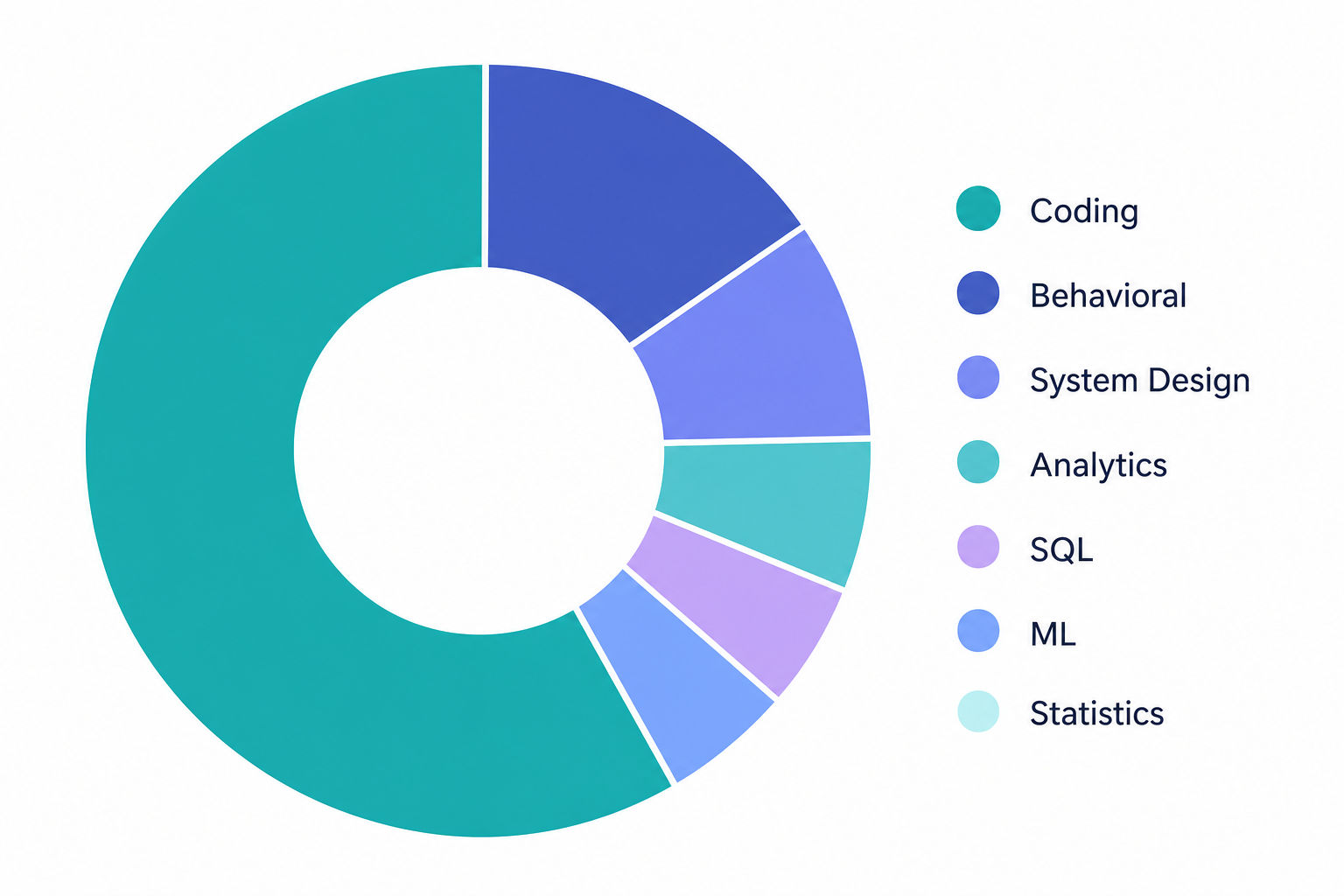
Question distribution by category
These are the live category counts across all unlocked questions in the PracHub bank. Percentages are rounded.
| Category | Count | Percentage |
|---|---|---|
| Coding & Algorithms | 3,013 | 36% |
| Behavioral & Leadership | 1,027 | 12% |
| System Design | 981 | 12% |
| Analytics & Experimentation | 909 | 11% |
| Data Manipulation (SQL/Python) | 653 | 8% |
| Machine Learning | 639 | 8% |
| Statistics & Math | 482 | 6% |
| Software Engineering Fundamentals | 350 | 4% |
| ML System Design | 285 | 3% |
| Product / Decision Making | 82 | 1% |
| Product Design & Strategy | 22 | <1% |
Coding is the single largest category, but it is barely over a third of the total. The other roughly two-thirds - behavioral, system design, SQL, ML, analytics, statistics - each demand a different kind of preparation. Treating "interview prep" as a synonym for "grind LeetCode" leaves most of the surface area untouched.
Browse the full breakdown by topic in the PracHub question bank, where you can filter every one of these categories.
Which companies ask the most questions
Volume roughly tracks two things: how many candidates report from a company, and how thorough that company's loop is. Meta leads on both.
Top companies by reported questions:
- Meta: ~1,129 questions (about 13% of the bank)
- Amazon: ~612 questions (about 7%)
- Google: ~467 questions (about 6%)
- Capital One, Uber, TikTok: ~290 each
- OpenAI: ~232; Anthropic: ~141
Meta's lead is partly because it tests across more categories than most companies. A single Meta loop can include coding, SQL, product/analytics sense, behavioral, and system design - so one candidate generates questions in five buckets at once. You can see each company's profile on its hub, for example Meta interview questions, Amazon, and Google.
How the big companies weight categories
The headline category split is an average across the whole industry. Individual companies skew hard, and matching your prep to your target's skew is the highest-leverage move you can make.
Meta - analytics and SQL heavy. The most common buckets are coding (~291), analytics/experimentation (~269), SQL/Python (~170), then behavioral and system design. If you are interviewing at Meta, data and experimentation prep matters about as much as algorithms.
Amazon - behavioral heavy. Coding (~198) leads, but behavioral (~125) is the clear second and Leadership Principles thread through every round. Behavioral is roughly a fifth of Amazon's reported questions, a far higher share than at most peers. ML and SQL round out the loop.
Google - coding heavy. Coding (~189) dwarfs everything else, with behavioral (~70), then ML, analytics, system design, and statistics clustered well behind. Google's algorithmic bar is widely considered one of the steepest in the industry.
Quick read on FAANG skew
| Company | Skews toward | Easy to underestimate |
|---|---|---|
| Meta | Coding + analytics + SQL | How much SQL/experimentation it tests |
| Amazon | Behavioral (Leadership Principles) | That behavioral can sink an otherwise strong loop |
| Algorithms / coding depth | Behavioral ("Googleyness") is still graded |
What's changing in 2026
AI labs are now a major source of questions. OpenAI, Anthropic, and other AI companies sit near the top of the bank by volume. Their loops tend to lean harder on ML fundamentals and on system design for ML infrastructure than a typical product-company loop.
LLM-specific questions have arrived. Topics like transformers, attention, fine-tuning, RLHF, and serving infrastructure now show up in ML interviews at companies that would not have asked about them a couple of years ago. If you target an ML or research-adjacent role, these are worth real study time rather than a skim.
System design prompts are getting more specific. The generic "design Twitter" is giving way to prompts about real-time ML serving, event-driven architectures, and data-pipeline design. Many of these assume more baseline knowledge than the classic open-ended prompts did.
Structured behavioral rounds are spreading. Amazon popularized rigorous, rubric-driven behavioral interviews, and more companies now run a dedicated, structured behavioral round rather than a casual culture chat. Prepare stories, not vibes.
Turning the numbers into a study plan
The data points to a few clear, practical takeaways.
- Do not over-index on coding. It is the largest single category, but it is only about a third of the questions. Spending 80% of your prep on algorithms leaves you exposed across most of the loop.
- Match your prep to the target company. Amazon behavioral prep looks nothing like Google coding prep. Pull up your target's company hub, read its skew, and allocate hours accordingly.
- Do not skip SQL. It is only ~8% of the bank, but it is a gatekeeper round in most data science, data engineering, and analytics loops. Fail the SQL screen and you never reach the onsite.
- Treat ML system design as a differentiator. It is a smaller, growing category where experienced ML engineers separate themselves from strong coders who have never shipped a model to production.
Prep allocation: do vs. don't
| Do | Don't |
|---|---|
| Spread study time across the categories your target actually tests | Spend every hour on LeetCode and ignore the other two-thirds |
| Read your target company's category skew before scheduling | Assume every FAANG loop weights topics the same way |
| Prepare 6-8 structured behavioral stories with metrics | Wing the behavioral round because "it's just talking" |
| Drill SQL to fluency if you're in a data role | Treat SQL as an afterthought you can cram the night before |
| Practice system design out loud with a clock running | Read system design blog posts and never speak an answer |
For role-specific question sets, start from your position hub, for example software engineer interview questions, and narrow by category and company from there. The full library lives under PracHub resources and the searchable question bank.
How to Use This Page as a Prep Plan
Do not treat this as passive reading. Convert the ideas in this page into a short weekly loop: learn one idea, practice it under interview conditions, then write down what changed. That is the fastest way to turn advice into visible interview behavior.
| Prep area | What you need to prove | Practice artifact |
|---|---|---|
| Understand | Turn the prompt into a concrete goal. | Clarifying questions and success criteria. |
| Practice | Use realistic constraints and timed reps. | Worked examples with edge cases. |
| Explain | Make reasoning visible. | Tradeoffs, assumptions, and test strategy. |
| Improve | Review misses quickly. | A short feedback log and next action. |
For Tech Interview Statistics 2026: What Gets Asked Most, the strongest candidates usually do three things well: they make their assumptions explicit, they use concrete examples instead of vague claims, and they review mistakes quickly enough that the next practice rep is better than the last one.
Video Walkthrough
This verified YouTube video gives a second pass on the same preparation area. Use it after reading the guide, then come back and turn the advice into a practice artifact.
FAQ
How many tech interview questions did this analysis cover?
This breakdown is computed live from the PracHub question bank: about 8,479 unlocked questions reported by candidates across roughly 452 companies. Counts shift as new questions are added, so the exact numbers move over time, but the relative shape of the distribution has been stable.
Is coding really the most-asked category?
Yes. Coding and algorithms is the single largest bucket at roughly 36% of all questions. The important nuance is that it is still only about a third of the total, so it should not consume the majority of your prep time on its own.
Which company asks the hardest questions?
There is no clean ranking, and difficulty is subjective. Google is widely regarded as having one of the steepest algorithmic bars, Amazon weights behavioral heavily through its Leadership Principles, and AI labs tend to push harder on ML fundamentals and ML system design. The honest answer: hardness depends on the role and round, not just the logo.
How should I split my study time?
Start from your target company's category skew rather than the industry average. As a rough default for a generalist software engineer: a plurality on coding, a solid block on system design, real time on behavioral stories, and dedicated SQL practice if your role touches data. Adjust the moment you know where you're interviewing.
Are behavioral interviews actually important?
For many companies, yes. Behavioral is the second-largest category overall and is decisive at companies like Amazon, where it can sink an otherwise strong loop. Prepare specific, structured stories with concrete outcomes instead of improvising.
Where can I practice these questions?
All of the questions behind these numbers are searchable on PracHub by company, role, category, and difficulty. Begin with the question bank, or jump straight to a company or role hub to see the exact mix for your situation.
Comments (0)