Top 5 LeetCode Alternatives for Tech Interviews in 2026
Quick Overview
Compare 5 LeetCode alternatives for tech interviews in 2026, including PracHub, NeetCode, interviewing.io, HackerRank, and AlgoExpert. See which tools are better for real-company questions, coding practice, mock interviews, and paid prep.
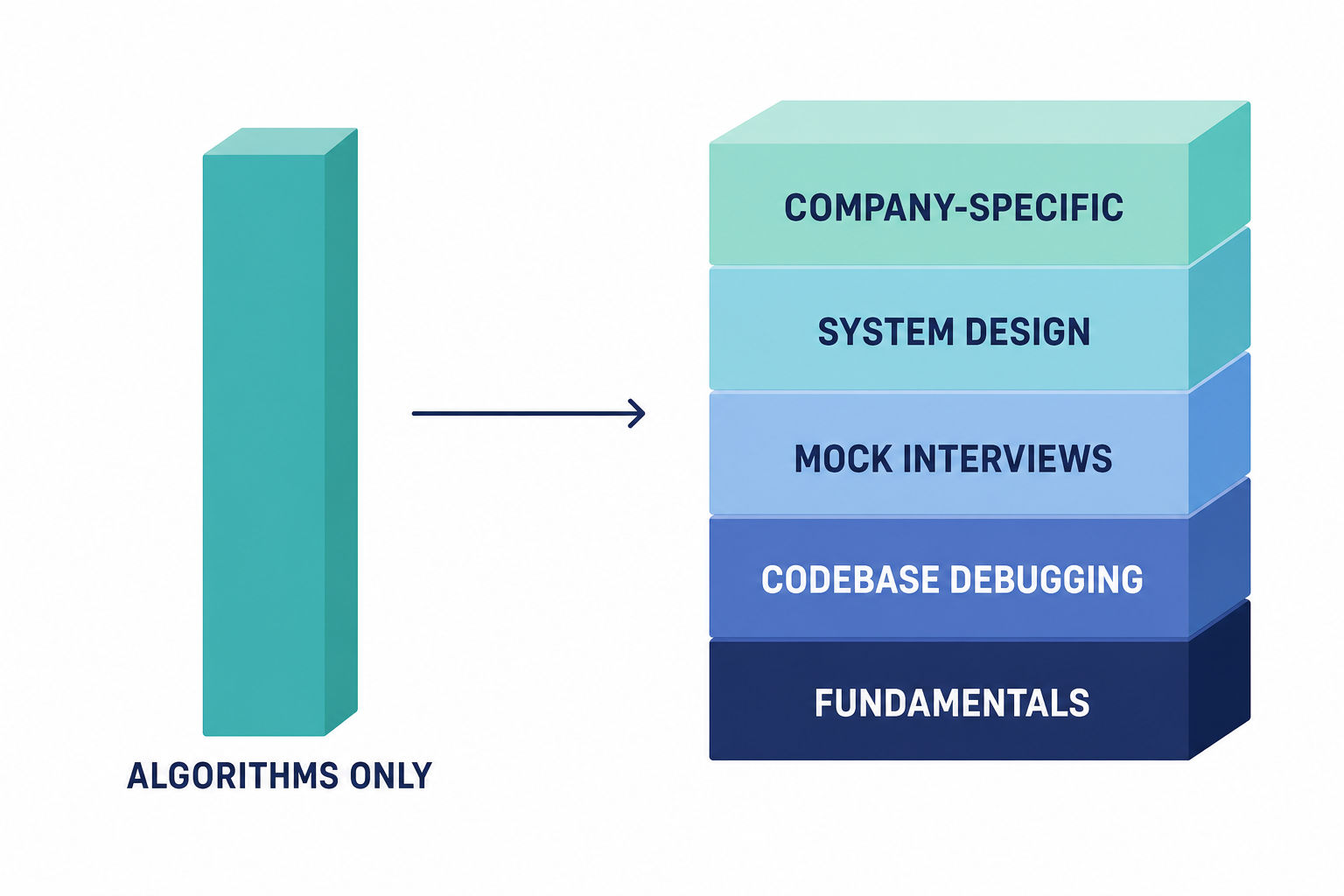
If you've solved hundreds of algorithm problems and still feel unprepared for a real onsite, the problem usually isn't your effort - it's your practice surface. Generic puzzle grinding optimizes for one slice of the interview (data structures and Big-O) while modern loops also test system design, behavioral judgment, real-world debugging, and role-specific depth. This guide walks through five LeetCode alternatives that train the skills an algorithm tracker leaves out, plus how to combine them based on how much time you have.
These aren't five interchangeable options to pick one from. Each covers a different skill the interview actually grades. The strongest preparation stacks several of them rather than betting everything on one.
The platform alternatives at a glance
If you came here for a direct platform swap, start with this comparison. Every option below is a real product you can use today; the rest of the guide covers the practice methods that platforms alone don't teach.
| Platform | What it does best | Pricing | Best for |
|---|---|---|---|
| PracHub | Real, company-specific interview questions with in-depth solutions, filterable by company, role, and topic, plus in-browser coding and SQL consoles | Freemium - most questions free | Targeted prep for a specific company or role (disclosure: this is our platform) |
| NeetCode | Curated problem roadmap with clear video explanations, organized by pattern | Free roadmap; paid Pro tier | Learning algorithm patterns without the random-problem shuffle |
| interviewing.io | Anonymous mock interviews with engineers from big tech, with recordings and feedback | Paid per mock | Realistic pressure testing before an onsite |
| HackerRank | Assessment-style practice in the exact format many companies use for online assessments | Free for candidates | Getting comfortable with timed OA environments |
| AlgoExpert | A hand-picked question set with dense video walkthroughs | Paid | A structured, finite curriculum if LeetCode's volume overwhelms |
Also worth knowing: Codewars and Exercism (both free) for language-fluency drills, Pramp for free peer-to-peer mocks, and GreatFrontEnd if you interview for front-end roles specifically.
One honest note: no platform on this list, ours included, replaces the methods below. Platforms give you material; the methods turn that material into interview performance.
What modern interviews actually test
A FAANG or top-tier loop in 2026 is rarely one coding round. A typical senior software-engineering loop mixes several formats, and each rewards a different kind of practice:
| Interview round | What it grades | Pure algorithm grinding helps? |
|---|---|---|
| Coding / data structures | Problem-solving, Big-O, clean implementation | Yes - this is its home turf |
| System design | Architecture, trade-offs, scaling, communication | No |
| Behavioral | Ownership, conflict, impact, structured stories | No |
| Debugging / "fix this codebase" | Reading unfamiliar code, scoped changes | No |
| Domain deep-dive (ML / DS / infra) | Role-specific depth (stats, modeling, distributed systems) | Rarely |
The takeaway isn't that algorithms don't matter - they do, and you should still practice them. It's that an algorithm tracker covers one column of a five-column scorecard. The alternatives below fill the other four.
How to use this list
Match the tool to the gap and the clock:
- Interview is 1-2 weeks out: lead with company-specific question banks (#1) so you study what's actually being asked, and add mock interviews (#3) for pressure tolerance.
- Interview is 1-3 months out: add system design reps (#2) and a foundational text (#5) to build durable depth.
- Targeting senior/staff or a debugging-heavy company: prioritize system design (#2) and codebase navigation (#4).
1. PracHub - company-specific question banks
The biggest weakness of generic coding platforms is the missing context. An infrastructure role at one company will probe idempotency keys and distributed consensus; a frontend role at another will drill you on rendering performance and framework edge cases. A random puzzle set prepares you for neither.
The fix is to practice the exact kinds of questions a target company asks for your specific role, instead of a one-size-fits-all feed.
That's what PracHub is built for. It aggregates real interview questions from top tech companies so you can target your prep:
- Filter by role - switch between software engineering, data science, machine learning, and product management question sets. Browse the full question bank or jump to a role hub like software engineer.
- Target specific companies - focus on what a given company is actually asking. Company hubs like Google collect questions reported for that company.
- Practice with structure - build a daily habit and work through questions organized by topic and difficulty rather than a random shuffle.
If your interview is two weeks out, this is the highest-leverage way to spend your remaining hours, because it removes the guesswork about what to study.
2. System design on a whiteboard
In senior and staff interviews, you'll rarely touch a compiler. You're evaluated on whether you can design a scalable system, reason about trade-offs, and defend your choices out loud. The best practice tool for that is deliberately low-tech: a whiteboard and a marker (a blank doc or paper works too).
To practice effectively:
- Work without a screen. Design a rate limiter or a URL shortener from a blank board so you're forced to recall the building blocks, not look them up.
- Hunt for the bottlenecks. Identify single points of failure, partitioning and sharding strategies, and where consistency-versus-availability trade-offs (the CAP theorem) actually bite.
- Narrate your reasoning. Interviewers care far more about why you'd choose a wide-column store over a relational database for a given access pattern than about a tidy final diagram.
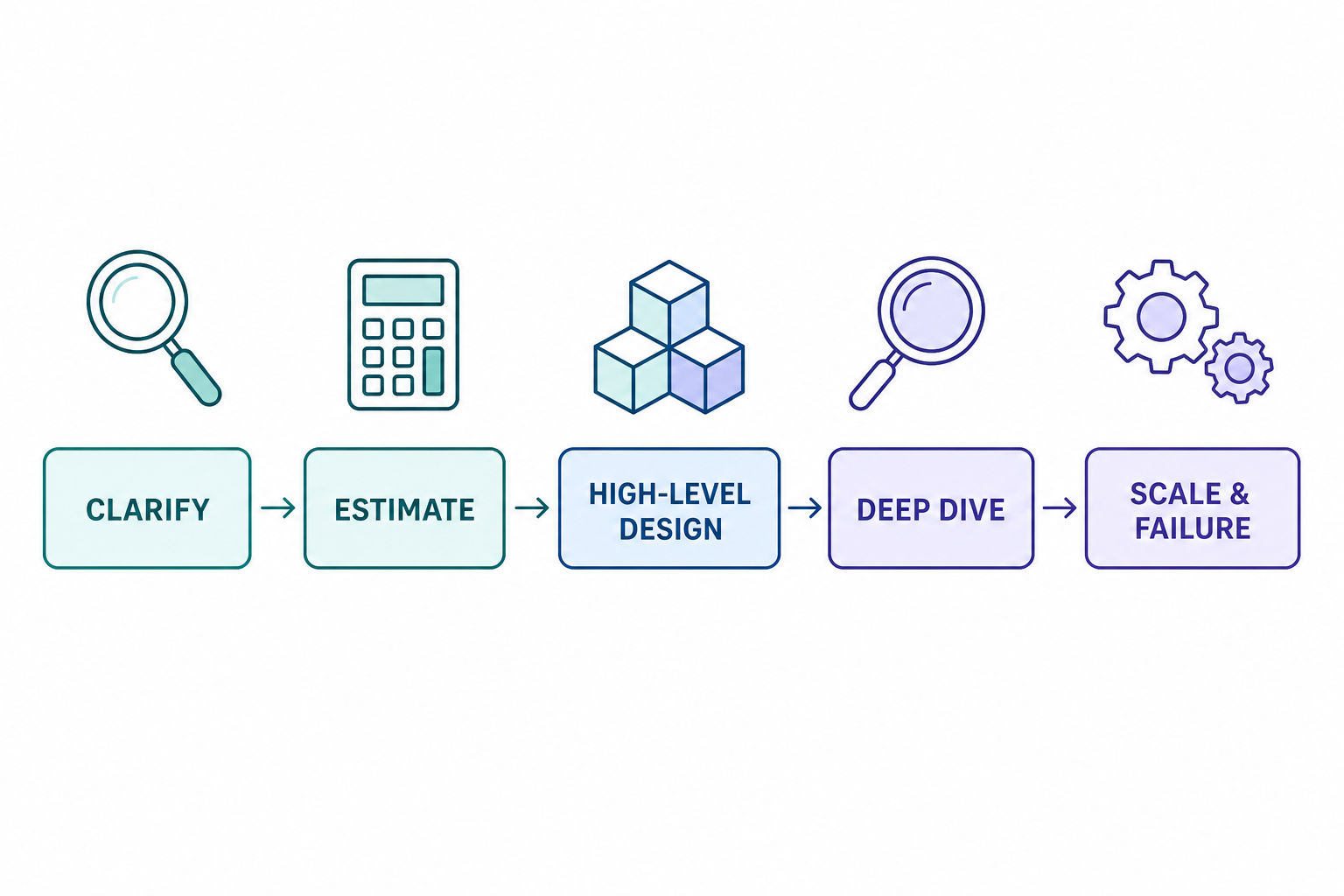
A repeatable structure keeps you from freezing on an open-ended prompt:
| Step | What to cover | Common mistake to avoid |
|---|---|---|
| 1. Clarify requirements | Functional needs, scale, read/write ratio, latency targets | Jumping to a design before scoping |
| 2. Estimate | Rough QPS, storage, bandwidth back-of-envelope | Inventing precise numbers you can't justify |
| 3. High-level design | Core components and data flow | Adding services with no clear job |
| 4. Deep dive | Data model, the bottleneck component, trade-offs | Staying shallow across everything |
| 5. Scale & failure modes | Caching, sharding, replication, what breaks first | Ignoring failure and consistency |
For a worked example of this flow end to end, this walkthrough is a solid primer:
3. Peer-to-peer mock interviews
No automated test suite reproduces the pressure of someone watching you think. When a senior engineer is staring at your screen mid-graph-traversal, your cognitive load spikes, and that pressure is exactly what trips up otherwise-prepared candidates. Practicing with a live partner is how you build tolerance for it.
To run a useful mock:
- Pair with someone at a similar level, interviewing at a comparable tier of companies, so the bar and the question difficulty are realistic.
- Take turns as interviewer and candidate. Playing the interviewer sharpens your eye for what good answers look like - you start noticing when a candidate skips edge cases or stops narrating.
- Grade like a real loop. As the interviewer, evaluate code maintainability, edge-case handling (integer overflow, null inputs, empty collections), and how clearly the candidate communicates while solving.
A simple scorecard keeps feedback honest instead of vague:
| Dimension | What "strong" looks like | What "weak" looks like |
|---|---|---|
| Communication | Narrates approach before coding, asks clarifying questions | Silent, jumps straight to typing |
| Problem-solving | States a brute-force baseline, then optimizes deliberately | Random tweaks until something passes |
| Code quality | Readable names, small functions, handles edge cases | Works but brittle; no edge cases |
| Recovery | Catches own bug, reasons out the fix calmly | Freezes or gets defensive when stuck |
If you'd rather practice against an experienced interviewer than a peer, PracHub also lists coaches you can book for a structured mock.
4. Open-source codebase navigation
Interviews are shifting from "implement this algorithm from scratch" toward "here's a working system - find the bug and fix it." Companies want to know whether you can move through a large, unfamiliar codebase without drowning in it. The best free training ground is a real open-source project on GitHub.
To practice:
- Clone a large, real project. Projects like Kubernetes, React, or Redis are good choices because their architecture is non-trivial and well documented.
- Pick a scoped issue, ideally one tagged
good first issueor a small bug, so the problem is contained. - Make a localized fix. Trace the dependency tree, understand the surrounding patterns, and change behavior without breaking anything global. That's the exact muscle a practical debugging round tests.
The skill here isn't writing the cleverest code. It's orienting fast: finding where a behavior lives, understanding the blast radius of a change, and resisting the urge to refactor the whole file.
5. Foundational engineering texts
If you want to stop memorizing optimal solutions and start understanding them, read the foundational literature. Once you grasp how a database index or a network protocol actually works, a lot of problem-solving becomes intuitive rather than rote.
Two high-return picks:
- Designing Data-Intensive Applications (DDIA) - a widely used reference for system design. The chapters on replication, partitioning, and distributed transactions give you a real answer for most backend architecture rounds.
- Introduction to Algorithms (CLRS) - for the rigor behind data structures. You don't need to read it cover to cover; working through the dynamic-programming and graph sections is enough to make the patterns stick.
Books are a long-lead investment, not a cram tool. Start them weeks out and let the concepts settle, then use the hands-on alternatives above to apply what you read.
Putting it together
Here's how the five alternatives map to the gap each one closes:
| Alternative | Best for | Time horizon |
|---|---|---|
| Company-specific question banks | Knowing what to study for a role and company | Days to weeks |
| Whiteboard system design | Senior/staff design rounds, trade-off reasoning | Weeks |
| Peer mock interviews | Pressure tolerance, communication | Days to weeks |
| Open-source codebase navigation | Debugging and "fix this code" rounds | Weeks |
| Foundational texts | Durable conceptual depth | Weeks to months |
Blindly grinding abstract puzzles is no longer enough on its own. The strongest preparation stacks the layers: conceptual depth from a book like DDIA, hands-on reps on a whiteboard and in a real codebase, live pressure from mock interviews, and company-specific targeting from a real question bank. Do that, and you walk in knowing what to expect instead of hoping the puzzles you memorized happen to show up. Browse more prep material in the PracHub resources library or the interview guides.
How to Use This Page as a Prep Plan
Do not treat this as passive reading. Convert the ideas in this page into a short weekly loop: learn one idea, practice it under interview conditions, then write down what changed. That is the fastest way to turn advice into visible interview behavior.
| Prep area | What you need to prove | Practice artifact |
|---|---|---|
| Understand | Turn the prompt into a concrete goal. | Clarifying questions and success criteria. |
| Practice | Use realistic constraints and timed reps. | Worked examples with edge cases. |
| Explain | Make reasoning visible. | Tradeoffs, assumptions, and test strategy. |
| Improve | Review misses quickly. | A short feedback log and next action. |
For Top 5 LeetCode Alternatives for Tech Interviews in 2026, the strongest candidates usually do three things well: they make their assumptions explicit, they use concrete examples instead of vague claims, and they review mistakes quickly enough that the next practice rep is better than the last one.
Video Walkthrough
This verified YouTube video gives a second pass on the same preparation area. Use it after reading the guide, then come back and turn the advice into a practice artifact.
FAQ
Should I stop doing LeetCode entirely?
No. Algorithm practice still matters for the coding round - it's just incomplete on its own. Keep a baseline of data-structure reps, then spend the rest of your time on the rounds an algorithm tracker doesn't cover: system design, behavioral, and role-specific depth.
What's the single best alternative if I only have one or two weeks?
A company-specific question bank. With limited time, the biggest win is studying the kinds of questions your target company actually asks for your role, so you're not spreading thin effort across topics that won't come up. Pair it with one or two mock interviews for pressure tolerance.
Which LeetCode alternatives are completely free?
Codewars, Exercism, and Pramp are free. NeetCode's roadmap and video explanations are free, with a paid Pro tier. PracHub is freemium - most of the question bank is free to practice, with some premium solutions gated. HackerRank is free for candidates, while interviewing.io and AlgoExpert are paid products.
Do these alternatives work for non-software-engineering roles?
Yes. Data science, machine learning, and product roles each have their own deep-dives (statistics and experimentation, modeling and ML systems, product sense and metrics). Filter a question bank by your role, and lean on mock interviews and foundational reading tuned to your domain rather than generic coding puzzles.
How many mock interviews are enough before the real thing?
There's no fixed number, but most candidates benefit from several spread over a couple of weeks rather than a cram session the night before. The goal is to get comfortable narrating your thinking under observation, which takes repetition, not a single session.
Is reading a book like DDIA worth it close to an interview?
Only if you have weeks, not days. Books build durable depth but are slow to pay off. Close to an interview, get the high-leverage concepts from targeted system design practice and notes instead, and save the full read for when you have runway.
Where can I find real questions from a specific company?
Browse company hubs on PracHub - for example the Google page - or filter the full question bank by company and role. That's faster than scattered forum threads because the questions are organized by company, role, and topic.
Comments (0)