Uber Graduate SWE OA 2026: HackerRank Questions, 105-Minute Format, and Interview Waitlists
Quick Overview
An evidence-led guide to Uber's 2026 Graduate Software Engineer HackerRank. It separates the candidate-reported three-question and 105-minute format from cohort variations, explains hidden-test strategy and integrity rules, and covers interviews, delays, and capacity waitlists after the OA.
Updated August 13, 2026: imagine passing every visible and hidden test case on an Uber coding assessment, then learning that the interview calendar is already full. That is not a hypothetical edge case. Multiple 2026 Graduate Software Engineer candidates reported receiving capacity or waitlist messages after the OA.
This Uber Graduate SWE OA 2026 guide separates the strongest signals from guesswork: the reported HackerRank format, what the 105-minute timer does and does not prove, and what an interview waitlist means. Before chasing remembered prompts, start with real Uber coding interview questions on PracHub and measure where your own solution breaks.
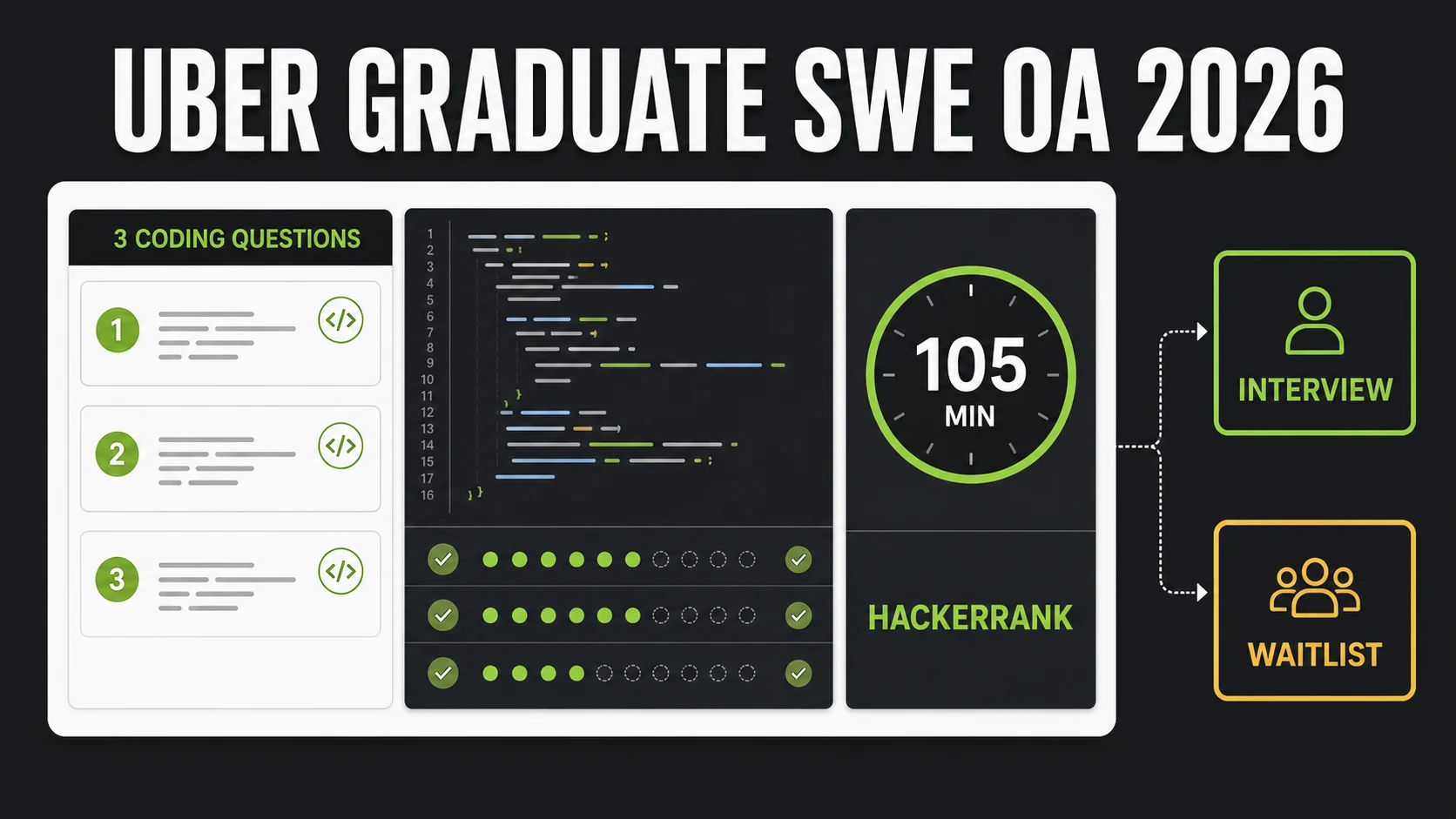
The 2026 Graduate SWE signal is three HackerRank coding questions, but the timer and next step vary by recruiting cohort.
Uber Graduate SWE OA 2026: Quick Answer
Several North American candidates for Uber's 2026 Graduate Software Engineer I roles reported a three-question HackerRank, and one reported a 105-minute limit. A separate India SWE-1 cohort reported three questions in 65 minutes. Your invitation is therefore the source of truth; 105 minutes is a current format signal, not a universal Uber rule.
| Signal | Best-supported 2026 evidence |
|---|---|
| Platform | Strong candidate signal: HackerRank appears repeatedly in US, Canada, and India reports. |
| Questions | Strong candidate signal: Three coding questions appear across multiple Graduate SWE reports. |
| Timing | Cohort-specific: One North American assessment was 105 minutes; another cohort reported 65. |
| Public cutoff | Unknown: Uber has not published a passing score for this OA. |
| After the OA | Variable: Candidates reported interviews, delayed decisions, and capacity waitlists. |
Start With Uber Questions, Not a Rumored Question List
A remembered prompt can change before your invitation arrives. The underlying skill usually does not. Use Uber Software Engineer interview questions to practice the company's broader coding style, then run unfamiliar questions under the timer shown in your own email.
Your first diagnostic should answer four practical questions: Can you recognize the data structure quickly? Can you reach a correct baseline before optimizing? Can you create edge cases without hints? Can you explain the complexity in one clean sentence? Those signals are more useful than knowing that somebody else saw three questions.
Is the 105-Minute Uber OA Format Universal?
No. In an April 2026 discussion covering US and Toronto Graduate SWE applicants, candidates described a three-question HackerRank and one participant reported a 105-minute limit. The thread includes different recruiting routes, including general SWE and mobile roles, so even nearby candidates should not assume identical settings.
A February 2026 India SWE-1 candidate instead reported three medium-to-hard questions in 65 minutes. That difference is large enough to change your pacing strategy. It also shows why “the Uber OA format” can be misleading without the year, role, region, and cohort.
Why can the format change?
HackerRank tests are configured by the hiring company. Uber can use different assessments for generalist, mobile, campus, country, or referral pipelines, and it can update a test during the same hiring season. Check the invitation for the question count, total time, allowed languages, deadline, and integrity requirements before you begin.
What Questions Should You Expect?
Public reports support algorithmic coding rather than one stable set of leaked questions. Candidates described the assessment as LeetCode-style and, in some cohorts, medium to hard. That is useful for setting the difficulty range, but it does not identify the exact prompt you will receive.
Build your prep around four reliable blocks: arrays, strings, and hash maps; sorting, intervals, and greedy reasoning; trees and graphs; then one dynamic-programming or simulation problem. Across all four, the recurring risks are duplicate values, boundary errors, disconnected inputs, stale state, and solutions that exceed the largest constraint.
Do not spend your final prep day learning a rare advanced technique. A three-question screen rewards clean implementation across common patterns. Practice selecting the simplest correct structure and writing adversarial tests before you submit.
How to Use a 105-Minute HackerRank
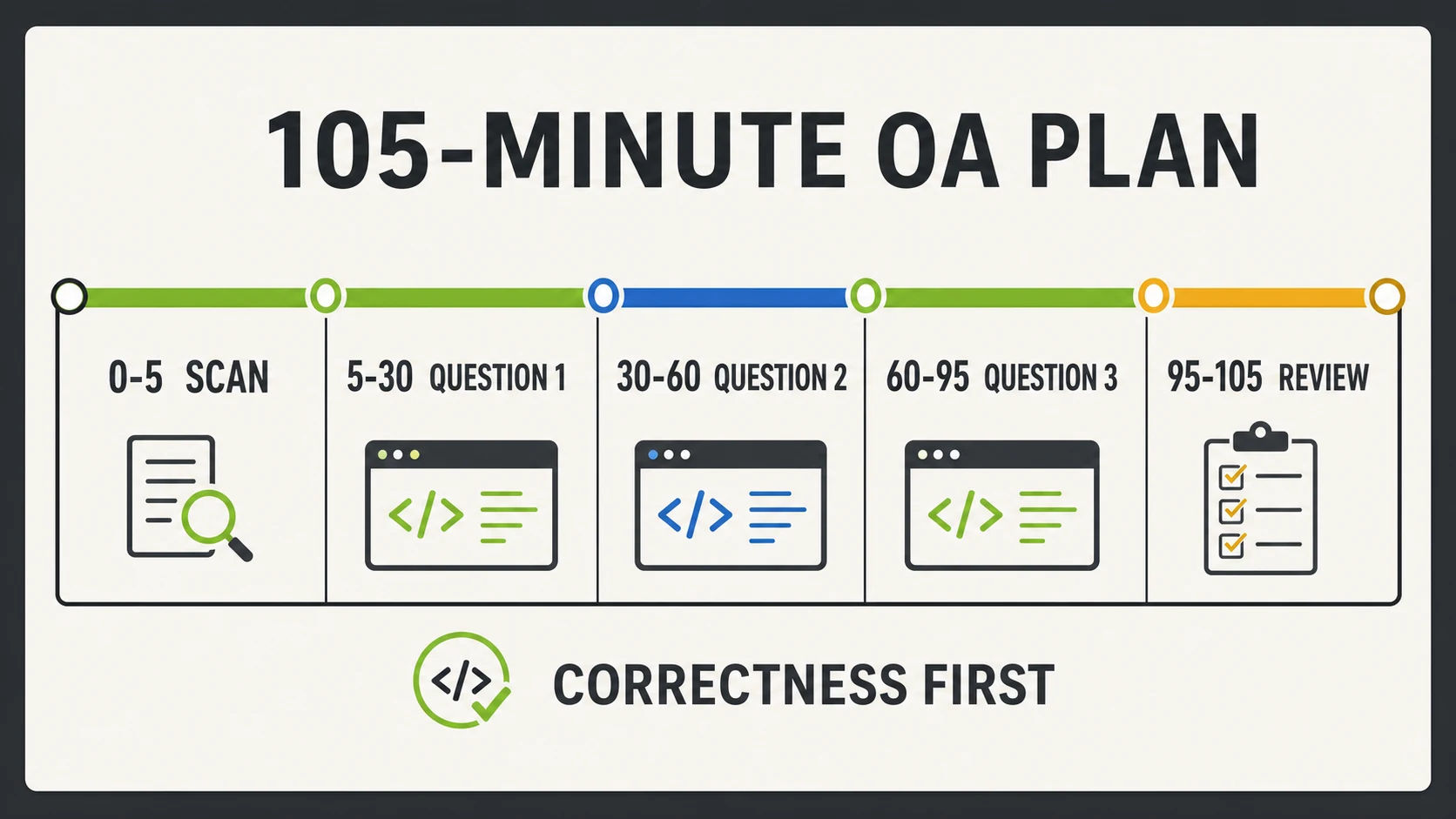
The timer is long enough to finish three questions, but only if you prevent one problem from absorbing the entire assessment. A practical starting plan is 5 minutes to scan, 25 minutes for question one, 30 for question two, 35 for question three, and 10 minutes for final testing.
| Time | Action |
|---|---|
| 0-5 minutes | Read all three prompts and constraints. Start where the route to a complete solution is clearest. |
| 5-30 minutes | Secure the first complete solution. Prefer correct and testable over clever. |
| 30-60 minutes | Complete question two. If blocked for eight minutes, leave notes and switch. |
| 60-95 minutes | Attack the hardest unfinished question. Submit a correct baseline before risky optimization. |
| 95-105 minutes | Run adversarial tests. Check complexity, boundaries, and leftover debug statements. |
If your invitation shows 65 minutes, compress the same sequence rather than blindly following this table. The general rule is to reserve at least the final 10 percent for tests and submission checks.
Why passing samples is not enough
HackerRank's official coding-question guide says hidden cases test both correctness and performance. Before submitting, try minimum input, maximum constraints, duplicate values, sorted and reverse-sorted data, and any case that could overflow or revisit state.
Proctoring, Tabs, and AI Rules
Do not infer the rules from another candidate's assessment. HackerRank supports several employer-configured integrity modes. Its current test-integrity documentation says Secure Mode can enforce full screen, restrict multiple monitors, block copy and paste, and record tab switching; enhanced modes can add screenshots, webcam checks, and session replay.
That does not prove every Uber Graduate OA uses every feature. It means your invitation and onboarding screen control what is allowed. Use external documentation, AI, extra tabs, or a second monitor only when the written rules explicitly permit them. The safest test-day setup is one supported browser, one display, a stable connection, and a quiet room.
For a broader platform walkthrough, review PracHub's HackerRank online assessment guide before test day.
What Happens After the Uber OA?
Uber's official How We Hire page describes a general path through talent acquisition, technical interviews, meeting the team, and a hiring decision. Graduate pipelines can place the HackerRank assessment before those live stages.
In 2026 Graduate SWE candidate discussions, outcomes after the OA were not uniform. Some candidates moved to an interview. Others waited without an update. Several received messages saying the interview funnel or available slots had reached capacity, including candidates who believed they had passed all test cases.
| Message or portal state | Meaning and response |
|---|---|
| Interview invitation | You are advancing. Shift from silent OA work to explaining code, projects, and trade-offs aloud. |
| Capacity full / waitlist | No slot is available now; future movement is not promised. Confirm interest once and keep interviewing elsewhere. |
| Under review / no update | The portal does not reveal your score. Follow up after the stated window, then keep applying. |
Is an interview waitlist a rejection?
Not formally, but it is also not an interview commitment. One US Graduate SWE candidate reported receiving a capacity message about two days after the OA, while another discussion mentioned roughly a week. An India SWE-1 candidate reported a waitlist email five days after completing all three questions.
Reply briefly to confirm continued interest and any real deadline from another offer. Then keep preparing and applying. A waitlist depends on headcount and interview capacity that you cannot control; pausing your search does not improve those conditions.
A Five-Session Uber OA Preparation Plan
Session 1: complete a three-question diagnostic and label lost time as recognition, implementation, debugging, or complexity. Session 2: practice arrays, hash maps, sorting, and intervals, with a custom edge-case checklist for every solution.
Session 3: cover trees or graphs plus one dynamic-programming or simulation problem. Session 4: run a full 105-minute mock using unseen questions and no hints. If your real timer is shorter, repeat the mock at that exact duration.
Session 5: re-solve the two weakest problems cleanly, then practice explaining one solution aloud. Add two concise behavioral and leadership stories so a fast interview invitation does not catch you preparing only for the OA.
Uber Graduate SWE OA 2026 FAQ
Is the Uber Graduate SWE OA always three questions?
Three HackerRank coding questions are the clearest repeated signal in 2026 Graduate SWE reports, but Uber has not published a universal question count. Generalist, mobile, campus, and regional pipelines may use different tests. Confirm the count shown in your own invitation before planning your time.
Is the Uber OA always 105 minutes?
No. A North American Graduate SWE candidate reported 105 minutes, while an India SWE-1 candidate reported 65 minutes for three questions. Treat 105 minutes as a relevant 2026 cohort format, not an official company-wide standard.
What score do I need to pass?
Uber has not published a Graduate SWE OA cutoff. HackerRank can score passed test cases, but advancement can also depend on solution quality, recruiting capacity, role fit, and the rest of the candidate pool. Aim for complete, efficient solutions rather than guessing a percentage.
How long does Uber take to respond after the OA?
There is no public response-time guarantee. Current candidate reports range from roughly two days to about a week for capacity messages, while other candidates waited longer or moved to interviews. Use the recruiter's stated window when available and avoid reading a portal status as a score.
Does passing every test case guarantee an Uber interview?
No. Multiple 2026 candidates reported interview-capacity or waitlist messages even after strong OA performance. Passing the assessment can make you eligible to advance, but it cannot create interview slots or headcount. Keep your preparation warm while continuing other applications.
Prepare for the Test and the Queue
The most defensible 2026 preparation target is a three-question HackerRank with strong hidden-test discipline. Use 105 minutes for your main simulation if that is what your invitation shows, but do not assume another cohort's timer, proctoring setup, or post-OA timeline applies to you.
Practice Uber coding questions on PracHub, run one honest timed mock, and review every failed edge case. Prepare to explain your code and projects immediately afterward, because the next email may be an interview invitation, a delay, or a capacity waitlist.
Research note: This guide was checked on August 13, 2026 against Uber's current hiring-process page, HackerRank candidate and integrity documentation, and 2026 candidate discussions covering US, Toronto, and India Graduate or SWE-1 pipelines. Candidate-reported formats can change; your invitation is authoritative.
Related Articles
Rippling HackerRank OA 2027: Questions, Timing, and What Comes After
Rippling HackerRank OA 2027 guide to reported questions, 45-60 minute formats, hidden-test strategy, and what follows from first round to team match.
Google SWE Intern OA 2027: Questions, Difficulty, Timeline, and What Happens Next
Google SWE Intern OA 2027 guide: current question patterns, difficulty, test-case expectations, response timelines, and what happens next.
Microsoft SWE Intern OA 2027: HackerRank Questions, AI Proctoring, and What Comes Next
Microsoft SWE Intern OA 2027 guide: HackerRank question types, AI proctoring rules, preparation strategy, and what happens after you submit.
Authentication and Authorization Interview Questions: OAuth, OIDC, JWT, and Sessions
Prepare for authentication interviews with practical questions on OAuth, OIDC, JWT validation, sessions, PKCE, revocation, and access control.
Comments (0)