Rippling HackerRank OA 2027: Questions, Timing, and What Comes After
Quick Overview
An evidence-led guide to the Rippling HackerRank OA for 2027 candidates, separating asynchronous assessments from live 60-minute HackerRank interviews. It covers reported question areas, timing variation, hidden-test strategy, and the candidate-reported path from first round through virtual onsite and team match.
Updated August 13, 2026: two candidates can both say they received a "Rippling HackerRank" and still be preparing for different events. One may have an asynchronous online assessment. Another may have a scheduled 60-minute coding interview inside HackerRank.
That distinction matters more than any rumored question list. The most useful way to prepare for the Rippling HackerRank OA 2027 is to identify your stage, read the timer and format in your own invitation, and practice for the evaluation that actually follows.
Start with real Rippling software engineer coding questions on PracHub. Use them to practice company-specific implementation patterns, then add timed algorithm drills for the broader OA coverage described below.
Rippling candidates report multiple HackerRank formats, so your invitation is more authoritative than any single interview post.
Rippling HackerRank OA 2027: Quick Verdict
Rippling is actively recruiting Winter 2027 engineering interns, and current candidates have reported receiving HackerRank invitations. The strongest broader pattern is algorithmic coding at approximately medium to medium-hard difficulty, but there is no verified universal 2027 question count or timer.
Recent reports describe a 60-minute live HackerRank exercise for US Winter 2027 intern interviews. Separate campus reports describe a 45-minute asynchronous assessment with different question sets. Older Rippling reports often mention two coding questions in 60 minutes. Treat those as useful preparation ranges, not a promise about your test.
What Is Confirmed and What Is Candidate-Reported?
| Claim | Evidence | What it means for you |
|---|---|---|
| Winter 2027 roles are open | Rippling's current backend intern posting covers a 13-week term from mid-January through April. | This is a live recruiting cycle, not recycled 2025 advice. |
| HackerRank is being used | Multiple Winter 2027 applicants report receiving HackerRank tests or interview exercises. | Practice in the HackerRank interface, but verify your exact stage. |
| Questions are algorithmic | Fresh reports mention medium-hard coding, layered follow-ups, graphs, strings, and hidden cases. | Prepare broad DSA fundamentals and implementation discipline. |
| Timing varies | Current reports include a 60-minute live exercise and a separate 45-minute campus assessment. | Use the duration displayed in your invitation, not a forum average. |
| There is no public cutoff | Rippling has not published a 2027 OA score threshold or advancement formula. | Maximize correct test coverage without trying to reverse-engineer a cutoff. |
Rippling's official backend internship posting emphasizes Python experience, backend fundamentals, quality code, communication, and solving real-world problems. It does not publish an OA syllabus. Any fixed question count you see elsewhere is candidate-reported.
Which Rippling HackerRank Did You Receive?
1. An asynchronous online assessment
This is the classic OA: you receive a link, choose when to begin within an allowed window, and complete the test without a live interviewer. A Winter 2027 candidate reported receiving this HackerRank shortly after applying, confirming that the screening path exists in the current cycle.
HackerRank says the login page shows the duration, question count, and test format before you start. It also says the hiring company controls the deadline and timer. Read those fields before accepting advice based on another role or region.
2. A scheduled 60-minute HackerRank exercise
A fresh Winter 2027 full-stack candidate described a 60-minute HackerRank exercise as an interview. Another backend candidate said the first round was expected to be a medium-hard LeetCode-style problem, with follow-ups building on the initial solution.
This is a live technical round, not simply an OA with a longer timer. Expect to explain assumptions, narrate complexity, react to follow-ups, and keep code readable while another person evaluates your decisions. A 60-minute calendar slot may leave closer to 50 minutes for coding after introductions.
3. A campus or region-specific assessment
Current Indian campus reports describe different sets and a 45-minute assessment, while other commenters recall two or three questions in other Rippling screens. These accounts should not be merged into one global format.
If a report does not match your location, role, and recruiting route, use it only as topic evidence. The exact format in your invitation wins.
What Questions Should You Expect?
The safest preparation range is medium to medium-hard algorithmic coding. Current reports mention graph traversal, shortest paths, disjoint-set union, strings, and dynamic programming, while PracHub's Rippling question bank also shows map-heavy logic, intervals, stateful components, and practical business rules.
Do not memorize a leaked prompt. Rippling can change the story, constraints, or follow-up while preserving the same underlying skill. Train yourself to identify the graph, state, invariant, or data structure beneath the wording.
| Practice area | What a strong solution shows | Common failure |
|---|---|---|
| Arrays, strings, and hash maps | Clean state tracking, exact indexing, and linear-time reasoning | Duplicate handling and off-by-one errors |
| Trees and graphs | Correct traversal state, visited logic, and complexity | Cycles, disconnected inputs, or deep recursion |
| Shortest paths and DSU | Knowing when DFS is insufficient and choosing the right structure | Applying a familiar template without checking assumptions |
| Dynamic programming | A clear state definition, transition, and base cases | Correct samples but excessive time or memory |
| Stateful implementation | Readable APIs, consistent updates, and deliberate edge cases | Code that works once but breaks across repeated operations |
For targeted practice, combine Rippling Software Engineer interview questions with a smaller set of unseen timed problems. Company-specific practice teaches the flavor; unseen problems prove that you can transfer the pattern.
Why Hidden Tests Matter So Much
Passing the examples does not prove that an OA solution is ready. HackerRank's official hidden-test documentation says these cases check boundaries, error scenarios, correctness, and performance without exposing the expected output.
Before submitting, test empty or minimum inputs, duplicates, already sorted data, disconnected graphs, repeated operations, and the largest meaningful case. Then calculate the actual time and space complexity. A solution that is logically correct but too slow can still lose most of its hidden-test credit.
A practical debugging order
When hidden tests fail, first confirm the input and output contract. Next inspect boundary conditions and stale state. Only then replace the algorithm if the failure looks like a timeout. This order prevents a complete rewrite when the real issue is one missing edge case.
How to Manage a 45- or 60-Minute Test
For an asynchronous test, scan every question before committing. Secure the problem with the clearest route to a complete solution, then return to the harder one. For a live exercise, spend the first few minutes clarifying inputs, output, constraints, and whether follow-ups are expected.
On a 60-minute OA, a reasonable starting budget is five minutes to scan, about 22 minutes per problem, and the final 10 minutes for optimization and adversarial cases. On a 45-minute single-problem test, reserve roughly five minutes for clarification, 25 to 30 for implementation, and 10 for tests and cleanup.
These are planning templates, not Rippling rules. HackerRank confirms that your recruiter sets the actual schedule and duration, and that the timer continues through a connectivity interruption. Use a stable connection and leave time to submit.
What Comes After the Rippling OA?
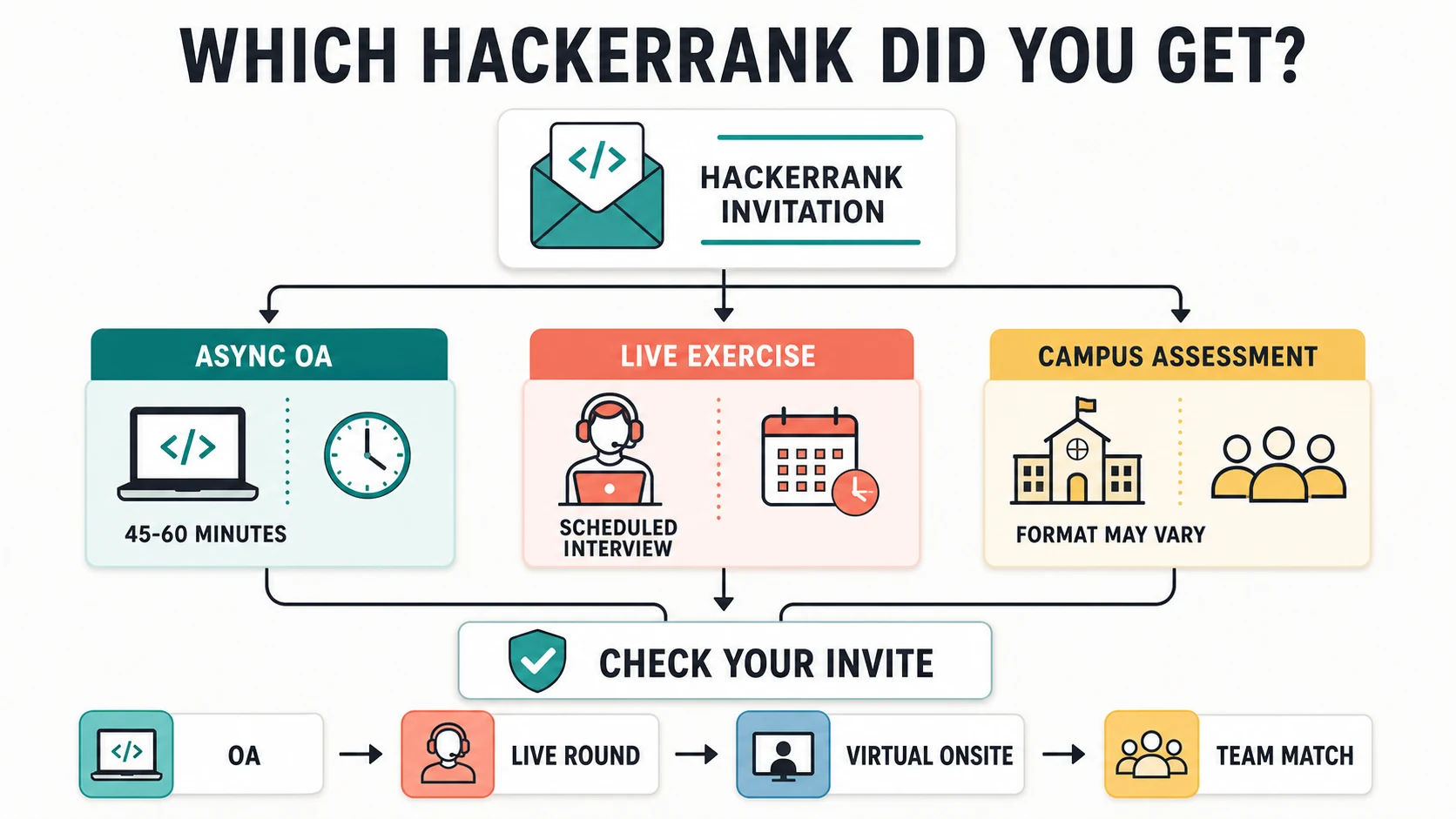
Fresh Winter 2027 reports suggest a common US intern path of OA, first-round coding interview, virtual onsite, team-manager or team-match conversation, then decision. The exact order and number of rounds can change by team, and Rippling has not published this as a universal 2027 process.
| Possible stage | Candidate-reported focus | Prepare before the email arrives |
|---|---|---|
| Initial HackerRank OA | Timed algorithmic coding with hidden tests | Broad DSA, pacing, complexity, and edge cases |
| First-round HackerRank interview | One problem that may expand through multiple follow-ups | Code aloud, clarify requirements, and preserve extensibility |
| Virtual onsite | Additional technical and role-specific evaluation | Company questions, projects, practical design, and communication |
| Team manager or team match | Project depth, motivation, working style, and mutual fit | Two strong project stories and informed team questions |
| Decision | Feedback, team capacity, and hiring needs | Keep the recruiter updated on real competing deadlines |
Timelines are uneven. In current public discussions, some candidates reported team-match movement within hours or a few days after the virtual onsite, while others waited for weeks. A fresh backend intern thread also raised changing team headcount, which means silence is not a reliable score report.
A Five-Session Rippling OA Prep Plan
Session 1: take a two-question diagnostic under 60 minutes. Label every lost minute as recognition, coding, debugging, or complexity. Session 2: practice graphs and strings, including one traversal problem and one shortest-path or DSU problem.
Session 3: solve one dynamic-programming problem and one stateful implementation problem. Write your own hidden tests before submitting. Session 4: complete a live-style exercise in which a partner adds two follow-ups after your first solution.
Session 5: run the format shown in your invitation. Finish with a 15-minute project walkthrough and two concise behavioral and leadership stories so you are ready if the next email is a live interview rather than another test.
Rippling HackerRank OA 2027 FAQ
Is the Rippling OA always two questions in 60 minutes?
No. Two questions in 60 minutes appears in multiple older and broader Rippling reports, but current 2027 discussions include other formats. One campus assessment was reported as a single 45-minute problem, while a US intern candidate described a 60-minute live exercise. Check your invitation.
How hard is the Rippling HackerRank?
Candidate reports generally place the coding around medium to medium-hard. The difficulty often comes from time pressure, hidden edge cases, and follow-ups rather than obscure syntax. Graphs, strings, dynamic programming, and stateful implementation are all reasonable preparation areas.
Does everyone who applies receive the OA?
There is no official statement that every applicant receives one. Current discussions include both quick rejections and HackerRank invitations, so candidates should not assume the assessment is automatic or that receiving it means the resume review is complete.
How long does Rippling take after the OA?
Rippling does not publish an OA response deadline. Current candidates report everything from fast movement to weeks of waiting, especially later in the cycle when team capacity may change. Follow up politely after the recruiter's stated window, not after an arbitrary forum average.
Will the next round also use HackerRank?
It can. Fresh Winter 2027 candidates describe scheduled live coding exercises in HackerRank after the initial screening stage. Confirm whether your invitation says test, exercise, interview, or CodePair, because the communication expectations differ even when the editor looks similar.
Prepare for the Stage You Actually Have
The best Rippling OA strategy is not to predict one exact question. It is to verify your format, build broad medium-to-hard coding fluency, defend your solution against hidden tests, and be ready to explain the same code if the next stage is live.
Practice Rippling coding questions on PracHub, run one honest timed diagnostic, and let the result decide what you study next. That is more reliable than copying a preparation plan built for somebody else's region or interview stage.
Research note: This guide was checked on August 13, 2026 against Rippling's current Winter 2027 backend internship posting, HackerRank candidate documentation, PracHub's current Rippling question bank, and fresh Winter 2027 candidate discussions. Candidate-reported formats can change; your invitation is authoritative.
Related Articles
Optiver SWE OA 2027: The Long OOD Problem, Constraints, and How to Prepare
Optiver SWE OA 2027 guide to the long OOD problem, likely constraints, hidden-test risks, and a practical 90-minute preparation strategy.
Capital One Technology Internship OA 2027: CodeSignal, Role Fit, Score Reuse, and Missing Links
Capital One TIP OA 2027 guide to CodeSignal, role fit, score reuse, proctoring, and what to do when your assessment link is missing.
Bank of America Global Technology OA 2027: Coding, Situational Judgment, and HireVue
Bank of America Global Technology OA 2027 guide to coding, situational judgment, HireVue, timelines, retakes, and focused preparation.
Millennium Management Engineering and AI OA 2027: HackerRank, Python, Data Science, and Timing
Millennium Management Engineering and AI OA 2027 guide to HackerRank, Python repository tasks, Criteria, AI tools, timing, and preparation.
Comments (0)