xAI Interview Guide 2026: Hiring Process & What to Expect
Quick Overview
This guide covers xAI's 2026 hiring process, interview loop structure, the Exceptional-Work essay, timeline variability, and the emphasis on owned engineering work and systems judgment over memorized algorithm patterns.
xAI Interview Guide 2026: Hiring Process, the Exceptional-Work Essay, and What to Expect
xAI is a frontier AI lab competing with a handful of others for a small pool of engineers who can build large-scale ML systems. Its hiring process shows it. The loop weights deep, owned engineering work and systems judgment more than a typical big-company process weights memorized algorithm patterns. The general shape candidates report: an application, a recruiter screen, one or more technical screens, an onsite or virtual loop of several rounds, and a decision. Sometimes team-matching happens before or after the loop. Reported timelines are all over the map. Some candidates describe a few weeks, others several months, with recruiter gaps and team-matching limbo stretching things out. Treat any single number as anecdote, not policy.
This guide walks each stage with concrete prep and worked examples. Where a claim comes from candidate reports rather than an official rubric, I flag it. Frontier labs publish almost nothing about their loops, so most of what circulates is reconstructed from interviews, not documented.
How xAI hires in 2026
The teams are small and the work is unusually self-directed. In interview terms, that turns into specific things you'll be asked to demonstrate: that you can scope an ambiguous problem yourself, pick an approach and defend the alternatives you rejected, and ship something that runs without a spec handed to you. "High ownership" isn't a vibe to absorb. It's the behavior the behavioral and practical rounds are built to surface.
Roles span research engineering, ML engineering, infrastructure and distributed-training engineering, full-stack and product engineering, and a notably large hardware, datacenter, and cluster-operations footprint. xAI runs its own large GPU clusters, so site-reliability, networking, and low-level systems roles are a real and growing track, not an afterthought. The loop differs by track and by level, which the sections below break out.
What carries the most weight across tracks, by candidate report:
- Depth on something you personally built. A genuinely hard problem you owned end to end, with a measurable outcome you can defend under follow-up questions.
- Systems and ML judgment. Reasoning about scale, trade-offs, and failure modes rather than reciting framework names.

The application and the exceptional-work essay
xAI's application has historically included a free-text prompt asking you to describe the most exceptional thing you've built or worked on. That free-text essay, not a branded, named deliverable, just an open question on the form, is the part candidates consistently single out as different from a standard application. There's no official "form" for it. You get a text box and a prompt about your best work, and reviewers read the answer closely.
Treat it as the written version of the story you'll tell out loud in the behavioral round. Both are the same underlying material: a hard problem, your specific contribution, the decision, the result. The emphasis differs by medium. The written essay rewards tight, scannable structure and a single sharp claim a reviewer can evaluate in thirty seconds. The spoken version rewards going deeper under cross-examination, because the interviewer will push on any number you state. Write the essay to earn the conversation. Prepare the conversation to survive the follow-ups.
What reviewers appear to evaluate:
- Genuine technical depth. Was the problem actually hard, or just large and time-consuming?
- Your contribution versus the team's. "We shipped X" is weak. "I designed the prefetch scheme that removed the data-loader stall" is strong.
- Measurable impact. Before and after, with scale attached.
- Decision-making. Why this approach over the alternatives you rejected.
Structure for the written essay, kept to a few hundred words:
- Context (1–2 sentences): the system, the scale, the constraint that made it hard.
- The problem you owned: the specific technical obstacle, stated concretely.
- What you did: the approach, the key decision, the alternative you rejected and why.
- Result: the measurable outcome and what it unlocked.
A worked example of the core of one (the numbers here are illustrative - use your own real figures):
Our training pipeline plateaued well below the GPU utilization we expected on a large multi-node run. I profiled it, traced the stall to a synchronous data loader that blocked compute on every step, and rewrote the sharded prefetch to overlap I/O with the forward pass. Utilization rose substantially and per-epoch wall time dropped. I owned the profiling, the redesign, and the rollout across the cluster.
One warning that matters more here than at most companies: don't invent or inflate the numbers. A frontier-lab loop cross-examines the deep-dive. Claim a utilization jump and expect "how did you measure utilization, and what was the second bottleneck after you fixed the first?" A fabricated metric that collapses under one follow-up is a fast no-hire. Pick a real result you can defend three questions deep, even if it's less impressive than something you could make up.
Stage 1: recruiter screen
A 30-minute conversation that filters for motivation, level, and logistics before engineering time gets spent. Expect:
- Why xAI, specifically. The trap is reciting the company's stated mission back at the recruiter. Recruiters hear the tagline all day. Instead, name a concrete technical problem in large-model training, inference, or alignment that you actually find interesting, and connect it to what you want to work on. Specificity reads as genuine; slogans read as prepared.
- A high-level walk through your strongest work. The two-minute spoken version of your exceptional-work essay.
- Level and compensation. Frontier labs are widely reported to pay aggressively, with a large fraction of total comp in equity, and offers are often negotiable. Come in with a researched range and a target number rather than deferring. Because so much is equity, ask how it's structured and valued; a headline number means little without the equity terms.
- Logistics. xAI roles concentrate in the SF Bay Area (Palo Alto) with strong in-person expectations, plus other US sites including Memphis for cluster and infrastructure work. Confirm location fit early.
Stage 2: technical screen and coding
The coding screen favors practical problem-solving over puzzle-style trivia. You reason through a problem aloud, usually data structures and algorithms at a working-engineer level, often in a shared editor where the code is expected to run.
On AI-assisted coding: candidates and recruiters report that fluency with AI tools is viewed favorably at AI labs, which is plausible given what these companies build. But treat the interviewer's expectation as unknown until they signal it, rather than reaching for an assistant unprompted. The defensible posture is the same either way: be ready to explain how you use AI tools and, more importantly, how you verify their output.
What separates a strong showing isn't the data structure you pick but the reasoning and verification you narrate around it. Consider a frequency-ranking task:
from collections import Counter
import heapq
def top_k_frequent(items, k):
counts = Counter(items)
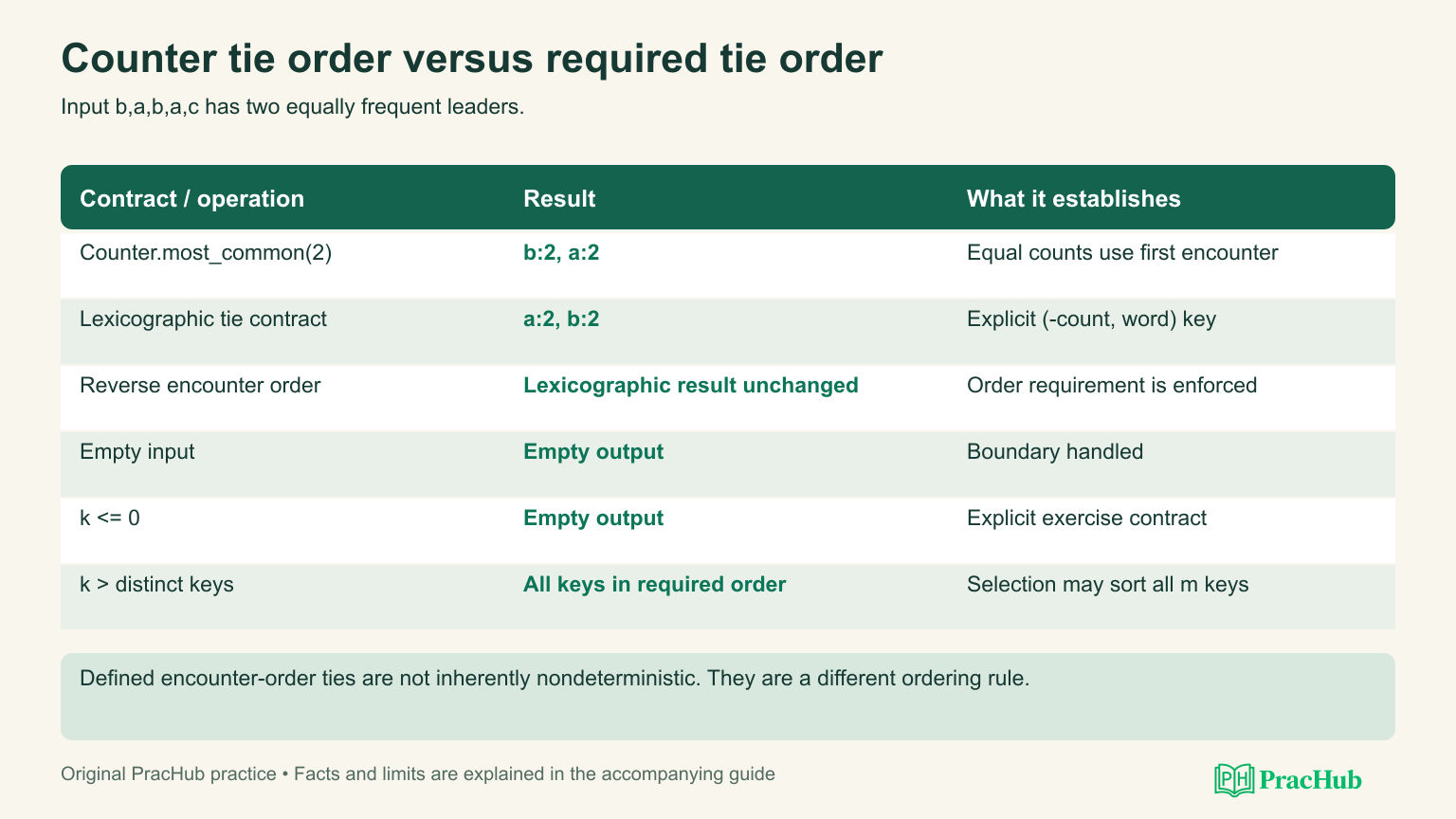
# most_common(k) uses a heap internally: O(n log k), not the
# O(n log n) of sorting every distinct item. Matters when the
# number of distinct items is large but k is small.
# Ties are NOT broken deterministically here, so if the spec
# wants lexicographic tie-breaks, do it explicitly:
return heapq.nsmallest(k, counts, key=lambda w: (-counts[w], w))
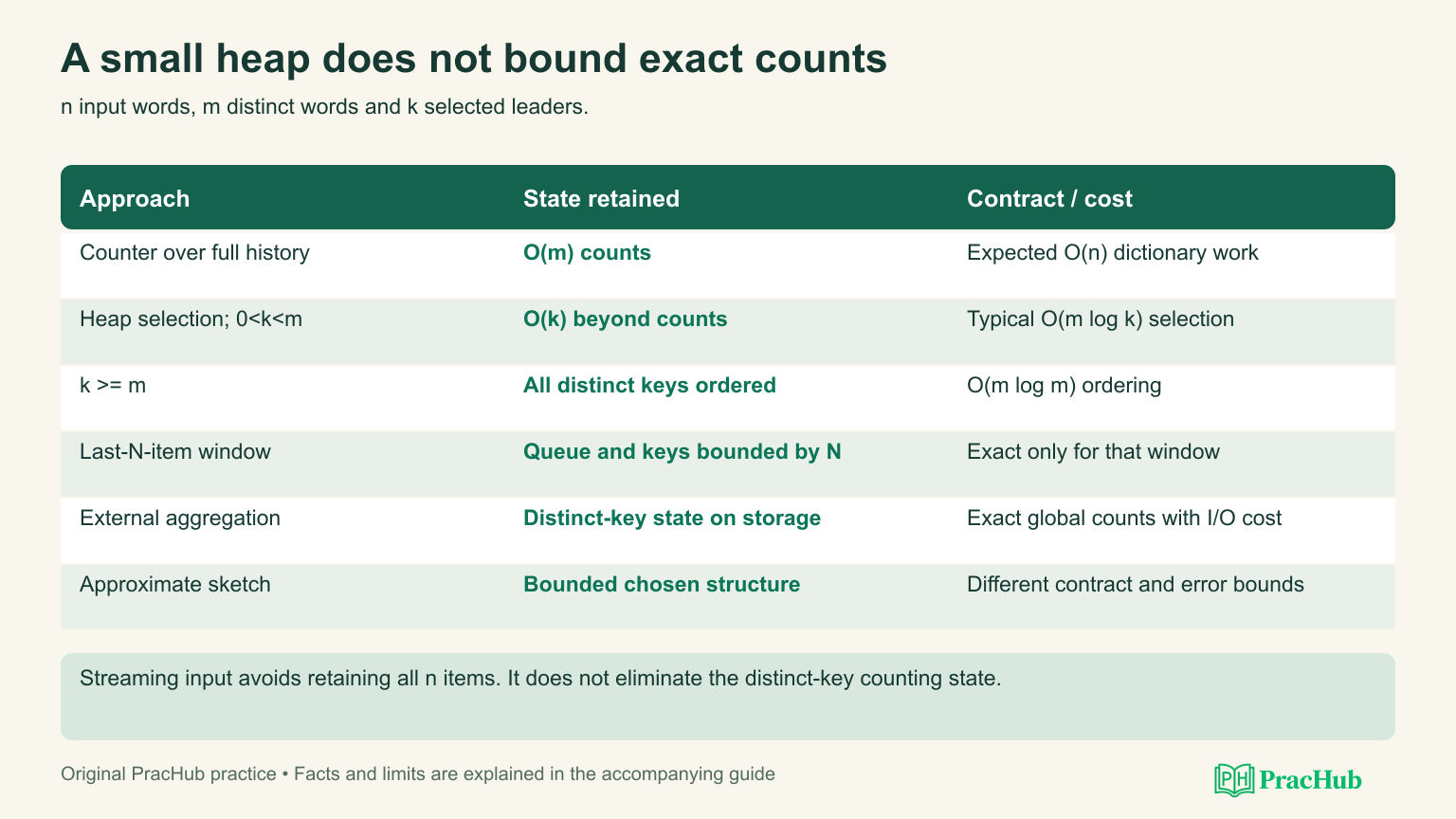
The signal is in the dialogue, not the snippet: noticing that Counter.most_common(k) is O(n log k) and beats a full sort when k is small; asking whether ties need a deterministic order before writing the comparator; and saying which approach you'd pick if the input were a genuine stream that doesn't fit in memory (a running Counter plus a bounded heap, flushing as you go) versus a materialized list. If you reach for an AI assistant, narrate the same checks you'd apply to your own code: run it, write a failing test first, probe edge cases - empty input, all-ties, unicode - and read the output instead of trusting it. Pasting code you can't explain, or claiming you'd never touch a tool the company builds, both read as poor judgment.
Stage 3: the onsite or virtual loop
The loop is commonly several rounds in a day; the exact count and composition vary by team and level. A representative structure reported by candidates:
| Round | Focus | Typically led by |
|---|---|---|
| Coding deep-dive | Harder DS&A, code that runs, optimization | IC engineer |
| Systems / ML design | End-to-end design for a real workload | Tech lead |
| Domain round | Matched to team: RL, infra, distributed training, datacenter | Senior IC |
| Behavioral / ownership | Owned work, motivation, collaboration | Hiring manager |
| Leadership round (often senior roles) | Vision, judgment, mission fit | Senior leader |
Some teams run a practical build round - a small but real task in a live environment instead of a contrived puzzle. Whether xAI uses an offline take-home, how long it runs, and whether it's paid aren't reliably documented and vary by team; ask the recruiter directly rather than assuming. For any practical round, treat it as a work sample: scope it, get something running early, then improve, narrating trade-offs as you go. Interviewers score judgment and process, not just the final artifact.
New-grad versus senior matters here. New-grad and junior loops lean harder on the coding rounds and fundamentals, with a lighter behavioral bar and usually no leadership round. Senior and staff loops invert that: the design and ownership rounds carry the offer, and a founder or senior-leader conversation on vision and judgment is common. Calibrate where you spend prep accordingly.
ML and systems design
For ML and research-engineering roles, the design round is where offers are won or lost. A canonical prompt: "Design a training and inference system for a large language model at scale." A strong answer moves in this order:
- Clarify first. Model size, token budget, cluster size, inference latency target, and whether the task is pretraining, fine-tuning, or RL-based post-training.
- Parallelism strategy. Data, tensor, pipeline, and sequence parallelism - and which combination fits the given model and cluster, justified with memory arithmetic (below).
- Distributed-training mechanics. Sharded optimizer state, activation checkpointing to trade compute for memory, gradient accumulation, mixed precision.
- Cluster efficiency at xAI's scale. xAI's known emphasis is enormous single-cluster training on the order of 100k+ GPUs, which makes interconnect topology, overlapping communication with compute, and fault tolerance the dominant concerns. At that node count, hardware failures during a run are routine, so frequent checkpointing and fast restart aren't optional - a design that ignores them fails the round.
- Data pipeline. Streaming, sharded, deduplicated input that keeps GPUs fed; the data loader is a frequent real bottleneck.
- Inference serving. KV-cache management, continuous batching, quantization, and the latency-versus-throughput trade-off.
Do the memory arithmetic out loud. It's the difference between a generic answer and a credible one:
Per-parameter memory for training in mixed precision (rough):
fp16 weights : 2 bytes/param
fp16 gradients : 2 bytes/param
Adam optimizer : fp32 master copy + 2 moments = ~12 bytes/param
-> ~16 bytes/param before activations
A 70B-param model: 70e9 * 16 ≈ 1,120 GB just for states.
That cannot fit on one 80 GB GPU, so you MUST shard.
ZeRO-3 splits weights+grads+optimizer across N GPUs -> ~1/N each:
1,120 GB / 64 GPUs ≈ 17.5 GB/GPU for states, leaving room for activations.
Decision rule: keep tensor-parallel groups inside a node (fast NVLink),
put pipeline-parallel stages across nodes (slower interconnect).
For RL-flavored roles - relevant given how central RL-based post-training is to current chat models - expect reward modeling, on- versus off-policy trade-offs, training stability, and how you'd debug a policy that collapses mid-training. Tie every design choice to something you've actually measured.

Behavioral and ownership
The behavioral round centers on ownership, and it wants the same material as your exceptional-work essay, made interactive: a hard problem, your specific role, the decision, the result. What's actually being scored:
- Action under ambiguity - you moved without waiting for a spec.
- Intrinsic motivation - you'd have done the work regardless.
- Operating with minimal process - you function without a scaffold of tickets and approvals.
- Isolating your contribution - you can separate what you did from what the team did.
A lean STAR works well: compress Situation and Task, expand the Action's decision and the measured Result (again, real numbers only):
S/T (one line): Training jobs died on preemption, losing hours of GPU time each.
A (the decision): I rejected naive full-checkpointing as too slow and built
async sharded checkpointing that wrote in the background every N steps.
R (measured): Restart time fell from a full job restart to under two minutes,
and we stopped losing runs to preemption. I owned design, code, and rollout.
The frequent failures: team-narrated stories with no isolated personal contribution, effort described as if it were achievement, and stories with no number attached. Have two or three of these ready so you're not reaching for the same example every round.
AI safety and ethics
Frontier labs ask about safety and responsible deployment, and xAI is no exception. The trap is the same one as the "why xAI" question: candidates recite the company's stated principles back to the interviewer, which reads as shallow. What's scored is layered reasoning on a concrete case, not a slogan. Here's what a layered answer sounds like, given a realistic prompt - "your model sometimes invents citations; ship it or hold it?":
First, scope the harm by context. A confident fake citation in a casual brainstorming tool is low-stakes; the same failure in a tool people use for medical or legal questions is not, because users act on it and the fabrication is hard to detect. So my answer depends on the deployment surface, and I wouldn't give one blanket yes or no.
For a higher-stakes surface I wouldn't block the launch outright, but I'd gate it: measure the fabrication rate on a representative eval set first, add retrieval so claims are grounded in real sources, surface uncertainty in the UI instead of presenting every answer as confident, and log a sample for review so we see the real-world rate, not just the offline one. Then I'd set a threshold the rate has to clear before widening access.
The general principle I'm applying: match the mitigation to who's affected and how reversible the harm is, ship behind measurement rather than guessing, and prefer making the model's uncertainty visible over silently suppressing outputs.
That's the move to practice - name the affected parties, reason about reversibility, propose concrete mitigations, and state the principle underneath - rather than asserting any company's tagline as the answer.
How xAI compares to other frontier labs
If you're interviewing across labs, the practical overlap is large: real-world coding, systems and ML design, and concrete safety reasoning transfer to all of them. The table below reflects patterns in candidate reports, not official rubrics, and the differences are matters of emphasis, not kind.
| Dimension | xAI | Other frontier labs (general pattern) |
|---|---|---|
| Application | Free-text "most exceptional work" essay is the part candidates flag as distinctive | Most also include substantive written or project prompts; few are a bare resume submission |
| Coding style | Practical, runnable; AI-tool fluency reportedly viewed favorably | Practical and reasoning-heavy across the board |
| Design emphasis | Large-scale distributed training and cluster efficiency feature heavily | Varies; all test ML/systems design at depth |
| Safety framing | Asked, framed around the company's own stated mission | Asked everywhere; framing differs by lab |
| Logistics | Bay Area plus other US sites, strong in-person expectation | Bay Area-centric, in-person leaning |
The honest summary: don't over-index on lab-specific trivia. The biggest transferable investments are a defensible deep-dive on owned work, fluency in large-scale ML systems design, and the ability to reason about safety concretely. The one xAI-specific thing worth dedicated effort is writing the exceptional-work essay well, because it doubles as the spine of your behavioral answers.
Getting the interview, and what happens after
Getting in. Cold applications work but are noisy; a referral from someone inside moves you up the queue far more reliably. xAI's culture is unusually public-facing, and visible technical work - open-source contributions, a substantive write-up of something hard you built, demonstrated work on relevant problems - functions as a real backchannel that recruiters and engineers do notice. Make the work findable.
After the loop. Frontier labs frequently match candidates to a specific team during or after the loop rather than hiring into a fixed role, so expect a team-matching step and conversations with potential managers. Treat those as two-way evaluations of what you'd actually work on. On the offer, because compensation is equity-heavy and reportedly negotiable, the decision turns on understanding the equity - vesting, the valuation it's struck at, refresh policy - not just the headline figure. Ask for the detail in writing and compare offers on the equity terms, not the top-line number.
A preparation plan
The essay is part of the application, so it has to be done before you apply. By the time a recruiter reaches out, weeks of "draft your essay" are already moot. Order your prep around the process, not a fixed calendar:
Before you apply: Write the exceptional-work essay. Cut it to a few hundred words, isolate your contribution, attach one real number you can defend three questions deep, and line up two backup stories. This same material becomes your behavioral spine.
Between applying and the screens: Drill practical DS&A you can solve aloud and run. Practice verifying AI-tool output - write the failing test first, probe edge cases - and be ready to explain your workflow either way.
Before the onsite: Drill the LLM training and inference design end to end with the memory arithmetic, parallelism choices, and fault-tolerance story. For RL roles, add reward modeling and policy-stability debugging. Rehearse the lean-STAR stories out loud, and practice one layered safety answer on a concrete scenario. If the role is senior, over-weight design and ownership; if new-grad, over-weight the coding rounds.
Rehearse on real, recently-asked questions rather than invented ones. Practicing against the actual problems companies ask is what makes the difference, and a question bank with worked written solutions, like PracHub, is more useful for this than grinding random puzzles.
Pre-interview checklist:
- Exceptional-work essay submitted, and memorized as a two-minute spoken story
- Two or three backup behavioral stories, each with an isolated contribution and a real, defensible number
- One LLM training/inference design you can draw end to end, with the memory math
- A clear account of how you use and verify AI coding tools
- A layered safety answer worked through on a concrete scenario
- Researched compensation range, equity questions ready, location confirmed
Frequently asked questions
Does xAI ask for a written statement about your best work? The application has historically included a free-text prompt asking you to describe the most exceptional thing you've built. It's an open essay question on the form, not a separately named deliverable. Write a few hundred words structured as context, the problem you owned, what you did, and the measurable result - and isolate your contribution from the team's.
How hard is the interview, and does it use LeetCode-style puzzles? It's demanding, but the difficulty is in depth rather than puzzle trivia. The coding round favors practical problems you reason through and run. The design and behavioral rounds carry real weight, and at senior levels they often decide the offer.
How long does the process take? Reported timelines vary widely - some candidates describe a few weeks, others several months, with recruiter gaps and team-matching adding delay. Treat any specific number as anecdote.
Does xAI use take-home assignments? Some teams run a practical build round, sometimes live and sometimes offline, but whether there's a take-home, its length, and whether it's paid aren't reliably documented and vary by team. Ask your recruiter.
Is using AI coding tools allowed in the interview? Fluency with AI tools is reportedly viewed favorably at AI labs, but the specific interviewer's expectation isn't guaranteed. The safe approach is to be ready to explain how you use such tools and how you verify their output, and to follow the interviewer's lead rather than assuming.
How is the loop different for new grads versus senior candidates? New-grad loops weight coding and fundamentals more and usually skip the leadership round. Senior and staff loops are decided by the design and ownership rounds and typically add a conversation with a senior leader on vision and judgment.
How to Use This Page as a Prep Plan
Do not treat this as passive reading. Convert the ideas in this page into a short weekly loop: learn one idea, practice it under interview conditions, then write down what changed. That is the fastest way to turn advice into visible interview behavior.
| Prep area | What you need to prove | Practice artifact |
|---|---|---|
| Understand | Turn the prompt into a concrete goal. | Clarifying questions and success criteria. |
| Practice | Use realistic constraints and timed reps. | Worked examples with edge cases. |
| Explain | Make reasoning visible. | Tradeoffs, assumptions, and test strategy. |
| Improve | Review misses quickly. | A short feedback log and next action. |
For xAI Interview Guide 2026: Hiring Process & What to Expect, the strongest candidates usually do three things well: they make their assumptions explicit, they use concrete examples instead of vague claims, and they review mistakes quickly enough that the next practice rep is better than the last one.
FAQ
How should I use this guide?
Read it once for the structure, then turn each section into a practice task with a visible artifact.
What should I do if I am short on time?
Prioritize the skills most likely to be tested, then do one mock or timed drill to expose the largest gap.
How do I know I am ready?
You can explain your approach clearly, recover from hints, and name tradeoffs without relying on memorized wording.
Related Articles
From Non-CS Major to Software Engineer: A Practical Guide to Cracking the Technical Interview
Prepare for technical interviews with a practical guide to DSA practice, live coding, mock interviews, communication, and interview mindset.
From Non-CS Major to Software Engineer: A Practical Guide to Cracking the Technical Interview
Prepare for technical interviews with a practical guide to DSA practice, live coding, mock interviews, communication, and interview mindset.
Design WhatsApp: the presence and receipt problems most candidates ignore
Design WhatsApp-style chat with WebSockets, offline inboxes, Kafka partitions, presence TTLs, receipts, and reliable delivery.
I Pinned Our Autoscaler for a Month to See What Would Break. Nothing Did.
Learn when Kubernetes autoscaling helps, when CPU-based HPA wastes money, and how capacity planning can cut cloud costs safely.
Comments (0)