Coinbase Regulated Crypto Risk And Compliance Leadership
Asked of: Software Engineer
Last updated
What's being tested
A Software Engineer should be able to design compliance-critical services that are correct, auditable, resilient under failure, and safe to change. Coinbase cares because transaction holds, sanctions decisions, identity checks, and regulatory reporting directly affect customer funds and legal obligations; an unavailable or non-reproducible decision can become both a customer incident and a compliance incident. The interviewer is probing whether you can translate policy requirements into explicit system invariants, durable data models, reliable workflows, and operational controls without pretending that engineering alone determines legal policy. No concrete interview question was supplied, so the examples below use representative prompts from this domain.
Core knowledge
-
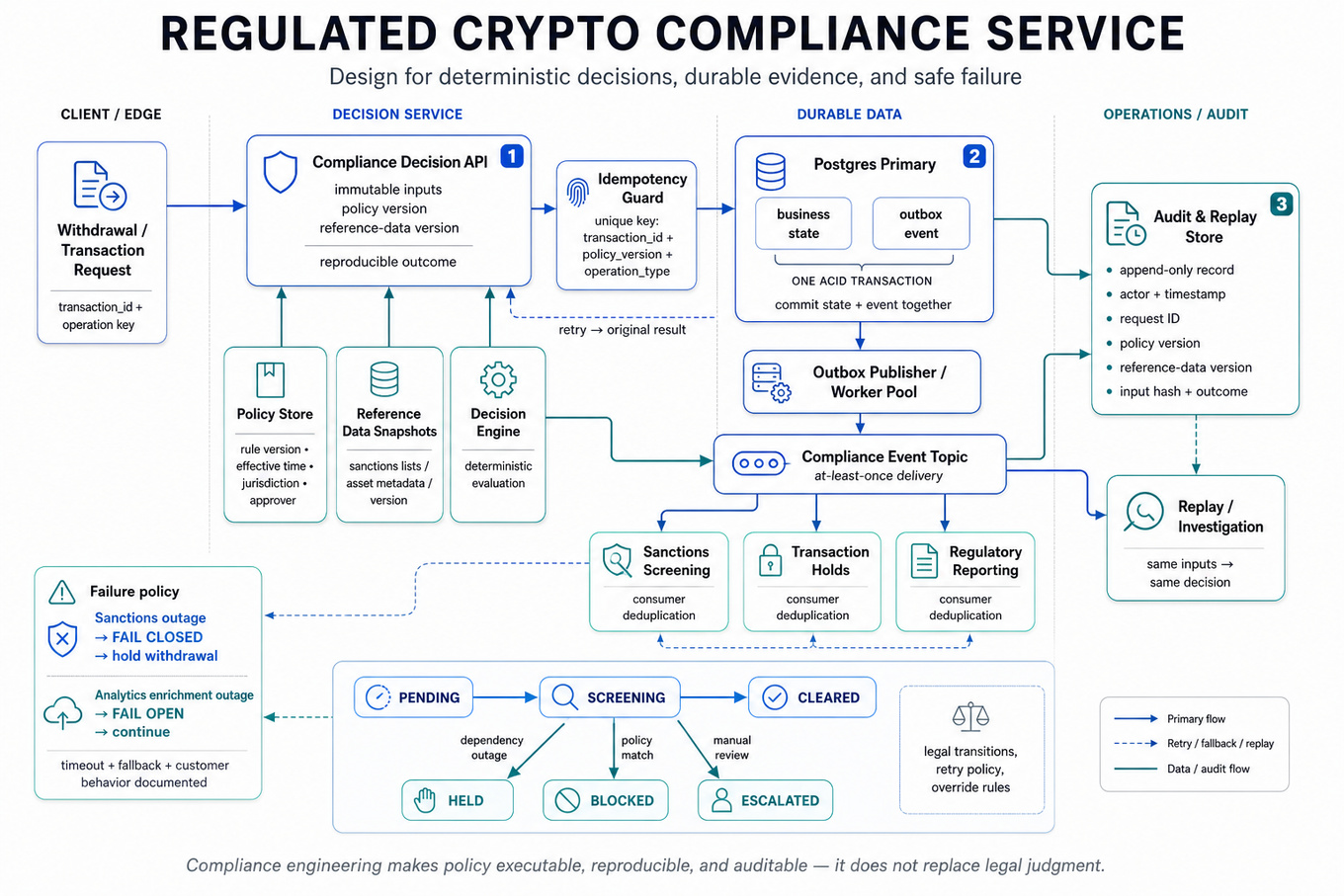
Policy-as-data separates changing rules from deployment code: store rule versions, effective timestamps, jurisdictions, asset scope, and approver metadata. A decision must record the exact policy version used, not merely the current configuration.
-
Decision determinism is essential for audit and replay. Given immutable inputs, policy version, and reference-data versions, the same request should produce the same outcome; nondeterministic ordering, mutable lookups, and wall-clock dependence must be controlled.
-
Idempotency prevents duplicate screening, holds, or reports when clients retry. Use a stable operation key such as
(transaction_id, policy_version, operation_type), enforce uniqueness in durable storage, and return the original result for repeated requests. -
Transactional outbox reliably publishes compliance events after a database commit. Write the business state and outbox record in one
Postgrestransaction, then publish asynchronously; consumers use deduplication because delivery is at-least-once. -
State machines make lifecycle behavior explicit:
PENDING → SCREENING → CLEARED, with terminal or review states such asBLOCKED,HELD, andESCALATED. Define legal transitions, retryable failures, operator overrides, and whether a transition is reversible. -
Fail-closed versus fail-open must be chosen per operation. A sanctions-screening dependency outage may safely hold a withdrawal, while a noncritical analytics enrichment may proceed; document the choice, timeout, fallback, and customer-visible behavior.
-
Audit trails need append-only records containing actor, timestamp, request identity, old and new values, reason, correlation ID, and policy/reference-data versions. “The row currently says blocked” is weaker than a history proving who changed it and why.
-
Reference-data versioning applies to watchlists, jurisdiction mappings, and risk policies. Pin each decision to a snapshot or version, retain enough data for replay, and define propagation latency so one service does not screen against stale data unknowingly.
-
Exactly-once effects are rarely provided end to end. Design for at-least-once messages, idempotent consumers, deduplication keys, reconciliation jobs, and a dead-letter workflow; do not confuse
Kafkaoffset commits with successful business processing. -
Privacy and access control are engineering requirements, not afterthoughts. Minimize sensitive fields, encrypt in transit and at rest, restrict case access by role and jurisdiction, redact logs, and define retention/deletion behavior that respects legal holds.
-
Reliability targets should distinguish synchronous decision latency from asynchronous case completion. Track
p50,p95, andp99latency, dependency error rate, backlog age, replay success, and reconciliation discrepancies rather than relying only on uptime. -
Operational controls include circuit breakers, bounded retries with jitter, bulkheads, backpressure, and manual-review queues. A queue that grows without an age-based alert can silently create regulatory exposure even while every service reports healthy.
Worked example
Because no concrete title was provided, consider the representative prompt: “Design a transaction compliance screening service for crypto withdrawals.” In the first 30 seconds, clarify supported assets and jurisdictions, required decision latency, whether the result must block settlement, expected peak throughput, screening-provider guarantees, and the retention and replay requirements. State the assumptions explicitly: withdrawals cannot settle before a required successful decision, providers may be unavailable, and duplicate requests must not create duplicate holds or cases. Organize the answer around four pillars: the withdrawal state machine, durable decision and audit storage, provider integration with retries and idempotency, and observability plus manual-review operations. A strong design would persist a screening attempt and outbox event transactionally, invoke the provider with a stable idempotency key, record the provider response and reference-data version, then advance the withdrawal only through validated transitions. The key tradeoff is fail-closed behavior: holding withdrawals during provider failure protects compliance guarantees but increases customer impact and queue pressure. Explain how operators can inspect evidence without editing history, while a controlled override creates a new auditable transition rather than mutating the original decision. Close by saying that with more time you would add a replay tool, reconciliation against the settlement ledger, capacity testing for incident spikes, and a disaster-recovery exercise.
A second angle
A different representative prompt is “Design an auditable compliance case-management workflow for suspicious activity escalations.” The core concepts transfer, but the dominant constraint changes from low-latency transaction gating to durable human workflow, authorization, and evidence integrity. Model assignment, investigation, escalation, filing, and closure as explicit states with optimistic concurrency so two investigators cannot silently overwrite one another. The system should preserve immutable evidence snapshots while allowing append-only investigator notes and supervisor approvals. The main tradeoff is flexibility versus control: free-form workflows help investigators, but tightly defined transitions and separation of duties provide stronger auditability.
Common pitfalls
Pitfall: Treating compliance as a single synchronous boolean such as
is_allowed = trueloses policy versions, evidence, provider failures, manual review, and the distinction between “blocked,” “pending,” and “unable to decide.” Model the decision lifecycle and its provenance instead.
Pitfall: Saying “use retries and exactly-once delivery” is not a complete distributed-systems design. Retries can duplicate external effects, and message systems commonly provide at-least-once delivery; explain idempotency keys, durable state, deduplication, and reconciliation.
Pitfall: Overstepping into legal or product ownership by inventing what transactions must legally be blocked. A better answer says engineering enforces an approved policy contract, makes policy changes versioned and reviewable, and escalates ambiguous requirements to compliance stakeholders.
Connections
An interviewer may pivot to distributed sagas, event sourcing, RBAC/ABAC authorization, disaster recovery, or reconciliation between a compliance ledger and a settlement ledger. Be prepared to discuss consistency boundaries, recovery-point objectives, and how to prove that operational actions match the recorded audit history.
Further reading
-
NIST SP 800-61 Rev. 2: Computer Security Incident Handling Guide — useful for incident response, escalation, evidence preservation, and post-incident controls.
-
Designing Data-Intensive Applications by Martin Kleppmann — strong treatment of idempotency, logs, consistency, transactions, and stream-processing tradeoffs.
-
The Twelve-Factor App: Admin Processes and Logs — concise operational guidance relevant to auditable jobs, repeatable tasks, and structured service logging.
Related concepts
- Technical Leadership, Communication, And Mission FitBehavioral & Leadership
- Behavioral Ownership, Tradeoffs, And CommunicationBehavioral & Leadership
- Crypto Trading Order LifecycleSystem Design
- Capital One Model Risk Governance And SR 11-7
- Trust, Safety, Fraud, And Content Moderation Measurement
- Privacy, Governance, And Leakage For Community Data