Crypto Trading Order Lifecycle
Asked of: Software Engineer
Last updated
What's being tested
These designs test whether you can model an order as a distributed state machine, preserve correctness across retries and partial failures, and expose an API whose behavior remains understandable under asynchronous execution. The interviewer is probing your command of idempotency, consistency boundaries, external exchange integration, reconciliation, rate limiting, and operational observability. Coinbase cares because an incorrect balance, duplicate order, or silently lost fill directly affects customer funds and requires strong reliability engineering from Software Engineers.
Core knowledge
-
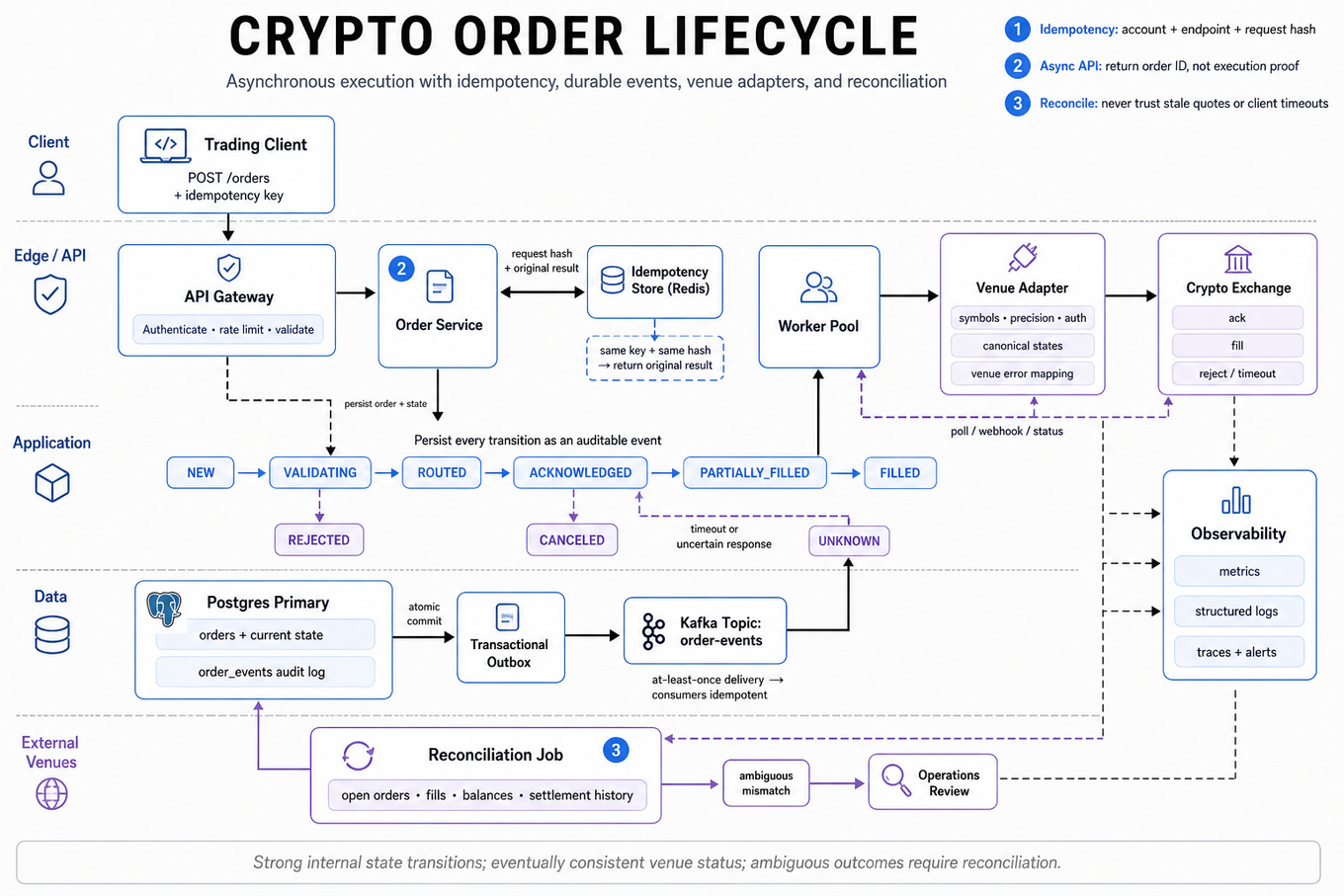
Order lifecycle modeling should use explicit states such as
NEW,VALIDATING,ROUTED,ACKNOWLEDGED,PARTIALLY_FILLED,FILLED,CANCELED,REJECTED, andUNKNOWN; define legal transitions and persist every transition as an auditable event. -
Idempotency prevents client retries or worker retries from creating duplicate orders. Accept an idempotency key scoped to the account and endpoint, store the request hash plus terminal or in-progress result, and return the original result for repeated identical requests.
-
The order API should usually be asynchronous: validate synchronously, persist an order, enqueue work, and return an order ID. A synchronous response from an exchange is not proof of execution; distinguish accepted, rejected, timed out, and unknown outcomes.
-
Use a transactional outbox to atomically commit the order and an outbound event in
Postgres, then publish throughKafkaor a queue. Consumers must still be idempotent because at-least-once delivery can repeat messages. -
Consistency boundaries matter: the internal order ledger should be strongly consistent for accepted state transitions, while market data and exchange status may be eventually consistent. Never claim
FILLEDfrom a stale quote or an unverified client timeout. -
Treat each third-party venue as an adapter translating capabilities, symbols, precision, authentication, error codes, and lifecycle events into a canonical model. A venue may support limit orders but not post-only, fractional quantities, amend-in-place, or durable client order IDs.
-
Reconciliation resolves divergence between internal state and venue state. Periodically query open orders, fills, balances, and settlement history; compare by stable venue IDs, repair safe mismatches, and send ambiguous cases to an operational review path rather than guessing.
-
Routing can optimize price, fees, liquidity, latency, and venue reliability, but begin with deterministic rules before introducing complex optimization. Avoid splitting an order unless you can correctly aggregate partial fills, fees, rounding, cancellation, and customer-visible status.
-
Rate limiting and backpressure must exist per customer, API credential, asset pair, venue, and global worker pool. Use token buckets or leaky buckets, bounded queues, exponential backoff with jitter, and circuit breakers; never retry permanent validation or authentication failures.
-
Exactly-once execution is generally unavailable across an internal service and an external exchange. Design for at-least-once delivery plus idempotent submission, durable client-generated IDs, timeout reconciliation, and a
UNKNOWNstate that blocks unsafe duplicate placement. -
Money correctness requires integer smallest units or fixed-point decimals, never binary floating point. Validate minimum quantity, tick size, price bands, quote-currency precision, available balance, and fee reservation before routing; test zero, maximum, and rounding-boundary values.
-
Observability and recovery should include correlation IDs, order-to-venue IDs, transition latency, acknowledgment latency, fill latency, rejection rate, unknown-order count, reconciliation drift, queue age, and
p99API latency. Alerts should distinguish customer impact from a single venue outage.
Worked example: Design a crypto trading platform
For Design a crypto trading platform, start by clarifying supported order types, custody model, target throughput and p99 latency, venue count, cancellation guarantees, and whether the platform owns execution or routes to exchanges. Declare an assumption such as asynchronous placement with durable order status, multiple venues, and no promise of exactly-once external execution. Organize the answer around the API and idempotency layer, the canonical order state machine and ledger, the asynchronous routing/adapter workers, and reconciliation plus observability. Explain that validation and persistence happen in one transaction, while an outbox publishes work after commit. Explicitly flag the tradeoff between strong internal consistency and eventual venue visibility: synchronous venue calls simplify the client experience but make request latency and failure handling much worse. Describe timeout handling as UNKNOWN, followed by venue lookup using the client order ID before any retry. Close by saying that, with more time, you would detail balance reservation, multi-region failover, venue-specific rate limits, and recovery drills.
A second angle: Design Crypto Order Routing
For Design Crypto Order Routing, the central challenge shifts from a general trading API to selecting and coordinating venues under latency, liquidity, fee, and reliability constraints. Begin by clarifying whether routing is best-execution-oriented, latency-sensitive, or simply failover-based, and whether orders may be split. A strong design introduces a routing decision service, venue adapters, a durable execution coordinator, and an aggregate order view that combines fills across venues. The important edge case is partial success: one venue may fill while another rejects or times out, so cancellation and customer reporting must be coordinated without pretending atomicity. Keep routing policy deterministic and auditable before discussing more sophisticated optimization.
Common pitfalls
Analytical mistake: Saying “retry on timeout” is insufficient and can duplicate an order. A timeout is an ambiguous result; use a durable client order ID, query the venue, and model UNKNOWN until reconciliation establishes the outcome.
Pitfall: Treating an exchange API as a transactional database leads to incorrect claims about exactly-once execution.
Communication mistake: Jumping directly into Kafka, databases, and microservices without clarifying order types, scale, venue behavior, and customer-visible guarantees makes the design appear unfocused. State assumptions first, then tie each component to a requirement or failure mode.
Pitfall: Listing technologies without explaining the consistency or reliability property each one provides.
Depth mistake: A simple “orders table plus worker” answer misses duplicate submission, partial fills, cancellation races, stale balances, and exchange outages. Show at least one concrete state transition, one retry path, and one reconciliation loop to demonstrate production readiness.
Pitfall: Assuming an acknowledged order is filled, or that cancellation is instantaneous and guaranteed.
Connections
The interviewer may pivot to ledger design, distributed transactions, event sourcing, rate limiting, or multi-region disaster recovery. Be ready to discuss optimistic concurrency, balance reservations, dead-letter handling, and how API contracts expose eventual consistency without confusing customers.
Further reading
-
Designing Data-Intensive Applications — Martin Kleppmann’s treatment of replication, streams, consistency, and distributed-system failure modes.
-
Stripe Idempotent Requests — a practical reference for idempotency-key semantics and safe API retries.
-
The Log: What every software engineer should know about real-time data's unifying abstraction — foundational context for durable event streams and replayable processing.
Practice questions
- Deliver Limit-Order Fill Notifications under Consumer BackpressureCoinbase · Software Engineer · Onsite · medium
- Design Crypto Order RoutingCoinbase · Software Engineer · Onsite · hard
- Implement a crypto order management systemCoinbase · Software Engineer · Onsite · hard
- Design crypto trading order control APICoinbase · Software Engineer · Technical Screen · medium
- Design a Cryptocurrency Trading System with Third-Party ExchangesCoinbase · Software Engineer · Onsite · hard
- Design real-time exchange data sync systemCoinbase · Software Engineer · Onsite · hard
- Design order stream with state transitionsCoinbase · Software Engineer · Onsite · medium
Related concepts
- Crypto Trading And Order Routing SystemsSystem Design
- Low-Latency Trading System ArchitectureSystem Design
- Order Book Data Structures And Market Data AggregationSoftware Engineering Fundamentals
- Large-Scale Marketplace System DesignSystem Design
- Limit Order Book Price-Time MatchingCoding & Algorithms
- Order Book And Matching Engine Data StructuresCoding & Algorithms