Order Book Data Structures And Market Data Aggregation
Asked of: Software Engineer
Last updated
What's being tested
These problems test whether you can model an order book with the right data structures, preserve price-time priority, and answer best-price and quantity queries efficiently. You must reason about updates—add, cancel, replace, and trade—rather than only computing a snapshot from static rows. Citadel cares because market-data and execution components require predictable `p99` latency, deterministic behavior, correct handling of stale state, and clear complexity tradeoffs under high event rates.
Core knowledge
-
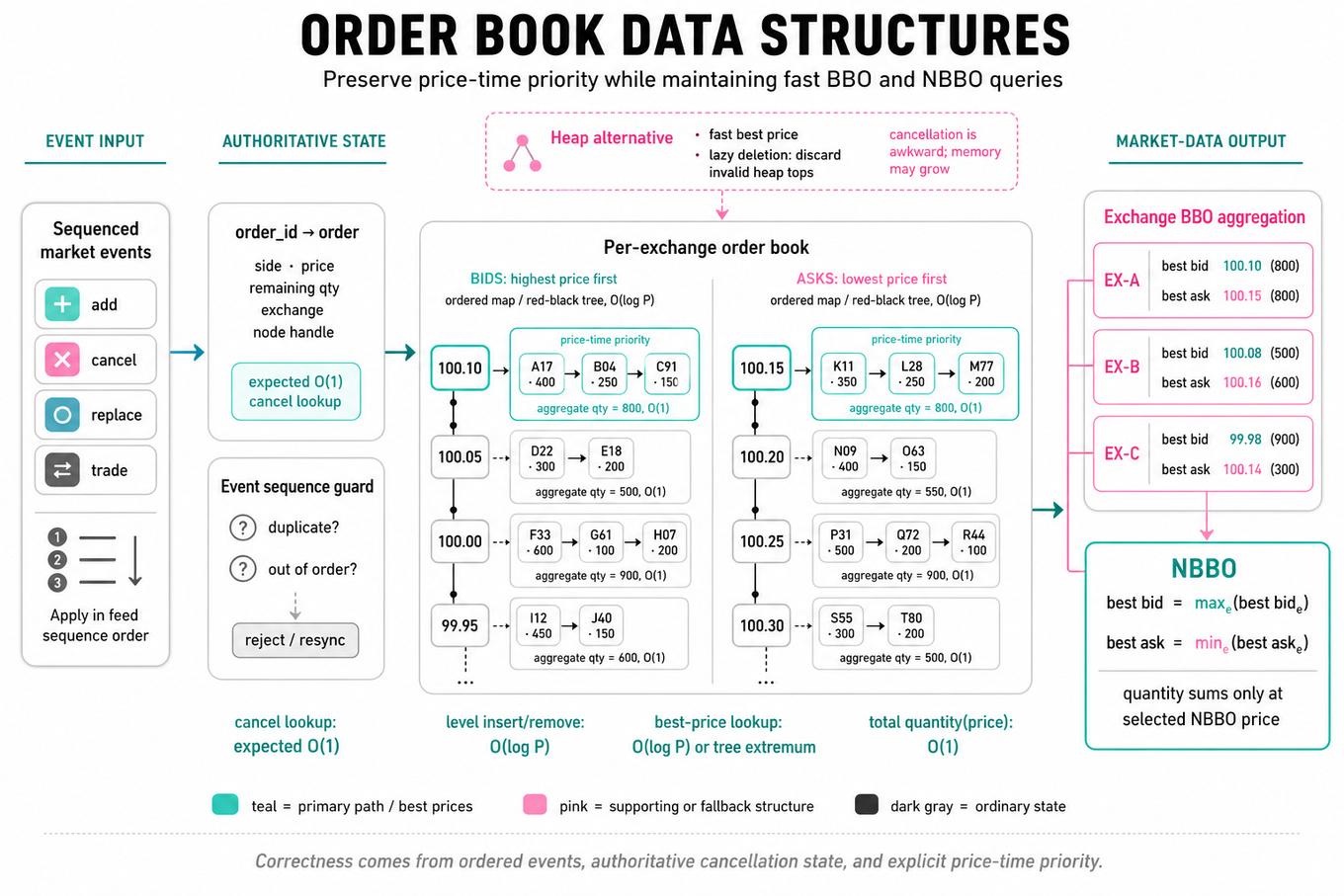
A price level aggregates all live orders sharing
(side, price): bids maximize price, asks minimize price. The BBO is , with missing sides represented explicitly. -
Use an ordered map such as
`std::map`or a balanced red-black tree from price to level. Each insert, cancel-induced cleanup, and best-price lookup costs , where is the number of active price levels. -
For faster best-price access, combine a hash map of
`order_id` → orderwith a price-level map. The hash map gives expected cancellation lookup; the ordered structure locates and removes empty levels in . -
A price-time priority queue stores orders at each level in FIFO sequence, commonly with a linked list or deque. The level’s aggregate quantity is maintained incrementally, so
total_quantity(price)is rather than rescanning every order. -
A heap can provide fast best-price access, but cancellation is awkward because arbitrary removal is not efficient. Use lazy deletion: mark or remove orders in the authoritative map, then discard invalid heap tops while querying; understand possible memory growth and periodic rebuilding.
-
For per-exchange aggregation, maintain state keyed by
(exchange, side, price)and derive exchange BBOs separately. The NBBO is and , while quantity is summed only across venues at the selected NBBO price. -
Cancellation requires an authoritative
`order_id`index, not a scan through price levels. Store side, price, remaining quantity, exchange, and an iterator or node handle when possible; this supports expected lookup and avoids disturbing neighboring orders. -
Event sequencing is part of correctness: apply add, cancel, replace, and execution events in feed sequence order. A duplicate or out-of-order event can double-count quantity unless sequence numbers, session resets, and idempotency rules are defined.
-
Separate authoritative state from derived indexes. The order record or node owns lifecycle state; price totals, best-price caches, and heaps are derived structures that must be updated atomically with the mutation or rebuilt deterministically.
-
In a single-writer design, one thread owns a symbol’s book and processes events sequentially, avoiding locks and making replay deterministic. Shard by symbol or instrument, not arbitrary events, because one book’s ordering must remain serialized.
-
Define semantics before optimizing: whether quantities are integer lots or decimal values, whether prices use fixed-point ticks, how zero or negative quantities are rejected, and whether replace preserves time priority or receives a new timestamp.
Worked example
For “Compute BBO and NBBO from order data”, I would first clarify whether records are a snapshot or an event stream, whether orders can be canceled, whether exchange identity matters, and whether the output needs only prices or also aggregated quantities. I would declare fixed-point integer prices, nonnegative quantities, one sequential pass, and explicit behavior for an empty bid or ask side. I would organize the answer around parsing and validation, per-side/per-venue aggregation, best-price selection, and complexity plus edge-case handling. For a static snapshot, a hash map keyed by (venue, side, price) can accumulate quantities, followed by a best-price scan; for streaming updates, I would retain order IDs and incrementally maintain levels. The global NBBO would select the highest bid and lowest ask across venue-level BBOs, then sum quantities at the winning price where the specification requires it. A key tradeoff is a simple scan— per query and low implementation risk—versus an ordered map or heap, which costs more state but supports frequent queries in or near best lookup. I would explicitly test duplicate IDs, zero quantities, empty books, multiple venues at one price, and a crossed book if validation forbids it. If I had more time, I would add property-based tests comparing the incremental implementation with a slow reference recomputation.
A second angle
For “In-Memory Order Book with Price-Time Order, Level Aggregation and Order Cancel”, the central challenge shifts from aggregating a completed dataset to preserving mutable lifecycle state. The design needs a sorted bid/ask view, FIFO order queues within each price, aggregate quantities, and direct cancellation by ID without changing other orders’ priority. A linked list plus ID-to-node index gives efficient arbitrary cancellation, while a tree or sorted map handles price levels. The interviewer may probe replace semantics, partial fills, empty-level deletion, and whether a canceled order can accidentally remain at the head of a lazy heap.
Common pitfalls
Pitfall: Analytical mistake. A tempting answer is “use a heap for each side and sum the top level when queried,” without explaining cancellation or stale entries. That can return incorrect BBOs or repeatedly scan dead orders; identify the authoritative record, lazy-deletion invariant, and worst-case cleanup behavior.
Pitfall: Communication mistake. Jumping straight to
`TreeMap`or`unordered_map`obscures the required semantics. State assumptions first—snapshot versus stream, update types, price representation, and latency target—then map each requirement to a structure and give operation complexities.
Pitfall: Depth mistake. Saying “make it concurrent for low latency” is not enough and can introduce races in aggregate quantity and best-price state. Prefer a single-writer-per-symbol model, explain sharding and publication boundaries, and mention replay, sequence gaps, and deterministic recovery when persistence or failover is discussed.
Connections
The interviewer may pivot to matching-engine algorithms, event sourcing and replay, lock-free or single-writer concurrency, and market-data normalization. Be ready to distinguish an order book’s live derived state from an append-only audit log and to discuss fixed-point arithmetic, sequence gaps, and recovery snapshots.
Further reading
-
Nasdaq TotalView-ITCH 5.0 — concrete feed-message semantics, sequence handling, order lifecycle events, and replay considerations.
-
Designing Data-Intensive Applications by Martin Kleppmann — useful background on logs, deterministic processing, state reconstruction, and consistency tradeoffs.
Practice questions
- In-Memory Order Book with Price-Time Order, Level Aggregation and Order CancelCitadel Securities · Software Engineer · Onsite · medium
- Order Book With Per-Exchange BBO and Cross-Exchange NBBO QueriesCitadel · Software Engineer · Technical Screen · medium
- Compute BBO and NBBO from order dataCitadel · Software Engineer · Technical Screen · medium
- Design a low-latency trading systemCitadel · Software Engineer · Technical Screen · hard
Related concepts
- Order Book And Matching Engine Data StructuresCoding & Algorithms
- Limit Order Book Price-Time MatchingCoding & Algorithms
- Crypto Trading And Order Routing SystemsSystem Design
- Auctions, Ticketing, And Real-Time MessagingSystem Design
- Low-Latency Trading System ArchitectureSystem Design
- Banking Ledgers And Cashback OperationsSystem Design