Behavioral Ownership, Tradeoffs, And Communication
Asked of: Software Engineer
Last updated
What's being tested
These prompts test ownership, technical judgment, and the ability to communicate an engineering decision from problem definition through production outcome. The interviewer is looking for a precise account of what you personally did, which alternatives you rejected, how you handled uncertainty, and how you measured success—not a polished description of a team project. Coinbase cares because financial systems require engineers who can make responsible tradeoffs among reliability, security, latency, delivery speed, and operational risk while keeping collaborators aligned.
Core knowledge
-
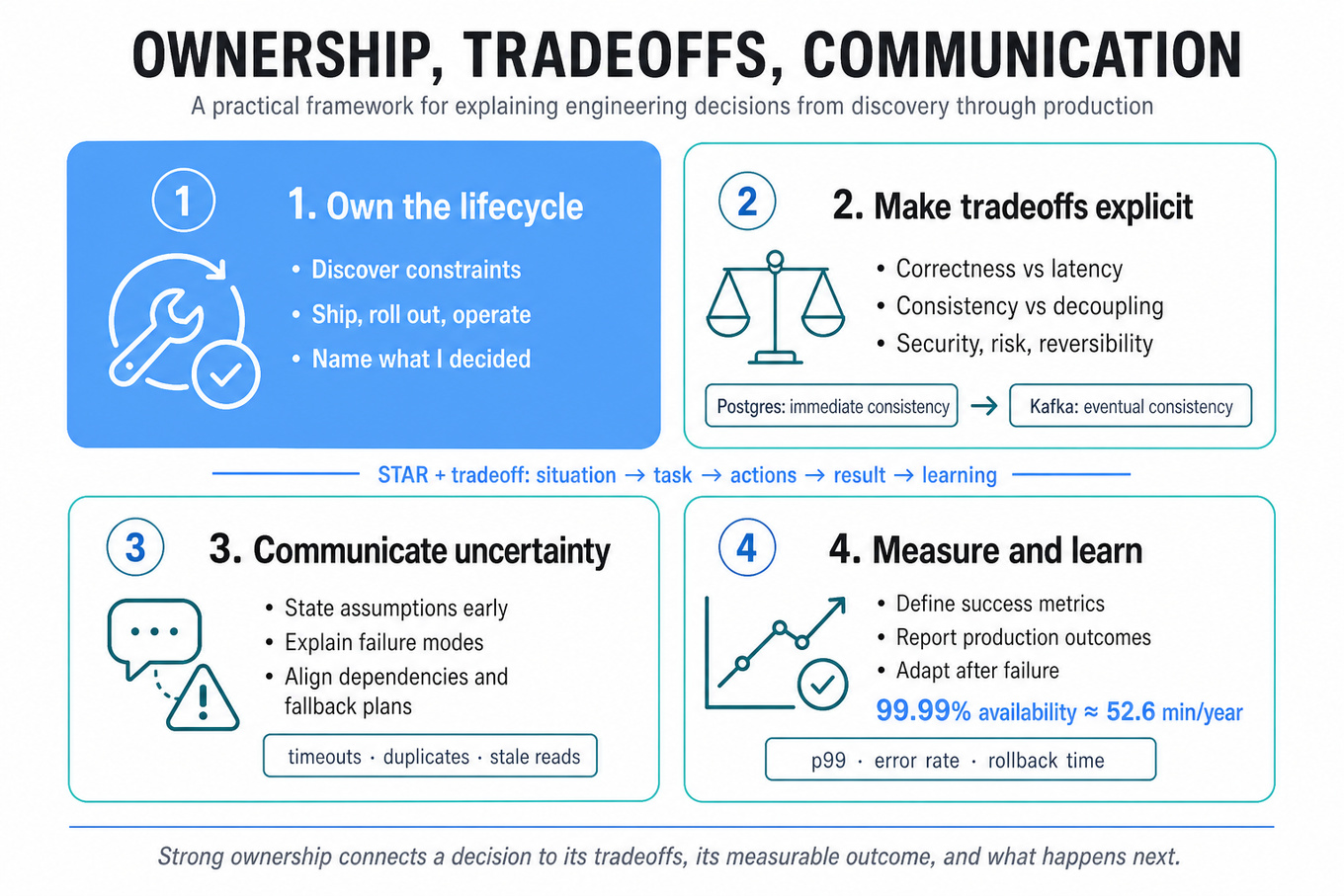
Ownership means carrying a problem through discovery, implementation, rollout, and operation. Distinguish your decisions from team output using “I”; name dependencies, risks you surfaced, and what you did after launch or during failure.
-
Use a STAR-plus-tradeoff structure: situation and constraints, task and success criteria, actions and alternatives, result with metrics, then what you learned. State assumptions early instead of hiding ambiguity until the end.
-
Define engineering success with measurable outcomes:
`p99`latency, error rate, throughput, availability, deployment frequency, rollback time, alert volume, or incident count. For availability, communicate the budget explicitly: 99.99% permits roughly 52.6 minutes of annual downtime. -
Compare alternatives against explicit dimensions: correctness, consistency, latency, scalability, operational complexity, security, reversibility, and delivery time. A synchronous
`Postgres`transaction may maximize immediate consistency; an asynchronous`Kafka`workflow may improve decoupling but introduce retries, duplicates, and eventual consistency. -
Idempotency is essential when requests can be retried. Use a client-supplied idempotency key, persist the result or operation state, and enforce a uniqueness constraint; never rely only on an in-memory deduplication cache across processes.
-
Explain failure modes rather than claiming a design “handles scale.” Cover timeouts, partial writes, duplicate messages, stale reads, dependency outages, malformed input, deploy rollback, and recovery after a process or region failure.
-
For a distributed write, identify the consistency boundary: validate authorization and invariants before committing, make state transitions atomic where required, and use an outbox or durable event record when a database change must reliably produce an event.
-
Show incremental delivery: feature flags, dark reads, canary deployment, bounded blast radius, dashboards, and a rollback plan. A reversible first release is often preferable to a theoretically optimal design that cannot be safely tested.
-
Use observability as an engineering responsibility: structured logs with correlation IDs, metrics for success and failure paths, traces across services, and alerts tied to user-visible symptoms. Avoid logging secrets, private keys, authentication tokens, or sensitive financial data.
-
Decompose complex work by stable interfaces and risk, not merely by service count. A useful plan identifies API contracts, ownership boundaries, migration sequencing, compatibility requirements, and exit criteria; for large datasets, prefer resumable, checkpointed migrations over one unbounded job.
-
Communicate disagreement with evidence and a decision record. An ADR should capture context, options, decision, consequences, and revisit triggers; this prevents repeated debate while making the tradeoff visible to reviewers and future on-call engineers.
-
Quantify scale and edge cases. A single-process solution might be adequate for records or low request volume, while millions of records may require pagination, batching, backpressure, indexes, and bounded memory; state the threshold that changes your design.
Worked example
For “Discuss complex project and multi-approach example,” I would begin by asking what complexity the interviewer wants emphasized—scale, cross-service coordination, ambiguous requirements, reliability, or security—and I would state the project’s users, constraints, my role, and the measurable definition of success. I would organize the answer around four pillars: decomposition and interfaces, the alternatives I evaluated, execution and risk control, and production results plus lessons learned. I might describe replacing a fragile synchronous workflow with a durable command API and asynchronous processing, while preserving an idempotent status endpoint for clients. The key tradeoff would be lower coupling and better recovery versus eventual consistency and more operational machinery. I would explain how I compared the approaches using latency, correctness, retry behavior, on-call complexity, and migration risk rather than asserting that one was simply “more scalable.” I would then cover contract tests, dashboards, a canary rollout, duplicate-event handling, and the rollback mechanism. Results should include concrete changes such as reduced `p99` latency, fewer failed operations, or shorter recovery time, while separating my contribution from teammates’ work. I would close with, “If I had more time, I would add a failure-injection test plan and revisit the design against the next order-of-magnitude increase in traffic.”
A second angle
For “Discuss complex project choices,” the same concept is framed less around the entire project narrative and more around judgment at a decision point. I would present the decision context, two or three viable designs, the invariant that could not be compromised, and the evidence used to choose. For example, choosing a transactional database update plus an outbox over a direct publish-first flow prioritizes state correctness and recoverability, at the cost of storage and reconciliation work. I would also explain who disagreed, how I incorporated valid objections, and which production signal would cause me to revisit the choice.
Common pitfalls
Pitfall: Giving a technically impressive solution without analyzing alternatives. Saying “we used microservices because we needed scale” is weak; explain the actual bottleneck, the simpler option considered, and the specific cost introduced by the chosen design.
A strong answer connects decisions to constraints such as `p99` latency, consistency, deploy safety, or operational load. If you cannot name what would have changed your decision, the tradeoff was probably not understood clearly enough.
Pitfall: Using “we” for every action or taking sole credit for team results. The interviewer needs your individual ownership, but not exaggerated ownership.
Say, “I designed the retry state machine, partnered with the platform team on deployment, and the team reduced timeout errors by 35%.” Also acknowledge contributions, disagreement, and dependency failures instead of presenting collaboration as frictionless.
Pitfall: Staying at architecture-diagram altitude. Naming
`Kafka`, caching, or retries without explaining duplicate delivery, poison messages, stale data, timeout budgets, or recovery makes the answer sound memorized.
Go one level deeper into one critical path: its invariant, failure handling, observability, and test or rollout strategy. You do not need every implementation detail, but you must demonstrate that the design could survive production.
Connections
The interviewer may pivot to incident response, distributed-systems consistency, API and schema evolution, observability, or secure coding. Be ready to connect ownership to on-call behavior, rollback decisions, idempotent APIs, and protecting financial or authentication data.
Further reading
-
Site Reliability Engineering — Google’s practical treatment of service-level objectives, error budgets, monitoring, and incident response.
-
Designing Data-Intensive Applications — rigorous coverage of consistency, replication, transactions, streams, and distributed-system tradeoffs.
-
Architecture Decision Records — a concise format for documenting technical context, decisions, and consequences.
Practice questions
- Push Back on a Technical Decision under Time PressureCoinbase · Software Engineer · Onsite · medium
- Describe cross-team collaboration on past projectsCoinbase · Software Engineer · Technical Screen · medium
- Discuss your proudest projectCoinbase · Software Engineer · Onsite · medium
- Explain motivation, UX quality, and change handlingCoinbase · Software Engineer · Technical Screen · medium
- Discuss complex project and multi-approach exampleCoinbase · Software Engineer · Onsite · medium
- Handle recruiter transparency and background checksCoinbase · Software Engineer · Onsite · medium
Related concepts
- Behavioral Ownership, Communication, And TradeoffsBehavioral & Leadership
- Behavioral Ownership, Communication, And LeadershipBehavioral & Leadership
- Behavioral Ownership, Impact, And LeadershipBehavioral & Leadership
- Technical Leadership, Communication, And Mission FitBehavioral & Leadership
- Behavioral Communication And OwnershipBehavioral & Leadership
- Project Ownership, Conflict, And Tradeoff CommunicationBehavioral & Leadership