C++ And Language Runtime Fundamentals
Asked of: Software Engineer
Last updated
What's being tested
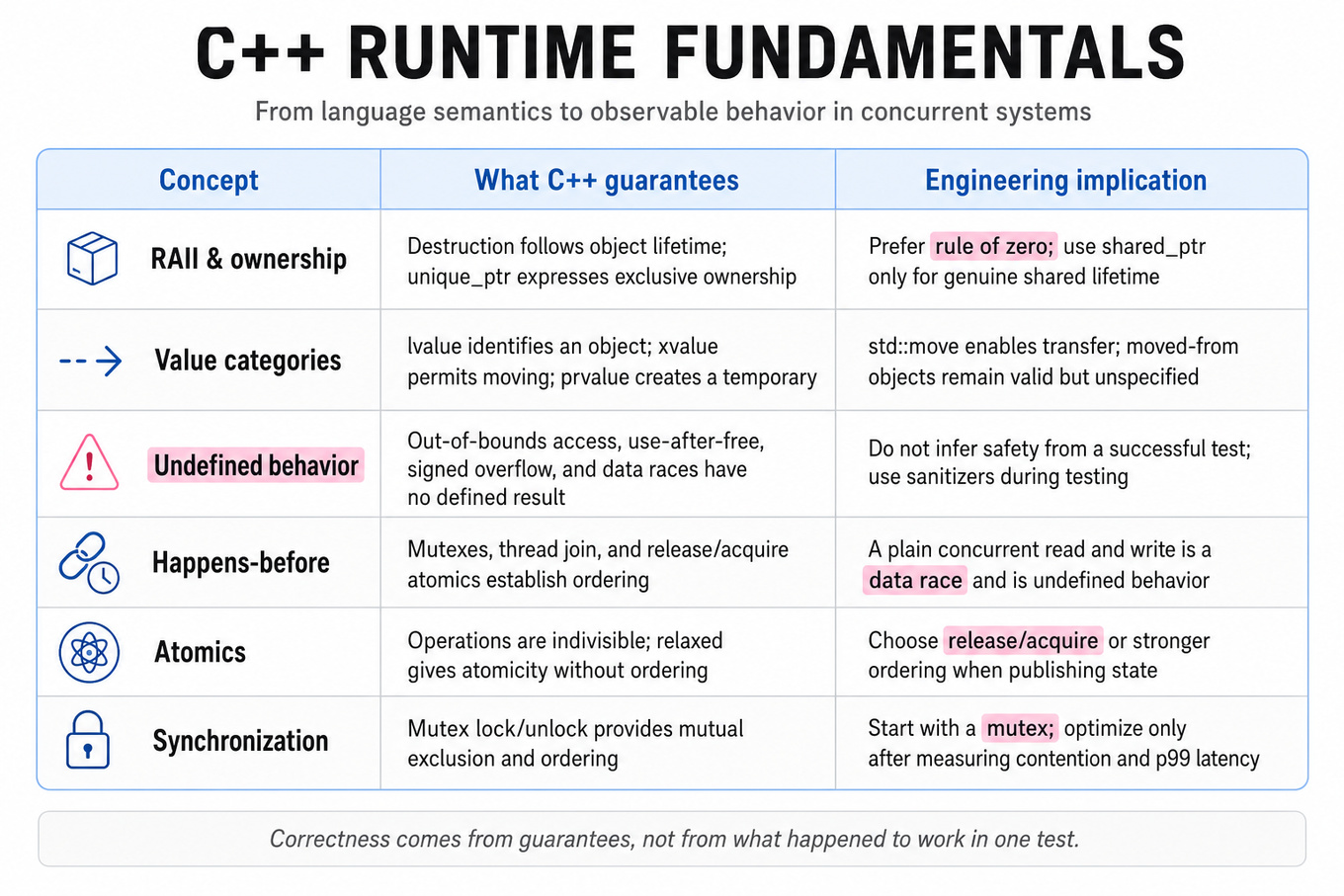
These interviews test whether you can reason from language semantics to observable behavior: object lifetime, ownership, undefined behavior, memory ordering, and synchronization. You must distinguish “works in my test” from behavior guaranteed by the C++ standard, then select the simplest correct implementation before optimizing. Citadel cares because low-latency and high-throughput systems amplify small mistakes: a data race, unnecessary copy, cache-line conflict, or incorrect wakeup can become a correctness failure or a measurable `p99` latency regression.
Core knowledge
-
RAII ties resource lifetime to object lifetime: acquire in a constructor and release in a destructor. Prefer
`std::unique_ptr`for exclusive ownership,`std::shared_ptr`only for genuine shared lifetime, and`std::weak_ptr`to break ownership cycles. -
Value categories matter for performance and correctness: lvalues identify persistent objects, xvalues permit moving, and prvalues create temporary values. Use
`std::move`to enable transfer, but remember it only casts; the moved-from object remains valid but has unspecified value. -
Rule of zero is preferable: compose members such as
`std::vector`,`std::string`, and smart pointers instead of manually implementing destructor, copy constructor, and assignment. If a type owns a raw resource, follow the rule of five and define or delete all relevant operations. -
Undefined behavior includes out-of-bounds access, use-after-free, signed overflow, invalidated iterators, and data races. The compiler may assume it never occurs, so sanitizers such as
`-fsanitize=address,undefined,thread`are essential during testing, not substitutes for reasoning. -
The C++ memory model defines happens-before relationships through mutex unlock/lock, thread creation and join, and atomic release/acquire operations. A plain read concurrent with a plain write is a data race and therefore undefined behavior, even if the machine instruction appears atomic.
-
Atomics provide indivisible operations but not automatically a complete protocol.
`memory_order_relaxed`provides atomicity without ordering; release/acquire publishes prior writes; sequential consistency is easier to reason about but can impose stronger compiler and hardware constraints. -
A mutex is usually the right baseline for shared mutable state: it gives mutual exclusion and ordering, while
`std::condition_variable`supports blocking waits. Always usewhile (!predicate) cv.wait(lock)because wakeups may be spurious and another consumer may win the race. -
Lock-free designs require a complete ownership and reclamation story, not merely
`compare_exchange`. ABA, use-after-free, memory reclamation, and false sharing are common failures; techniques include tagged pointers, hazard pointers, epoch-based reclamation, or carefully bounded ring-buffer slots. -
A single-producer multi-consumer ring buffer can use fixed storage and circular indices, but consumers must claim distinct positions atomically. Capacity must distinguish full from empty, and object construction/destruction must be coordinated so a consumer never reads a slot before publication.
-
Mutex, spin lock, and lock-free designs optimize different contention regimes. Spinning can win for waits below roughly a few microseconds on dedicated cores, but wastes CPU and worsens tail latency under oversubscription; blocking is safer for unpredictable waits.
-
Cache coherence makes adjacent frequently-written fields expensive even when logically independent. Use
`alignas(std::hardware_destructive_interference_size)`where appropriate, keep hot data compact, and benchmark on the target hardware rather than assuming lock-free means faster. -
Exception safety has levels: no-throw, strong guarantee, basic guarantee, and no guarantee. For containers and resource-owning types, structure updates as prepare-then-commit so an exception cannot leave partially updated state; mark move operations
noexceptwhen valid to improve reallocation behavior.
Worked example: Design a Thread-Safe Shared Counter
A strong opening would clarify whether counts must be exact, whether keys are bounded, whether updates and reads are per-key or global, and whether the scope is one process or multiple processes. I would declare a baseline assumption: many threads update a bounded key set in one process, reads need exact values, and durability is not required. I would organize the answer around data layout, synchronization strategy, visibility semantics, and verification under contention. For a simple implementation, `std::unordered_map<Key, uint64_t>` guarded by a mutex is easy to prove correct; for a fixed key set, per-key `std::atomic<uint64_t>` avoids one global lock. I would explicitly flag the tradeoff between lower contention and higher memory/cache cost, including padding if adjacent counters are hot. If multiple processes must contribute, process-local atomics are insufficient and I would introduce shared memory with interprocess synchronization or an external service such as `Redis`, while defining crash and durability semantics. I would test with randomized concurrent updates, compare against a serial reference, run `ThreadSanitizer`, and measure throughput plus `p99` latency. If I had more time, I would investigate sharded maps, overflow policy, snapshot consistency, and whether eventual aggregation could replace exact per-update coordination.
A second angle
For Thread-Safe Producer-Consumer Queue: Mutex, Then Spin Lock, Then Lock-Free, the same principles are applied to ownership transfer rather than numeric updates. The key framing questions become queue capacity, blocking versus nonblocking behavior, fairness, shutdown semantics, and whether producers or consumers may be multiple. A mutex-plus-condition-variable queue is the correctness baseline; a spin lock is justified only with short critical sections and controlled core allocation. A lock-free queue additionally requires explicit memory ordering and a safe reclamation strategy, so “replace the mutex with atomics” is not a complete design.
Common pitfalls
Pitfall: Claiming that
`std::atomic`makes an entire compound operation safe.if (count < limit) ++countstill has a check-then-act race unless the reservation is implemented with a suitable compare-exchange loop or protected by a lock.
A tempting analytical mistake is to choose lock-free code immediately because the setting sounds latency-sensitive. A stronger answer first establishes a correct mutex design, identifies the measured bottleneck, then explains whether sharding, batching, padding, or nonblocking algorithms address that bottleneck.
Pitfall: Saying a condition variable “waits until notified” without mentioning the predicate loop. Notifications are not stored as events, wakeups can be spurious, and another thread can consume the condition before the awakened thread reacquires the lock.
A communication mistake is presenting implementation details before stating assumptions. Start with scope, exactness, capacity, lifetime, and failure behavior; otherwise an answer can be technically correct for a different problem.
Pitfall: Treating a successful
`compare_exchange_weak`loop as proof of a correct lock-free structure. You must also explain publication ordering, ABA, object lifetime, reclamation, and what happens on full or empty states.
A depth mistake is discussing benchmark numbers without methodology. State workload, thread count, CPU pinning or scheduling assumptions, contention distribution, warm-up, and metrics such as throughput and `p99`; otherwise “faster” is not meaningful.
Connections
An interviewer may pivot to false sharing, NUMA, memory reclamation, iterator invalidation, or exception safety. They may also connect language-level guarantees to compiler optimization, CPU cache coherence, and profiling with `perf` or sanitizers.
Further reading
-
C++ Core Guidelines — Practical guidance on ownership, RAII, concurrency, and exception safety.
-
cppreference: Memory model — Precise reference for data races, atomics, and happens-before.
-
Anthony Williams, C++ Concurrency in Action, 2nd ed. — Detailed treatment of mutexes, atomics, lock-free structures, and memory reclamation.
Practice questions
- Thread-Safe Producer-Consumer Queue: Mutex, Then Spin Lock, Then Lock-FreeCitadel Securities · Software Engineer · Onsite · medium
- Refactor a Correct but Quadratic C++ Routine Under a Microsecond BudgetCitadel · Software Engineer · Online Assessment · medium
- Design a Thread-Safe Shared CounterCitadel · Software Engineer · Technical Screen · medium
- Implement a single-producer multi-consumer ring bufferCitadel · Software Engineer · Technical Screen · medium
- Explain JS types, Promises, Maps, WebSocketsCitadel · Software Engineer · Technical Screen · medium
Related concepts
- C++ Concurrency, Memory Ownership, And RAII
- C++ Concurrency And Memory Model
- C++ And Virtual Memory FundamentalsSoftware Engineering Fundamentals
- C++ Systems, Memory, Concurrency, And VirtualizationSoftware Engineering Fundamentals
- C++ STL Performance And Interview Idioms
- Core Data Structures, Algorithms, And ComplexityCoding & Algorithms