Distributed Job Scheduling For Payment Workflows
Asked of: Software Engineer
Last updated
What's being tested
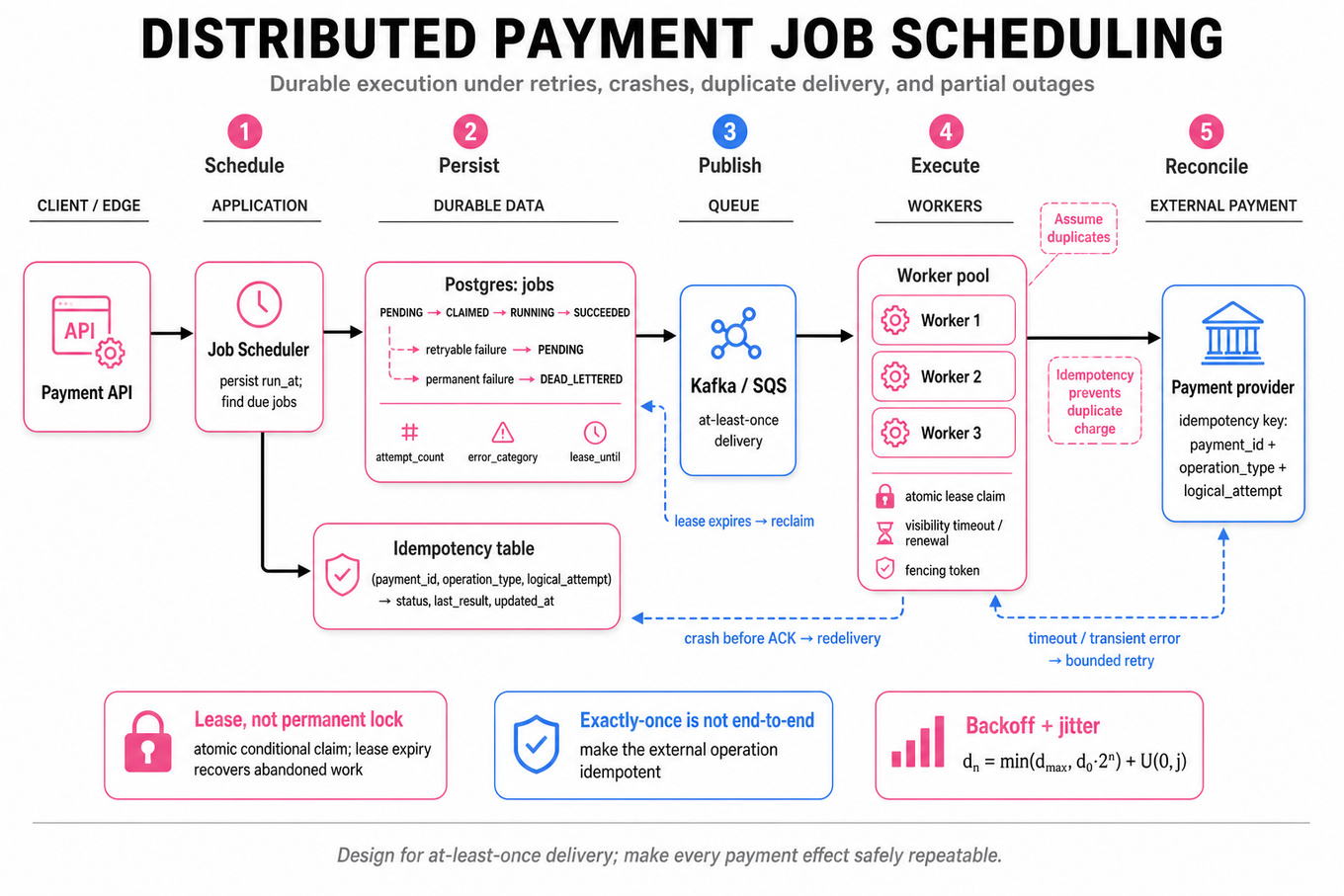
This topic tests whether you can design a durable distributed scheduler that executes payment-related work reliably despite crashes, retries, duplicate deliveries, clock errors, and partial outages. The interviewer is probing your command of state machines, leases, idempotency, queue semantics, and failure recovery—not merely whether you can put delayed messages into a queue. Affirm cares because a missed, duplicated, or incorrectly ordered payment operation can create customer harm, reconciliation defects, financial loss, and compliance risk.
Core knowledge
-
A job state machine makes legal transitions explicit:
PENDING → CLAIMED → RUNNING → SUCCEEDED, with retryable failures returning toPENDINGand permanent failures becomingDEAD_LETTERED. Store transitions durably with timestamps, attempt counts, and an error category. -
Separate scheduling from execution. A scheduler determines when work is eligible; workers perform the operation. Persist
run_atand query or index due jobs, then publish them to`Kafka`,`SQS`, or a database-backed queue. This lets workers scale independently. -
Use at-least-once delivery as the practical default. A worker can crash after charging a card but before acknowledging the message, so redelivery is expected. “Exactly once” is generally not end-to-end achievable across a queue and an external payment provider; make the operation idempotent instead.
-
An idempotency key should be stable across retries, such as
payment_id + operation_type + logical_attempt, and be accepted by the payment service or stored in an idempotency table. Enforce a unique constraint so concurrent workers cannot create two effects for one logical operation. -
Claim work with a lease, not a permanent lock. An atomic conditional update such as
UPDATE jobs SET owner=?, lease_until=? WHERE id=? AND status='PENDING'prevents two workers from claiming the same job; lease expiry makes abandoned work recoverable. -
Use visibility timeouts or lease renewal for long-running jobs. Set the timeout above normal
p99execution time plus network margin, renew only while healthy, and fence stale workers with a monotonically increasing fencing token checked before committing results. -
Retries need a bounded backoff policy: commonly exponential delay with jitter, for example . Retry timeouts, connection failures, and
5xxresponses; avoid retrying invalid payment details or other known permanent failures. -
Preserve payment-specific ordering where required. Partition by
account_idorpayment_id, or enforce a database sequence such asoperation_number; do not impose global ordering, which limits throughput and creates a single bottleneck. -
Make enqueueing and state changes atomic with the transactional outbox pattern. Write the business-state update and an outbox record in one
`Postgres`transaction; a relay publishes the outbox record and marks it sent. Consumers remain idempotent because the relay can publish duplicates. -
Treat time carefully. Store timestamps in UTC, use a synchronized wall clock only for eligibility, and use a monotonic clock for lease-duration measurement. Define behavior for daylight-saving changes, missed schedules, clock skew, and jobs whose deadline has already passed.
-
Design for horizontal scale with an indexed due-time query such as
(status, run_at), bucketed time wheels, or delayed queues. For very large volumes, shard by job ID or payment ID and avoid repeatedly scanning millions of future jobs; a single scheduler partition is a throughput and availability risk. -
Build operational controls into the design: queue lag, due-job age, execution latency, retry rate, lease expirations, duplicate suppression, dead-letter count, and provider error rate. Add alerts for stuck transitions and reconciliation mismatches, plus a replay tool that requires authorization and preserves the original idempotency key.
Worked example — Design a distributed job scheduler for payment workflows
I would first clarify the workload: expected jobs per second, delay precision, maximum execution time, required ordering, provider behavior, and whether a duplicate external charge is unacceptable. I would state an assumption such as at-least-once delivery with a payment API supporting idempotency keys, because that is safer and more realistic than promising exactly-once execution. I would organize the design around four pillars: a durable job/state store, a scheduler-to-queue handoff, leased workers, and idempotent payment-side effects. The job row would contain run_at, status, attempt count, lease metadata, a stable idempotency key, and a fencing token, while an outbox would make state changes and enqueue requests atomic. Workers would claim jobs conditionally, execute with bounded exponential backoff, record the result, and move unrecoverable work to a dead-letter state. The explicit tradeoff is database polling versus a managed delayed queue: indexed polling is simpler and gives strong visibility, while a delayed queue can scale better but complicates cancellation, inspection, and recovery. I would close by adding reconciliation against the payment provider and, with more time, detail shard rebalancing, provider rate limits, and multi-region failover.
A second angle — Recovering from worker and scheduler failures
A recovery-focused version changes the emphasis from normal scheduling to crash consistency and duplicate prevention. Ask what happens if the scheduler publishes a job and crashes before recording that fact, or if a worker completes a payment immediately before losing its lease. The answer should use an outbox, lease expiry, fencing tokens, and a provider-side idempotency key rather than relying on acknowledgments alone. You should also distinguish safe replay from unsafe replay: replaying a status lookup may be harmless, while replaying a non-idempotent charge requires reconciliation first. This framing tests whether your design remains correct under adversarial failure timing, not just under healthy operation.
Common pitfalls
Pitfall: Claiming “exactly once” because the queue deduplicates messages. Queue-level deduplication does not cover a worker crash after an external payment succeeds; explain at-least-once execution plus idempotent effects.
Pitfall: Saying “use a lock” without specifying ownership, expiry, renewal, and stale-owner behavior. A strong answer names an atomic claim, lease timeout, fencing token, and the database condition that prevents an old worker from committing.
Pitfall: Focusing only on throughput and omitting payment correctness. Discuss permanent versus transient errors, reconciliation, dead-letter handling, audit history, operator replay, and metrics such as due-job age and duplicate suppression.
Connections
The interviewer may pivot to transactional outbox, saga orchestration, leader election, or rate limiting against payment providers. Be ready to compare `Kafka` consumer offsets, database leases, and workflow engines such as `Temporal`, especially around durability, visibility, cancellation, and operational complexity.