Dynamic Programming Patterns For Technical Screens
Asked of: Software Engineer
Last updated
What's being tested
Dynamic programming screens test whether you can turn exponential recursive search into a polynomial-time algorithm by identifying overlapping subproblems and reusable state. The interviewer is probing your ability to define a precise state, derive a correct recurrence, choose evaluation order, and justify time and space complexity. Jane Street values this because production-quality engineering often requires making correctness, performance, and assumptions explicit rather than pattern-matching to a memorized solution.
Core knowledge
-
Optimal substructure means an optimal solution contains optimal solutions to relevant subproblems; do not assume it blindly—problems involving arbitrary path history may require augmenting the state or may not admit a simple DP.
-
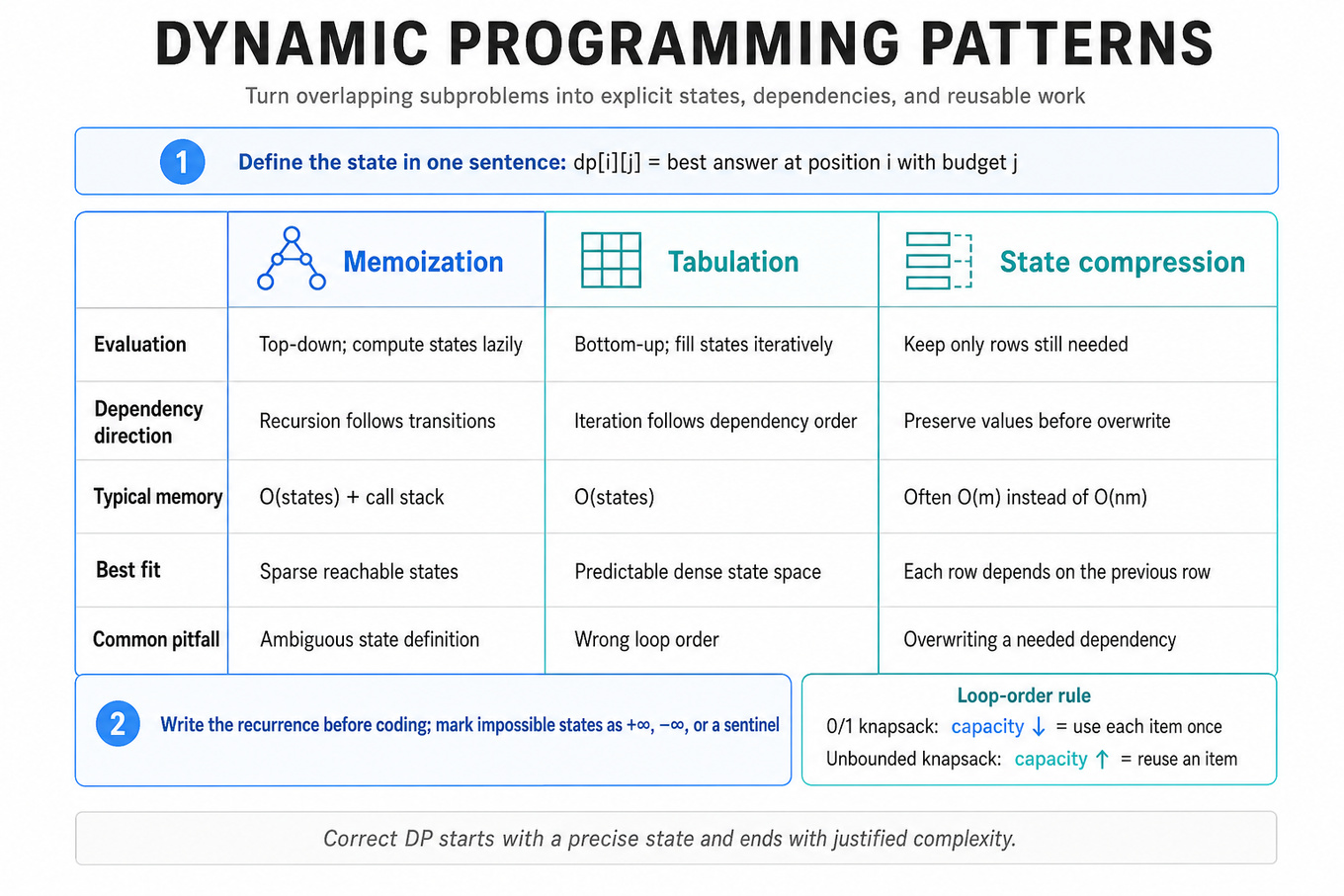
Memoization evaluates a top-down recurrence lazily, usually with recursion plus a cache; tabulation fills a bottom-up table iteratively. Both commonly achieve time.
-
Define the state in one sentence:
`dp[i]`might mean “best answer using the first`i`items,” while`dp[i][j]`might mean “best answer at position`i`with resource budget`j`.” Ambiguous state definitions cause most bugs. -
Write the recurrence before coding. A typical optimization has
while counting problems generally sum alternatives rather than minimize or maximize them. -
Identify base cases and unreachable states explicitly. Use
0for a legitimate zero count, but use`+∞`,`-∞`, or a sentinel for impossible optimization states; never let an impossible state participate as if it were valid. -
Choose iteration order from dependency direction. For 0/1 knapsack, iterate capacity downward so each item is used once; for unbounded knapsack, iterate upward when the same item may be reused.
-
State compression reduces memory when row
`i`depends only on row`i-1`, often from to . Preserve the previous value when in-place updates would overwrite a dependency needed later. -
DAG shortest path is DP in graph form: process vertices in topological order and relax incoming or outgoing edges. Cycles require a different method, such as Bellman–Ford, or an expanded state that makes transitions acyclic.
-
Distinguish path-dependent constraints from local transitions. “Cannot take adjacent elements” needs only the previous decision; “must remember the last two values” requires a larger state, and arbitrary history may require exponential state.
-
For interval DP, states often look like
`dp[l][r]`, with transitions over a split point`k`; compute by increasing interval length. Examples include matrix-chain multiplication and optimal binary search tree variants. -
For string DP, define whether indices represent prefixes or suffixes. Edit distance uses insertion, deletion, and substitution transitions; empty prefixes are essential base cases, and equal characters usually avoid a substitution cost.
-
Separate the value from reconstruction. Store parent choices, decision bits, or recompute a maximizing transition after the table is built; do not retain full solution objects in every state unless constraints make the overhead acceptable.
Worked example
Because no specific interview title was supplied, use the canonical Coin Change prompt: “Given coin denominations and a target amount, return the minimum number of coins needed.” In the first 30 seconds, clarify whether denominations are positive integers, whether each coin is reusable, what to return when the amount is unreachable, and whether the target can be zero. I would define `dp[a]` as the minimum coins required to form amount `a`, then organize the answer around state meaning, recurrence, initialization, and complexity. The recurrence is `dp[a] = 1 + min(dp[a - coin])` over coins not exceeding `a`, with `dp[0] = 0` and all other entries initialized to infinity. I would explain that bottom-up evaluation guarantees every predecessor amount is already known, giving time and space for target `A` and `K` denominations. A key tradeoff is top-down memoization versus tabulation: memoization may avoid unreachable amounts, while tabulation avoids recursion depth and is usually simpler to bound. I would test amount zero, an unreachable target, duplicate denominations, a denomination larger than the target, and a target where greedy selection fails. If I had more time, I would discuss reconstructing the actual coin sequence and whether constraints justify optimizing or validating the input.
A second angle
The same state-design discipline applies to 0/1 Knapsack, but the resource dimension changes from “amount formed” to “capacity remaining.” The crucial framing difference is that each item may be selected at most once, so a one-dimensional in-place table must iterate capacity downward. If repetition is allowed, upward iteration becomes appropriate, demonstrating that loop order encodes the problem’s combinatorial constraint. The interviewer may also ask how to reconstruct the selected items, which requires retaining decisions or using a second pass.
Common pitfalls
Pitfall: Treating a greedy choice as universally valid. Choosing the largest available coin first works for some canonical denominations but fails for arbitrary denominations; derive the recurrence or provide a proof before using greediness.
Pitfall: Giving a recurrence without defining what the indices mean. Saying “
`dp[i]`is the best answer up to`i`” is insufficient unless “up to” and the allowed choices are precise; state the invariant in plain language.
Pitfall: Quoting only the final complexity while ignoring constraints and memory. A strong answer distinguishes from space, explains whether recursion can overflow the stack, and identifies how reconstruction changes storage.
Connections
An interviewer may pivot to greedy algorithms, shortest paths, backtracking with pruning, or amortized analysis. Be ready to explain why a DP state forms a finite acyclic dependency graph and when a more specialized algorithm—such as `Dijkstra’s algorithm` or a monotonic deque optimization—improves the baseline.
Further reading
-
Introduction to Algorithms, 4th ed., Cormen et al. — rigorous treatment of optimal substructure, memoization, tabulation, and shortest paths.
-
Algorithms, 4th ed., Sedgewick and Wayne — practical visualizations and implementations of graph and optimization dynamic programs.
Related concepts
- Dynamic Programming Patterns For Coding Interviews
- Dynamic Programming Patterns Refresher
- Dynamic Programming, Scheduling, And Set CoverCoding & Algorithms
- Dynamic Programming Refresher For Product Coding
- Dynamic Programming, Greedy, And Combinatorial OptimizationCoding & Algorithms
- Dynamic Programming And MemoizationCoding & Algorithms