Financial Calculations, Precision, And Rounding
Asked of: Software Engineer
Last updated
What's being tested
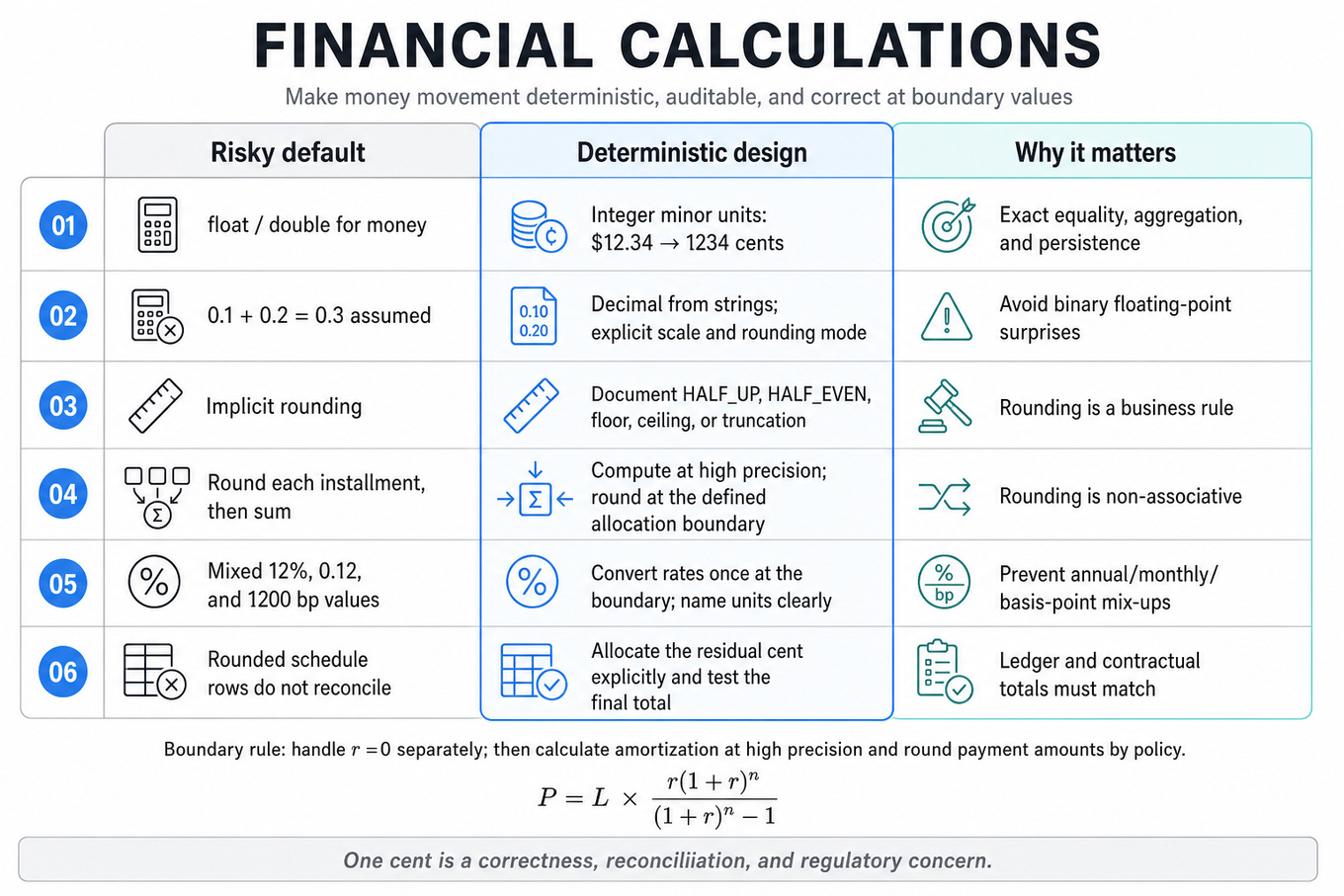
This topic tests whether you can design financial computations that are deterministic, auditable, and correct at boundary values—not merely produce a plausible numerical answer. You should demonstrate judgment about numeric representation, rounding policy, overflow, ordering of operations, and how to test calculations independently. Upstart handles lending decisions, payment schedules, and money movement, so a one-cent discrepancy can become a reconciliation failure, incorrect customer balance, or regulatory issue.
Core knowledge
-
Money representation should use integer minor units, such as cents, when the currency has a fixed two-decimal scale:
$12.34becomes1234. This avoids binary floating-point surprises and makes equality, aggregation, and persistence straightforward. -
IEEE 754 floating point cannot represent many decimal fractions exactly; for example,
0.1 + 0.2 != 0.3in common languages. Never usefloatordoublefor balances, rates, repayment amounts, or ledger totals without a deliberate error analysis. -
Decimal arithmetic is appropriate when calculations require fractional cents or configurable precision. Use language-native decimal types such as Java
BigDecimalor PythonDecimal, construct values from strings, and specify both scale and rounding mode explicitly. -
Rounding policy must be a business rule, not an implementation accident. Distinguish
HALF_UP,HALF_EVEN, floor, ceiling, and truncation; document when rounding occurs and whether intermediate values retain extra precision. -
Order of operations matters because rounding is generally non-associative: rounding each installment and then summing can differ from calculating a total and rounding once. Define whether allocation occurs per transaction, payment, day, or schedule line.
-
Rates need explicit units and scales. A 12% annual rate may be represented as
0.12,12, or1200basis points. Convert once at the boundary, name units clearly, and avoid silently mixing annual, monthly, daily, percentage, and basis-point values. -
Amortization calculations commonly use where is principal, is periodic interest rate, and is the number of payments. Handle separately, then round payment amounts according to policy.
-
Residual allocation is required when rounded schedule rows do not sum to the contractual total. Compute the high-precision target, round ordinary rows, and assign the remaining cent to a defined row—often the final payment—while preserving nonnegative principal and interest.
-
Overflow and scale growth are practical risks even with integer units. Use a sufficiently wide type, such as 64-bit integers for ordinary currency ranges or arbitrary-precision integers for aggregate ledgers; check multiplication before it overflows.
-
Determinism and reproducibility require fixed inputs, explicit timezone and date rules, stable iteration order, and the same arithmetic implementation across services. Avoid platform-dependent decimal conversions and ensure serialization preserves scale, sign, currency, and rounding metadata.
-
Ledger invariants provide stronger validation than example outputs. Useful checks include debits equaling credits, opening balance plus signed transactions equaling closing balance, total principal equaling original principal, and rounded schedule amounts equaling the contractual repayment total.
-
Property-based testing can generate rates, terms, principal values, and boundary amounts to verify invariants. Add examples for zero interest, one payment, half-cent values, very large balances, negative or invalid inputs, leap days, and currencies with different minor-unit scales.
Worked example
Representative question: “Calculate a loan repayment schedule with correct precision and rounding.” In the first 30 seconds, clarify the currency, annual-rate convention, payment frequency, day-count convention, whether interest compounds, and whether the requested output is a displayed schedule or a legally binding repayment plan. I would state that monetary values use integer cents or BigDecimal, while rates retain sufficient precision until the prescribed rounding point. I would organize the answer around input validation, periodic-rate conversion, amortization or installment calculation, per-row principal and interest allocation, and invariant-based testing. I would explicitly flag the tradeoff between rounding each row immediately for customer display and retaining extra precision internally to prevent cumulative drift. The implementation should handle zero interest separately, define the final-payment residual rule, reject overflow and invalid terms, and expose a deterministic result. Tests would compare principal and payment totals, exercise half-cent boundaries, and verify that the final balance is exactly zero or the documented residual. If I had more time, I would also discuss versioning the calculation policy so historical loans remain reproducible after a business-rule change.
A second angle
Representative question: “Compute the total payoff amount from transactions, fees, and interest.” The same precision principles apply, but the dominant concern shifts from schedule generation to aggregation and reconciliation. I would clarify whether transactions arrive in chronological order, whether duplicate events are possible, and whether fees can be refunded or partially applied. A robust design uses immutable ledger entries, integer minor units or decimal values with explicit scale, idempotency keys, and a deterministic ordering for interest and fee application. I would test that replaying the same transaction stream does not change the balance and that every adjustment has an auditable source.
Common pitfalls
Pitfall: Using
doublebecause the result “looks correct” for ordinary values. Binary floating-point can produce incorrect comparisons and one-cent drift; use minor units or decimal arithmetic with an explicit policy.
Pitfall: Rounding every intermediate expression without explaining why. This may create cumulative errors or make the final schedule fail to reconcile; retain precision internally and round at the domain-defined boundary.
Pitfall: Jumping directly into formula code without clarifying rate units, day-count rules, currency scale, and final-payment behavior. A strong answer states assumptions first and identifies which requirements must come from the contract or product specification.
Connections
The interviewer may pivot to idempotency, event sourcing, ledger reconciliation, or property-based testing. They may also ask about database numeric types, serialization contracts, or how to safely migrate a rounding rule without changing historical results.
Further reading
-
Java
BigDecimaldocumentation — precise decimal arithmetic, scale, and rounding behavior. -
Martin Fowler, “Accounting Patterns” — useful background on immutable entries, ledgers, and financial auditability.
-
IEEE 754 Floating-Point Standard — why binary floating-point behaves differently from decimal arithmetic.
Related concepts
- Money-Safe Financial ComputationCoding & Algorithms
- Robust Coding And Numeric Edge CasesCoding & Algorithms
- Backend System Design For Fintech PlatformsSoftware Engineering Fundamentals
- Unit Economics, Break-Even, And Profit DecompositionStatistics & Math
- Project Ownership And Operational Follow-ThroughBehavioral & Leadership
- Fintech Ledger Idempotency and Money Movement