Functional Programming And OCaml Readiness
Asked of: Software Engineer
Last updated
What's being tested
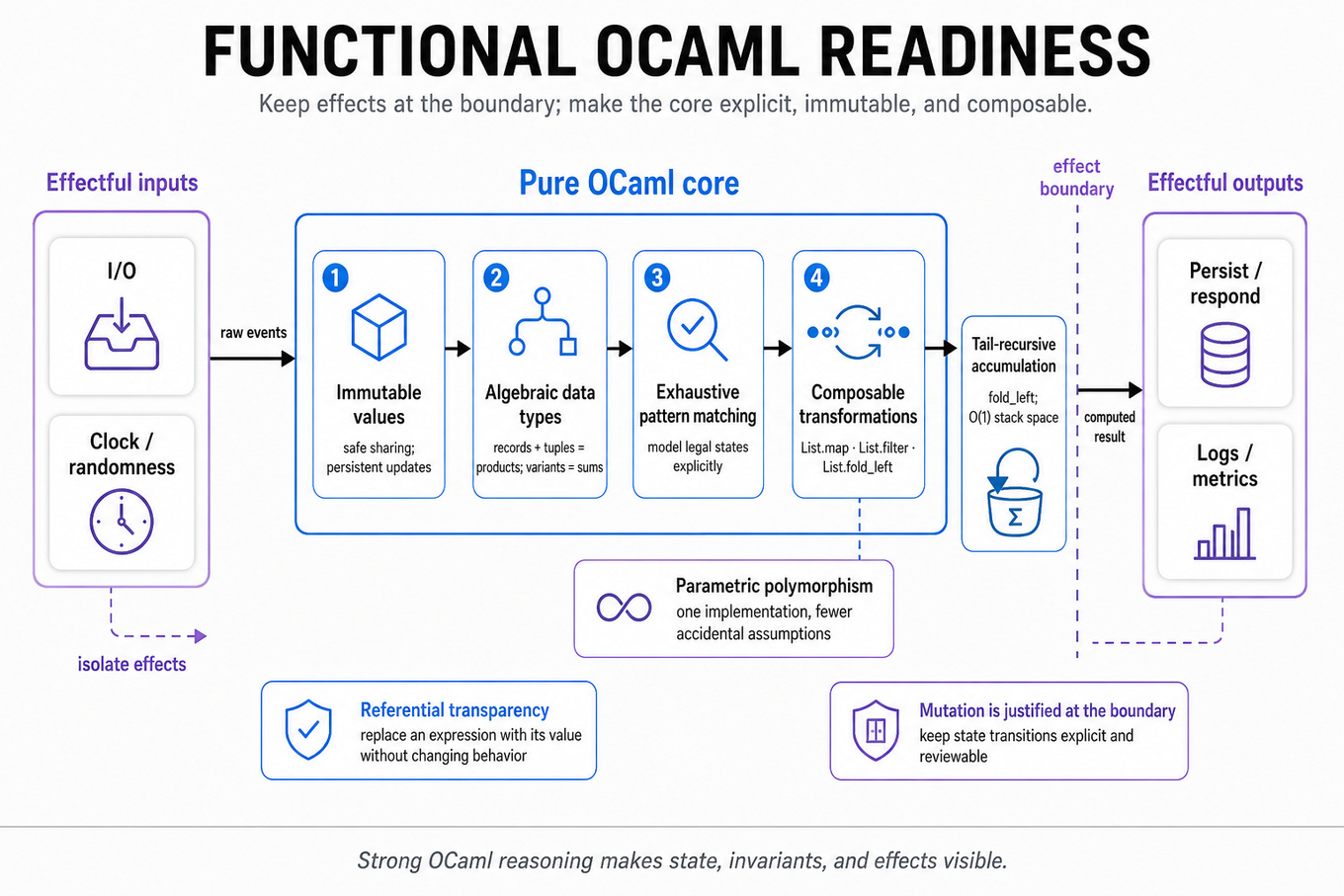
This topic tests whether you can reason about immutable data, higher-order functions, algebraic data types, and pattern matching rather than treating OCaml as syntax memorization. A strong Software Engineer can decompose a problem into small, composable transformations, state invariants clearly, and explain when purity improves correctness or when mutation is justified. Jane Street cares because production code benefits from explicit state transitions, strong compile-time guarantees, predictable performance, and abstractions that remain understandable during debugging and review.
Core knowledge
-
Referential transparency means an expression can be replaced by its value without changing program behavior. Pure functions simplify testing, caching, parallelization, and reasoning; isolate unavoidable effects such as I/O, clocks, randomness, and mutation at system boundaries.
-
Immutability makes sharing safe: multiple callers can hold the same value without coordination. Persistent data structures may allocate updated paths rather than copy everything, typically giving structural sharing and logarithmic updates instead of copying.
-
Algebraic data types combine product types and sum types. In OCaml, records and tuples represent products, while variants represent sums; use them to model legal states explicitly rather than encoding state with nullable fields or undocumented integer tags.
-
Pattern matching should be exhaustive and ordered from specific to general. The compiler’s warning for a missing constructor is valuable; avoid catch-all patterns when they could silently hide a newly added variant and create a correctness bug.
-
Parametric polymorphism lets one implementation work uniformly across types, such as
`List.map` : ('a -> 'b) -> 'a list -> 'b list. Type variables constrain what code can do, often preventing accidental assumptions without runtime type checks. -
Higher-order functions such as
`List.map`,`List.filter`,`List.fold_left`, and`List.fold_right`express reusable traversal structure. Choose`fold_left`for strict accumulation and usually constant stack space; naïve`fold_right`can overflow on large lists. -
Tail recursion requires the recursive call to be the final operation. An accumulator converts many recursive algorithms from stack usage to stack usage; confirm that the compiler can optimize the intended recursive shape rather than assuming it.
-
Option and result types make absence and failure explicit:
`option`represents “a value may not exist,” while`('a, 'e) result`represents success or a typed error. Do not use exceptions for ordinary control flow when callers should handle failure locally. -
Modules and functors provide abstraction boundaries and compile-time dependency injection. A module signature can hide representation invariants, while a functor parameterizes an implementation over a module such as an ordering, hash, or storage policy.
-
Evaluation order and effects matter even in a mostly functional language. Pure expressions can be freely rearranged, but mutation, exceptions, I/O, and lazy computations introduce sequencing requirements; make those dependencies visible in types or APIs.
-
Performance tradeoffs are concrete: lists provide head access but indexing, arrays provide indexing but mutation or copying concerns, and maps offer logarithmic lookup with allocation. Discuss allocation rate, garbage-collector pressure, and asymptotic behavior together.
-
Type-driven design starts by writing the data model and function signatures before implementation. A compiler-guided workflow—define variants, implement one match at a time, compile frequently, then test edge cases—turns many integration errors into local compile errors.
Worked example
No interview-question title was supplied for this concept, so use the representative prompt: “Design a typed expression evaluator in OCaml.” In the first 30 seconds, clarify the expression grammar, whether variables are resolved from an environment, how division-by-zero and missing variables are reported, and whether evaluation must preserve source locations. I would organize the answer around a recursive variant type, an environment abstraction, a total evaluator returning `result`, and tests for each constructor and failure path. A plausible model is `Int of int | Add of expr * expr | Var of string`, with evaluation recursively producing `('a, 'e) result` rather than raising exceptions for expected errors. I would make the environment an abstract module or a function from names to values, depending on whether lookup performance and representation hiding matter. The explicit tradeoff is between a simple association list with lookup and a balanced map with lookup plus more allocation and module complexity. I would state that pattern matching must be exhaustive so adding `Mul` later forces the evaluator and tests to be updated. If I had more time, I would add source spans, property-based tests for arithmetic identities, and benchmarks comparing environment representations.
A second angle
A different representative prompt is: “Implement a generic grouping function over a list.” The same principles apply, but the emphasis shifts from recursive domain modeling to polymorphism, accumulator invariants, and complexity. Clarify whether output order matters, whether keys preserve insertion order, and whether duplicate values are allowed. A list-based implementation may be simplest but can become if every insertion scans existing groups; a map-based implementation can reduce expected or worst-case lookup costs depending on the structure. The key transferable skill is explaining how types, invariants, and data-structure choice jointly determine correctness and performance.
Common pitfalls
Pitfall: Saying “functional means no mutation” is too absolute. A stronger answer distinguishes pure interfaces from localized mutation, noting that arrays, hash tables, and imperative loops can be appropriate when profiling shows allocation or traversal costs dominate.
Pitfall: Treating
`option`and`result`as interchangeable misses their semantics.`option`communicates absence without details;`result`carries a typed error and supports meaningful recovery, propagation, and diagnostics.
Pitfall: Reciting OCaml syntax without discussing invariants, complexity, or edge cases signals shallow preparation. Explain what each pattern guarantees, how large inputs behave, and what the compiler will catch versus what tests must catch.
Connections
Expect pivots to persistent data structures, module signatures and functors, type inference, exception safety, and property-based testing. The interviewer may also connect immutability to concurrency, garbage-collector behavior, or designing APIs that make invalid states unrepresentable.
Further reading
-
Real World OCaml, 2nd Edition — practical coverage of modules, error handling, performance, and production OCaml style.
-
OCaml Programming: Correct + Efficient + Beautiful — rigorous treatment of types, recursion, modules, data structures, and functional design.
-
Types and Programming Languages, Benjamin C. Pierce — deeper foundations for type systems and typed language design.
Related concepts
- C++ And Language Runtime FundamentalsSoftware Engineering Fundamentals
- Stateful Data Structures And OOP API DesignCoding & Algorithms
- Object-Oriented Design, API Design, And TestabilityCoding & Algorithms
- Dynamic Programming Patterns For Coding Interviews
- Core Data Structures, Algorithms, And ComplexityCoding & Algorithms
- Parsing, Expression Evaluation, And InterpretersSoftware Engineering Fundamentals