Interval Scheduling And Calendar Systems
Asked of: Software Engineer
Last updated
What's being tested
Interval scheduling problems test whether you can model time ranges precisely, sort/merge bookings, and search for overlaps or gaps efficiently. Uber-style variants often add calendar-system constraints: cancellations, multiple participants, meeting rooms, time zones, and scalable aggregation with MapReduce/Spark.
Patterns & templates
-
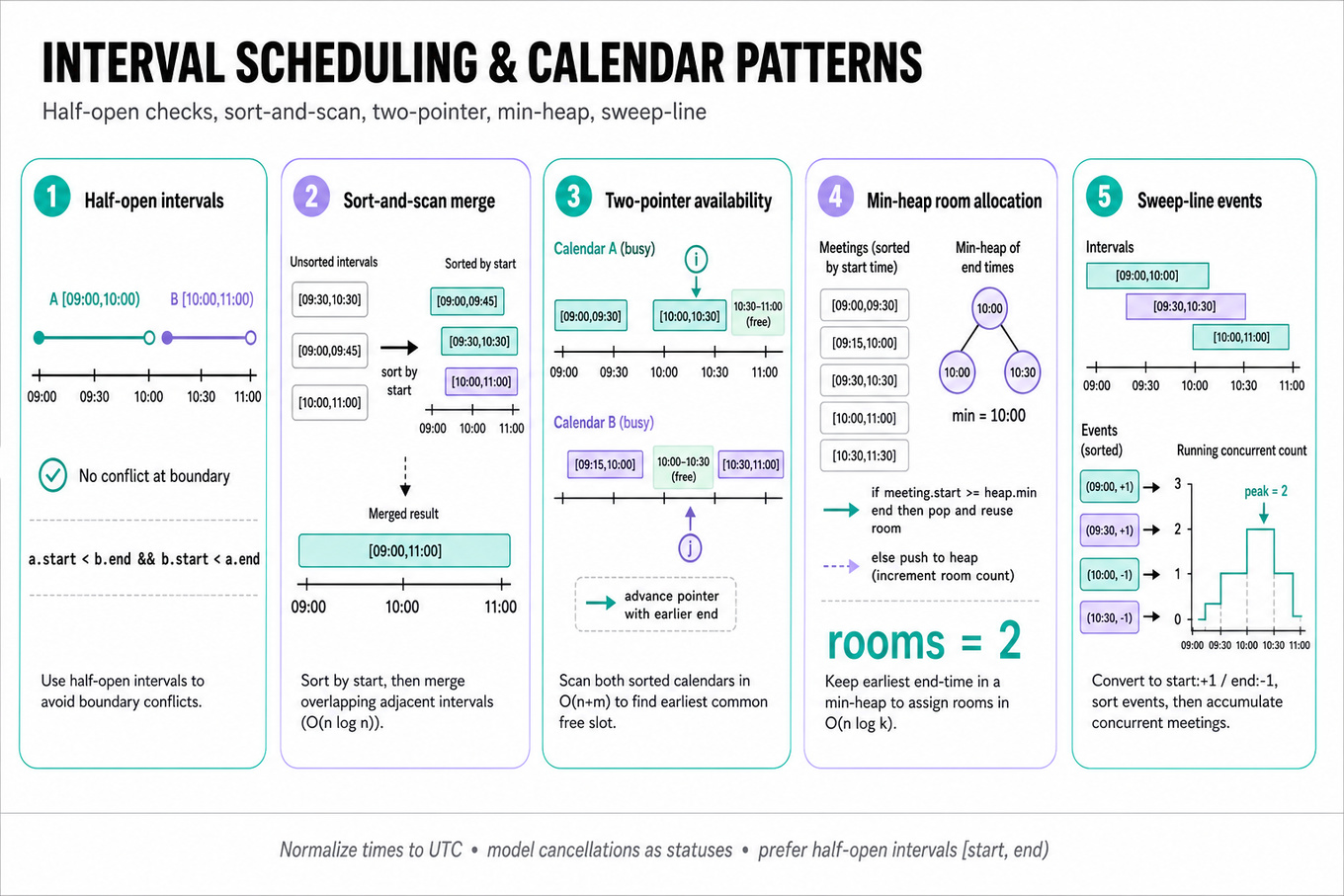
Half-open intervals
[start, end)simplify overlap checks: two intervals conflict whena.start < b.end && b.start < a.end. -
Sort-and-scan merge runs in
O(n log n)time; sort bystart, merge adjacent/overlapping intervals, then inspect gaps. -
Two-pointer availability search finds earliest common slot across two sorted calendars in
O(n + m); advance the interval ending earlier. -
Min-heap room allocation uses
heapqby earliest end time;O(n log k)for assigning or finding an available room. -
Binary search over sorted bookings checks one room’s availability in
O(log n)plus neighbor overlap checks viabisect_left. -
Sweep line events convert intervals to
(time, +1/-1)deltas; sort events to compute concurrent meetings, free capacity, or aggregate load. -
Distributed aggregation maps intervals to time buckets or event deltas, reduces by key, and handles skew with salting or hierarchical combining.
Common pitfalls
-
Pitfall: Treating intervals as closed
[start, end]causes false conflicts when one meeting ends exactly as another starts. -
Pitfall: Ignoring cancellations or updates leads to stale availability; model bookings with status/version, not just append-only intervals.
-
Pitfall: Mixing local times across users breaks correctness; normalize to UTC internally and only localize at input/output boundaries.
Practice these
The practice cards below cover the canonical variants — solve all of them and time yourself.
Featured in interview prep guides
Practice questions
- Schedule Non-Overlapping Meetings EfficientlyUber · Software Engineer · Onsite · hard
- Find Any Available Meeting RoomUber · Software Engineer · Onsite · medium
- Design MapReduce for schedulesUber · Software Engineer · Onsite · hard
- Find earliest common meeting slotUber · Software Engineer · Onsite · medium
- Prioritize rooms for allocationUber · Software Engineer · Onsite · hard
- Define and integrate room ranking factorsUber · Software Engineer · Onsite · medium
- Design MapReduce for schedule aggregationUber · Software Engineer · Onsite · medium
- Design a meeting scheduler with cancellationsUber · Software Engineer · Onsite · hard
Related concepts
- Intervals, Sliding Windows, And Time-Ordered StateCoding & Algorithms
- Time Interval Overlap And Sweep-Line AlgorithmsCoding & Algorithms
- Greedy Scheduling And Resource ReuseCoding & Algorithms
- Greedy, Heaps, And Scheduling OptimizationCoding & Algorithms
- Intervals, Line Sweep, And Range UpdatesCoding & Algorithms
- Distributed Job Scheduler SystemsSystem Design